1822 Quarter Error List with Pictures

A quarter should not read fifty cents. On one 1822 variety, traces of 50 survive beneath the corrected 25, making the mistake visible without a history lesson.
An exceptional ordinary-strike example sold for $195,500 in March 2006. The 1822 quarter errors below have estimated whole-coin values of $100 to $200,000.
A much later discovery adds incomplete arrows and a small metal peel to the search. Use the close checks below to separate missing design from worn or damaged silver.
1. 1822 Capped Bust Quarter Small Peel near the Lower-Left Front
A small patch of metal separates near 8 o’clock on the front of the reported discovery coin. This is a lamination: a weakness inside the coin metal that allows a thin piece to separate.
NGC described the feature on its 1822 B-3 discovery. The coin received AG3, a grade indicating very heavy wear.
Its worn design does not turn every shallow mark into a mint error. An original separation must be distinguished from a scrape or pit created after the coin entered circulation.
Estimated Value
For an ordinary 1822 quarter with a small genuine peel, estimate $100 to $2,000, depending on wear and surface quality. That range does not price the rare discovery variety.
If the coin also matches the B-3 broken-arrow combination, use the separate whole-coin estimate of $10,000 to $50,000. The overall range is therefore $100 to $50,000.
The upper tier reflects the rare variety, not a large premium for a tiny peel. It is an estimate rather than a recorded sale.
How to Identify
Begin at the lower-left front, near 8 o’clock, when comparing the discovery coin. Keep the nearby design in view so the small patch is not confused with an unrelated surface mark.
If any metal remains attached, leave it untouched. A close photograph under side lighting can show the lifted edge without bending it.
Inspect the boundary for a natural separation within the metal. A sharp cut with displaced silver, loose dirt, or a corrosion pit calls for a different explanation.
Heavy wear may soften both the design and the separating edge. Compare the complete coin with the discovery photographs before assigning its rare variety, rather than relying on the peel alone.
2. 1822 Capped Bust Quarter Incomplete Arrow Shafts and Lower Arrowhead
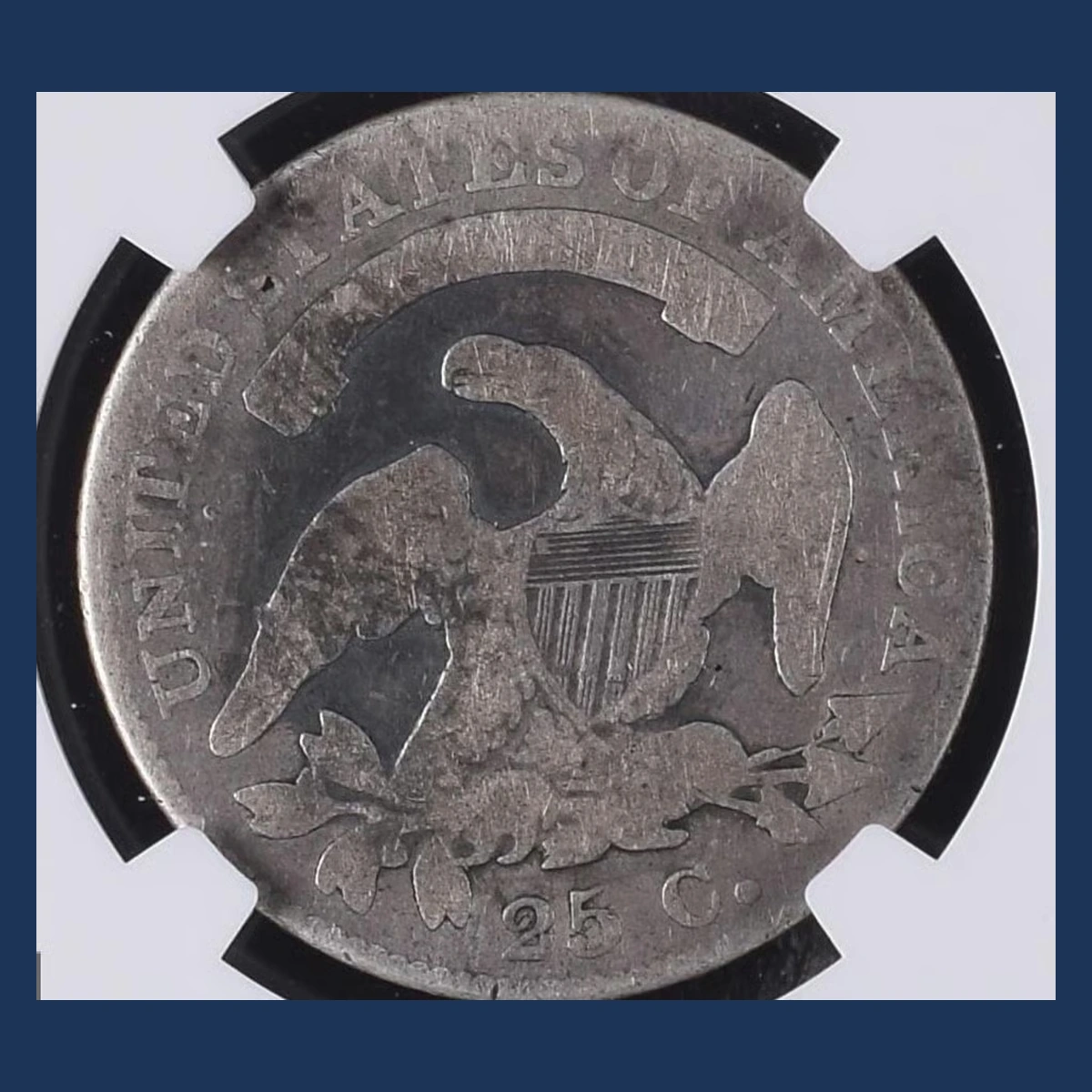
The eagle’s arrows do not all continue as complete, clean lines on this variety. The upper shaft is interrupted, and the lowest arrow has an incomplete shaft and head.
These features identify the back used for the 1822 B-3 combination. The same stamping tool later served other years, with repairs changing the arrow detail.
The 1822 discovery was announced in 2017 despite the coin’s very heavy wear. Enough of the unusual back remained to identify it.
This is missing detail in a particular tool’s design. It should not be diagnosed from worn arrow tips alone.
Estimated Value
An estimated $10,000 to $50,000 allows for a confirmed 1822 B-3 with the broken-arrow pattern. This is a specialist-variety estimate, not an auction result for the discovery coin.
The discovery’s low AG3 grade shows why wear alone cannot determine the value. Correctly identifying the rare combination matters far more than treating it as an ordinary worn quarter.
A second matching example would need its own condition assessment. The small peel on the known discovery is included in that coin’s value.
How to Identify
Locate the arrows held by the eagle and compare them as a group. Starting with one weak tip can lead you to mistake ordinary wear for the special back.
Follow the upper shaft, then inspect the lowest shaft and arrowhead. Match the interruptions to an authenticated 1822 B-3 image while checking the neighboring feather and letter positions.
The year must remain readable. Later quarters used this back after repairs, so a repaired arrow on an 1824 or 1828 coin does not demonstrate the original 1822 appearance.
On a heavily worn candidate, compare the strength of nearby details with the missing parts. Request a specialist examination if wear prevents a reliable match across the arrow group.
3. 1822 Capped Bust Quarter 25 over 50 Cents
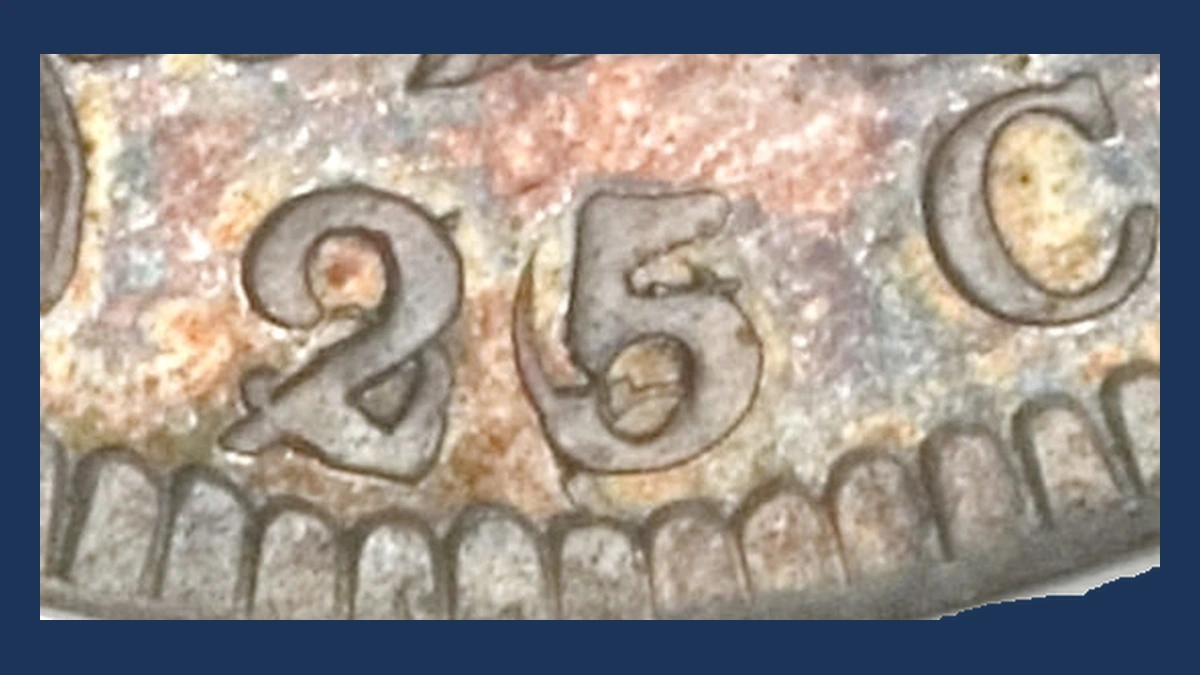
The number below the eagle should be 25, but extra curves reveal an earlier 50. A worker first punched the wrong denomination into the die, the steel tool that stamps the coin.
The correction put 25 over the unwanted digits. It did not completely remove their outlines.
This mistake is commonly called 25/50 C and also carries the B-2 variety number. Those names describe the same feature.
The coin remains a quarter, not a half dollar made smaller. A normal 1822 half dollar bearing 50 C is a different denomination with no such correction implied.
Estimated Value
The ordinary-strike record is $195,500 in March 2006 for an MS66 example. MS66 describes an unworn coin with excellent preservation.
Estimate $2,500 to $200,000 across worn examples through exceptional unworn pieces. At the lower end, the older digits still need to be identifiable despite wear.
Scratches, cleaning, and surface damage can reduce the price. A shiny background does not automatically make an ordinary strike a specially produced Proof or justify using a Proof sale.
How to Identify
Confirm the denomination before enlarging the numbers. A normal large-size quarter is about 27.5 millimeters across and originally weighed 6.74 grams; a half dollar is a different coin.
Look beneath the eagle at 25 C with a 10× magnifier. Trace the intended 2 and 5 first, then compare the extra curves around and beneath them with a recognized 25/50 example.
Use photographs under two lighting directions to separate raised outlines from scratches. Wear may merge parts of the digits, but a few random bright lines cannot establish the correction.
Include the entire denomination and nearby design in the close-up. The older-number pattern should stay in the same position when the lighting changes.
Conclusion
The denomination, arrows, and surface metal give three useful starting points on an 1822 quarter. Extra digits concern the stamping tool, while a genuine peel concerns the metal itself.
Estimated whole-coin values range from $100 to $200,000. The rare broken-arrow variety can carry a small lamination too, so those estimates must not be added together.
Keep the date and surrounding design visible when photographing any of these features.