1820 Quarter Error List with Pictures

A small extra curve beside the date and a line through the left stars tell different stories on an 1820 quarter. One began when a number was punched into a stamping tool; the other appeared as that tool cracked.
A lightly worn B-3 example sold for $3,538 in January 2026. Its price reflects the whole collectible coin, not a separate charge for a crack.
Explore these 1820 Capped Bust Quarter errors, with estimated values of $100–$10,000. The checks below explain which lines to follow and which marks can be damage.
1. 1820 Capped Bust Quarter Incomplete Clip
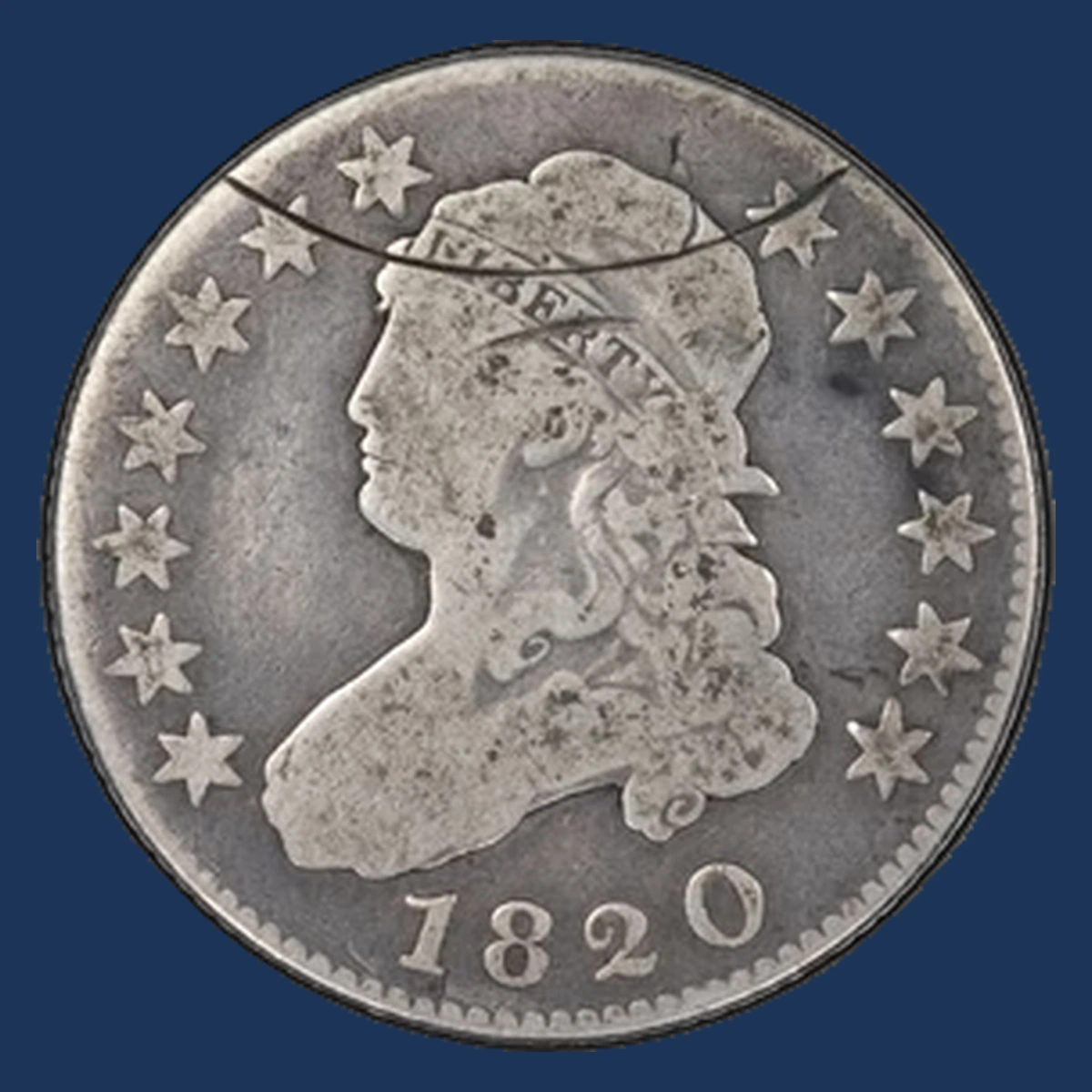
A curved line can remain on a coin even though no crescent of metal is missing. An incomplete clip starts while a punch cuts round blanks, the plain metal discs used to make coins.
The cut fails to pass completely through the metal. Later punching and striking can leave part of that earlier cut in the finished coin.
Toronto Coin Shop has offered an 1820 quarter under this error name. The feature must be separated from a later cut or scratch.
Unlike a complete clip, this error can retain metal on both sides of the curved line.
Estimated Value
For a confirmed example, estimate $200–$1,500, depending on wear, surface damage, and how clearly the original cut can be recognized.
The Toronto Coin Shop example is a dealer offering rather than an auction result. A worn coin with a subtle line belongs nearer the lower end.
Clear photographs of both faces and the edge matter when paying more. A later scratch or saw cut adds no Mint error premium.
How to Identify
Do not expect a missing bite from the edge. Examine the curved line itself, then turn the coin over to see whether a related mark appears on the opposite face.
Under angled light, follow its depth and curve with a magnifier. Look at how the struck design meets the line, since an original cut existed before the design was pressed into the metal.
A later blade can leave bright cut walls or rough edges, while scratches may cross the finished design. Neither a curved shape nor old toning proves a Mint origin.
Ask for clear edge photographs if the coin is sealed in a holder. Comparison with an authenticated incomplete clip should show an original partial cut rather than damage through the finished design.
2. 1820 Capped Bust Quarter Repunched Small 0
The Small 0 variety can show an extra outline beside the final digit. The number was punched more than once into the die, the steel tool that stamps the design onto coins.
A slight change in position left part of the earlier impression visible. Coins made with that tool repeat the feature in the same place.
This concerns the small final 0, not every 1820 quarter. Large, medium, and small forms of that digit occur in the year.
The size difference alone is not the error; the repeated contour is what matters.
Estimated Value
Allow an estimated $100–$8,000 for worn through attractive unworn Small 0 examples. Their overall condition usually matters more than the tiny repeated outline.
A PCGS AU55 Small 0, B-4 sold for $3,360 at Heritage on October 5, 2025. AU55 describes a coin with light wear and much detail remaining.
That is a whole-coin comparison for the Small 0 variety. Do not add the full amount again as a repunching premium.
How to Identify
Select the right comparison first: a clearly identified Small 0 quarter. A photograph of a Large 0 coin will not explain the repeated outline on this variety.
Keep all four digits visible when enlarging the date. Compare the final 0 with the Small 0 photograph discussed by quarter specialist Steve Tompkins, rather than treating any uneven edge as doubling.
Move the lamp gently to separate raised metal from shadows. The old punch outline should keep its shape as the lighting changes.
A scratch cuts into the coin and can run beyond the digit. A dent may push metal against the 0 without repeating its curve.
Matching the extra contour beside the Small 0 is more useful than comparing digit size alone.
3. 1820 Capped Bust Quarter Raised Crack through the Left Stars
A thin raised line joins the stars to Liberty’s left and continues through the 1 and 8 in the date. This is a known crack pattern on the B-3 variety.
The steel stamping tool cracked during use. Silver pressed into the narrow opening, leaving a raised line on coins struck afterward.
The coin itself did not split. Earlier examples from the same tool can lack the line because the break had not yet developed.
The path helps identify this example, but it should not be expected on every 1820 quarter.
Estimated Value
Estimated whole-coin values are $150–$10,000, covering well-worn through strong unworn examples. The crack is one feature of the collectible B-3 variety.
A PCGS AU58 B-3 sold for $3,538 on January 17, 2026. This provides a recent comparison for a coin with only slight wear.
Deeper wear, cleaning, or scratches reduce value. A clear crack can interest a specialist without making a damaged coin equal to a well-preserved example.
How to Identify
Trace the stars on the left side of Liberty, working toward the first two date digits. Browning’s quarter reference describes a connected raised path through these points on the B-3 variety.
Use low light from the side to check the line’s height. A genuine tool crack produces a ridge above the coin surface, unlike the channel left by a scratch.
Pay attention where the line meets a star or number. Wear may hide short sections, so compare the whole route instead of rejecting a coin for one faint gap.
The back design helps confirm the variety: the denomination has a low 25 and a higher C set farther away. Matching both that layout and the raised front line is the direct check for this particular example.
Conclusion
The Small 0 outline, the crack through the left stars, and an incomplete cut in the blank require different checks. Compare the date, follow the raised line, or inspect the curved cut and edge as appropriate.
Estimated values span $100–$10,000 for the examples discussed. Wear and original surfaces drive much of that spread, so treat the error feature as part of the coin’s total value.