1871 Penny Error List with Pictures

Turning a penny over can reveal something a close-up photograph misses. An 1871 cent offered with a rotated back had a reported auction result of $320 in August 2026.
This 1871 Indian Head penny error list covers estimated whole-coin values of $50–$25,000. It includes peeling bronze, misplaced date fragments, broken stamping tools, and an unusual nickel-based blank.
Follow the checks below to separate the visible feature from a seller’s label or an older catalog name.
1. 1871 Indian Head Penny Peeling Bronze above AMERICA
The bronze can separate above the first two letters of AMERICA on the front. A weak layer within the metal opens and may leave a flap or shallow missing patch.
This kind of defect is called lamination. Stack’s described an 1871 example with an original lamination above AM in its 2000 anniversary auction.
The catalog called that coin Choice Very Fine, meaning a pleasing worn example with recognizable detail. The peeling area remained visible despite the wear.
The location helps choose the right comparison. A rough patch elsewhere can have a different cause, including corrosion or scraping.
Estimated Value
Estimate $50–$300 for worn 1871 laminations, with $300–$1,500 for clearer defects on better-preserved examples. These are complete-coin ranges, including the value of the underlying 1871 cent.
A different 1890 Indian cent with lamination sold for $104 in April 2010. That later example is a comparison, not a sale of this 1871 coin.
A larger peeling area can remove attractive lettering. The size of the flaw therefore should not be treated as a simple measure of increasing value.
How to Identify
Find AM in AMERICA before examining the rough area. With a 10× magnifier, look above those letters for the edge of a thin sheet or a shallow boundary left by separated bronze.
Photograph the entire front as well as the small opening. A picture cropped too closely can hide whether the mark occupies the reported location.
For a loose coin, compare 3.11 grams on a scale and about 19 millimeters with calipers. Inspect the plain edge if the separation reaches it.
Leave an attached flap undisturbed.
Side light can reveal a layer within the metal, while corrosion often leaves scattered pits. Do not scrape a patch to make its boundary easier to see.
2. 1871 Indian Head Penny Back Turned from Its Normal Position
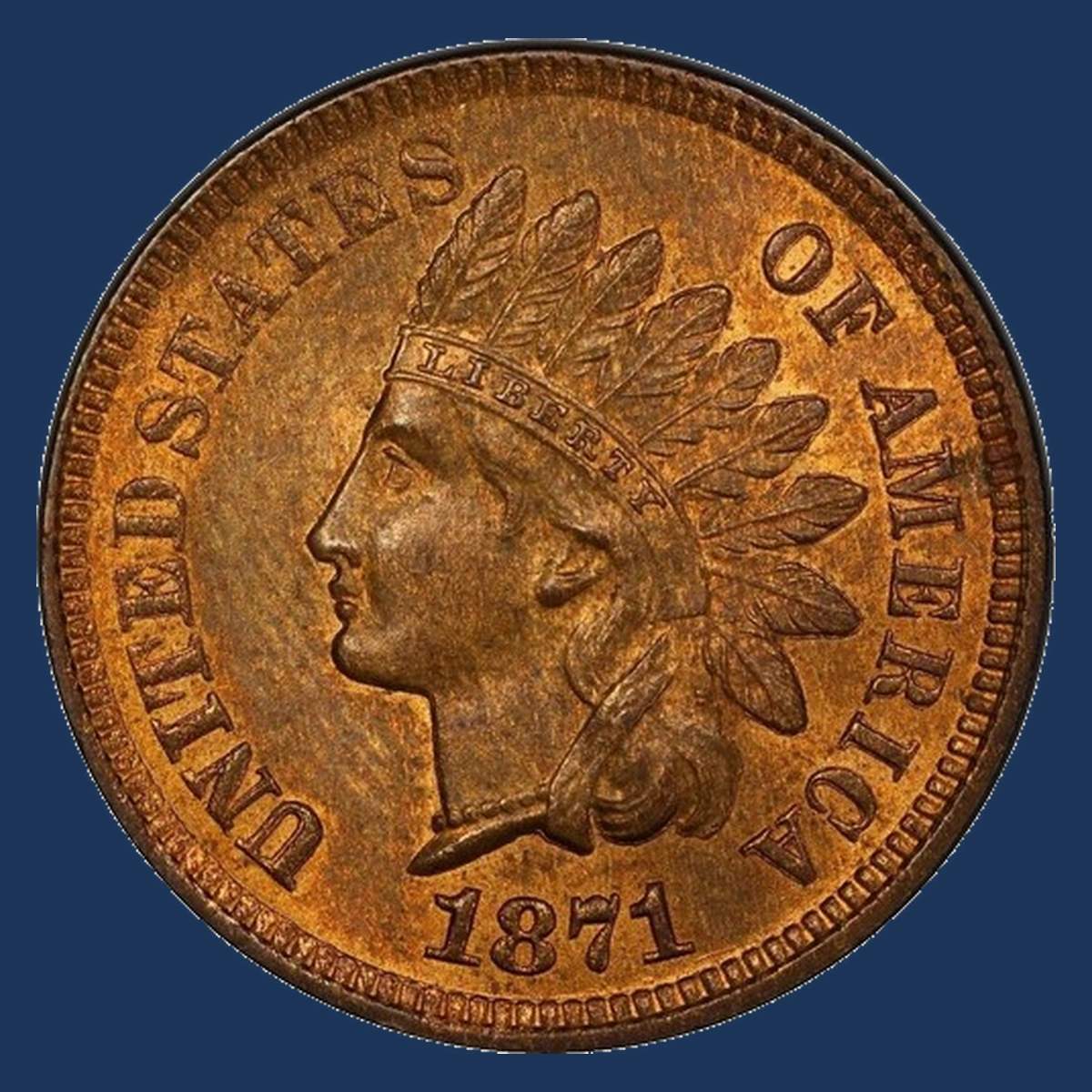
A penny’s back should appear upright after an upright front is turned top to bottom. A rotated stamping tool changes that relationship while leaving each face’s design complete.
An auction offered an 1871 cent as Extra Fine with a “190-degree rotation.” A separate seller described another as showing about sixty-five degrees.
The first description does not state the starting line used for its angle. It should not be read automatically as a 190-degree departure from normal alignment.
Measure each coin using the same controlled turn. Separately rotated photographs can create a tilted-looking back without showing the relationship between its faces.
Estimated Value
The Lampasas auction catalog reports $320 for lot 187 in August 2026. That is the example described as Extra Fine with a 190-degree rotation.
Estimate $75–$2,000 for authenticated 1871 rotations across different angles and conditions. Measure the angle before selecting a comparison.
The separate sixty-five-degree listing asked C$199.99, in Canadian dollars. It was an asking price, so it is neither another confirmed sale nor a directly interchangeable US-dollar amount.
How to Identify
Check the plain edge with a 10× magnifier for a seam joining two different coin faces. On a loose cent, use a scale and calipers to compare the normal 3.11 grams and approximately 19 millimeters.
Set the portrait upright over a soft surface. Turn the coin top to bottom without twisting it sideways, then note the wreath’s position.
Repeat the movement with the same top and bottom points. A fixed camera or continuous video is more useful than two independently turned photographs.
Use a protractor against the upright reference line to measure the back. Record clockwise or counterclockwise as well as the angle, and keep that measurement separate from a listing that does not explain its starting line.
3. 1871 Indian Head Penny Cracked Tools and Retained Rim Breaks
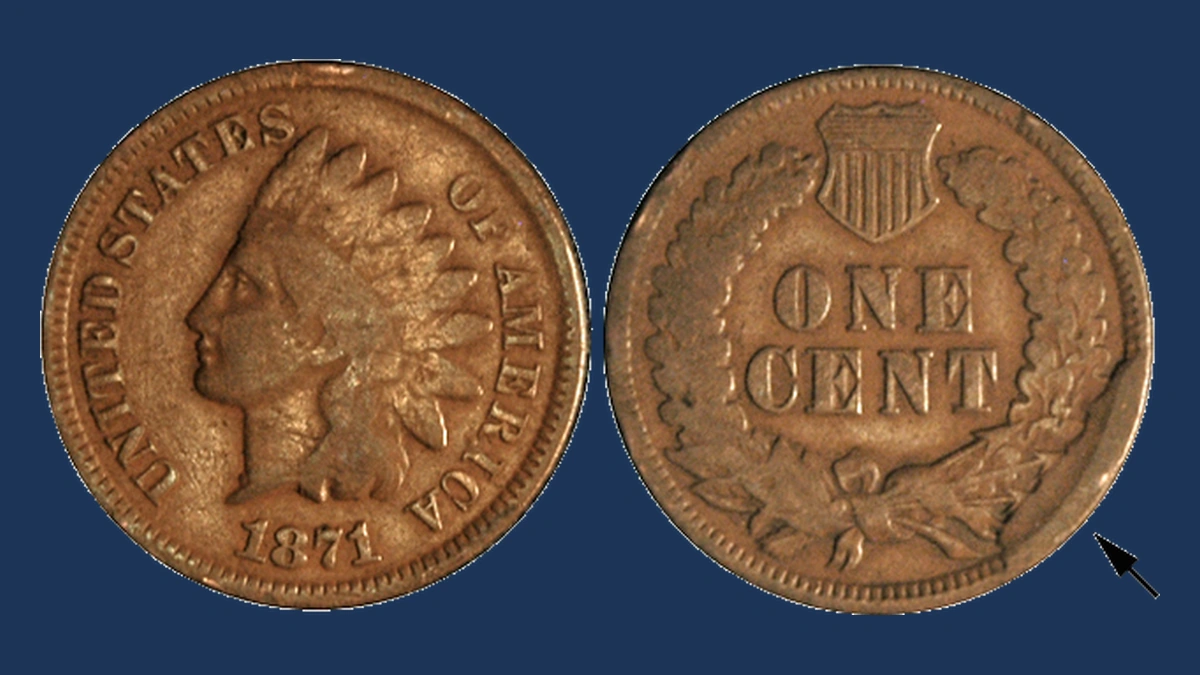
The right side of the back can show a raised boundary around a section that still contains design. Part of the steel stamping tool broke, but the broken piece stayed in place.
This is called a retained cud or retained rim break. It differs from the broad plain patch left after a tool piece falls away completely.
One 1871 pattern spans roughly three-fifteen to five on the clock. Another runs from about two-thirty to four.
Other backs show raised cracks along the right side or starting near eight-forty-five. These related tool failures belong to separate patterns and stages of wear.
Estimated Value
Estimate $50–$300 for readable cracks and $100–$2,500 for more distinct retained rim breaks on 1871 cents. Wear and original surfaces affect the complete price.
An unworn 1866 Indian cent with a back cud sold for $504 in March 2021. Its different date and break provide context rather than an exact value for a retained 1871 section.
Ordinary coin value is already included in every range. A small raised line should not automatically receive the price of a dramatic rim failure.
How to Identify
Watch the surface level as you tilt the back under a lamp. A retained broken section can sit at a different level while still showing part of the wreath.
With a 10× magnifier, follow the boundary to both rim connections. Compare the right-side location with the appropriate recorded pattern, rather than combining three-fifteen-to-five and two-thirty-to-four into a larger break.
A loose bronze cent normally weighs 3.11 grams and measures about 19 millimeters. Use a scale and calipers without pressing against the raised area.
The PCGS report distinguishes a retained broken section from a crack whose surrounding surface remains level. Inspect the plain edge too, since an impact can fold copper inward without a broken stamping tool.
4. 1871 Indian Head Penny Extra Date Fragments in the Border Teeth
A numeral fragment can appear among the small border teeth below 1871. The date punch reached an unintended part of the stamping tool before the final date was placed.
Later coins copied both the main date and those stray marks. This feature is called a misplaced date.
The recorded Snow-5 pairing has a back known as Shallow N, describing how the N in ONE is shaped. That back design is not an error by itself.
The fragment must be matched with its front photograph. A weak tooth, scratch, or mark beside the main date cannot establish the misplaced-date variety alone.
Estimated Value
For identified 1871 misplaced dates, estimate $100–$750 in circulated condition and $750–$4,000 for better-preserved examples. The underlying Shallow N variety also affects the complete coin’s appeal.
An 1878 Indian cent with a misplaced date brought $1,920 in October 2019. That is a different-year comparison, not a sale of the 1871 pairing.
The small fragment’s clarity matters for identification. The top of the range also requires suitable preservation, rather than simply a faint unusual mark in a damaged border.
How to Identify
Compare both faces with the recorded Snow-5 pairing. The Shallow N back supports the combination, but the front still needs its misplaced numeral traces.
Enlarge the date and lower border together under a 10× magnifier. Choose a matching variety photograph before assigning a particular numeral to a small curved mark.
For a loose cent, use a scale against 3.11 grams and calipers against about 19 millimeters. Examine the plain edge for filing that reaches the border teeth.
A narrow cut may pass across several teeth or into the date. An original numeral remnant should form part of the raised struck detail, rather than an engraved groove added afterward.
5. 1871 Indian Head Penny Repeated Strokes around 1871
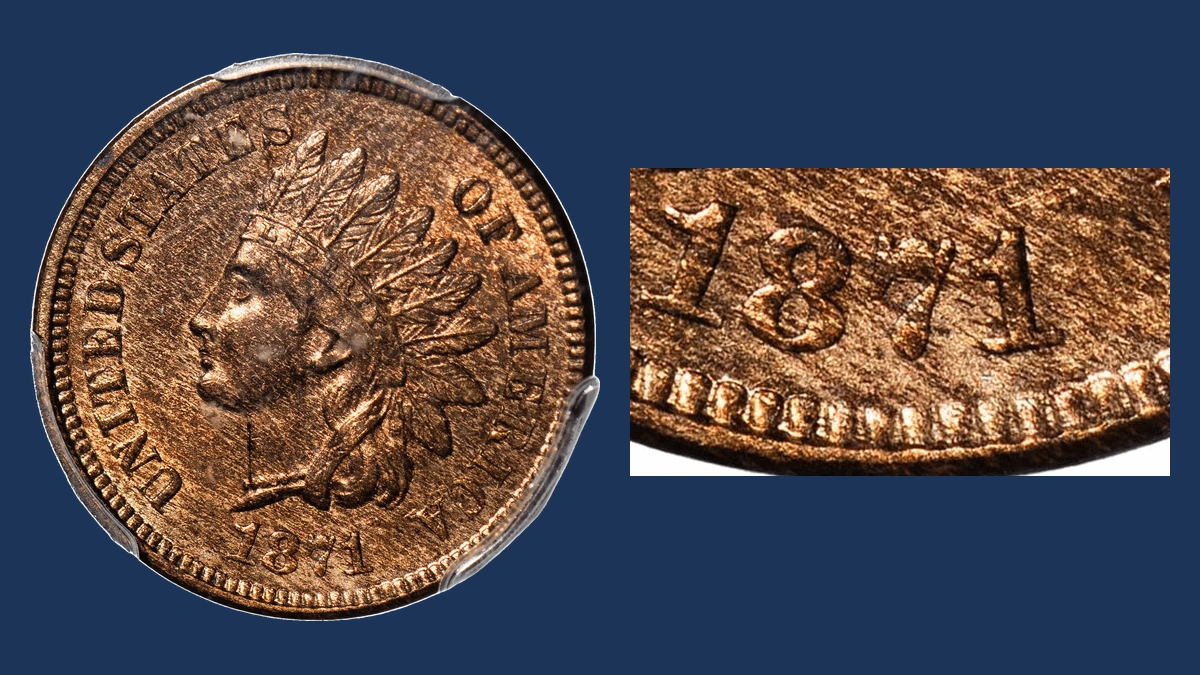
Each of the four date digits can carry a faint earlier outline. Stack’s described this on a lightly worn 1871 cent in its 2000 anniversary catalog.
Repunching occurs when a date punch enters the stamping tool more than once at shifted positions. Surviving earlier strokes then appear on coins made from that tool.
The catalog also noted old cleaning on its example. Cleaning affects the surface and value, not the cause of the extra strokes.
Some date features come from duplication on the date punch itself. Those should not be assigned the same cause or variety name as ordinary repunching.
Estimated Value
Estimate $75–$500 for identifiable worn 1871 repunched dates, or $500–$6,000 for attractive unworn examples. The pattern, remaining detail, and copper color affect the whole price.
A PCGS MS66 Red 1875 repunched-date cent sold for $5,040 in August 2020. Its exceptional unworn preservation makes it a higher-condition comparison, not a result for the cleaned 1871 catalog coin.
Slight date traces do not cancel the effect of cleaning. Price the actual surfaces as well as the recognizable earlier strokes.
How to Identify
Before enlarging the date, check a loose coin with a scale and calipers against 3.11 grams and about 19 millimeters. Inspect its plain edge and photograph any old cleaning without polishing the copper.
Now look across all four digits with a 10× magnifier. Move the light to compare faint raised strokes with the main numeral shapes.
The lightly worn catalog example had slight repunching on every digit. Other 1871 varieties need their own photographs, since the extra strokes do not all point the same way.
A scratch cuts into the surface. A flat shelf that narrows a numeral is also different from a raised earlier punch impression, even when both make the date look doubled.
6. 1871 Indian Head Penny Unusual Nickel-Based Blank, J1042A
An 1871 cent appears in references for pieces struck in nickel or copper-nickel instead of ordinary bronze. It carries the catalog numbers J1042A and P1177.
The historical report gives a weight of 68.25 grains, about 4.42 grams. That is substantially heavier than the standard bronze cent.
A trial coin is an experimental piece made to test a design or metal. References differ on whether this cent was such a test or an accidental wrong-blank strike.
The exact alloy and source denomination need evidence from the specimen. Weight alone does not turn the blank into a confirmed five-cent piece.
Estimated Value
For an authenticated 1871 nickel-based cent matching this rare cataloged issue, estimate $5,000–$25,000. Its metal, condition, and final identification belong in the comparison.
An 1879 Indian cent on an unusual nickel-rich blank sold for $13,200 in February 2025 at PCGS AU58. That lightly worn coin is a different-year comparison.
The range excludes plating or pale toning on a bronze cent. Identifying the piece as an experiment instead of an accident can also affect which collectors want it.
How to Identify
Record weight and diameter before assigning a denomination to the blank. Use a scale and calipers on a loose coin, comparing the reported 4.42 grams with the ordinary 3.11-gram, approximately 19-millimeter cent.
The historical list reports the weight without a measured alloy percentage for this 1871 piece.
Under a 10× magnifier, inspect the edge for plating, seams, and later reshaping. Photograph both faces and the complete outline.
A specialist should assess the metal without scratching it and compare the coin with its original catalog history. A shiny surface alone establishes neither a special trial finish nor an accidental wrong-metal strike.
Conclusion
Check how the back lines up, where a surface flaw begins, and whether extra date strokes belong beside the numerals or in the border. These different clues need different comparisons.
Whole-coin estimates run from $50–$25,000. The highest range concerns the cataloged unusual-metal issue, while ordinary bronze errors depend heavily on condition.
Keep a seller’s angle description separate from your measured rotation, and leave peeling metal or original surfaces untouched.