1868 Penny Error List with Pictures

The shield on an 1868 penny can carry a flaw copied from its stamping tool. A much rarer historical report describes the cent design on a small silver dime disc.
For a price comparison, an 1869 cent on a dime disc sold for $25,300 in January 2012. That is a different-year sale, not a transaction for the reported 1868 coin.
These 1868 Indian Head penny errors have estimated whole-coin ranges of $40–$40,000. Read on for the distinct clues behind each type.
1. 1868 Indian Head Penny Clashed Dies (Estimated Up to $500)
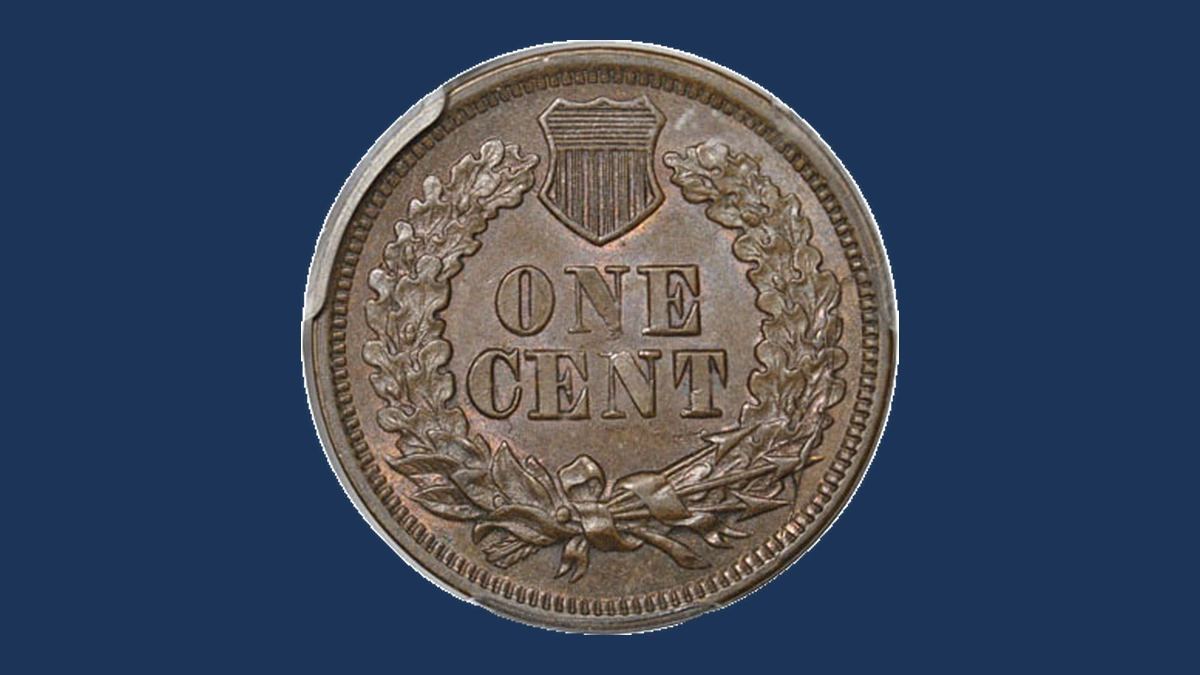
An unexpected outline beside ONE CENT can belong to the design normally seen on the front. It may be a clash mark copied onto the back.
The steel stamping tools are called dies. When they contact each other without a metal disc between them, parts of their designs can mark the opposite tool.
Later coins then reproduce those marks alongside their normal design. The listed 1868 example has traces around both sides of the back denomination.
These are transferred shapes, not a second set of ordinary raised letters. Their resemblance to the opposite design helps separate them from scratches.
Estimated Value
Use an estimated $40–$500 for a recognizable clash on an ordinary 1868 penny. The condition and underlying value of the date are included.
A faint trace on a worn coin may add little. A stronger, clearly matched outline gives collectors more to see, but several lines do not become several separate premiums.
No actual 1868 clash sale is assigned here. The estimate assumes an original transferred shape, rather than a straight scratch or an unrelated line left by tool polishing.
How to Identify
Look beside ONE CENT, then compare the strange outline with the front design. A useful candidate should resemble a real design shape rather than an arbitrary mark.
Check the penny with a scale and calipers against 3.11 g and about 19 mm, and inspect its plain edge. A clash does not require an unusually large coin or missing metal.
With a 10× magnifier, trace the outline through its clearest bends and compare that path with the recorded 1868 example. Keep the normal front design beside the back photograph so you can identify what was transferred, rather than matching a single short line.
2. 1868 Indian Head Penny Die Cracks and Rim Breaks (Estimated Up to $1,000)
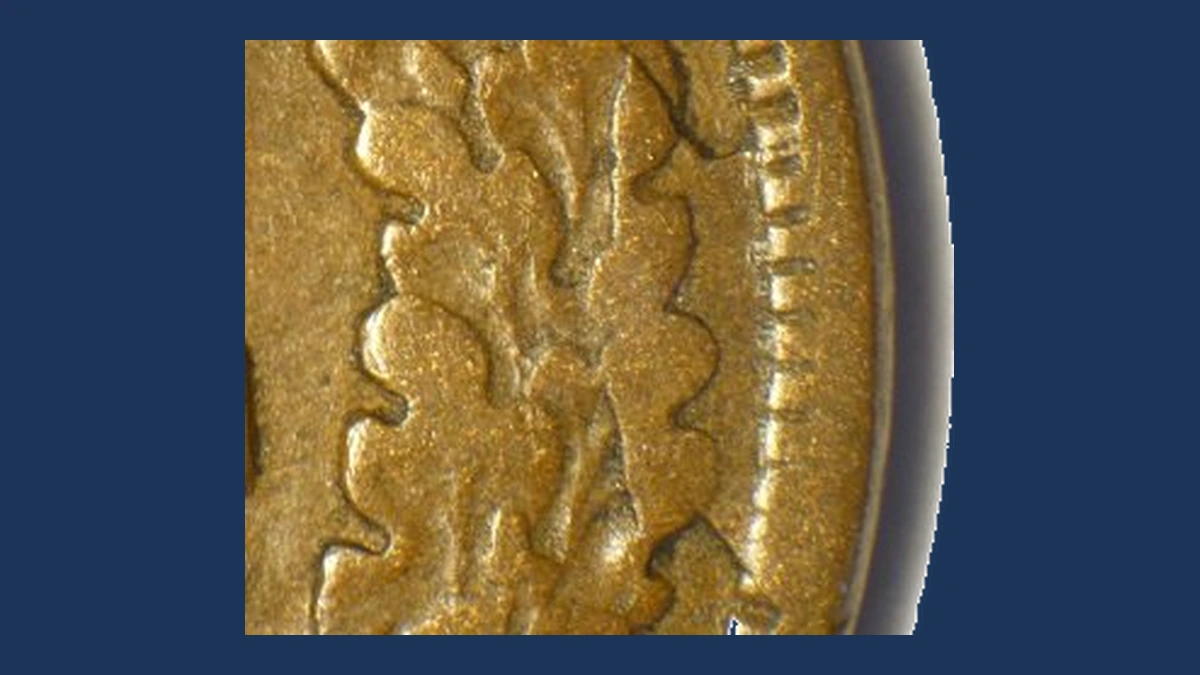
A ridge through the wreath can begin as a crack in the stamping tool. Metal pressed into that opening forms a raised line on the finished penny.
A larger broken section at the tool’s edge can leave a broad patch that reaches the rim. If the fragment remains in place, some original design may survive within that patch.
The 1868 catalog records back rim breaks around 2:45–3:30 and 11:15–12:45 on different examples. Cracks also run beside the shield and through the wreath.
The shape changes as a tool fails. A line and a broad break need different visual comparisons.
Estimated Value
Estimated whole-coin values are $40–$1,000. Fine cracks on worn pennies usually contribute much less than a substantial, clearly defined rim break.
The higher estimate assumes a desirable example in suitable condition, not every raised patch on an 1868 cent. Dark corrosion and rim impacts can hide or imitate the original boundary.
There is no individual auction result assigned to each listed pattern. Judge the size and surviving design together, while remembering that the ordinary coin already has collector value.
How to Identify
Find where the unusual area joins the rim.
Inspect that part of the plain edge through a 10× magnifier for an impact, squeezing, or added metal. A later blow can push copper inward without any damaged stamping tool being involved.
Compare the patch with the appropriate 1868 photograph. In a retained break, look for recognizable design inside its outlined area instead of requiring a completely smooth lump.
Use a scale and calipers against the usual 3.11 g and about 19 mm. For a thin crack, angle a lamp across the line to see that it rises above the surface.
Follow the suspected raised crack into the wreath or shield area and compare its course with the same pictured example.
3. 1868 Indian Head Penny Repunched Date (Estimated Up to $1,500)
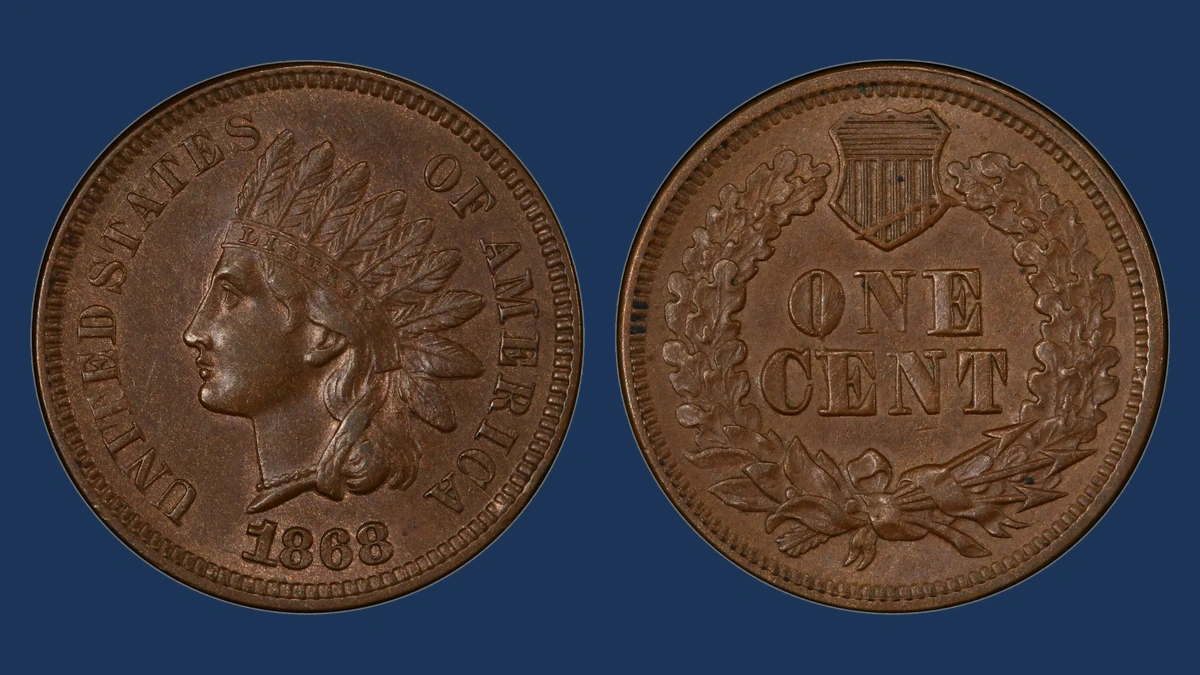
Small extra curves can remain inside a date digit or along its upper and lower edges. The date punch moved between impressions in the stamping tool.
The final, stronger date did not always cover the earlier one completely. Coins made with that tool carried the surviving strokes.
This is a repunched date. It affects the numbers added to the tool, rather than requiring two strikes on each penny.
The 1868 catalog lists several forms with different positions of the extra strokes. Their directions should be compared individually, not combined into a single imaginary date showing every listed feature.
Estimated Value
Estimate $50–$1,500 for matched 1868 repunched dates across worn and well-preserved examples. Sharper extra strokes and cleaner surfaces generally support stronger prices.
An unworn 1872 FS-301 cent, graded MS65 Red and Brown, brought $2,160 in January 2018. That is a comparison, not a sale of an 1868 variety.
The lower range allows for more ordinary condition. A thick-looking number without a clear extra digit stroke should not receive the same variety premium.
How to Identify
Put a normal 1868 date image beside the suspected variety, with both pictures at the same angle. Then use a 10× magnifier to compare the inside curves and edges of each digit.
Where an extra stroke appears, ask whether it follows a recognizable part of that number. Irregular lumps and cuts need a different explanation.
Compare scale weight and caliper diameter with the ordinary 3.11 g and about 19 mm, and examine the plain edge. The metal and dimensions do not establish which date punch was used.
Choose one cataloged 1868 date and compare every visible extra stroke with that photograph, rather than matching one digit from each of several examples.
4. 1868 Indian Head Penny Misplaced Date (Estimated Up to $2,000)
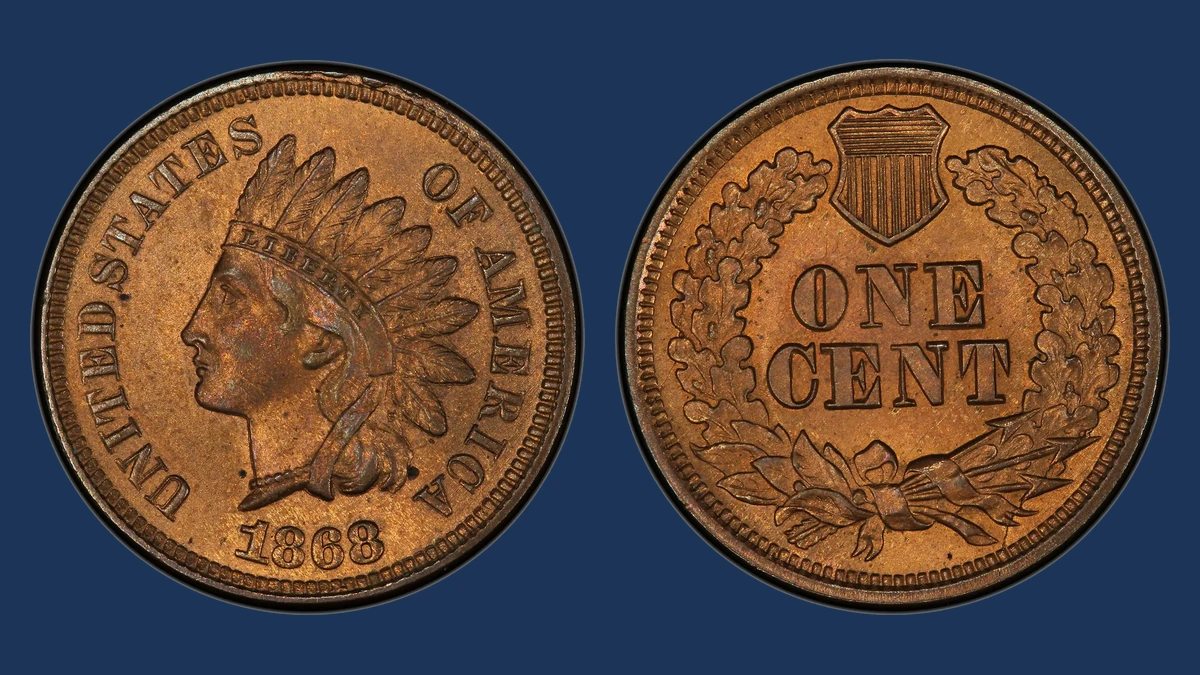
The border beneath 1868 can contain parts of another date impression. Recorded forms include fragments of a 6, an 8, or a longer group of digits.
The date punch touched the stamping tool outside its proper location. Even after the correct date was added, some misplaced marks remained.
Those marks were then copied onto coins as extra number fragments. This differs from a repunched date whose extra strokes stay close to the intended digits.
Not every recorded form belongs to the same coin. Match the particular fragment and its position among the border teeth before choosing a variety name.
Estimated Value
For an identifiable 1868 misplaced date, estimate $75–$2,000. Condition and the clarity of the extra numbers influence the whole-coin value.
A later example offers perspective: an unworn 1908 FS-301 cent graded MS65 Red and Brown has a recorded $1,187 eBay price from December 2021. It is a different variety and is not presented as an 1868 auction sale.
The upper estimate assumes a strong, attractive match. A misshapen border tooth should not be priced as an extra number.
How to Identify
Hold the full date upright while searching the border below it with a 10× magnifier. The extra fragment should remain tied to a clear position under the normal numbers.
Try low-angle lighting to separate the curved number trace from neighboring teeth. Do not clean the border to make a weak mark seem sharper.
The normal penny weighs 3.11 g and measures about 19 mm. Check it with a scale and calipers, then inspect the plain edge for filing or other alteration.
Compare the suspected 6, 8, or longer fragment with the corresponding 1868 photograph, using the adjacent teeth to establish its exact location rather than its general shape alone.
5. 1868 Indian Head Penny Doubled Die (Estimated Up to $2,500)
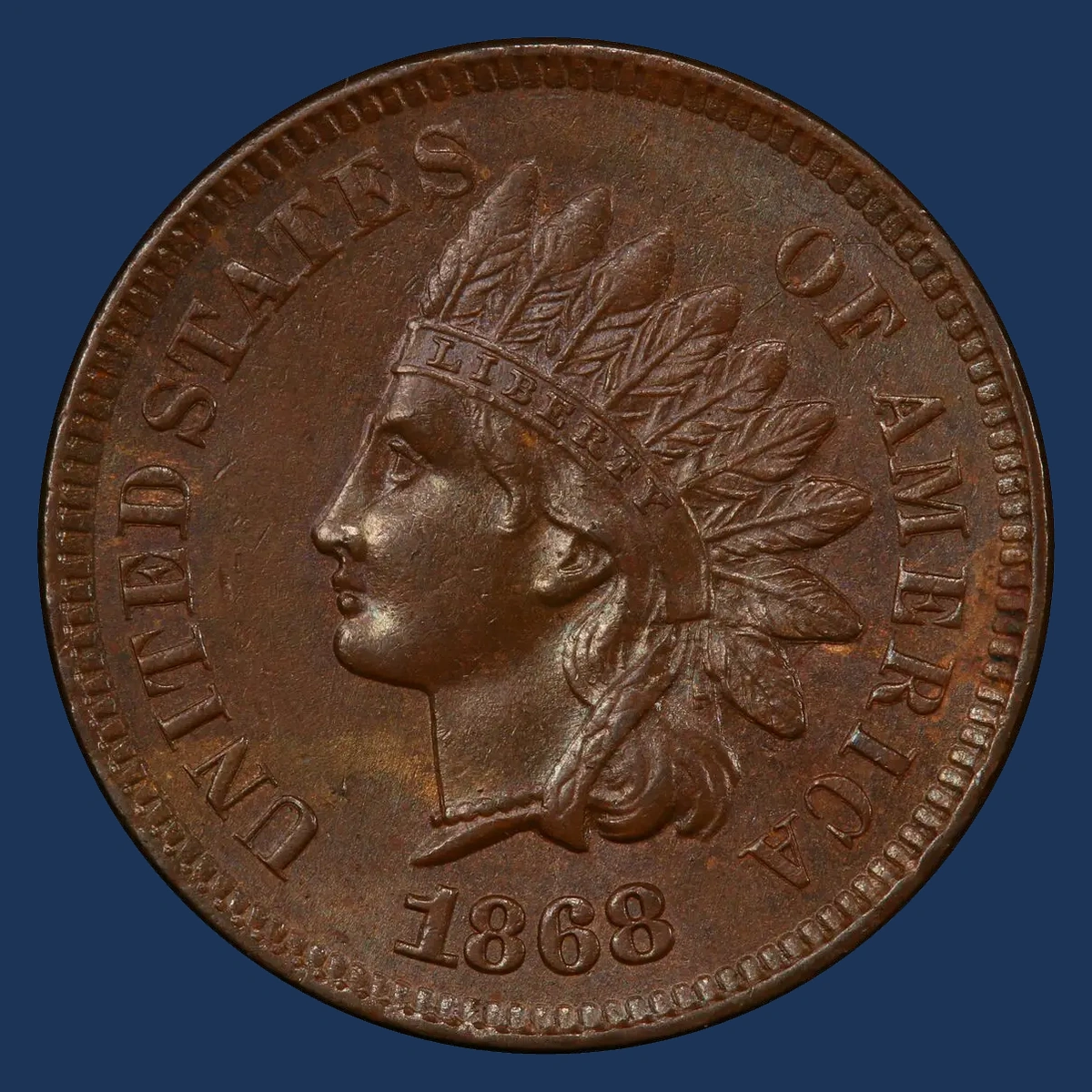
Extra raised outlines can show in RTY on the headband and in the small designer’s initial. Another recorded form affects IBERTY.
The repetition was already part of the stamping tool’s design. It did not require the finished penny to move between two press blows.
Collectors call this a doubled die. The two listed patterns must be compared separately, because their extra detail does not occupy every letter in the same way.
The designer’s initial is a small L at the base of the portrait. A doubled-looking date belongs to a different check and should not replace inspecting the named letters.
Estimated Value
Use an estimated $100–$2,500 for a clearly matched 1868 doubled die in an appropriate range of conditions. A faint, worn trace usually supports less than strong separated detail.
An unworn 1887 FS-101 front doubled die graded MS63 Brown sold for $1,380 in June 2025. That is a different-year comparison, not a price attached to either 1868 pattern.
The full coin’s preservation matters alongside the doubling. A shallow flat shelf caused by striking movement should not receive the doubled-die premium.
How to Identify
Choose which letter pattern you are testing before moving the magnifier. The RTY-and-initial example and the IBERTY example need their own photographs.
Check basic identity with a scale and calipers against 3.11 g and about 19 mm, and inspect the plain edge. Then examine the named letters at 10× under changing light.
Follow a repeated outline around a letter corner rather than judging a thick straight stroke. A reflection moves with the light, while a flat shelf may result from striking movement.
For the form that includes the initial, compare its tiny L as well as RTY. For the other form, match the repeated detail across IBERTY to the same illustrated example.
6. 1868 Indian Head Penny Debris Marks from Tool Making (Estimated Up to $3,500)
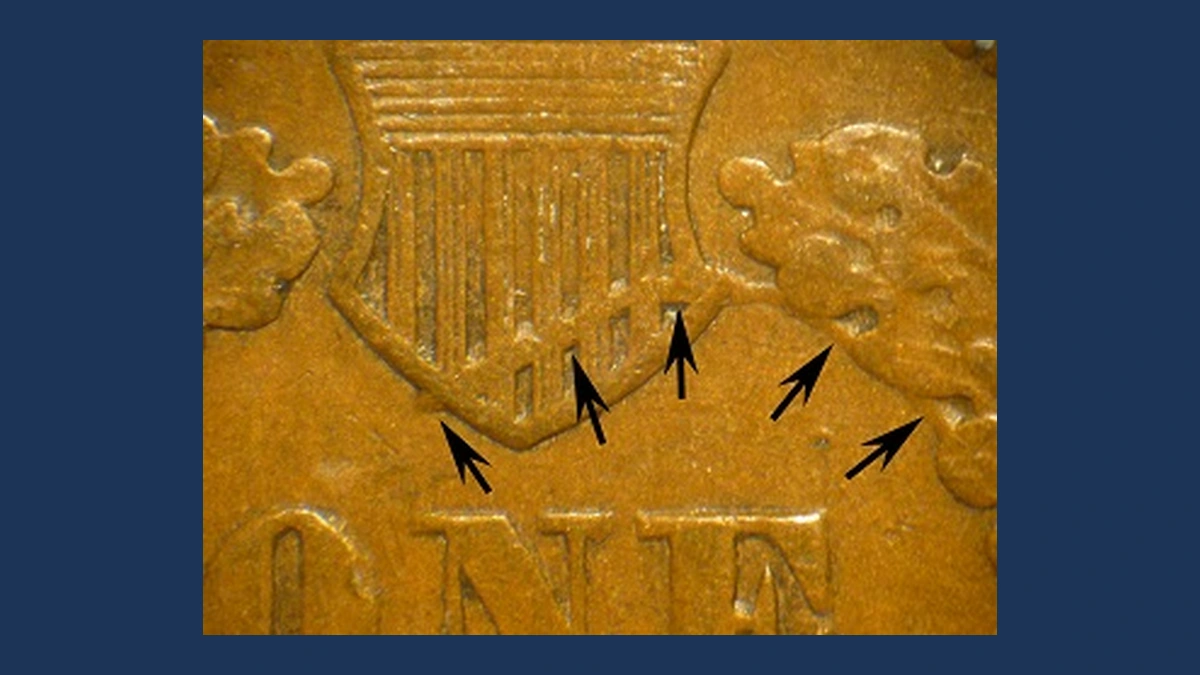
A broad unusual area inside the back shield can repeat on coins made with the same tool. Its origin lies in tool making rather than a loose object pressed onto each coin.
The master design was pressed into the steel stamping tool. Material trapped between those surfaces could leave an unwanted shape that later pennies copied.
This is called a hub-through defect. The recorded circulation example has a larger shield-area mark.
Fine line-like marks are also reported on Proofs, which are specially struck collector coins. Their photographs should remain separate from the larger defect on an ordinary circulation piece.
Estimated Value
Circulation examples have an estimated whole-coin range of $40–$1,500, depending mainly on condition and how clearly the repeated mark can be matched.
For a Proof with a small tool-making mark, estimate $500–$3,500 for the entire collector coin. Much of that price concerns the finish and preservation, not the mark itself.
No actual 1868 transaction is assigned to these defects. Do not transfer the Proof range to a worn circulation penny simply because both show an unusual line.
How to Identify
Choose a photograph of the right finish: the larger shield mark belongs to a circulation example, while fine marks are reported on Proofs. A Proof is a specially made collector issue, not just a polished ordinary coin.
At 10×, compare the entire shield-area defect with another coin from the same stamping tool. A repeated outline in exactly the same place supports a tool-making origin more than a similar-looking short line alone.
The normal bronze coin weighs 3.11 g and measures about 19 mm, which a scale and calipers can check if safely accessible. Inspect the plain edge, then compare the mark’s boundary against the fixed details of the shield.
7. 1868 Indian Head Penny Double Strike (Estimated Up to $5,000)
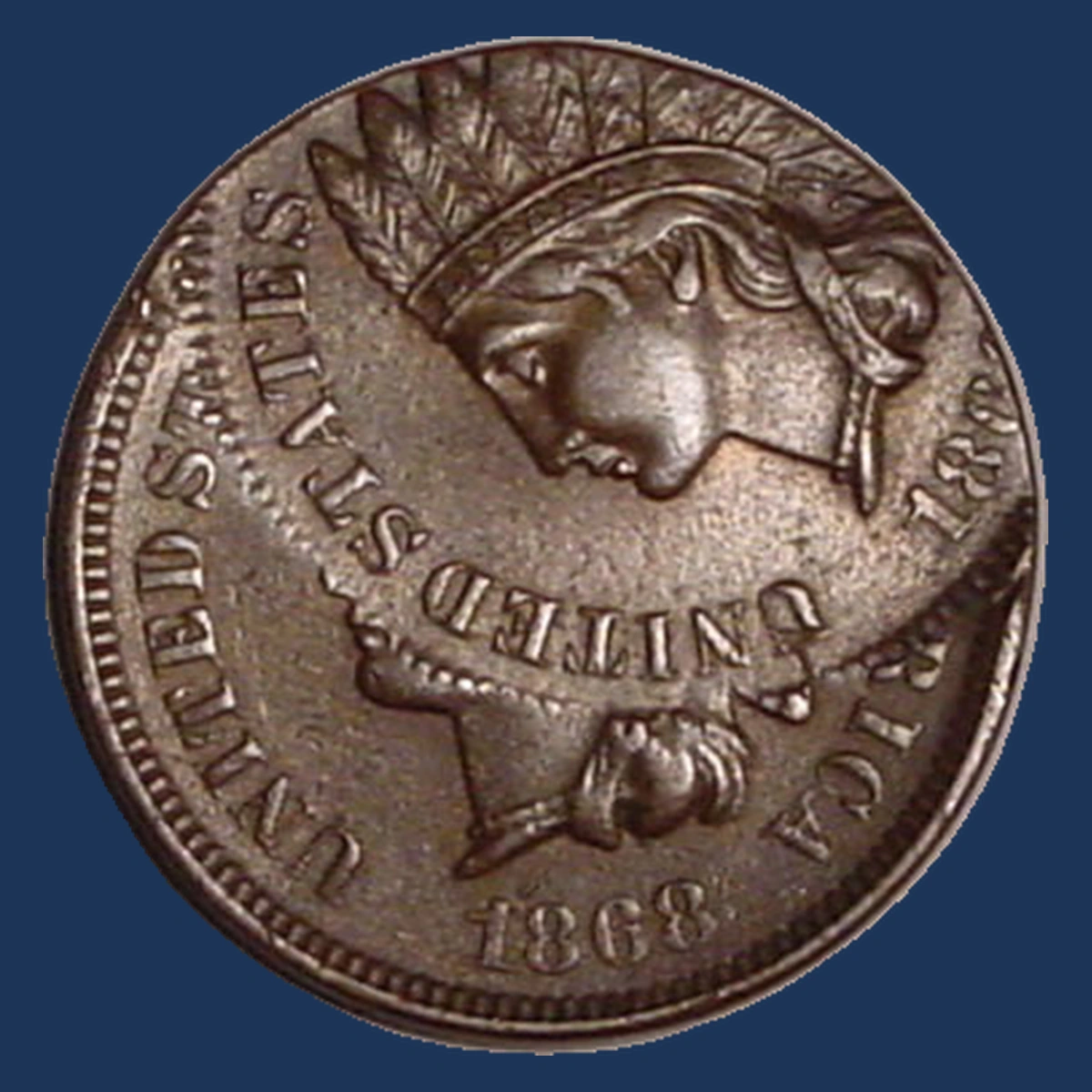
A second image overlaps the main design toward the upper right. The recorded 1868 penny received its first strike in the center, then moved before another blow.
The later strike was about 35% off-center toward 1 o’clock. It placed a second set of details across part of the coin.
This movement affects more than the fine edge of one letter. The two larger design positions explain why it is a double strike rather than a doubled stamping tool.
The original account describes the sequence and direction. It does not supply a sale price used here for that exact example.
Estimated Value
Allow an estimated $600–$5,000 for a genuine dated 1868 double strike, depending on condition and the clarity of both impressions. A complete readable date is especially useful.
For comparison, an unworn 1908 double strike graded MS62 Brown sold for $4,080 in June 2024. Its later date and different second-strike position prevent a direct price transfer.
The estimate applies to the whole coin. A scratched or heavily worn example can bring less despite having an impressive second image.
How to Identify
Find the centered first portrait.
Follow the overlapping image toward 1 o’clock with a 10× magnifier. Identify a recognizable design feature in each position rather than calling every extra ridge another strike.
Inspect the plain edge for added or joined metal, then weigh the coin against 3.11 g. Calipers can record its distorted outline around the normal 19 mm size.
Look where the second impression crosses the first. Its edge should fit a real later blow, not a shallow shelf following the same design everywhere.
Trace that second design back toward the upper-right strike position and compare the overlap with the documented 35% example.
8. 1868 Indian Head Penny Reported Silver Dime-Disc Strike (Estimated Up to $40,000)
A smaller silver disc cannot hold the full outer design of an Indian Head cent. When cent tools strike such a disc, some border detail falls beyond the available metal.
USPatterns lists an 1868 example reported by Don Taxay. The entry records the historical report without giving a photographed, graded specimen here.
The proposed mistake concerns a dime disc entering the cent press. It should not be confused with silver-colored plating on a normal bronze penny.
Color, size, weight, and missing outer design all need to fit the same explanation before an individual coin receives this name.
Estimated Value
For an authenticated 1868 cent on a silver dime disc, use a conditional estimated $10,000–$40,000. This is not an actual sale assigned to the historical report.
A nearby-year comparison is the 1869 example recorded at $25,300 in January 2012, described as lightly worn (AU55) with old cleaning. Its date and condition remain separate from the reported 1868 coin.
The estimate assumes a genuine wrong-disc strike. A plated or cut-down bronze cent cannot be valued from that comparison.
How to Identify
Weigh the suspected coin before relying on its silver color. A normal bronze cent is 3.11 g and about 19 mm, while PCGS lists the period dime at 2.48 g and 17.90 mm.
Those dime figures are comparison specifications, not measured results for the reported 1868 error. Use calipers to record the actual outline.
At 10×, inspect the edge for plating or filing and examine where outer design disappears. An unstruck dime disc need not carry the grooves found on a finished dime.
Professional metal testing should establish the silver alloy. Compare the smaller measured coin and naturally incomplete outer design together before treating a pale penny as a dime-disc strike.
Conclusion
The key questions change with the feature: where the extra letter edge appears, whether a tool mark repeats, or whether a pale coin has the right metal. A larger second strike requires its own design match.
Estimated values here span $40–$40,000. The silver-disc range uses a nearby-year comparison, while smaller features depend strongly on the condition and clear identification of the individual coin.