1857 Braided Hair Cent Error List with Pictures

The 1857 Braided Hair cent is the large copper coin with Liberty’s portrait, not the small Flying Eagle penny. Its tiny date fragments and tool marks can be worth examining without promising a separate error premium.
An N-3 Proof, a specially prepared collector coin, sold for $11,162.50 in January 2013. That was the whole coin’s price.
This 1857 Braided Hair cent error list covers estimated values of $75–$15,000. Read on to distinguish ordinary date varieties, Proof cracks, and the evidence needed for larger striking errors.
1. 1857 Braided Hair Cent Clipped Planchet — Estimated Value $100–$1,500
A clipped blank was missing metal before the design was struck. The press formed the coin around that incomplete outline, rather than a collector cutting a piece out afterward.
For an 1857 candidate, the date and large-cent design both need to survive clearly enough for identification. A clip on a small Flying Eagle cent is a different coin, despite sharing the year.
The useful clues lie where the struck rim and design approach the opening. The gap’s size alone cannot tell when it formed, and there is no required clock position for a clip.
Estimated Value
For a genuine, dated 1857 large-cent clip, estimate $100–$1,500 according to preservation and the missing section’s size. This is a conditional estimate, not a sale assigned to a particular 1857 specimen.
An 1852 Braided Hair clip graded NGC MS63 Brown sold for $384 in June 2024. It is an unworn same-series comparison with visible marks.
The later date should not inherit that result automatically. Original edge formation and remaining detail still need to support the comparison.
How to Identify
Check the denomination-sized body before enlarging the gap. An intact Braided Hair cent was about 27.5 mm across and 10.89 g, much larger than the same-year Flying Eagle cent.
For a loose candidate, use calipers across surviving portions and a digital scale to record the remaining weight. Missing metal should affect weight, but later cutting also removes metal.
Under a 10× magnifier, examine how the rim ends at the opening. Saw cuts, filed grooves, or metal pushed over an already finished design suggest later damage.
A weak area opposite a curved clip can support the mint-made explanation. It is not required on every clip, and the remaining plain edge must also be examined.
2. 1857 Braided Hair Cent Off-Center Strike — Estimated Value $500–$5,000
A true off-center strike leaves some design beyond the edge of the blank. A bare crescent remains on the opposite side because the metal never met that part of the stamping tools.
That differs from a small shift producing an uneven rim around a complete design. The distinction matters particularly for collector coins with slightly uneven borders.
An 1857 claim must have a readable date on the actual large cent. A dateless coin described only as belonging to the 1839–1857 series cannot establish the final year, however dramatic its off-center shape looks.
Estimated Value
A genuine dated example can be estimated at $500–$5,000, with the amount of displacement and condition guiding the comparison. This range does not assign a price to a dateless series-wide example.
A worn 1855 Upright 5s large cent struck 70% off center sold for $1,092.50 in January 2009. Its complete date helped identify that earlier coin.
An uneven rim on an 1857 Proof should not receive the same comparison. Part of the intended design must actually fall outside the blank.
How to Identify
Read the date before estimating the percentage. If 1857 cannot be established from the coin itself, stop short of assigning a year-specific value.
Photograph the whole front and back at the same size. Match the bare crescent with the opposite area where lettering or portrait detail was cut off by the blank’s edge.
Then check a loose coin with a scale: an off-center blow does not itself remove copper from the original 10.89 g blank. Calipers may show a changed outline around the normal 27.5 mm size.
Inspect the plain edge for grinding that could have removed finished design. A fully present design with one wide border calls for a different explanation from a substantial off-center strike.
3. 1857 Braided Hair Cent Misplaced Date — Estimated Value $75–$5,000
Look directly below the first two digits in 1857. The tops of an extra 18 rise from the small border teeth on the Large Date variety called N-1.
The date punch touched the wrong position while the die, the steel tool that stamps coins, was being prepared. Part of that misplaced impression remained after the date was placed correctly.
A 2020 Stack’s Bowers catalog describes these fragments on an MS65 Brown example, an attractive unworn coin. The feature belongs to the tool used for this Large Date variety, rather than proving a second strike on each penny.
Estimated Value
Estimate $75–$5,000 for identifiable N-1 Large Date coins across worn and high-quality unworn examples. The extra 18 forms part of the variety’s identity; it is not a separate fixed-dollar addition.
The 2020 cataloged MS65 Brown example documents the feature without a realized price used here. Its condition should not be transferred to a worn coin with the same fragments.
Small chips on that same N-1 tool pair belong to the complete coin’s assessment. Do not add their full range again.
How to Identify
The 2020 catalog’s N-1 example places the extra 18 below the normal 18. Compare that narrow area with a 10× magnifier rather than trying to turn every uneven border tooth into a digit.
The fragment tops should rise from the original surface. Scratches cut through the teeth or lumps of attached material need another explanation.
A loose large cent should be checked with a scale and calipers against 10.89 g and 27.5 mm, including its plain edge. Do not substitute the much smaller Flying Eagle cent’s measurements.
Keep the entire date visible in a close-up. Its Large Date form and the position of both fragment tops need to agree with the same N-1 photograph.
4. 1857 Braided Hair Cent Die Chips and Cracks — Estimated Up to $15,000
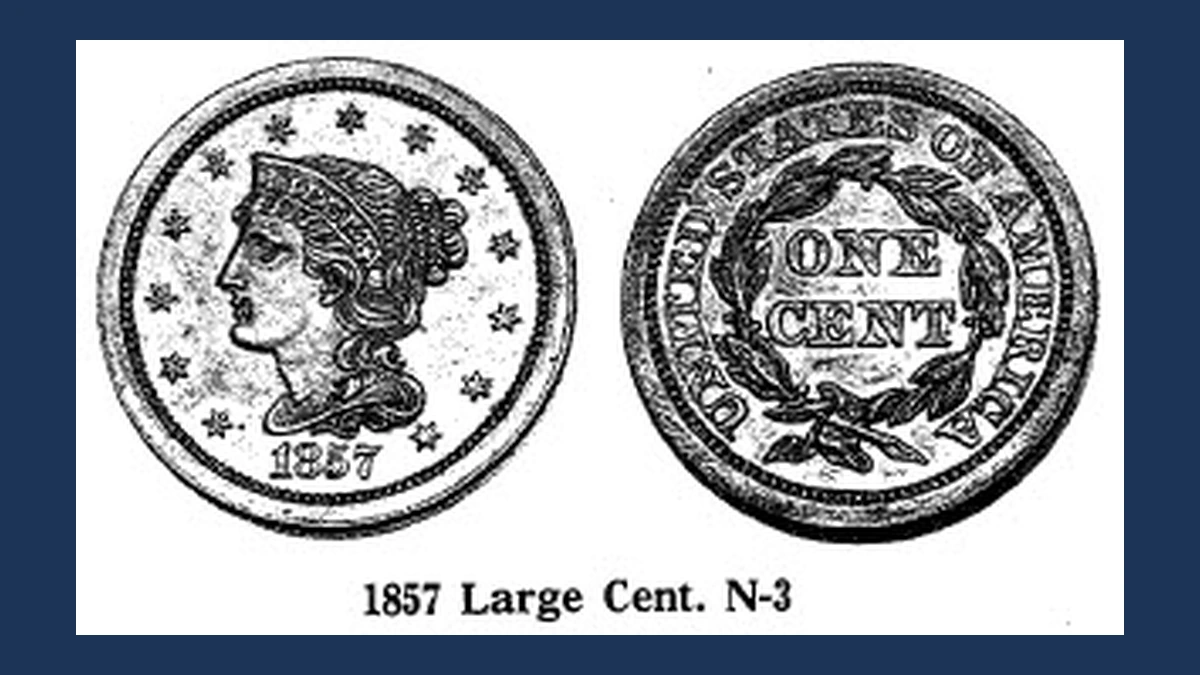
Two small raised bumps help identify the ordinary N-1 Large Date coin. One sits behind Liberty’s neck below the earlobe, and the other appears on C in AMERICA.
They formed when tiny pieces of the stamping tools broke away. Metal filled those openings during striking.
A separate Small Date Proof variety, N-3, has faint cracks running from stars toward the nose, crown, and lower curls. Cracks in a tool leave raised lines on the coin.
The Proof’s lines and the ordinary coin’s chips belong to different tool pairs. Neither requires a matching feature on the other variety.
Estimated Value
The N-3 Proof graded NGC PR66 Brown sold for $11,162.50 in January 2013 at Heritage. That price reflects a high-quality collector coin, not a measured charge for its cracks.
Estimate $3,000–$15,000 for suitable N-3 Proof comparisons and $75–$5,000 for ordinary N-1 coins with the identifying chips. The latter also carries the misplaced date.
Value each coin once. A tiny neck bump on an ordinary cent does not make it a five-figure Proof.
How to Identify
Separate the finishes first. A shiny ordinary coin is not necessarily a Proof, and the N-1 Large Date chips do not identify the Small Date N-3 collector issue.
For a loose example, a scale and calipers check the normal 10.89 g weight and 27.5 mm diameter. Examine the plain edge without cleaning the surfaces.
On N-1, use a 10× magnifier below the earlobe and at C in AMERICA. Both bumps should be raised parts of the coin.
For N-3, trace the faint third-star line toward the nose, the fifth-star line toward the crown, and the lower curls toward star thirteen and the rim.
These Proof lines can be extremely faint. A deep scratch in a similar place does not establish the same tool pattern.
Conclusion
The best starting point is the coin itself: a large copper Liberty head, a readable 1857 date, and the correct ordinary or Proof finish. Tiny raised fragments can identify a variety without creating a separate price premium.
Estimated values span $75–$15,000, including the much higher whole-coin level of suitable Proofs. For clips and off-center candidates, require convincing physical evidence before applying the error estimate.