1851 Cent Error List with Pictures

The name 1851/81 sounds like a date changed from the future, but it describes an upside-down date-punch impression. Other 1851 Braided Hair cent errors involve shifted designs, missing copper, or a tilted back.
Estimated values run from $15 to $6,000. An 1851/81 example brought $823 in February 2018, with its faint upside-down strokes still visible below the corrected date.
Use the individual checks below to identify the feature before comparing the coin’s condition and price.
1. 1851 Braided Hair Cent Rotated Dies — Estimated Value $25–$500
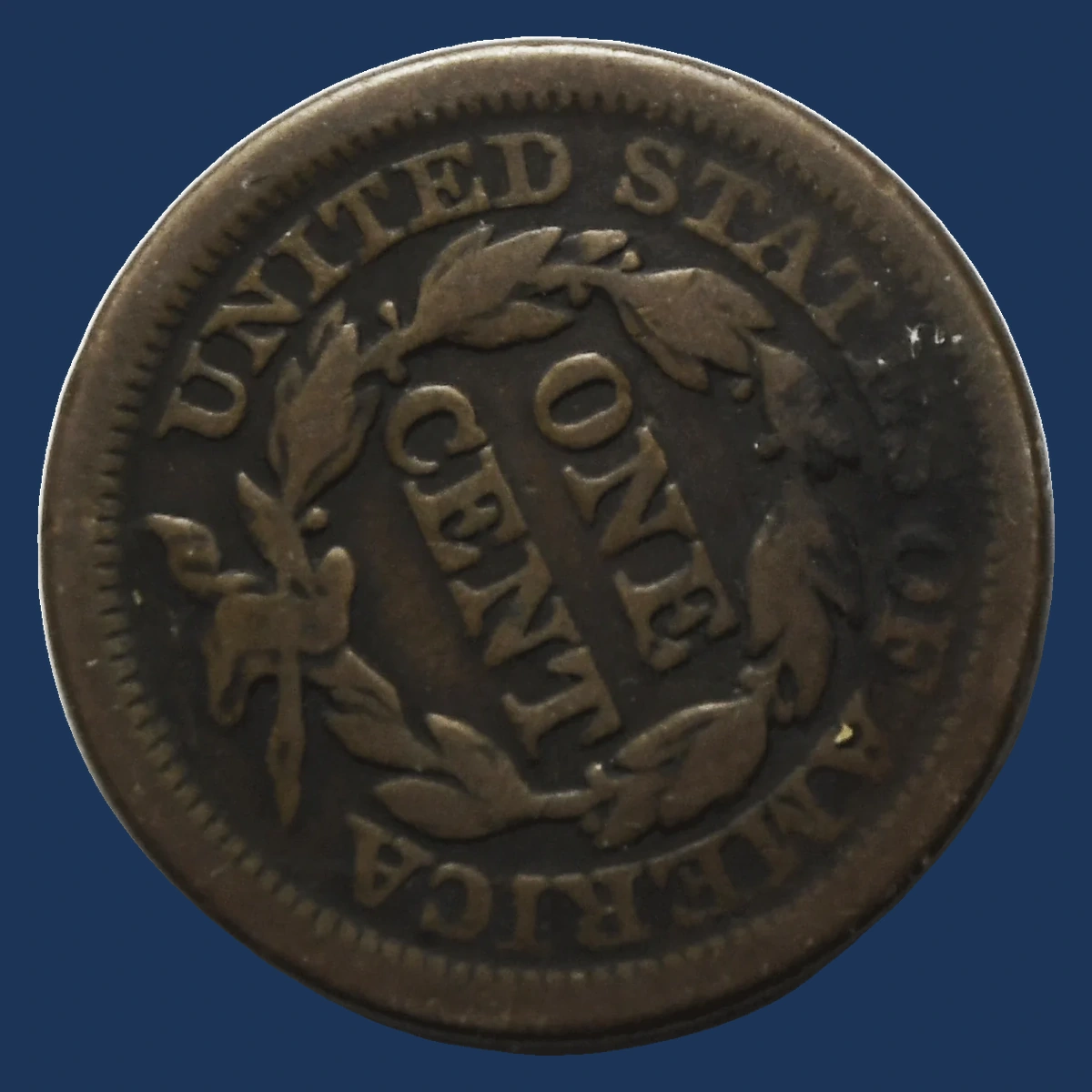
A tilted back can be the error even when both faces look normal on their own. One die, the steel tool that stamps a design, was turned away from its correct position relative to the other.
An ungraded 1851 example was offered as having a 60-degree rotation. The description does not say whether that turn is clockwise or counterclockwise.
This is a change in the relationship between the two faces, not an off-center design. The portrait and wreath can remain complete.
Photographs with both sides separately turned upright conceal the very feature that needs to be checked.
Estimated Value
The seller displayed $39.99 for the ungraded, circulated 60-degree example. The page is marked sold out, but that status does not confirm the final amount paid.
Use an estimated $25–$500 for a demonstrated 1851 rotation of this general size, allowing for condition and other collectible features. The angle must be shown by a controlled flip.
A slight lean caused by camera position should not receive this comparison. Nor should the asking price of a worn coin limit a better-preserved example.
How to Identify
Keep the front upright and turn the coin from top to bottom, like turning it over a horizontal line through its center. The back of a normal United States coin should then be upright.
Use a fixed vertical guide and repeat the movement before measuring the lean with a protractor. Do not turn the coin sideways or independently straighten the back photograph.
The seller’s 60-degree description leaves the direction open.
A scale and calipers can check a loose copper cent against 10.89 g and 27.5 mm, with a plain edge. These measurements support the coin’s identity but do not measure its rotation.
A continuous turning video is especially useful when the coin is sealed in a holder.
2. 1851 Braided Hair Cent Clipped Planchet — Estimated Value $40–$1,000
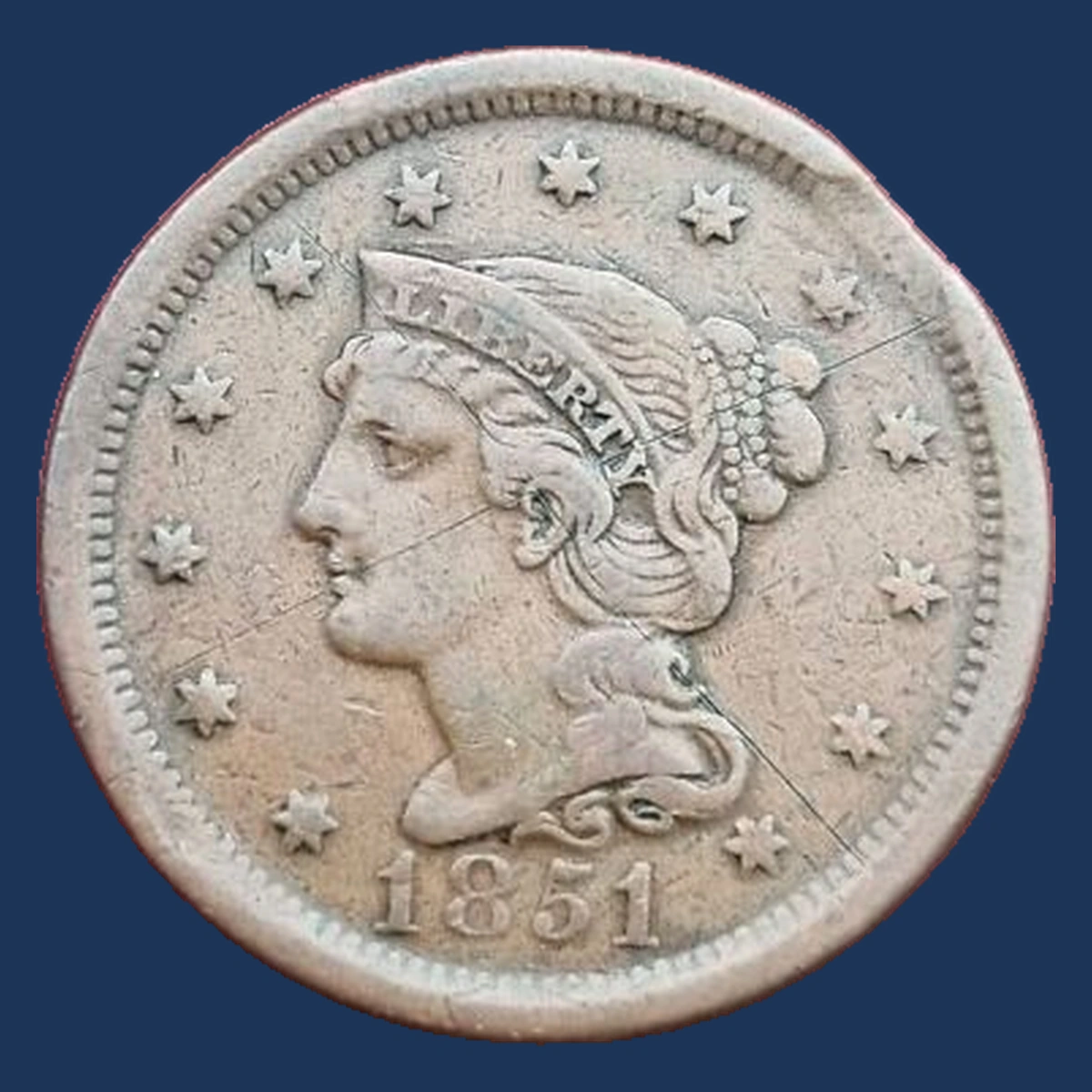
A clipped blank entered the press with part of its edge already absent. The designs formed around that incomplete disc, leaving a gap in the finished coin.
A dealer inventory lists an 1851 large cent as clipped. Its description does not establish the opening’s shape or location, so neither should be borrowed from a different coin.
The error is a missing part of the original blank, not simply any later loss of metal. Cutting, filing, and corrosion can also change a penny’s outline.
How the design ends at the gap is more useful than how unusual the gap looks.
Estimated Value
For an 1851 clip with convincing mint-made edge formation, estimate $40–$1,000. Both the amount missing and the remaining surface quality affect where it fits.
A same-series 1852 clip graded NGC MS63 Brown sold for $384 in June 2024. That unworn example is a stronger comparison than an ungraded coin with an unexplained cut.
The dealer’s 1851 listing is not assigned that sale price. Wear, cleaned surfaces, and a poorly preserved opening can all lower the useful comparison.
How to Identify
A missing edge shortens one diameter, so do not measure straight across the gap and call the whole coin undersized. Use calipers across intact portions of a loose cent, comparing the original 27.5 mm diameter.
Record its weight against the normal 10.89 g with a scale. Both clipping and later cutting can make it lighter.
Then enlarge the opening with a 10× magnifier and inspect the remaining plain edge. The struck rim may weaken as it approaches a genuine clip.
Saw marks or a cut slicing through finished lettering support later damage. If the gap is curved, check for possible rim weakness opposite it, while remembering that not every genuine clip shows that feature.
3. 1851 Braided Hair Cent Lamination — Estimated Value $20–$1,500
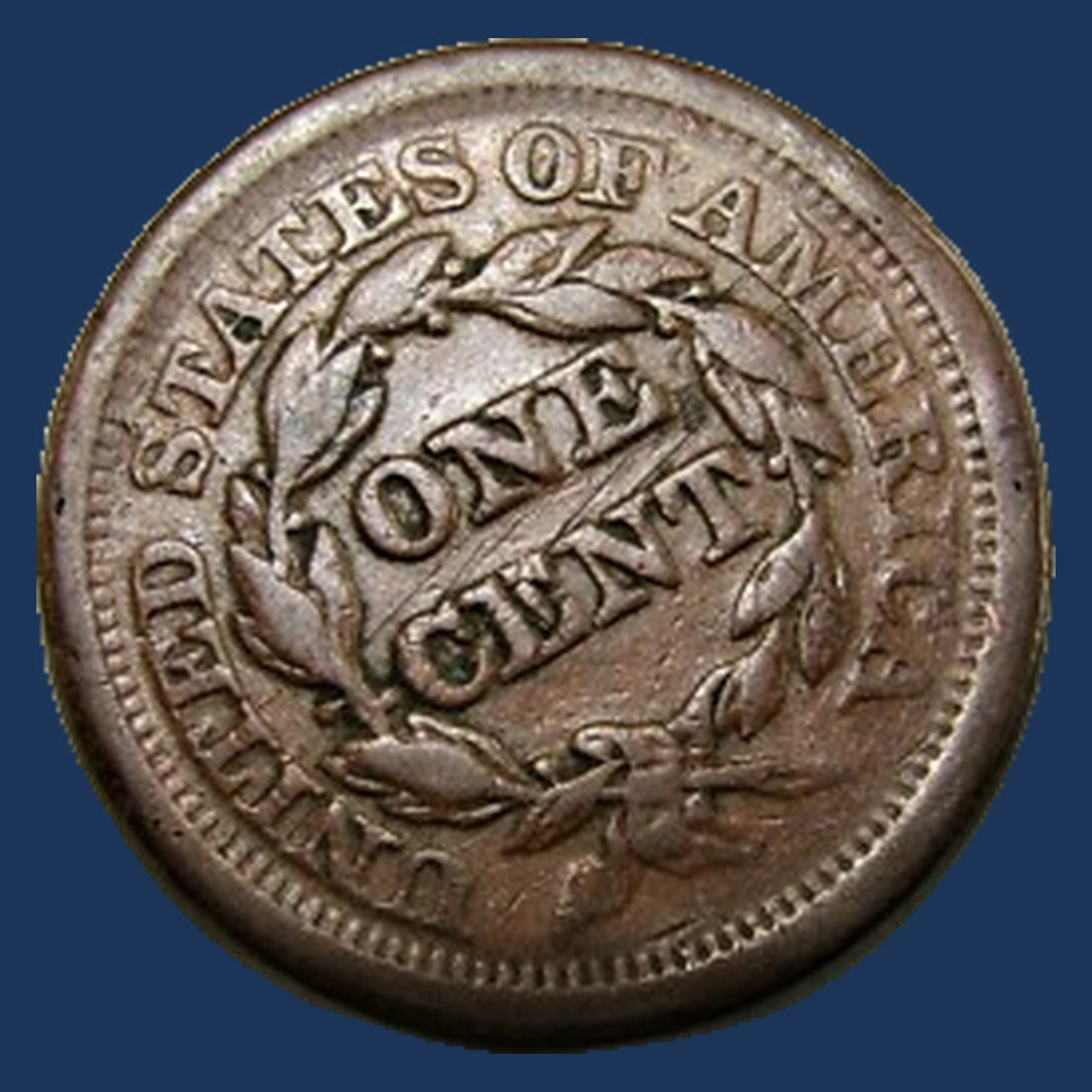
An uneven patch on the back can result from a copper layer separating from the blank. A weak boundary in the metal lets the surface lift or peel.
A listing describes back lamination on a coin graded AU55, meaning light circulation wear. It does not specify which letter or wreath area borders the defect.
A small separation should not be described as a whole coin split into two halves. Its extent needs to be judged from the actual surface.
The raised edge of a loose flake also differs from a solid ridge made by a cracked stamping tool.
Estimated Value
Estimate $20–$1,500 for an 1851 coin with lamination, with overall preservation often contributing more than a small peeling patch. A flake that obscures important detail can reduce appeal.
A different 1855 large cent with both lamination and a rim cud sold for $460 before the buyer’s fee in January 2011. That was one complete coin, cataloged as MS62.
Its price cannot be divided into a standard fee for each defect. The reported 1851 AU55 listing is not that auction specimen.
How to Identify
A loose layer should be photographed without being lifted. Prying it back may detach the part that shows how the copper separated.
Use light from the side to look beneath an exposed edge with a 10× magnifier. Compare a layered or peeling surface with the smooth depression and pushed-up border often left by a later impact.
Do not assume a particular letter position from the AU55 description. Follow the boundary that is actually present on the back.
For a loose coin, use a scale and calipers to compare 10.89 g and 27.5 mm, and inspect its plain edge. A thin surface flake may make too little weight difference to prove anything by the scale alone.
4. 1851 Braided Hair Cent Broadstrike — Estimated Value $75–$2,000
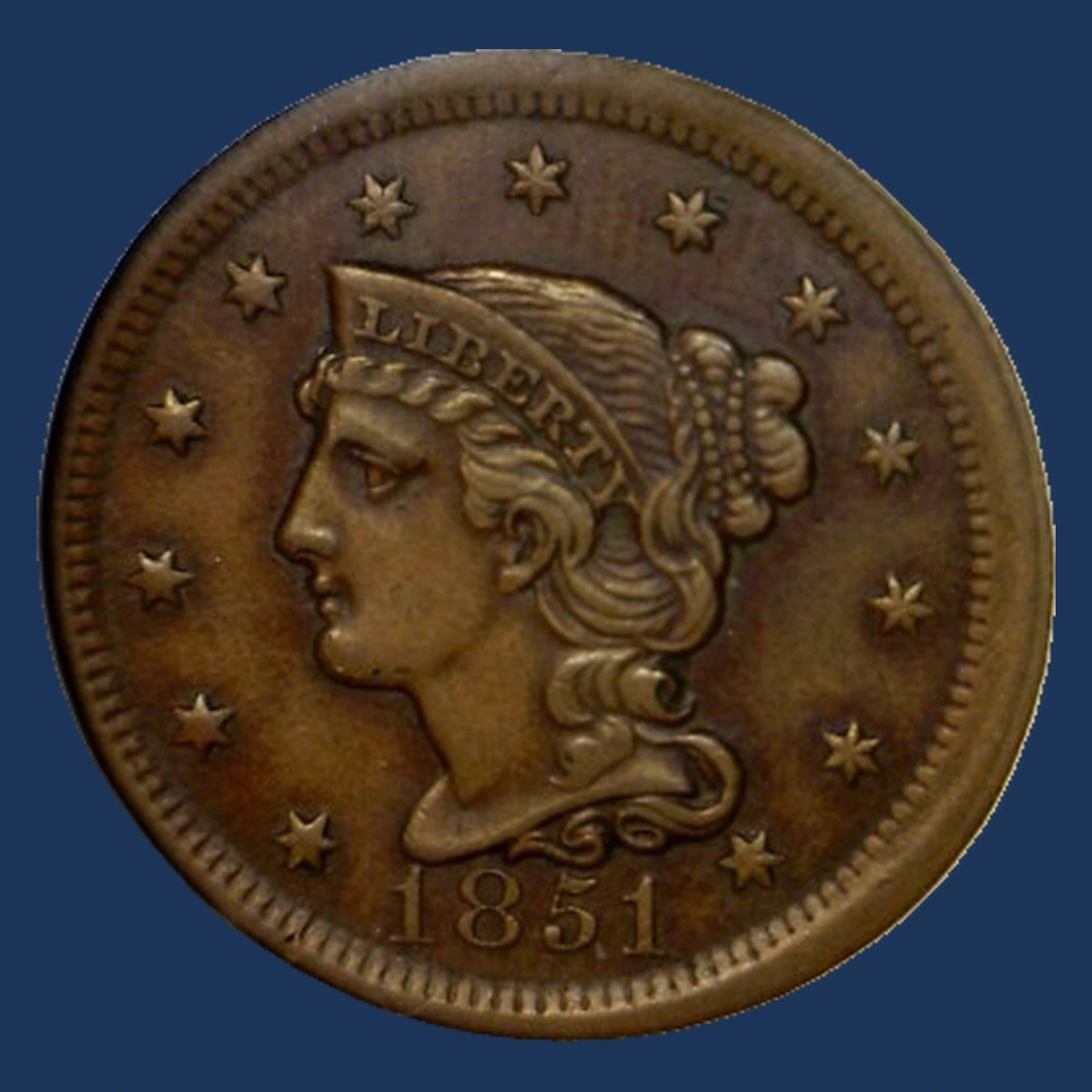
The coin spreads beyond its normal outline when the blank is not contained properly during striking. The collar, a ring surrounding the blank, normally limits that outward movement.
An 1851 broadstrike is reported as unworn, but its description does not establish a certified numeric grade. The feature to look for is expansion around a design that still fits on the disc.
A stepped edge is not a required part of a broadstrike. Such an edge can indicate partial contact with the collar, which is a different striking situation.
A large diameter alone therefore does not settle the cause.
Estimated Value
For a genuine 1851 broadstrike, estimate $75–$2,000 across worn and attractive unworn examples. The reported unworn coin does not have a realized price assigned here.
A later 1893 Indian cent broadstrike with very little wear sold for $414.80 in March 2026. Its smaller bronze blank makes it a broad process comparison, rather than a matching large-cent transaction.
The 1851 estimate concerns complete coins with original spreading. A coin flattened after minting belongs outside that range, regardless of its extra width.
How to Identify
A stepped rim is not a shortcut to this identification. Follow the outside letters on both faces and establish whether the intended design remains complete.
Then examine the central portrait and wreath for signs of general flattening. Later squeezing can increase diameter while crushing raised detail.
For a loose coin, measure several spans with calipers against the normal 27.5 mm width. Its original copper weight was 10.89 g; a scale helps check whether the disc remained substantially intact.
Look along the plain edge for tool marks or an added border. The strongest broadstrike case combines genuine outward metal movement with an intact design, rather than relying on one wide rim or a seller’s unworn description.
5. 1851 Braided Hair Cent Die Cracks and Cuds — Estimated Up to $3,000
A short raised line extending from Liberty’s hair bun can be a crack copied from the stamping tool. It should not be confused with a scratch cut into the finished coin.
A larger broken piece at the tool’s edge can leave a raised patch called a cud. Different 1851 examples have breaks above MER in AMERICA, below the ribbon and stems, or near the upper-left side of E.
Those locations belong to separate examples. One penny need not carry them all.
The common cause is damage to the tool, with the coin’s copper filling the opening during striking.
Estimated Value
A dealer asks $949 for the CACG MS64+ Brown coin with the hair-bun crack. That price chiefly concerns an attractive unworn coin and is not a completed auction result.
Estimate $15–$1,000 for identifiable cracks and $75–$3,000 for stronger rim breaks across different conditions. The better-preserved underlying coin can account for much of the difference.
The bun crack does not price every cud. Compare the location, size, and surface quality of the actual broken-tool feature before choosing a price tier.
How to Identify
View the hair-bun line with light from two directions. A raised ridge should change its highlight and shadow differently from a recessed cut.
The dealer describes that line on a CACG MS64+ Brown coin, so use its photograph for that feature. It is not a map for the separate back cuds.
For a suspected cud, study the place where the patch joins the plain rim. Check for folded metal or a seam suggesting damage or an added piece.
Use a scale and calipers on a loose coin to compare 10.89 g and 27.5 mm.
Now match just the relevant back location, whether above MER or below the ribbon and stems. Combining several photographs into one expected pattern would lead you away from the actual coin.
6. 1851 Braided Hair Cent Off-Center Strike — Estimated Value $150–$5,000
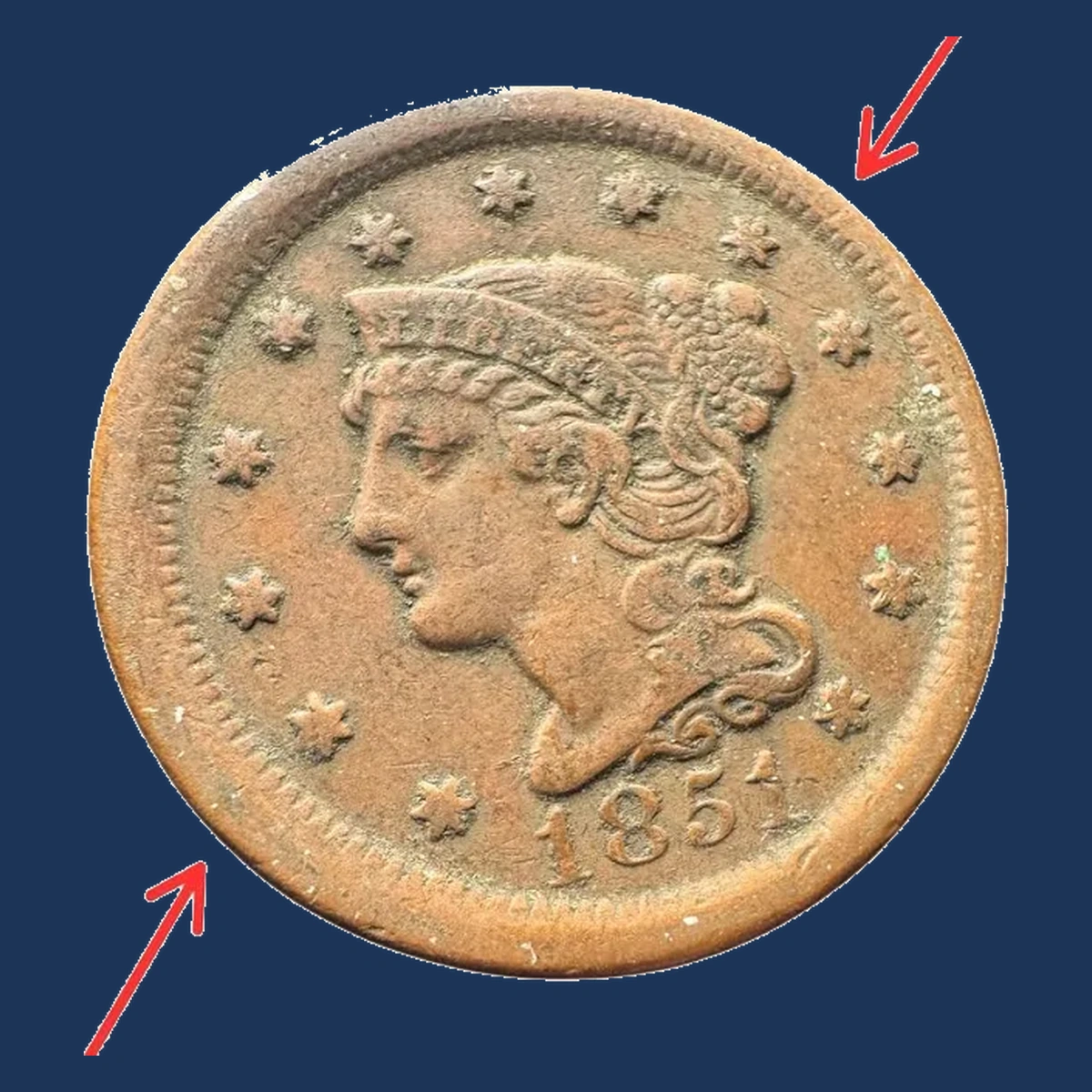
A bare crescent beside a partial design can show that the blank was misplaced in the press. Part of the design then fell outside the metal available to receive it.
An 1851 year guide reports a 35% off-center example described as AU Details. That suggests little circulation wear together with a condition problem, but the report does not name the problem or a grading service.
The direction is also unstated. Those details must come from the individual coin rather than another year’s photograph.
A shifted front tool with a centered back would call for a different explanation.
Estimated Value
Estimate $150–$5,000 for genuine dated 1851 off-center cents, allowing for different offsets and preservation. A coin labeled Details should be compared with examples having similar surface problems.
For a same-series auction reference, an 1855 Upright 5s cent struck 70% off center sold for $1,092.50 in January 2009. It was graded PCGS Fine 15, indicating substantial circulation wear.
That is a different-year coin with a greater offset. The reported 35% 1851 example is not assigned its grade, direction, or sale price.
How to Identify
The reported AU Details description makes condition part of the identification task. Read the actual holder or examination report before treating its remaining detail as evidence of a problem-free coin.
Then photograph both faces and locate the design cut off opposite the bare crescent. Keep the 1851 date readable in the full view.
A 35% description gives no compass direction by itself. Do not rotate another specimen’s picture to supply one.
For a loose coin, compare its weight with 10.89 g on a scale and record the altered outline with calipers beside the normal 27.5 mm size. Inspect the plain edge for filing or grinding, since later removal of struck metal can imitate missing design.
7. 1851 Braided Hair Cent Repunched and Inverted Date — Estimated Value $30–$6,000
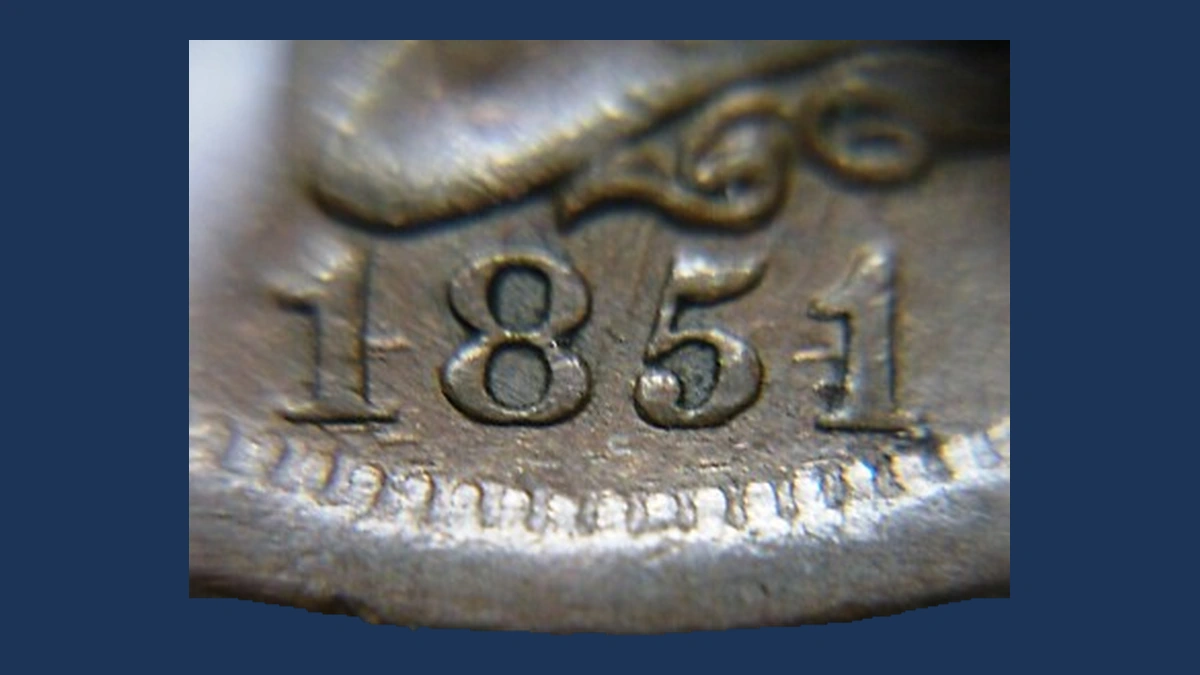
The unusual 1851/81 name refers to an upside-down 18 beneath the last two digits, 51. A worker initially placed the date punch in the wrong orientation, then corrected it.
The leftover strokes became part of the stamping tool and appeared on coins made from it. This does not mean an 1881 date was changed to 1851.
Other 1851 repunched-date patterns involve smaller repeated strokes near the two 1s. They include a remnant below and left of the first 1 and extra detail near the final 1.
Those ordinary repunchings should not be identified from the inverted-date photograph alone.
Estimated Value
A PCGS MS62 Brown 1851/81 example brought $823 in February 2018, as PCGS records. The auctioneer judged it slightly worn, AU58+, despite the holder’s unworn grade.
Estimate $75–$6,000 for the inverted-date variety and $30–$1,500 for more ordinary identified repunchings. These are whole-coin ranges across different conditions.
The grade disagreement illustrates why surfaces still need examination. An extra stroke alone should not transfer the best-preserved variety’s value to a worn, damaged, or incorrectly matched coin.
How to Identify
Draw the leftover strokes below 51 before trying to read the name 1851/81 literally. Compare those shapes with an upside-down 18 under a 10× magnifier.
The auctioned example’s remnants were faint but still visible. Weakness alone therefore does not rule out the pattern.
For the smaller repunchings, inspect the lower-left part of the first 1 and the base and middle stroke of the final 1. These are different comparisons from the inverted 18.
Check a loose cent’s plain edge, 10.89 g weight, and 27.5 mm diameter with a scale and calipers. Then inspect high points for wear independently of the variety name, especially when the holder and seller describe condition differently.
Conclusion
The inverted date is one of 1851’s most recognizable varieties, but it does not explain every extra line or missing patch. Separate repeated digits from raised tool cracks, peeling copper, and changes to the entire struck outline.
Estimated whole-coin values span $15–$6,000. Actual auction results, seller prices, and estimates play different roles in those comparisons.
A clear photograph showing the right feature is more useful than a dramatic name attached to the wrong coin.