1839 Coronet Head Cent Error List with Pictures

The hair cord matters as much as the date on an 1839 cent. A smooth cord helps identify the famous 1839/6 variety, whose exceptionally preserved example brought $376,000 in March 2017.
This 1839 Coronet Head cent error list separates that overdate from a repeated 9, raised cracks, missing layers, and displaced strikes. Estimated whole-coin values span $20–$400,000, with the upper end reserved for exceptional overdates.
Read on to compare the visible clues without confusing these coins with the different 1839 Braided Hair design.
1. 1839 Coronet Head Cent Repunched Date — Estimated Up to $500
The extra mark sits beside the 9, rather than forming a different number beneath it. This small repeated outline is reported on the N-3 variety, which uses the portrait called Head of 1838.
A date punch was applied more than once while preparing the steel stamping tool, called a die. A small change in position could leave part of the first impression visible.
This is a repunched date. It should be separated from the 1839/6 overdate, which has the remains of a 6 and a different portrait.
Estimated Value
For a correctly identified circulated example, an estimated $30–$500 allows for wear and surface quality. The small extra outline should not receive the much higher prices paid for genuine 1839/6 cents.
As a later date-punch comparison, an 1864 Indian cent with a repunched date sold for $1,560 in July 2024 at MS65 Brown. That unworn small cent is a different issue, so its price is not an 1839 N-3 sale record.
How to Identify
Place a clear Head of 1838 comparison beside the coin before enlarging its date. The ordinary portrait style comes first; a stray mark near a different head does not establish N-3.
With a 10× magnifier, examine the left side of the 9 for a second raised curve. Check whether nearby scratches or rough corrosion could explain the mark instead.
A scale should read close to the normal 10.89 grams, allowing for wear. Use calipers to compare the roughly 28 mm copper disc and inspect its plain edge.
Compare the extra curve specifically with an N-3 date photograph, keeping the underlying 6 of the separate overdate out of this match.
2. 1839 Coronet Head Cent Rotated Dies — Estimated Up to $600
The back may appear tilted when the portrait is held upright and the coin is turned over correctly. This happens when one stamping tool sits at an angle relative to the other.
Both faces can still be fully struck. The error concerns their relationship, not a sideways shift of the design across the metal.
Rotation is reported for 1839 Coronet cents, but no single measured angle applies to the whole year. Photographs rotated separately cannot demonstrate it, and a quarter-turn should not be described as the half-turn called medal alignment.
Estimated Value
An estimated $40–$600 is suitable for authenticated rotated examples, depending on the angle, wear, and surface condition. Very small departures may add little to the ordinary coin value.
For comparison, a rotated 1858 Flying Eagle cent graded ANACS F12 sold for $154 in June 2026. Its different design and metal limit the comparison; a more dramatic angle on an attractive 1839 copper cent would need its own assessment.
How to Identify
Inspect the plain edge under a 10× magnifier for a join that could mean two altered halves. Weigh the coin against 10.89 grams and use calipers to compare approximately 28 mm.
Hold the portrait upright above a fixed vertical line, then turn the coin top to bottom without twisting it. The back should finish upright under normal United States coin alignment.
If the back ends tilted, repeat the turn before measuring the angle. Neither the portrait’s natural lean nor two separately rotated photographs establishes a tool rotation.
Keep the lettering upright as you begin. A repeatable tilt after the controlled turn is the useful sign, not an angle chosen from a photograph.
3. 1839 Coronet Head Cent Die Cracks and Rim Breaks — Estimated Up to $1,000
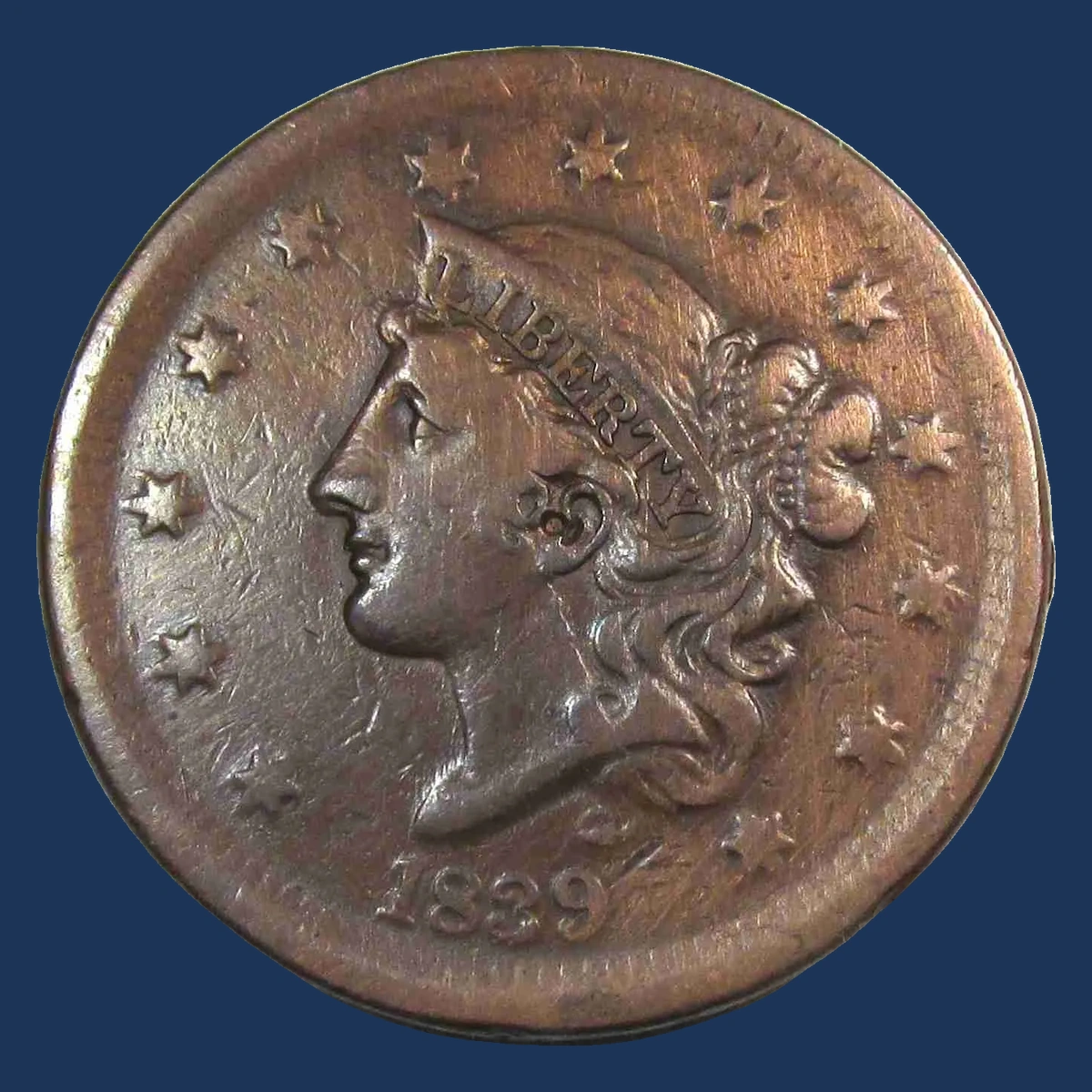
Raised lines cross different areas on two reported 1839 varieties. On the N-7 Booby Head, a crack runs through the fourth to sixth stars toward the rim.
The N-9 Silly Head has a different route, descending from the L in LIBERTY across the neck. The nicknames describe normal portrait styles, not errors themselves.
Copper entered cracks in the stamping tool and formed these raised lines. A larger missing tool piece can create a rim-connected raised patch, called a cud; a Coronet cud claim needs its own matching coin.
Estimated Value
Ordinary circulated pieces with small cracks may fall around $20–$400. For an authenticated, substantial rim break, use a broader estimated $100–$1,000, depending on size and preservation.
A copper-nickel 1864 cent combining a retained rim break with an expanded strike sold for $646.25 in 2016. That later coin provides only a broad comparison: its two errors cannot be priced separately, and the copper Coronet cent has its own collector demand.
How to Identify
Choose the portrait first. For N-7, count the left-side stars and follow the raised line around stars four through six; for N-9, begin at LIBERTY’s L.
Changing the light under a 10× magnifier helps distinguish a ridge from a groove. A scratch is normally cut into the surface, unlike copper raised by a cracked tool.
Weigh the coin against 10.89 grams and check its roughly 28 mm width with calipers.
A claimed cud must meet the original plain edge without a folded rim or added metal. Trace the N-7 or N-9 line along its correct route, rather than matching any random line on an 1839 coin.
4. 1839 Coronet Head Cent Lamination — Estimated Up to $2,000
Two small areas of missing copper were described on an 1839 cent graded PCGS MS65. One lies at the border teeth below the 8; the other is between the first T and A of STATES.
A thin layer separated from the original metal. This is called lamination, and it can leave an opening with an irregular, layered edge.
The flaws were described as present when the coin was made. They do not show that the whole disc split into two pieces, and rough corrosion is a separate surface problem.
Estimated Value
Use an estimated $30–$2,000 for worn through well-preserved cents with visible lamination. An exceptional high-grade coin can require separate pricing because its condition may matter much more than a small layer flaw.
An 1842 large cent with a border-layer flaw brought $750 in September 2021, providing a nearby-year comparison. That result belongs to a different coin, not the documented 1839 MS65 example, whose sale amount is not used here.
How to Identify
A loose copper layer can break if touched. Keep the coin supported and avoid pressing a caliper jaw against the damaged spot.
Across an intact part of the disc, compare approximately 28 mm; a scale checks the normal 10.89 grams. Small surface flakes may cause no obvious weight difference.
Look below the 8 with a 10× magnifier, then turn to the opening between STATES’ first T and A.
Do not assume an unrelated pit elsewhere is the same flaw. Inspect the plain edge and nearby copper for scraping.
Follow a visible layer boundary into the metal; that physical separation is more useful than the color of a rough patch.
5. 1839 Coronet Head Cent Off-Center Strike — Estimated Up to $3,000
A large part of the circular disc sits beyond the struck design on the documented Booby Head example. The auction described approximately 25% displacement at seven o’clock.
The metal disc entered the press out of position, so the tools could not stamp a complete design onto it. This differs from a small uneven rim around otherwise complete lettering.
The coin also has corrosion. ANACS described Fine detail but assigned a lower net assessment of Good 6 for its problems; those surface problems affect value without explaining away the off-center strike.
Estimated Value
The documented Booby Head example sold for $390 on January 11, 2003. Its corrosion and reduced net assessment are important when comparing another coin.
An estimated $300–$3,000 covers varied readable-date examples, with better surfaces and stronger displacement tending to attract more interest. For another large-cent comparison, an 1854 coin struck about 50% off center brought $1,527.50 in 2016 at ANACS VF20, so condition and displacement must be weighed together.
How to Identify
Examine the entire disc before studying the corrosion. An off-center strike should leave original unstruck metal beside a design that runs out of space on the other side.
The documented coin’s shift is about 25% at seven o’clock. Check both faces and the remaining date at 10×, rather than applying that description to every uneven 1839 rim.
Use a scale to compare 10.89 grams and calipers to record the outline against a normal diameter of about 28 mm. The plain edge should not show cutting that manufactured the apparent gap.
Look for the intact unstruck crescent opposite design cut off by the disc’s edge, while keeping the readable date in view.
6. 1839 Coronet Head Cent 1839/6 Overdate — Estimated Up to $400,000
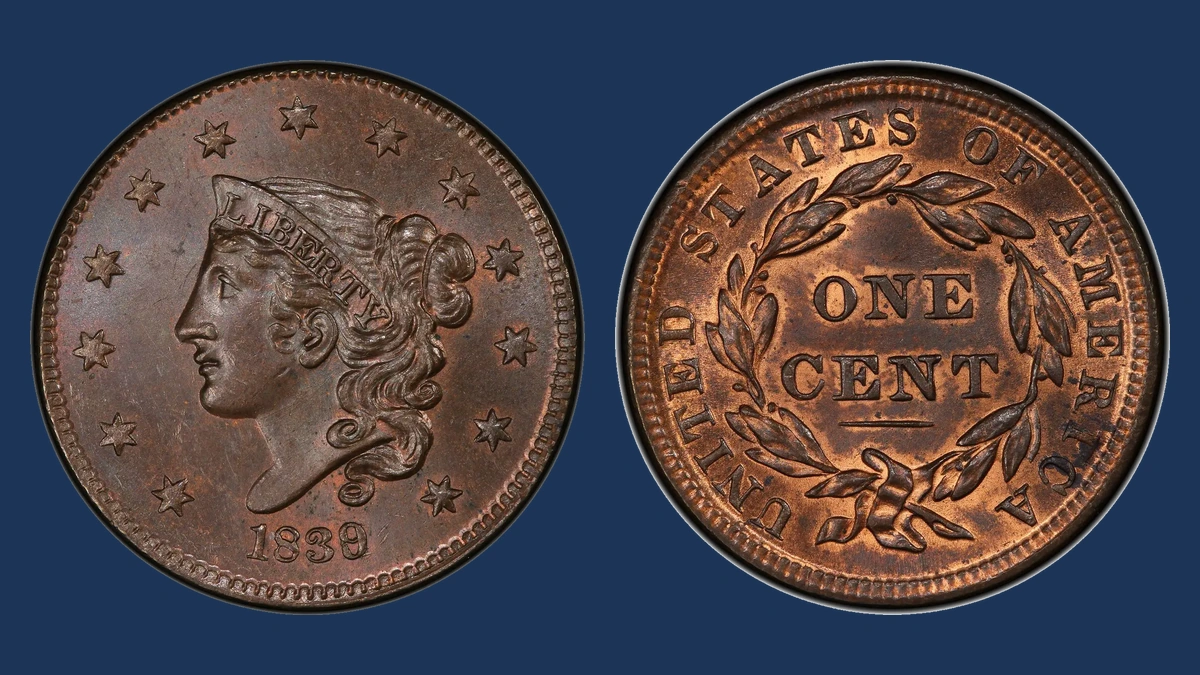
Part of a 6 remains beneath the final 9. The stamping tool’s earlier date was changed, but the old digit was not fully removed.
The resulting variety is called 1839/6. It uses the older portrait with a smooth hair cord, a useful clue when wear makes the date harder to read.
That combination separates it from ordinary 1839 cents and from a slightly repeated 9. Collectors seek the overdate even in worn condition, while exceptional preservation can place an example far above the prices of everyday early copper coins.
Estimated Value
For circulated examples, estimate roughly $400–$10,000, depending heavily on wear and damage. Near-unworn and exceptional pieces occupy a much higher estimated $20,000–$400,000 range.
The exceptional coin recorded in PCGS CoinFacts brought $376,000 in March 2017. That result reflects extraordinary preservation of a sought-after variety; it is not a typical price for any worn cent with a mark inside its 9.
How to Identify
Inspect the hair cord behind the portrait’s head before interpreting a crowded date. The correct older portrait has a smooth cord, rather than the beaded appearance seen on other 1839 versions.
A scale and calipers help compare the normal 10.89 grams and roughly 28 mm diameter, allowing for wear. Inspect the plain edge, then compare the date under a 10× magnifier with a clearly identified 1839/6 photograph.
Look for the older curves within and below the 9, rather than a random scratch or corrosion lump. Pair the visible older 6 with the smooth hair cord before treating the coin as 1839/6.
Conclusion
An 1839 portrait nickname is not an error, but it helps you choose the right comparison. Match the head before checking a crack, repeated date, or older digit.
Estimated values here range from $20 to $400,000, with exceptional overdates at the top. Keep corrosion separate from the mint-made feature, protect loose copper layers, and compare condition before applying an auction result to your own cent.