1836 Cent Error List with Pictures

A raised line through ONE can connect an 1836 penny’s back to the history of its worn stamping tools. One well-preserved coin also has a raised rim break on the front.
That coin sold for $4,025 in April 2006 and $2,040 in August 2020. Both amounts bought the whole coin.
This 1836 Coronet Head cent error list covers estimated values of $20–$7,000. Follow the examples below to distinguish broken tools, weak copper layers, a sideways back, and a displaced strike.
1. 1836 Coronet Head Cent Rotated Back Design
The wreath and lettering can appear tilted even though the front portrait sits upright. This happens when a die, the steel tool that stamps a coin, turns from its intended position.
The two faces no longer line up normally when the coin is turned top to bottom. A complete wreath can still fit comfortably inside the rim.
An 1836 variety called N-5 has been reported with this feature. Its description does not establish an angle to apply to every coin of that variety.
Rotating a photograph creates no mint error. The relationship must remain visible while the coin is turned.
Estimated Value
A small rotation on a worn 1836 cent may add little to its ordinary value. Estimate $20–$2,500 for authenticated examples across different angles and conditions.
The reported N-5 has no rotation-specific sale price used here. A dealer’s sixty-degree 1851 large cent displayed a $39.99 asking price, which is neither an 1836 sale nor a confirmed payment.
A larger turn can be more noticeable. Original surfaces and the underlying cent’s condition still account for part of the whole-coin price.
How to Identify
Use one continuous movement rather than comparing two separately rotated photographs. Hold Liberty upright, then turn the coin top to bottom over a soft surface without twisting it.
The back should now be upright. Repeat the turn, keeping track of the same top and bottom points.
Check the readable 1836 date with a 10× magnifier. The phrase Head of 1836 can also describe a portrait on a coin dated 1835.
For a loose coin, use a scale to check 10.89 grams and calipers to compare approximately 27.5 millimeters. Inspect the plain edge for a seam joining two pieces before accepting an unusual front-to-back relationship.
2. 1836 Coronet Head Cent Separating Copper Layers
A piece of copper may curl upward or leave a patch where it has fallen away. This is called lamination: a weak layer separates within the metal used to make the blank.
An 1836 cent can show the problem as a small opening or a broader peeling area. The general report does not identify a location shared by all examples.
A layer can remain partly attached. It should not be pulled off to expose more of the fault.
This surface separation differs from cutting a coin into pieces. Rough corrosion can also destroy copper without leaving an original weak layer.
Estimated Value
Estimated whole-coin values of $25–$3,000 cover genuine 1836 laminations from worn pieces to attractive examples with clear peeling. Damage and missing detail can reduce the underlying coin’s value.
A useful later-date comparison is an 1839 Petite Head cent cataloged AU50, or lightly worn. Its two front laminations accompanied a $600 hammer price in January 2026, before the buyer’s fee.
That is one coin with two faults. Neither its grade nor its price automatically transfers to an 1836 surface crack.
How to Identify
Keep cleaning tools away from an open layer. Even a small movement can break off copper that still carries part of the original design.
With a 10× magnifier and side light, look beneath a lifted edge without touching it. Follow the boundary to see whether it passes within the metal or merely scratches across the finished surface.
For a loose coin, use a scale against 10.89 grams and calipers against about 27.5 millimeters. A missing flake can lower weight, but a retained layer may leave both measurements close to normal.
Inspect the plain edge where the fault approaches it. A layered opening differs from the rough pits of corrosion and from a narrow groove with freshly displaced metal.
3. 1836 Coronet Head Cent Displaced Strike with a Bare Crescent
Part of the design can miss the blank entirely, leaving an unused crescent beside the struck area. The blank was outside its proper position when the tools came together.
Collectors call this an off-center strike. Its strongest clue is the relationship between lost outer detail on one side and bare metal on the other.
Off-center striking is reported for 1836 cents without a particular certified example or direction specified here. The date must remain readable to identify the year directly.
A broad rim alone is different. A complete design may simply sit unevenly within the coin’s outline.
Estimated Value
Use an estimated $300–$6,000 for authenticated, dated 1836 off-center strikes across different conditions. Greater displacement can attract interest when enough design survives to identify the coin.
An 1855 large cent struck seventy percent off center brought $1,092.50 in January 2009. PCGS graded that different-year example Fine 15, reflecting substantial circulation wear.
A readable 1836 date matters more than a seller’s broad date range. The estimate assumes original unstruck copper, rather than a border created by grinding away finished design.
How to Identify
For a loose coin, use a scale to compare its weight with the normal 10.89 grams. Record several spans with calipers beside the usual diameter of about 27.5 millimeters.
The shifted strike need not remove copper. An unusually low weight therefore needs an explanation beyond the bare crescent alone.
Under a 10× magnifier, examine the boundary where struck detail stops. Look for original metal instead of grinding lines or a flattened patch.
Photograph both faces without trimming away the rim or date. If one face is centered and only the other shifts, consider a misplaced stamping tool.
A genuinely off-center blank should explain the lost outer design and bare area across both faces.
4. 1836 Coronet Head Cent Cracks and Raised Rim Breaks
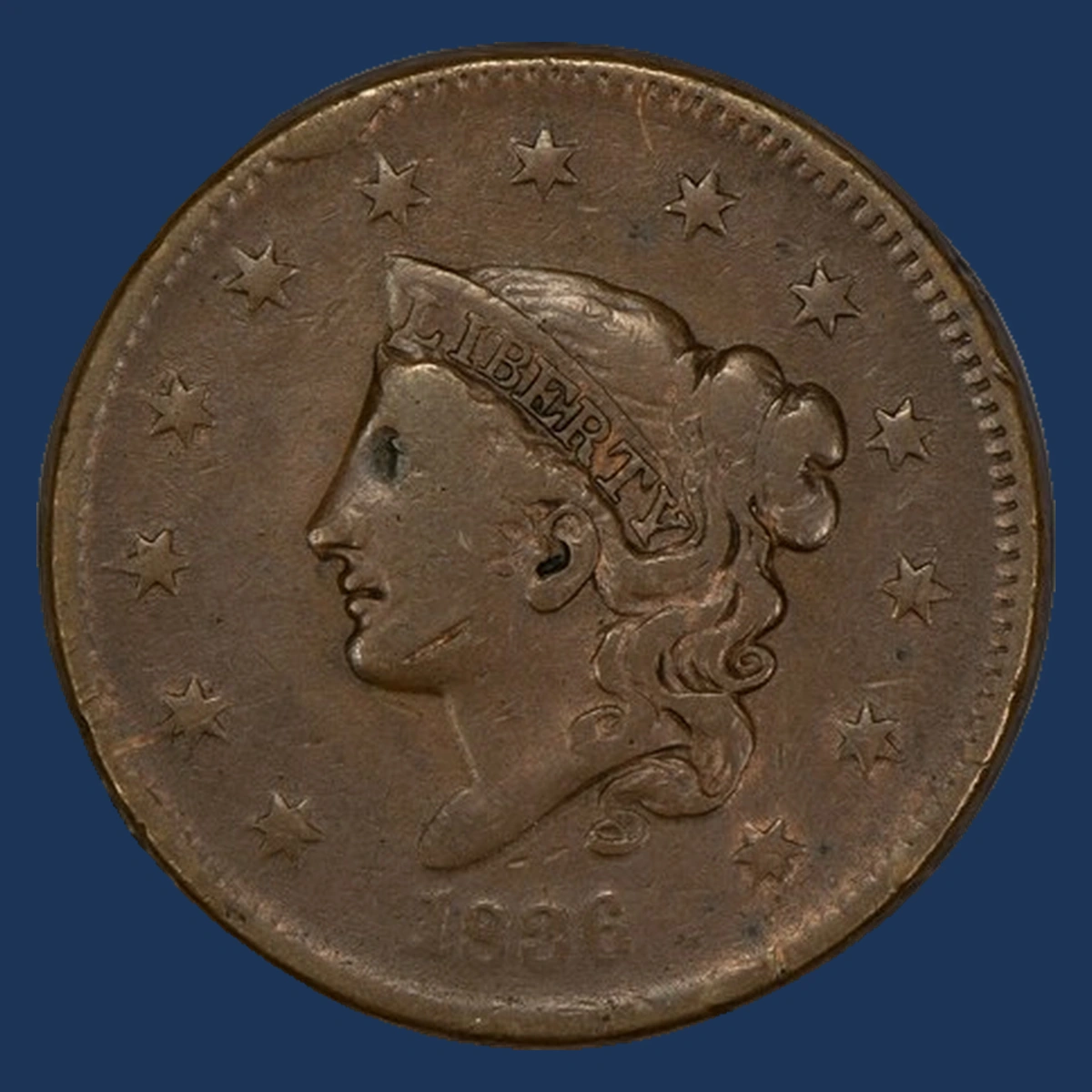
The front rim can carry a raised patch where a piece broke from the stamping tool. Such a rim-connected patch is called a cud.
Two 1836 examples place their cuds near eleven o’clock and one o’clock. They are different tool varieties, not two required marks on every coin.
A documented eleven-o’clock example has a back crack running through the top of ONE and toward surrounding letters. Copper entered that narrow opening in the steel and formed a ridge.
The same broken tools could strike many coins. A repeated raised pattern differs from a random scratch or dent acquired during use.
Estimated Value
An MS65 Brown example brought $2,040 in August 2020, after selling for $4,025 in April 2006. MS65 describes an unworn coin with relatively few marks.
Estimate $20–$7,000 across worn small-crack examples and well-preserved coins with distinct cuds. The auction figures include the ordinary value of that attractive cent.
Its front cud and back crack occurred together. They do not justify adding two whole-coin prices, and a tiny raised line alone need not command a large premium.
How to Identify
Choose the appropriate clock position before matching a photograph. The eleven-o’clock break sits near star six, while the separate one-o’clock example needs its own comparison.
Use a 10× magnifier to inspect where the raised patch joins the rim. A dent can fold the edge inward and flatten nearby design, leaving a different boundary.
Turn to the back of the documented crack-and-cud example. Follow the ridge through ONE toward the first S in STATES and M in AMERICA rather than combining unrelated scratches.
For a loose coin, use a scale and calipers to check 10.89 grams and about 27.5 millimeters. Inspect the plain edge beside the raised patch for a fold, attached metal, or a seam.
Conclusion
Raised ridges, peeling layers, and a tilted back require different checks. Turn the coin carefully for alignment, use side light for surface faults, and retain the complete outline in photographs.
The estimated ranges run from $20–$7,000 for whole coins. The documented crack-and-cud example shows why condition and auction history matter alongside the error.
Keep an 1835 coin labeled Head of 1836 separate from a coin actually dated 1836.