1973 Nickel Error List with Pictures

A tiny surviving 3 revealed that a nickel with a 1974 design had first been struck in 1973. The mint set containing it sold for $1,897.50 in August 1997.
Other 1973 nickel errors include foreign blanks, unusually placed mint letters, and coins missing most of their metal. Estimated values across these types run from $5–$3,500.
Follow the visible features below, including the difference between missing metal and metal that simply missed the strike.
1. 1973 Jefferson Nickel Die Cracks and Chips
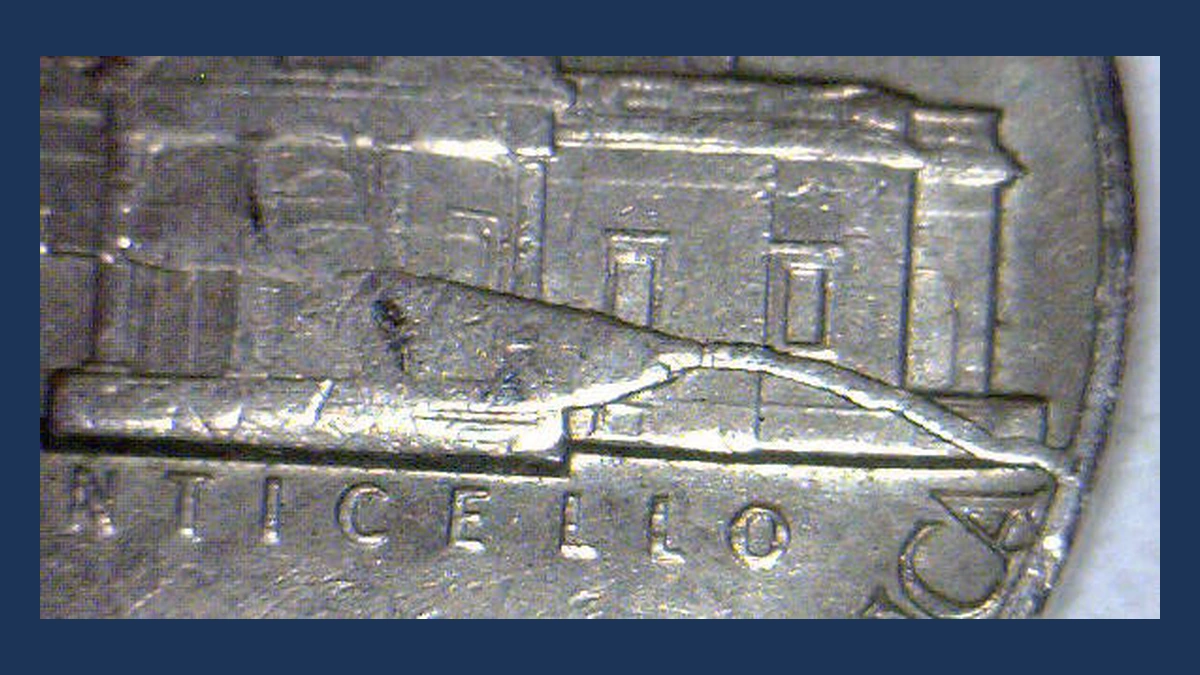
A small ridge or raised lump can appear even when the coin has never been struck twice. A crack or broken spot in a die, the steel stamping tool, allows extra metal to rise into that opening.
Fine cracks produce lines, while small missing pieces of the tool can leave wider patches. These forms of die damage appear in published 1973 error lists.
The reports do not establish one position shared by all examples. A scratch or a lump added after minting needs to be ruled out before identifying the raised feature as original.
Estimated Value
Estimated values of $5–$75 cover modest cracks and chips on ordinary 1973 nickels. Larger, easily recognized features generally attract more interest than a tiny line lost among circulation marks.
This is a range for the reported types, not an auction result for a particular cataloged die. Surface condition and the size of the raised metal should guide the comparison.
A dent with pushed-up edges does not automatically qualify as a die chip.
How to Identify
Try side lighting before using a stronger magnifier. A genuine raised ridge catches the light along its top, whereas a scratch has a groove beneath the surface.
With a 10× magnifier, follow the feature into the nearby design. A small chip should rise from the coin’s own metal without a seam suggesting solder or another addition.
Weigh a loose coin on a digital scale against 5.00 grams and check its width with calipers against 21.21 millimeters. If the feature crosses a letter, inspect that meeting point closely; it should fit a struck ridge rather than a later cut through completed detail.
2. 1973 Jefferson Nickel Clashed Dies
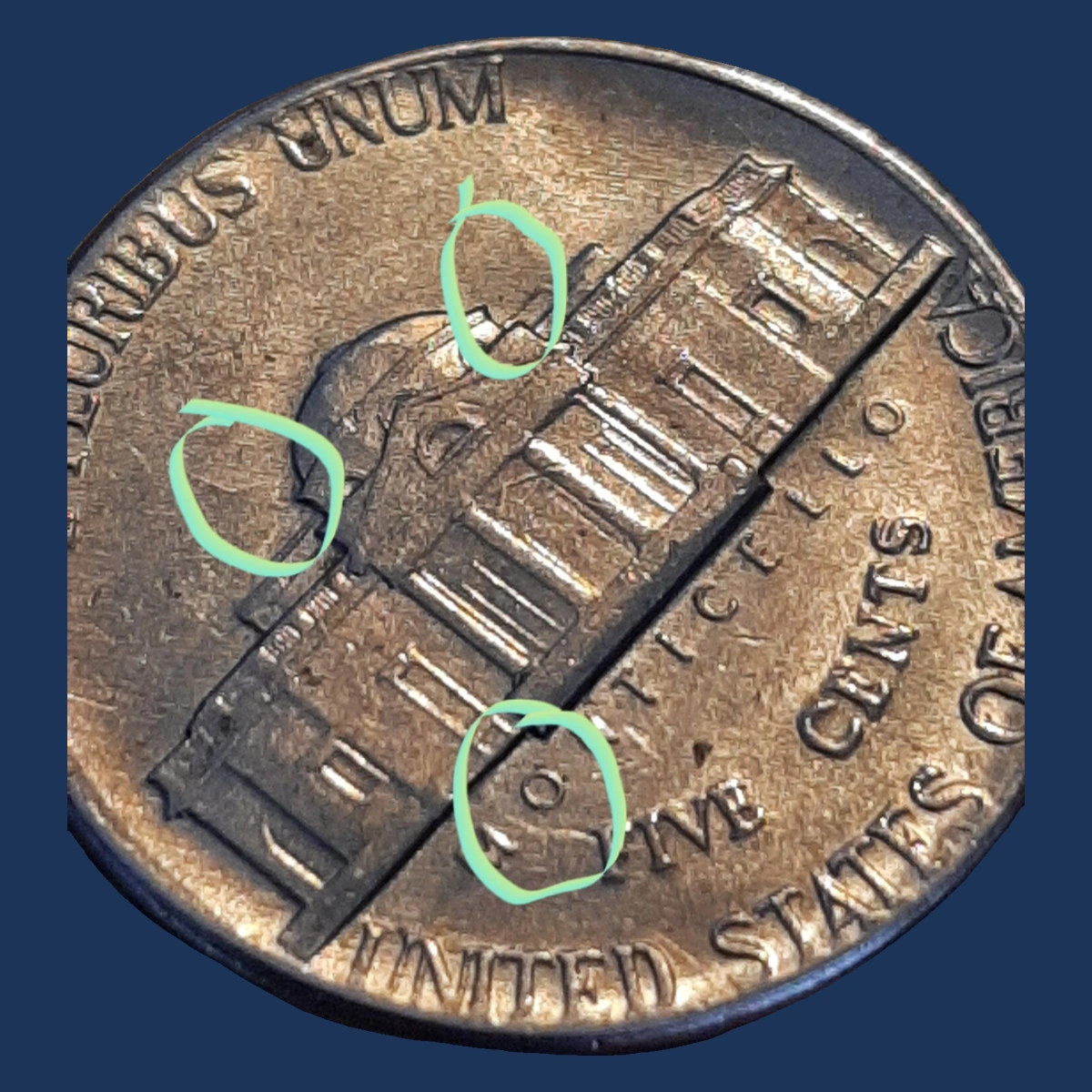
A curve that does not belong beside Jefferson might be part of Monticello. When the two stamping tools meet without a blank between them, they can leave marks on each other.
Later coins can carry those marks as fragments of the opposite design. Published 1973 lists report clashes without establishing one particular mint or a fixed location for every example.
Finding a recognizable shape is more useful than finding any extra line. Polishing marks and scratches can cross the same smooth areas without following the opposite side’s portrait or building.
Estimated Value
For a clear, recognizable clash on a 1973 nickel, estimate $10–$100. Strong fragments that can be matched in ordinary photographs should bring more interest than faint lines needing extreme lighting.
The estimate does not claim a sale of a newly identified 1973 specimen. Wear may remove the small transferred details, while later scratches can make the remaining pattern harder to follow.
A convincing connection to the opposite design is the feature being valued.
How to Identify
Choose a distinctive part of Monticello or Jefferson from photographs of a normal 1973 nickel. Look for that shape where it would not ordinarily appear on the other face.
Use a 10× magnifier to compare curves, angles, and their spacing. A second related fragment is better evidence than one isolated straight line.
The normal coin is 5.00 grams and 21.21 millimeters, which a scale and calipers can check if it is loose. Keep any marks from later squeezing or impact separate from the suspected clash.
Turn the reference image to follow the extra shapes as a group. The fragments should explain part of the opposite design rather than merely share its general direction.
3. 1973 Jefferson Nickel Doubled Dies
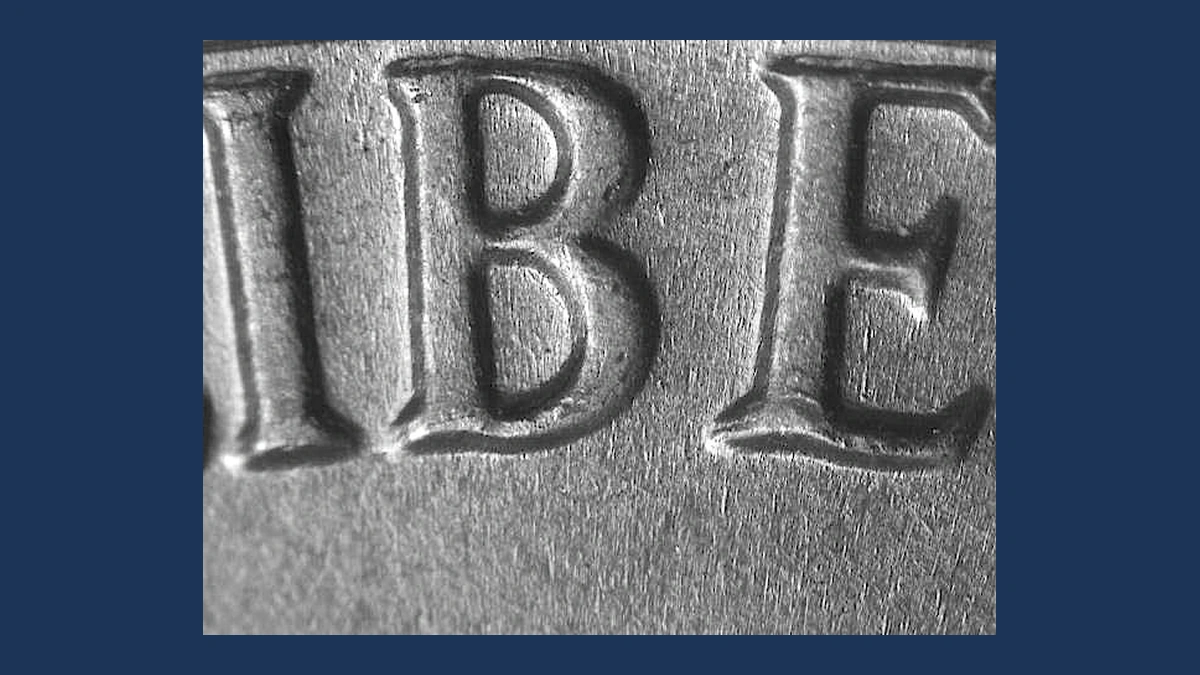
The star beside LIBERTY and the nearby date can show extra raised outlines on Denver nickels. Two patterns are recorded in the 1973 variety listings.
The first includes LIBERTY, the star, date, and IN. The second also includes extra thickness at the designer’s FS initials and more closely spaced doubling near IN GOD.
The design was doubled on the die before it struck the coin. Each pattern needs its own comparison; matching a few thick letters does not mean that the coin received a second blow in the press.
Estimated Value
A confirmed 1973-D doubled die can be estimated at $15–$150. Clearly separated details on an unworn coin should be more appealing than thick lettering partly flattened by circulation.
The two listed patterns provide comparisons for identification rather than completed sales supporting one fixed price. Flat mechanical shelves beside letters are a different effect and should not be priced as the same variety.
Look for a match that remains clear in a well-lit photograph.
How to Identify
Keep the date, star, and LIBERTY in one enlarged photograph. Seeing their relationship helps distinguish a repeated pattern from a single damaged numeral.
With a 10× magnifier, compare those details with each Denver listing separately. The second pattern also calls for checking the small FS initials near Jefferson’s portrait.
Useful marks on the back can help confirm a match, but doubling on the front should come first. Do not select a variety from one ordinary polishing line.
A loose nickel should remain near 5.00 grams and 21.21 millimeters on a scale and calipers.
Concentrate on matching rounded extra strokes or split corners, instead of a flat shelf that reduces the normal letter’s width.
4. 1973 Jefferson Nickel Low D Mint Mark
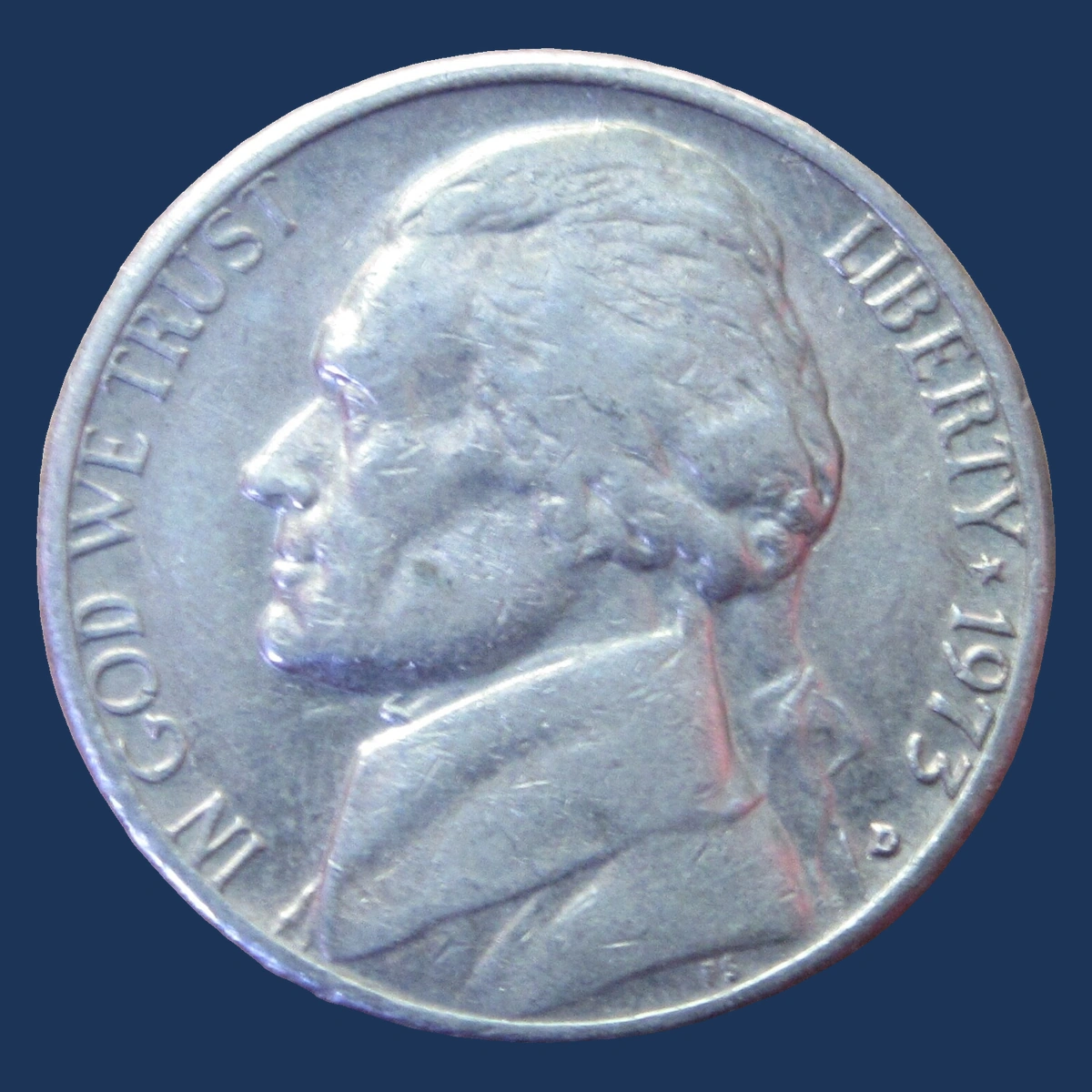
The D beneath the date can sit unusually low, closer to the coin’s border. This is a placement problem rather than two overlapping mint letters.
An example from the Fred Weinberg Collection was cataloged as a low misplaced mint mark and graded NGC AU55. That grade indicates some circulation wear, so the comparison should allow for softened details.
Mint letters were added to working dies by hand during this period. A normal 1973 Philadelphia nickel has no letter, while a Denver example needs comparison with other D coins from the same year.
Estimated Value
The NGC AU55 low-D example sold for $216 in May 2022. For a similarly clear, confirmed low placement, estimate $75–$350.
Small placement differences are not all equally striking, and the distance from the rim should be compared with the documented coin. The sale covers that entire nickel with its wear and surfaces, rather than establishing a separate price for any D that appears slightly lower in a photograph.
How to Identify
Align a normal 1973-D photograph with the suspect coin, keeping the date and rim at the same scale. A tilted camera or cropped image can make the mint letter seem closer to the border.
Inspect the D and nearby surface with a 10× magnifier. Its position should be natural to the struck design, without a seam or disturbed metal suggesting an added letter.
A digital scale and calipers can check a loose nickel against 5.00 grams and 21.21 millimeters. Compare the gap below the D with the gap on the documented low-mark coin; that distance matters more than a general impression that the letter looks unusual.
5. 1973 Jefferson Nickel Off-Center and Chain Strikes
An off-center nickel keeps blank metal where part of the design missed it. Denver examples include coins struck about 55% and 60% off center with signs of contact against a neighboring blank.
That side-by-side contact during striking is called a chain strike. It can shape the meeting edge while both pieces are under pressure.
A separate Denver coin was struck about 80% off center toward 9 o’clock and later suffered damage. The 60% chain-struck coin also has counting-wheel damage, which is separate from the original striking mistake.
Estimated Value
The 55% chain strike graded PCGS MS62 sold for $1,020 in May 2021. The 60% example with counting-wheel damage brought $384 in August 2021.
Estimate $75–$1,500 across the off-center and chain-struck examples, depending on the contact feature, remaining date, and condition. These two results show how strongly preservation can affect otherwise dramatic errors.
The later damage does not erase the Mint error, but it remains part of the whole coin’s value.
How to Identify
Compare ordinary unstruck metal with any area shaped by contact at the edge. A chain strike needs evidence of the neighboring blank, not simply an off-center design.
Trace that contact area with a 10× magnifier and photographs of the matching example. Do not borrow its location from a different coin with a different percentage.
A digital scale should remain near 5.00 grams unless metal was subsequently lost. Use calipers to document the distorted outline against a normal diameter of 21.21 millimeters.
For the 80% example, keep the 9 o’clock shift separate from later damage. Check both faces: their surviving design should fit one displaced blank, while the edge contact must have its own natural striking shape.
6. 1973 Jefferson Nickel Crescent Clip with an Off-Center Strike
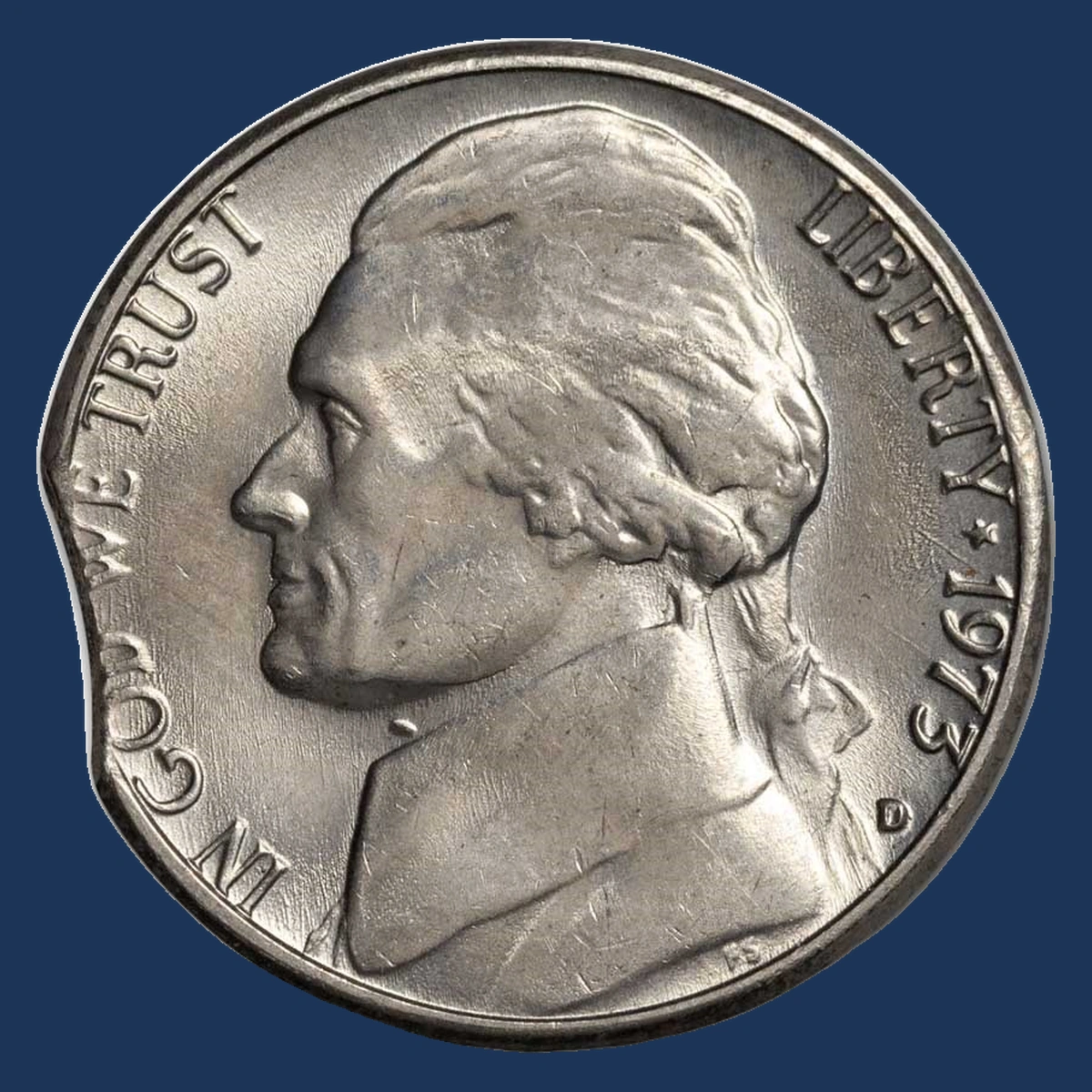
Only a small curved piece remains of this nickel’s blank. The 1973-D example was described as an 80% crescent clip and weighs just 1.1 grams.
That is missing metal, not a large unstruck area. The incomplete blank also received an off-center blow, adding a second feature to the same object.
NGC graded the coin MS66, indicating no circulation wear and relatively few marks. A large clip can leave very little room for the design, so the surviving date and Denver identity are especially important when comparing the piece.
Estimated Value
This 1.1-gram clipped nickel sold for $1,200 in January 2022. An estimated $600–$1,750 suits a comparable dramatic clip with a readable identity and preserved surfaces.
The off-center strike and huge missing crescent belong to one coin and one sale. A normal-weight nickel with a broad blank area is a different error, while a cut-down coin cannot inherit this value merely by being very small.
How to Identify
Weigh a loose example before judging its small shape. The recorded 1.1 grams contrasts sharply with a normal nickel’s 5.00 grams because most of this blank was absent.
Use a 10× magnifier to inspect the curved boundary for a natural clipped surface. Saw marks, filing grooves, or a sharply sheared finished rim point toward later removal.
With calipers, record only the surviving shape rather than forcing it into the usual 21.21-millimeter diameter.
Locate the remaining date and mint identity in the struck area. Compare where the design meets the missing crescent.
The clipped edge should explain an incomplete blank that was later struck, not a finished nickel that someone cut into an arc.
7. 1973 Jefferson Nickel Wrong Planchets
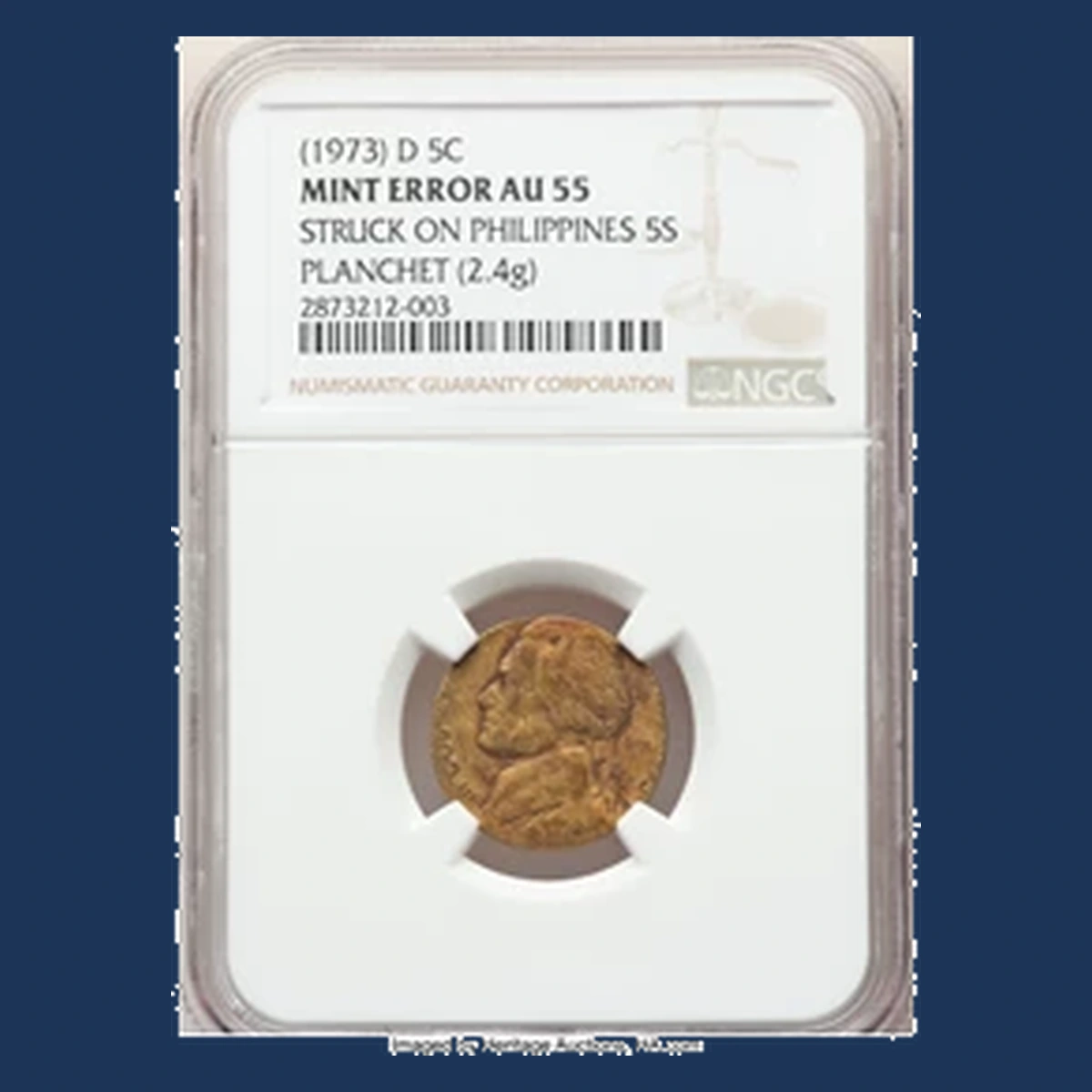
The design belongs to a nickel, but the metal can belong to another coin. Ordinary examples include a Philadelphia nickel on a clad dime blank and Denver nickels on copper cent or Philippine five-sentimo blanks.
The recorded cent blanks weigh around 3.1 grams, while one Philippine example weighs 2.5 grams. San Francisco Proofs, specially made collector coins, include different foreign blanks.
One Proof used a Liberian five-cent blank weighing 4.15 grams. Another used a Philippine twenty-five-sentimo blank, which should not be confused with the smaller-denomination blank recorded for Denver.
Estimated Value
Estimate $250–$1,500 for ordinary wrong-blank examples and $1,000–$2,000 for the foreign-blank Proofs. A Denver cent-blank coin brought $360 in September 2024.
A Denver Philippine five-sentimo example sold for $1,320 in July 2021. The Liberian-blank Proof brought $1,207.50 in January 2011.
Each result belongs to its own blank and condition. The lower weight does not automatically make one foreign-metal example more valuable than another.
How to Identify
Begin with the grading record when a foreign blank is claimed. Weight alone cannot distinguish every country or denomination.
A digital scale compares a loose coin with a normal nickel’s 5.00 grams. Recorded examples include 3.1-gram cent blanks, a 2.5-gram Philippine blank, and the 4.15-gram Liberian blank.
Calipers can compare U.S. blanks with the normal 21.21-millimeter nickel, 19.05-millimeter cent, or 17.91-millimeter dime. Foreign types require their own specifications.
Use a 10× magnifier to inspect naturally cropped lettering and the edge. A clad dime blank has different metal layers, while color alone does not prove a cent blank.
Match the coin’s metal and surviving design to the stated blank, keeping ordinary strikes and Proofs separate.
8. 1973 Jefferson Nickel Double Strikes and a Two-Year Overstrike
Two blows can leave the portrait or lettering in different positions. Denver examples include a second strike about 55% off center and another about 75% off center.
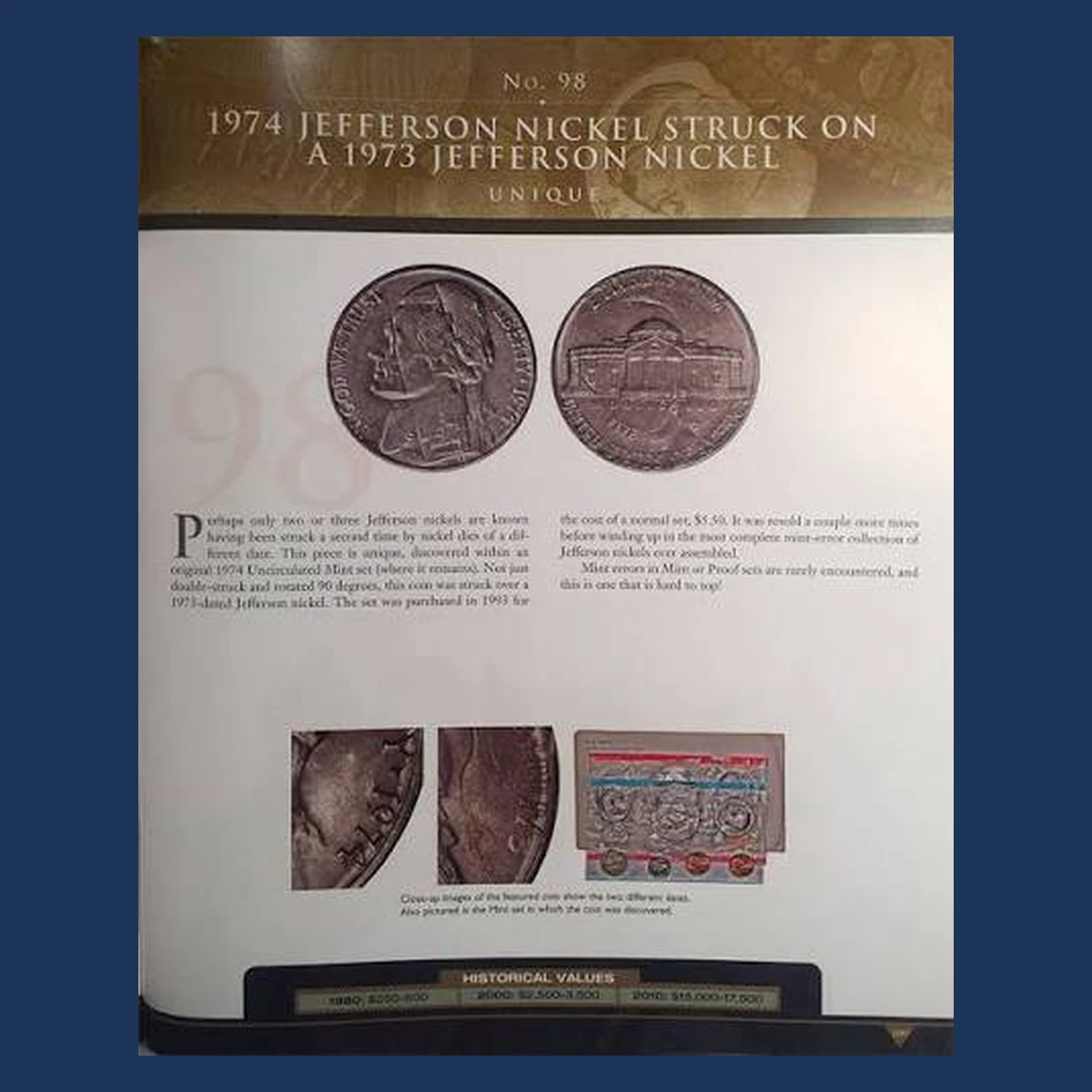
A more unusual nickel was struck in 1973, flipped over, and struck again with 1974 dies while held inside the edge ring. It remained in a 1974 mint set.
Part of the earlier date survives as a faint 3 beside the M of UNUM on the reverse. The later visible design is dated 1974, so this coin connects both years rather than showing two ordinary 1973 strikes.
Estimated Value
The 75% double strike sold for $587.50 in July 2016; estimate $150–$900 for comparable same-year double strikes. The 55% example’s $1,092.50 August 2010 sale included four other coins.
The mint set containing the 1974-over-1973 nickel brought $1,897.50 in August 1997. A working estimate of $1,500–$3,500 applies to that unusual two-year error, using the set result as a comparison rather than an isolated coin sale.
How to Identify
For the two-year coin, first locate the 1974 date, then turn to the reverse and inspect just right of the M in UNUM. A 10× magnifier helps reveal the faint earlier 3.
That fragment must fit the documented flip-over design, not an unrelated scratch. Keep the mint-set context with the coin rather than treating it as an ordinary 1973-D double strike.
For the Denver examples, trace two separate positions of the portrait or lettering through the overlap. A scale and calipers can document a loose nickel against the original 5.00 grams and 21.21 millimeters; the crossing impressions should explain the second blow’s position.
Conclusion
Estimated values run from $5–$3,500 across these 1973 nickel errors. A small raised crack, a foreign blank, and a two-year overstrike need very different comparisons.
Check whether metal is missing, merely unstruck, or carrying a second design. Keep damage separate from the original error, and remember that prices for a mint set or group are not individual coin sales.
Clear photographs, careful measurements, and preserved surfaces make the next identification step easier.