1968 Nickel Error List with Pictures

An S can identify either an ordinary 1968 nickel or a specially prepared Proof for collectors. That distinction matters: one S nickel struck over an already finished S penny brought $3,737.50 in August 2010.
These 1968 nickel errors range from small missing pieces to coins carrying designs from two denominations. Estimated values across the types below span $20–$7,000.
Read on to compare the metal, mint letters, and overlapping features without mistaking a shiny surface for a Proof.
1. 1968 Jefferson Nickel Clipped Blank
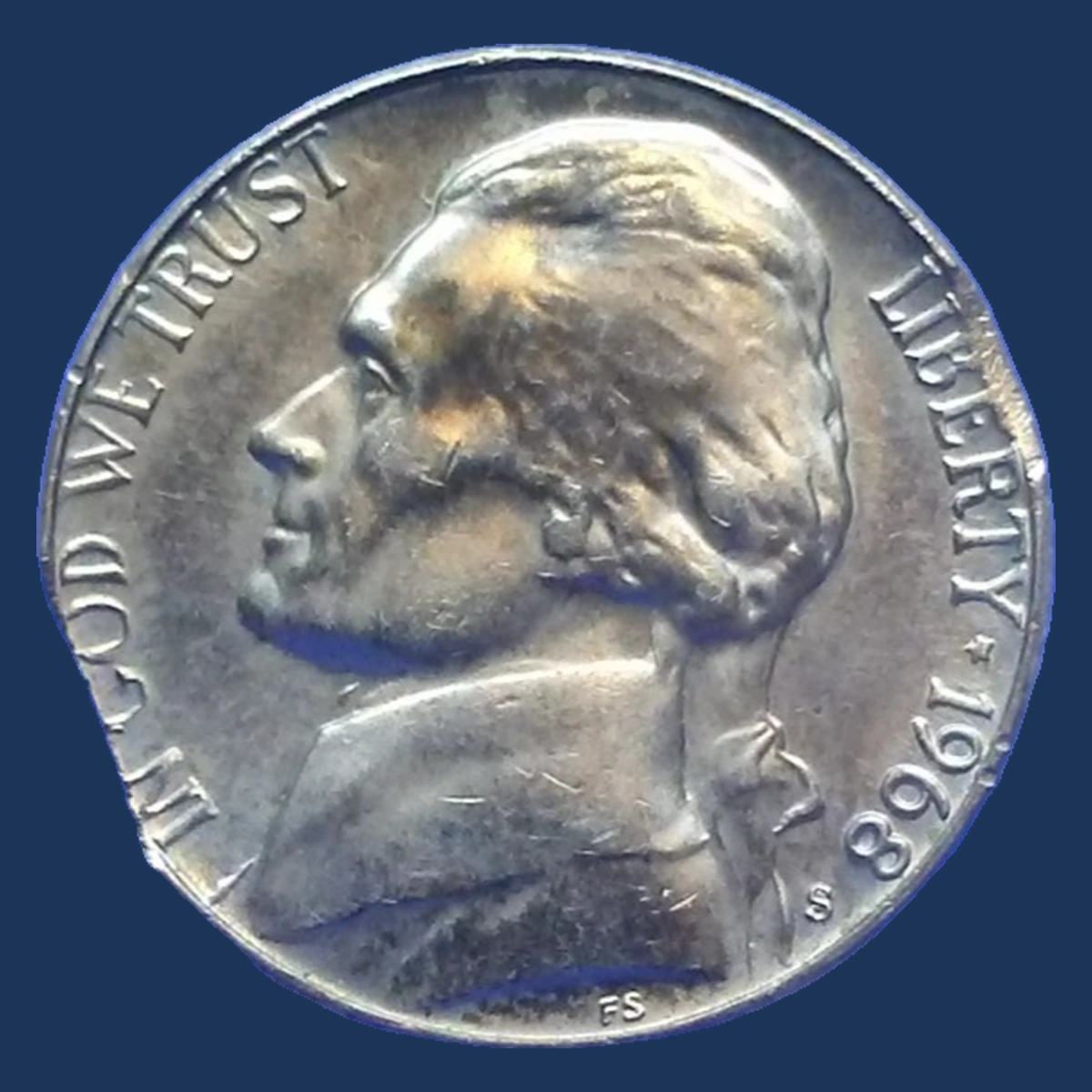
A small gap can interrupt the otherwise round edge of a 1968 nickel. If the blank was punched from an incomplete area of metal strip, that gap existed before the design was struck.
One Denver example has an approximately 5% curved clip and was offered inside a Mint Set. A separate ordinary S example is described with a roughly 5% clip near ten o’clock.
The S does not make that second coin a Proof. San Francisco also produced ordinary nickels in 1968.
These missing sections must be distinguished from later cuts through a finished coin.
Estimated Value
For genuine small 1968 clips, estimate $20–$200, depending on condition and how clearly the original gap is preserved. A readable date and mint letter help identify the comparison.
The Denver example appeared in a five-coin Mint Set lot that sold for $126.50 in August 2010. That was the complete group price.
A different-year 1997-P nickel with a larger 20% clip sold for $124 in March 2025, providing a recent comparison without turning either result into a fixed price.
How to Identify
Read the mint letter and photograph the entire gap before deciding its shape. The ten-o’clock location belongs to the ordinary S example, not automatically to the Denver coin.
At each end of the missing section, use a 10× magnifier to look for natural metal flow and possible weakness in the opposite rim. Fresh saw marks or cuts through finished letters point toward later removal.
For a loose coin, use a scale and calipers against a normal 5 grams and 21.21 millimeters. A clip should reduce metal, while the intact part of the plain edge should retain its original surface.
Keep a packaged Mint Set intact. Existing edge photographs can be more useful than disturbing the coin to force a measurement.
2. 1968 Jefferson Nickel Stepped Die Crack Below the Portrait
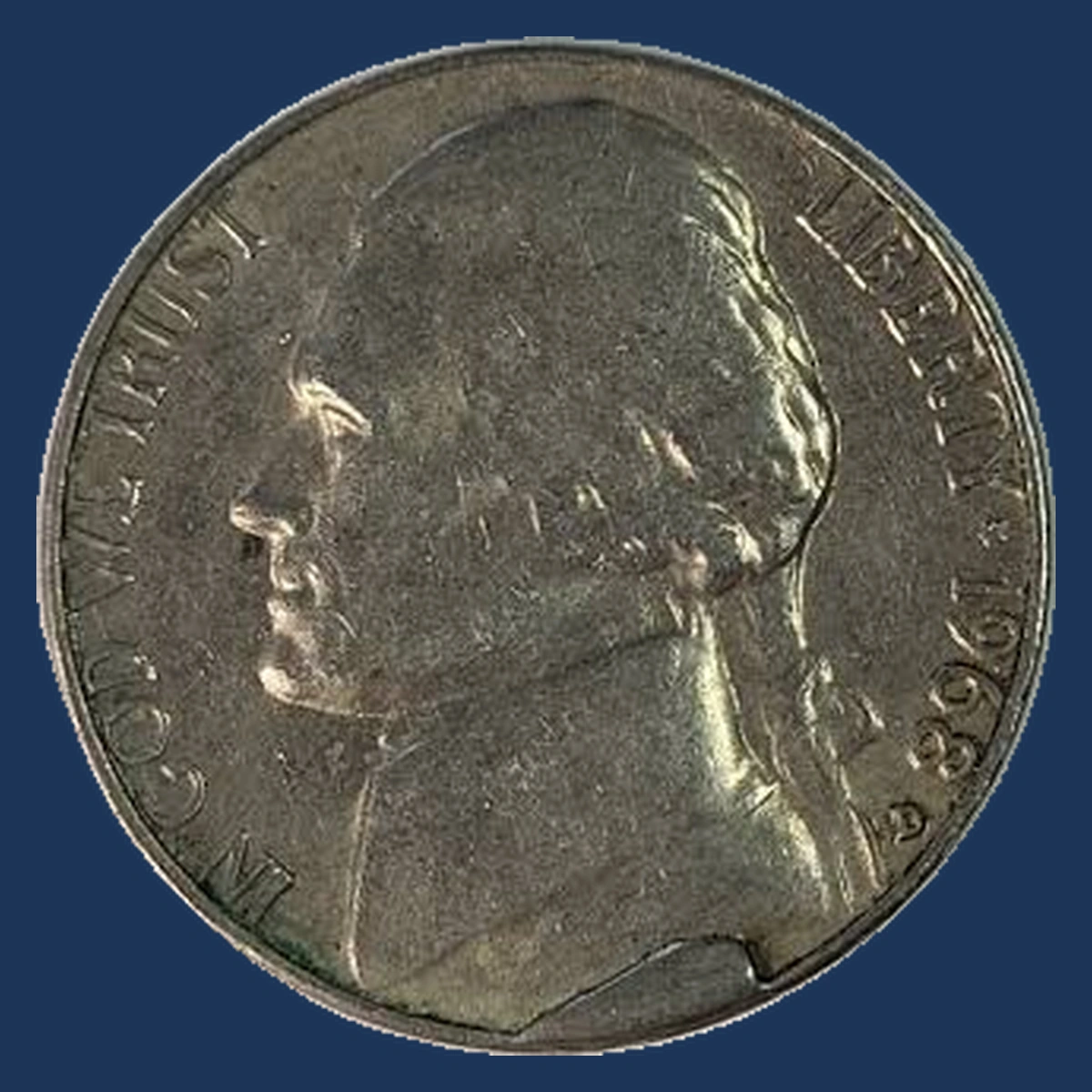
The bottom of Jefferson’s portrait can appear to step upward onto a small platform. A photographed Denver example shows this change in level around the lower portrait border and the FS designer initials.
The fault comes from a damaged die, the steel tool that stamps the design. Its raised step has sometimes been called a retained cud, meaning a broken tool fragment stayed in place.
Error specialist Mike Diamond offered another explanation: metal beneath a crack in the tool deformed. The visible step is documented, while a fully separated fragment is not established.
Estimated Value
For a clear example of this stepped-tool pattern, use an estimated $50–$500. The range concerns the visible raised area and original surfaces, without requiring a claim that a broken fragment stayed trapped.
As a related comparison, a 1972-D nickel with a large die break sold for $94 in July 2021. It has a different date and break shape.
A dent, soldered patch, or ordinary damaged rim does not qualify merely because part of the surface stands higher.
How to Identify
A straight-on picture can hide the height difference. Tilt the view and use low side lighting to compare Jefferson’s main portrait with the small platform carrying its lower border and FS initials.
Through a 10× magnifier, follow the boundary without touching the raised metal. Look for a consistent struck surface rather than a seam around an added piece.
If the coin is loose, compare weight and diameter with 5 grams and 21.21 millimeters using a scale and calipers. Inspect the plain edge for an impact that might have displaced finished metal upward.
The published study documents the step from an angled view. Match that visible feature without treating its height alone as proof of a detached tool fragment.
3. 1968 Jefferson Nickel Doubled Dies
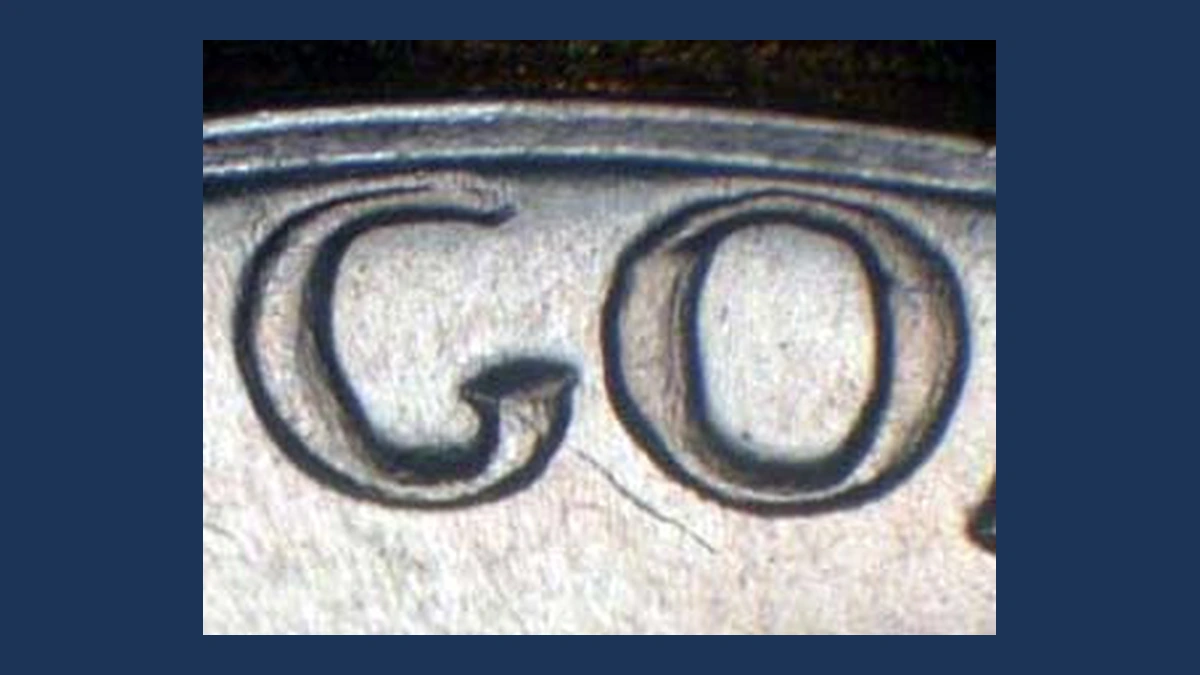
Several 1968 tools carried doubled details before they struck a coin. Denver examples can show extra outlines in LIBERTY, the date, motto, star, or designer initials.
S Proofs offer many front and back patterns. Back doubling affects the motto, country name, building, or denomination, with some examples showing three outlines.
Some coins combine doubled designs on both faces. Another combines back doubling with an extra S mint-letter impression.
Ordinary S front doubling is also reported, but it needs an ordinary-coin comparison. The many Proof photographs cannot establish that separate report simply because the mint letter matches.
Estimated Value
Estimate $20–$200 for minor matched examples and $200–$1,200 for stronger doubling on attractive coins. The range covers different Denver and S types, rather than assigning one premium to every extra outline.
These are editorial estimates for the reported patterns, not one shared auction record. Proof preservation, the strength of separation, and a correct variety match all affect the comparison.
A coin doubled on both faces is priced as one object, not by adding two complete coin values.
How to Identify
Sort by mint and finish before using the close-up photographs. D ordinary, S ordinary, and S Proof coins require the correct comparisons; an S alone does not mean Proof.
Use a 10× magnifier to study LIBERTY and the small FS initials on the front. FS here names designer Felix Schlag, not sharp building steps or a variety number.
Turn to the back and compare the motto, country name, and building as a connected pattern.
On a loose coin, check the plain edge and use a scale and calipers against 5 grams and 21.21 millimeters. A flat shelf cutting into lettering suggests movement during striking rather than a doubled tool.
If both faces are doubled, match each independently; one front tool could be paired with different backs.
4. 1968 Jefferson Nickel Repunched Mint Marks
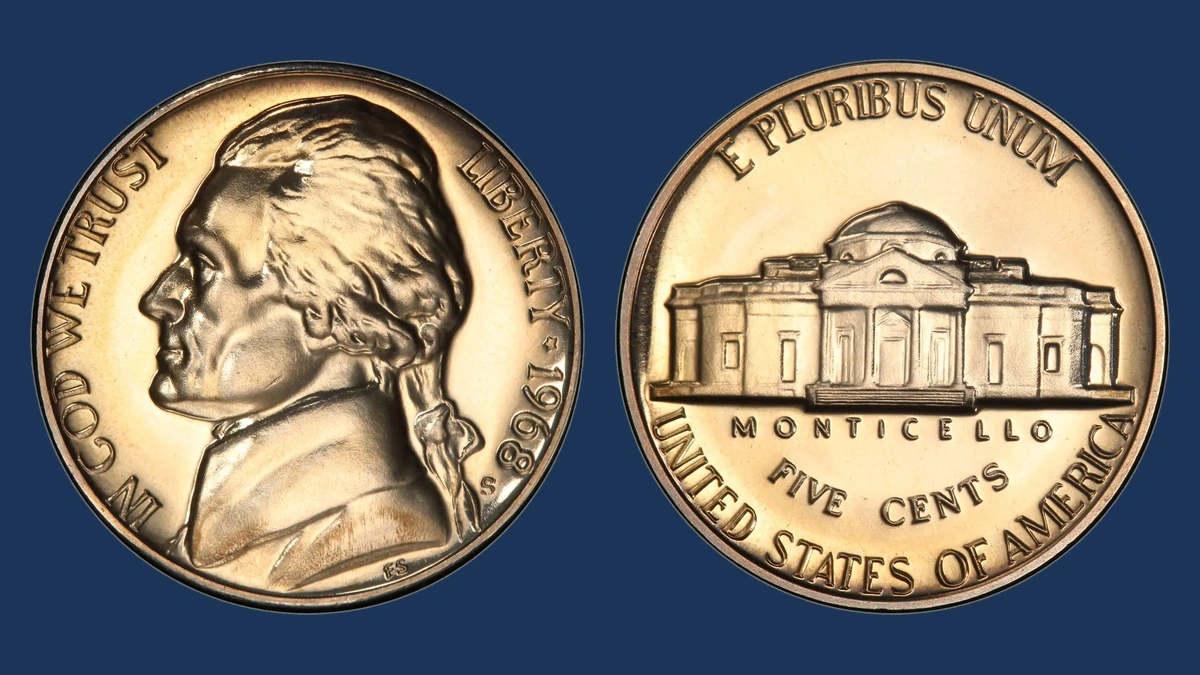
An extra curve beside the D or S can survive from an earlier hand-punched mint letter. Repeating the punch in a shifted or tilted position left traces in the tool.
Denver examples include extra D impressions toward the top or left, with one showing several impressions. S Proofs include earlier S outlines toward the right or left.
The well-known S Proof variety is called FS-501. Those letters and numbers are a catalog name, not an extra mark stamped on the coin.
Similar directions do not make every repunched S the same variety.
Estimated Value
Minor Denver repunched marks are estimated at $20–$200; S Proof examples can range from about $75–$2,500. The higher range requires a strong, correctly matched variety and attractive collector surfaces.
PCGS records a $1,705 GreatCollections sale in April 2014 for an FS-501 graded PR67. That is a very well-preserved Proof, rather than an ordinary worn S nickel.
Other cataloged S patterns need their own comparison and should not inherit that result solely because the earlier impression points right.
How to Identify
Find the mint letter below the date and trace its entire outline under a 10× magnifier. A repunched mark preserves a curved part of an earlier D or S, rather than merely a bright nick beside it.
Compare direction and shape together. Denver’s north-shifted or tilted impressions differ from its west-shifted example, just as the S Proof patterns need individual matches.
For a loose coin, use a scale and calipers against 5 grams and 21.21 millimeters, then check the plain edge for alterations. Protect Proof surfaces from fingerprints while photographing the tiny letter.
A match to FS-501 must come from that variety’s actual images. Do not convert another catalog’s similarly directed S into FS-501 without matching the complete shape.
5. 1968 Jefferson Nickel Repeated Strikes
The Denver triple strike carries three overlapping designs, all off center. Its first blow was about 35% off center, followed by roughly 80% and 75% displacement.
Another blank entered before the third blow, leaving a large hollow across the front. That indentation belongs to the same coin.
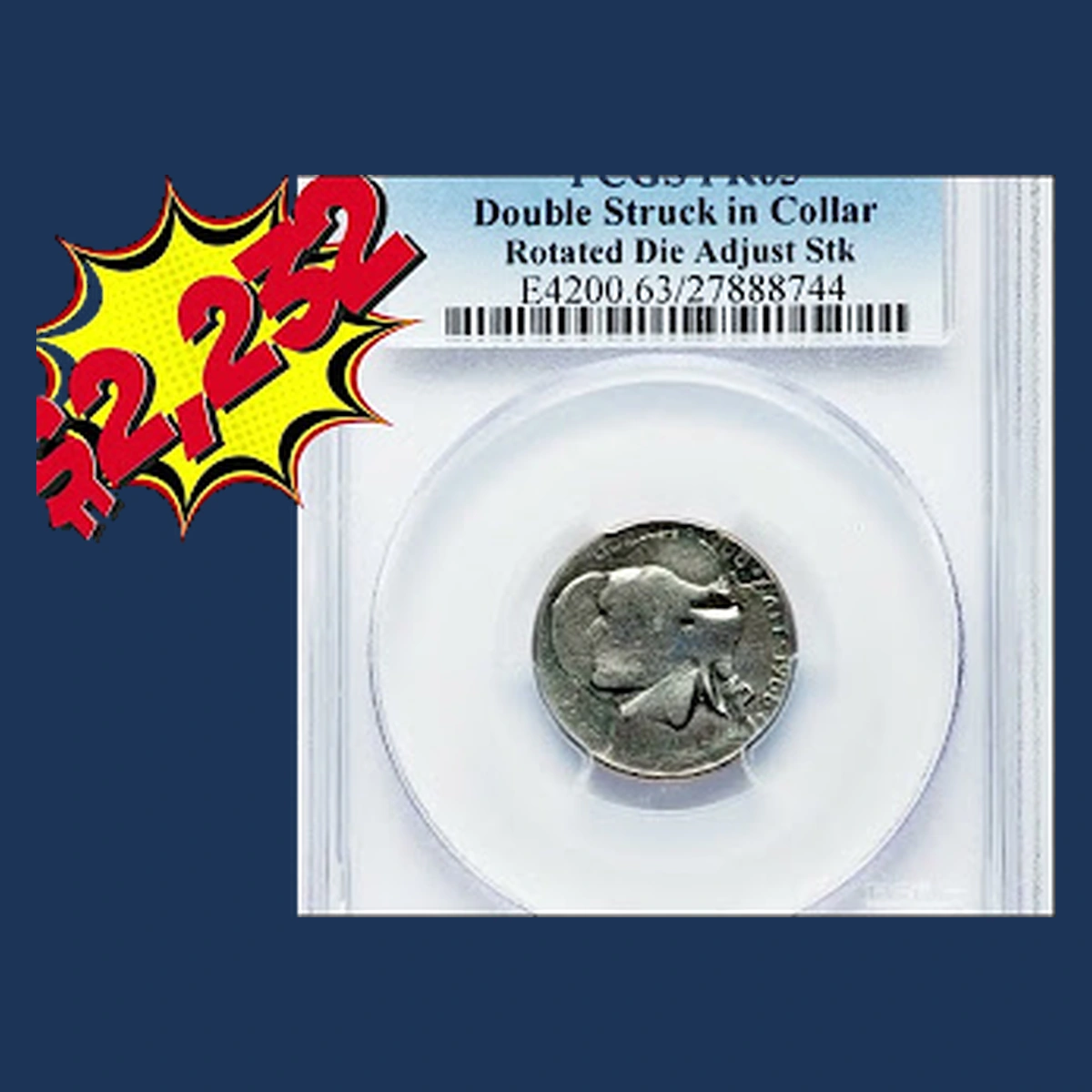
S Proof examples include two expanded strikes and a separate weak double strike rotated about 90 degrees. The latter remained within the edge collar and was described as a press-adjustment piece.
Another cataloged Proof shows repeated design without those specific extra descriptions. Each arrangement needs its own photographs.
Estimated Value
Estimate $500–$1,500 for dramatic ordinary repeated strikes and $1,000–$4,000 for comparable S Proof examples. The Denver triple strike sold for $1,150 in May 2008.
The Proof with two expanded strikes brought $1,840 in September 2010. The separate rotated, weak double strike sold for $2,232.50 in August 2017.
These are whole-coin prices. Adding separate charges for an indentation, expansion, and each blow would count the same combined event more than once.
How to Identify
The original date on the Denver triple strike survives near TRUST from the second impression, with the D still visible. Use a 10× magnifier to trace that first design before following the two later impressions and the third strike’s large hollow.
For a loose piece, a scale and calipers record weight against 5 grams and outline against 21.21 millimeters, while the plain edge reveals later impacts. The hollow came from another blank entering the strike, not from someone scraping away a portrait.
The Proofs require different comparisons: two impressions within a spread outline, or a weak design turned about a quarter-circle inside the collar. Weakness alone cannot prove a press adjustment without the correct overlapping pattern and original Proof surfaces.
6. 1968 Jefferson Nickel Struck on a Copper Cent Blank
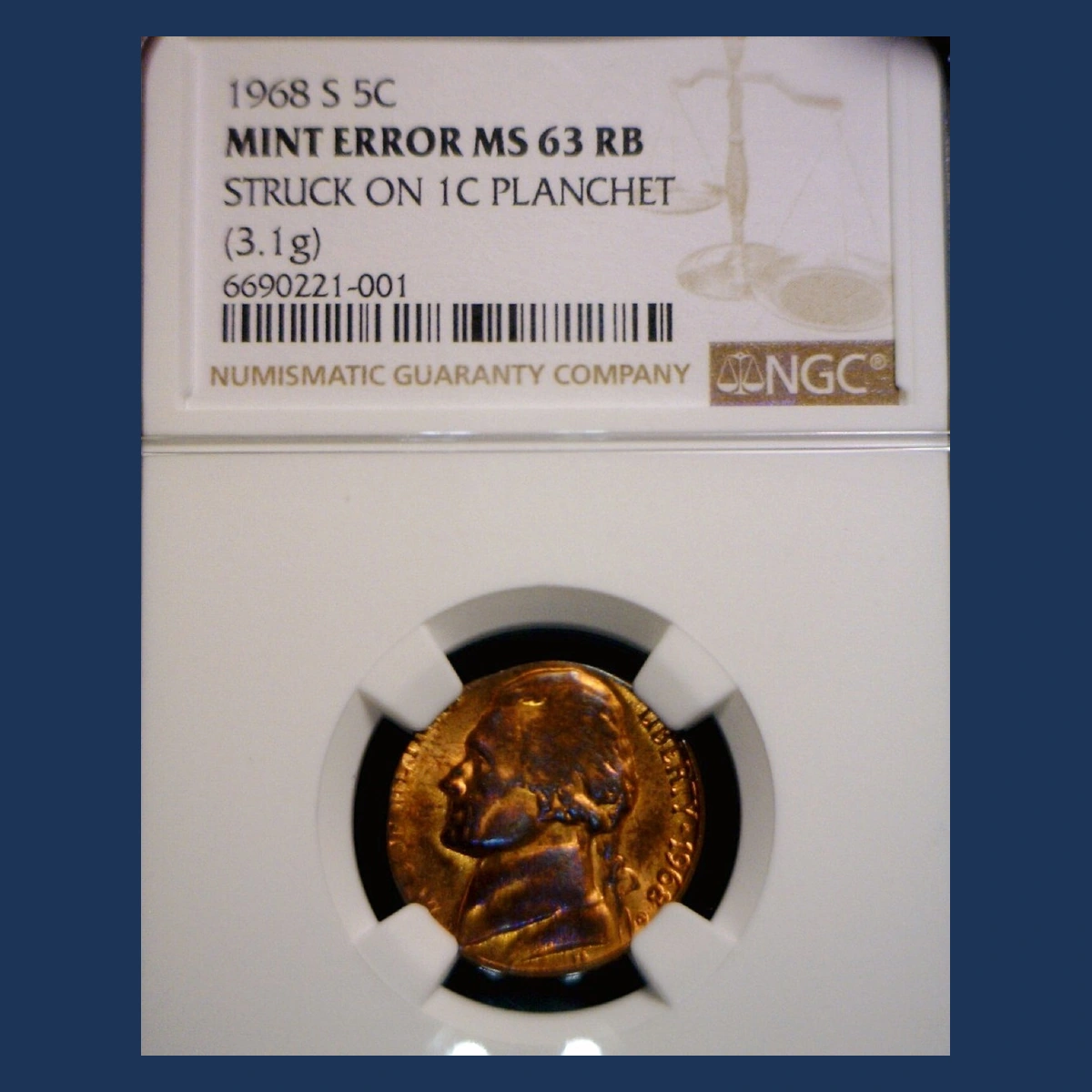
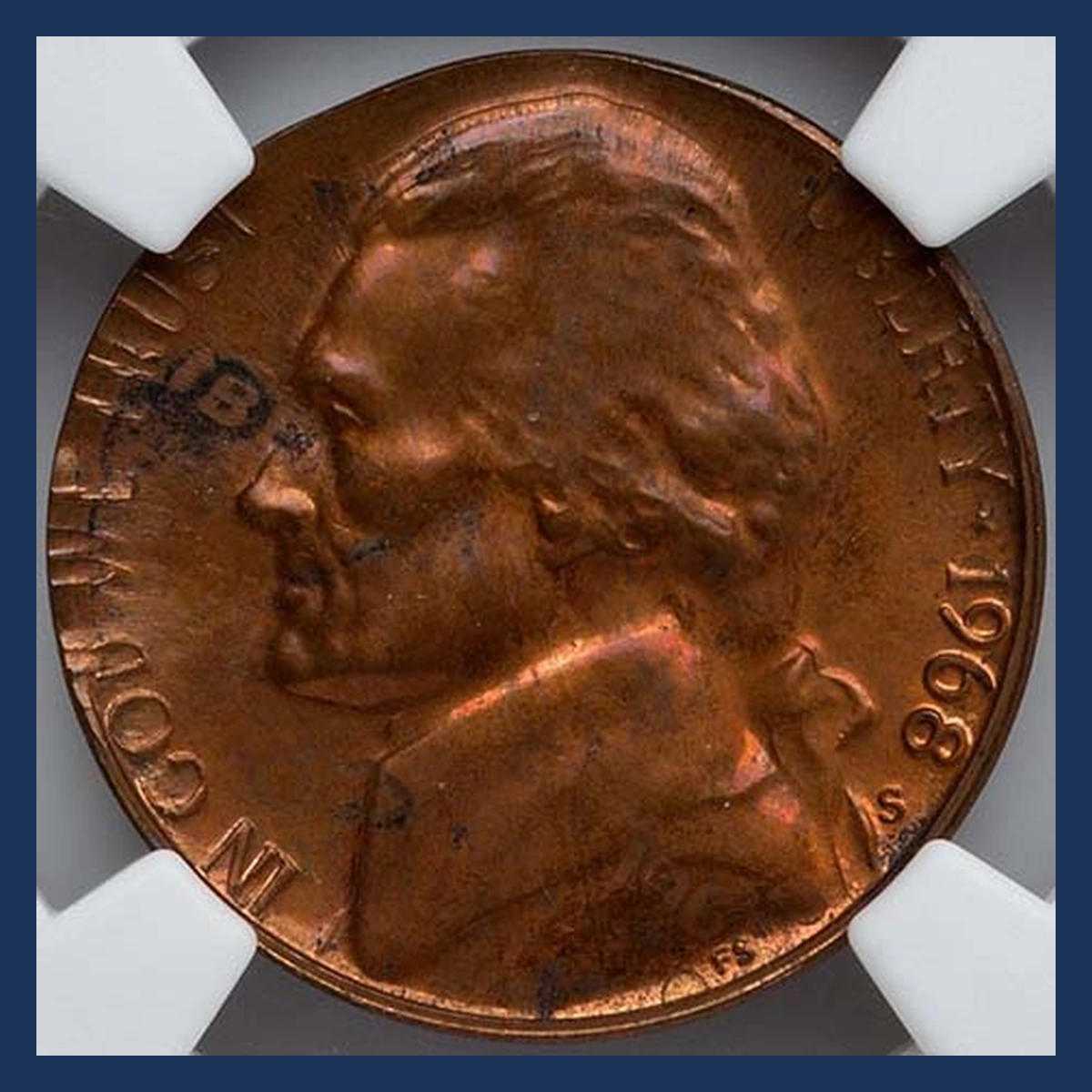
Copper-colored Jefferson designs can appear on disks intended to become pennies. Those cent blanks are too small to receive the complete nickel design.
An ordinary S example has a strong mint letter and final date digits, with distorted outer lettering from metal flowing toward the edge. A Denver example is also documented.
A separate S Proof was struck on a copper cent blank. Its collector finish must be distinguished from the ordinary S coins.
Because these disks were unused blanks, they do not require an earlier Lincoln portrait or penny date beneath the nickel design.
Estimated Value
Ordinary examples are estimated at $200–$1,000, while S Proof pieces are estimated at $2,000–$5,000. An ordinary S nickel graded MS65 sold for $480 in September 2024.
The S Proof graded PR66 Red brought $2,640 in May 2022. That result concerns a well-preserved collector coin, not the ordinary S piece with similar copper color.
A Denver example with slight wear sold for $218.50 in August 2009, providing another separate comparison within the ordinary-strike range.
How to Identify
A normal-sized copper-colored nickel may simply have a coating. Inspect the plain edge under a 10× magnifier before treating its color as evidence of the wrong blank.
For a loose coin, use a scale and calipers to compare with a period cent’s 3.11 grams and 19.05 millimeters. A normal nickel is 5 grams and 21.21 millimeters.
These are standard comparisons, not measured weights for every cataloged error.
Follow the outer lettering into the small disk’s boundary, checking for filing that removed finished design. An original cent-blank strike should not depend on a recently ground edge.
Finally distinguish ordinary S from S Proof surfaces. Polishing can add shine, but it does not reproduce preserved Proof preparation or justify the Proof price range.
7. 1968 Jefferson Nickel Reported Brockage Involving a Costa Rican Coin
A foreign coin can enter a striking sequence after it already carries its own design. Ken Potter reported a 1968-S Jefferson nickel brockaged over a Costa Rican five-centimos coin.
A brockage is a sunken, reversed design transferred by contact with another struck coin. This report therefore describes more than a nickel design landing on an unused foreign blank.
The short account does not give the Costa Rican date, exact face arrangement, or nickel finish. Those details should follow the original object, rather than borrowing them from a different foreign-blank error.
Estimated Value
For an authenticated coin matching this reported combination, use an estimated $1,500–$6,000. Ken Potter’s auction report published by PCGS records $2,070 for the 1968-S error involving a Costa Rican five-centimos coin.
That historical figure prices the combined object, including its unusual foreign-coin connection. Preservation and the amount of readable design would affect a modern comparison.
The estimate does not apply automatically to a nickel on any blank from Costa Rica or to an ordinary depressed mark.
How to Identify
A surviving foreign design is central to this claim. Photograph both complete faces and identify whatever Costa Rican lettering or design remains before trying to reconstruct the nickel impression.
Use a 10× magnifier to distinguish a reversed, sunken transfer from an ordinary raised overstrike. The report alone does not establish which face must carry each surviving feature.
For a loose object, record weight, thickness, and width with a scale and calipers. A normal nickel is 5 grams, 21.21 millimeters, and plain-edged, but a finished foreign host requires comparison with its own issue too.
Inspect the edge for later squeezing or joining. Keep the foreign date and exact nickel finish unassigned until the coin itself supports them, rather than turning the report into a more specific claim.
8. 1968 Jefferson Nickel Struck Over a Finished Lincoln Cent
Two dates and two versions of LIBERTY can reveal a penny beneath a nickel design. A documented 1968-S nickel was struck over an already finished 1968 Lincoln cent.
On one example, the nickel impression turns more than 90 degrees clockwise relative to the cent design. Lincoln Memorial outlines remain visible on the back.
A separate highly preserved specimen is specifically recorded over a 1968-S cent. Its two mint identities belong to that coin.
This is called a double-denomination error. Unlike an unused cent blank, the host had already received its own coin design before entering the nickel press.
Estimated Value
Estimated values span $800–$7,000 for authenticated examples, with preservation and surviving cent details making a substantial difference. The PCGS MS63 Red specimen sold for $1,265 in July 2002.
An NGC MS67 Red example over a 1968-S cent brought $3,737.50 in August 2010. An MS67 Red example described with that same host type later sold for $3,600 in July 2022.
These are whole-coin results, not separate values for a nickel and penny that should be added together.
How to Identify
Follow the earlier penny design before estimating how far the later strike turned. On the MS63 example, two dates and repeated LIBERTY accompany Lincoln Memorial traces beneath the nickel design.
Use a 10× magnifier to distinguish those older letters from scratches. More than a quarter-turn separates the two designs on that specimen, but another coin’s angle must be measured from its own features.
A loose period copper-cent host starts around 3.11 grams and 19.05 millimeters, versus the nickel’s 5 grams and 21.21 millimeters. Use a scale and calipers, then inspect the plain edge for later squeezing or assembly.
The earlier auction description identifies a 1968-dated cent underneath. Do not give every host an S merely because the later nickel carries that letter.
Conclusion
The estimated range for these 1968 nickel errors is $20–$7,000, from small clips to striking mistakes that preserve a second coin’s design. Ordinary S coins and S Proofs need separate price comparisons.
A copper disk without Lincoln details is different from an already struck penny used again. Likewise, doubled letters in a tool differ from overlapping designs caused by repeated blows.
Match those visible differences before applying a grade or an auction result to your own coin.