1913 Liberty Head Nickel Error List with Pictures

One of the five known 1913 Liberty Head nickels brought $4.56 million at auction in 2018. Its rarity explains the huge price; a weakly struck area is not a separate million-dollar bonus.
This 1913 Liberty Head nickel error guide examines reported differences in the back design. Estimated whole-coin values of $3 million–$6 million apply to authenticated examples of the famous rarity, with condition and ownership history affecting each coin.
Read on to see where the weak detail appears and what it says about the striking process.
1913 Liberty Head Nickel Weak Detail at the Bottom of the Wreath
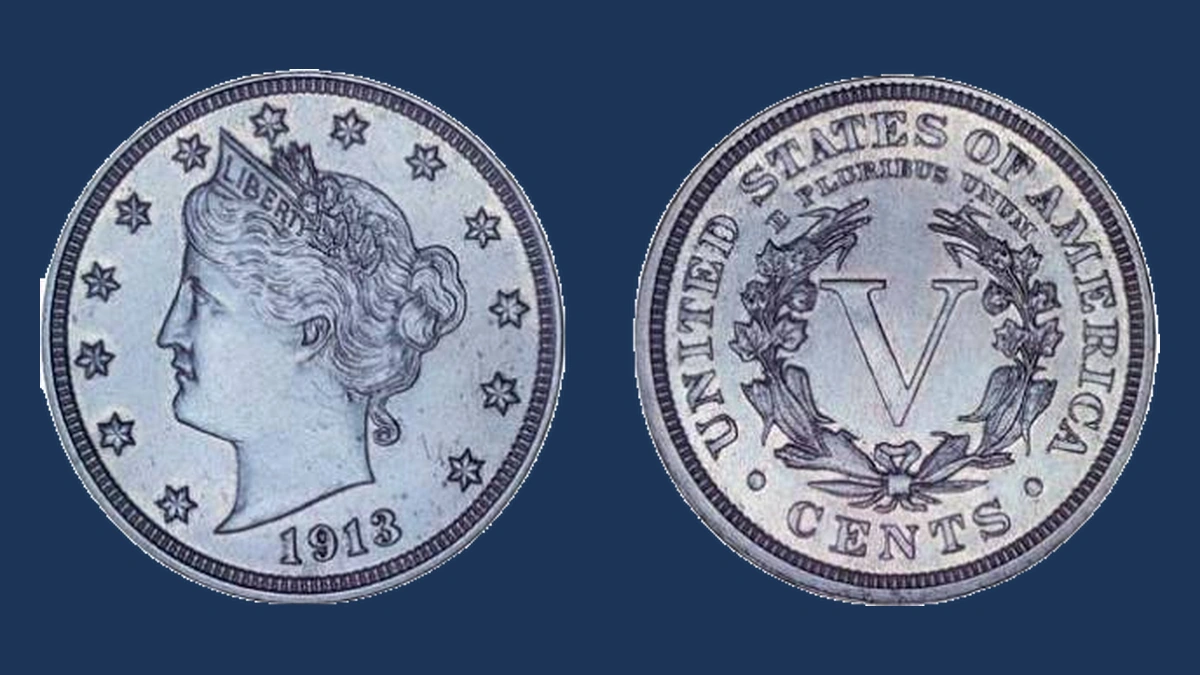
The ribbon bow and corn at the bottom of the wreath do not appear equally sharp on all five known coins. Specialists studied these differences when they examined the coins together.
Heritage describes John Dannreuther’s explanation: the steel tool that stamped the back was not held firmly in the press. He used the weakening detail to suggest which coins were struck first and which came later.
This explains a possible difference in how the coins were made. It does not authenticate a coin with a worn or altered 1913 date.
Estimated Value
Use an estimated $3 million–$6 million for an authenticated 1913 Liberty Head nickel, depending on the individual specimen. This is the whole coin’s value, including its extraordinary rarity.
The Olsen specimen sold for $3.29 million in January 2014. The Eliasberg specimen later brought $4.56 million at Stack’s Bowers in 2018.
The weaker back detail has no separately established premium to add to those prices. A worn or altered ordinary nickel does not belong in this range.
How to Identify
Confirm Liberty’s head on the front and a large V inside the back wreath. The 1913 Buffalo nickel has a different design and does not belong in this comparison.
Keep a certified coin sealed and use its recorded measurements. For a loose candidate, a scale and calipers can compare the normal 5-gram weight, approximately 21.2-millimeter diameter, and plain edge.
Those figures alone cannot prove such a rare coin genuine. Its date, designs, surfaces, and history need specialist examination.
For the striking difference, use a 10× magnifier and similarly lit photographs from Heritage’s specimen study. Compare the ribbon bow and corn at the bottom of the wreath on each named coin.
Conclusion
The estimated $3 million–$6 million range concerns genuine 1913 Liberty Head nickels as complete historic coins. It is not a price for weak lettering alone.
The useful visual comparison is the bottom of the wreath across the five named specimens. Keep wear, altered dates, and the separate Buffalo design out of that comparison, and establish the coin’s identity before interpreting its weak detail.