1893 Nickel Error List with Pictures

Only the tops of the date remained on one 1893 nickel struck 15% off center. That was enough to identify the year, and the well-preserved coin sold for $1,725 in November 2007.
The 1893 nickel errors below have estimated values of $10–$6,000. Some leave extra metal above the surface, while others remove metal or put the design in the wrong place.
Read on to compare each visible clue with the correct kind of error.
1. 1893 Liberty Head Nickel Raised Lines from a Cracked Tool
A fine ridge can appear when the steel stamping tool develops a crack. Coin metal enters that opening under pressure and leaves an extra line above the finished surface.
The tool is called a die, so this feature is known as a die crack. It is different from a crack splitting the coin itself.
Minor die cracks are reported for 1893 Liberty Head nickels, without a fixed path or affected face in the year listing. Inspect the whole line on the actual coin instead of expecting it to cross a particular letter or star.
Estimated Value
An estimated $10–$100 covers modest original die cracks on these nickels. A fine line on a heavily worn coin usually adds less interest than a clear raised ridge against clean surrounding detail.
The estimate includes the whole coin and its condition. Several short lines do not become separate values that can simply be added together.
A scratch, attached material, or metal pushed up beside a dent needs a different explanation before any mint-error premium is considered.
How to Identify
A line that splits the coin is different from a ridge left by a cracked stamping tool. At 10×, check whether the feature rises above the surrounding design.
Tilt it beneath a lamp. A scratch may have a raised lip, but a cut usually lies beside that lip.
Follow both ends of the suspected ridge and inspect the plain edge for a later dent. Leave any attached deposit alone rather than scraping it.
A scale and calipers should put a loose intact nickel near 5 grams and 21.2 millimeters. Tool cracks do not add a separate piece of metal.
Look for a continuous naturally struck ridge without a neighboring scratch groove.
2. 1893 Liberty Head Nickel Turned Back Design
The large V can sit at an angle after Liberty’s portrait is turned over in the normal way. One stamping tool was rotated relative to the other, changing the relationship between the two designs.
The coin can still be round and have a complete design on each face. Rotation concerns their relative angle, rather than one face moving sideways toward the rim.
Minor rotations are reported for 1893 without a measured angle or direction for a particular coin. A casual twist between the fingers can produce a similar appearance during inspection.
Estimated Value
Estimate $20–$300 for a clearly established rotation, with very small turns attracting less interest. A larger repeatable angle is easier to demonstrate and compare.
A different-year 2015-D nickel rotated 90 degrees counterclockwise sold for $79 in October 2021. That is a general price comparison, not an angle or sale assigned to the 1893 report.
The original coin’s preservation still matters. A tilted photograph should never take the place of a controlled alignment check when paying for this feature.
How to Identify
Hold Liberty upright, then flip the coin top to bottom without spinning it sideways. The large V should finish upright on a normally aligned coin.
Repeat the movement with an ordinary nickel beside it. Photograph the starting and finishing positions so the relative turn remains visible.
Keep a graded coin sealed and account for any tilt of the holder. The holder’s position alone does not measure the angle between the designs.
Inspect the plain edge with a 10× magnifier for a seam or alteration. A loose normal nickel should be near 5 grams and 21.2 millimeters on a scale and calipers.
A stable difference after repeated identical flips is the angle to assess.
3. 1893 Liberty Head Nickel Peeling Across Liberty’s Face
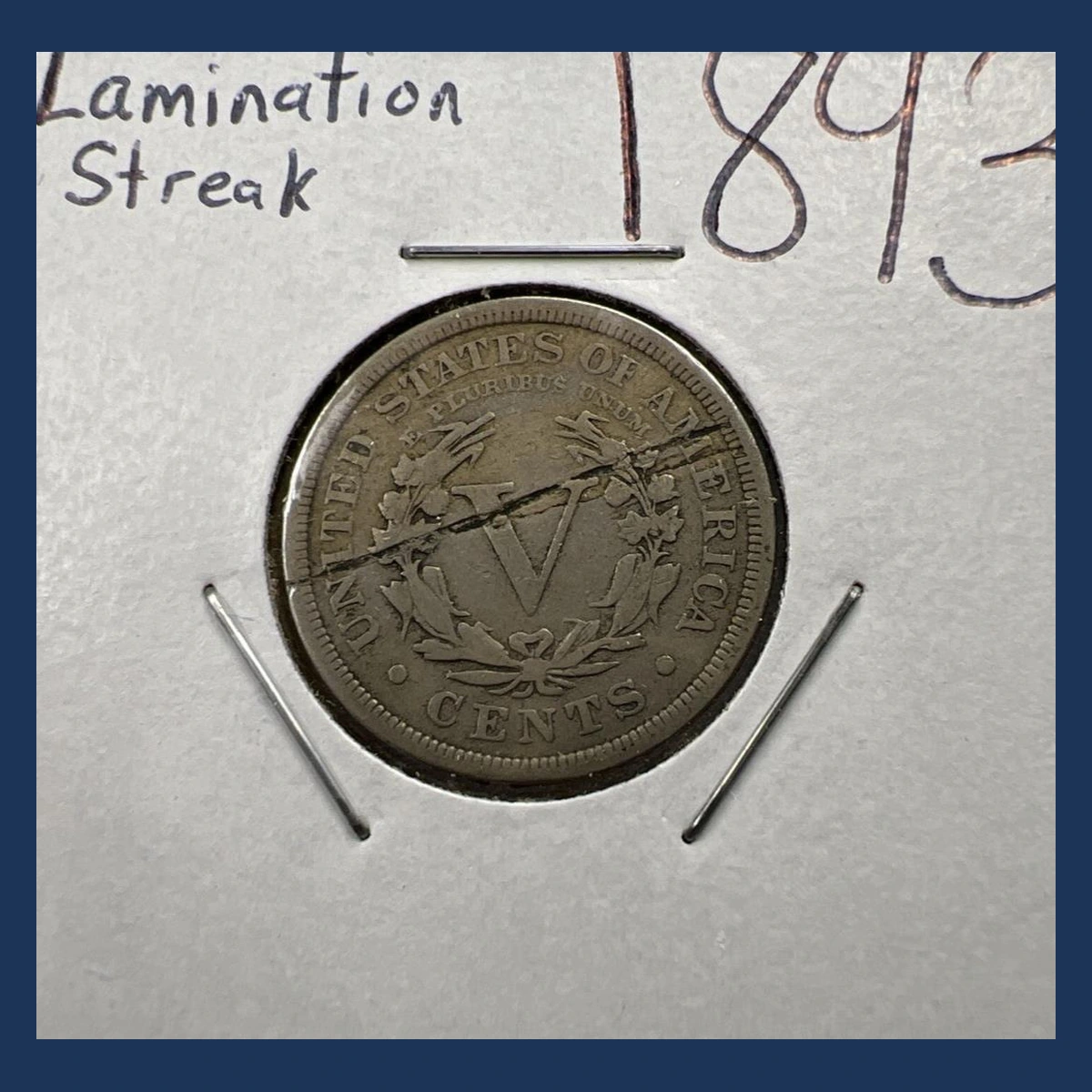
A surface layer can separate across the portrait while the rest of the nickel remains intact. The separation is called lamination and comes from a weakness within the metal.
An auction in 2022 included an 1893 nickel described as having lamination across the face. It shared a group lot with two other nickels.
That description does not say whether the loose layer remained attached or had fallen away. Both appearances need to be checked against the actual surface.
The face location makes this more specific than a peeling report, but it does not establish the exact path through Liberty’s features.
Estimated Value
Genuine local lamination is estimated at $20–$300. A clear facial separation can be visually interesting, especially when the surrounding portrait and date remain readable.
The 2022 description identifies a group lot, so a total for that group would not be this nickel’s individual value. Compare the actual size, condition, and remaining metal instead.
A natural attached flap can help show the separation. Pulling it away or scraping the exposed area can damage both the coin and its identifying evidence.
How to Identify
Keep any loose flap in place while checking the coin’s weight and size. A scale and calipers compare a loose nickel with 5 grams and 21.2 millimeters, but must not press against the lifted area.
Direct light across Liberty’s face and follow the split with a 10× magnifier. An attached layer may leave weight near normal, while a fallen piece can reduce it; neither condition identifies the precise path by itself.
Inspect the plain edge and nearby portrait for a tool entry point or metal pushed up by gouging. The useful sign is a thin natural layer separating across the original facial surface, rather than a cut dug through it.
4. 1893 Liberty Head Nickel Expanded Strike Outside the Collar
The coin can spread outward when the surrounding collar ring fails to hold the blank during striking. Its full design then sits inside a wider-than-normal outline.
A Superior Galleries auction described an 1893 broadstrike with ANACS About Uncirculated Details, indicating only slight wear. Scratches reduced its stated net grade to Extremely Fine 45.
The scratches are a condition problem, separate from the metal spreading in the press. They should not be counted as another minting error.
The catalog gives no measured diameter for this piece. Its actual expansion needs to be checked on the coin.
Estimated Value
A genuine 1893 broadstrike has an estimated range of $75–$600. Clearly expanded metal with a full readable design is easier to appreciate than a barely widened border.
Scratches can reduce the appeal of the cataloged example even though little circulation wear remains. A cleaner coin with similar expansion would make a stronger comparison.
The price should follow the whole object and its preservation. A normal nickel hammered wider after minting does not receive this mint-error range.
How to Identify
Look at the outer lettering and stars before reaching for a ruler. A straightforward broadstrike keeps the intended design on the available metal instead of losing it beyond one side.
Use calipers across several spans of a loose candidate, comparing with the normal 21.2 millimeters. Do not assign a generic enlarged diameter to the cataloged coin.
A scale should read near the normal 5 grams if all the blank remains. Expansion spreads metal rather than adding it.
Under a 10× magnifier, inspect the wider border and plain edge for hammer blows or grinding. Separate the documented scratches from the original strike, then compare how naturally the design sits within the expanded outline.
5. 1893 Liberty Head Nickel Straight and Curved Missing Sections
A blank can be cut from the end of a metal strip and lose a straight section before it is struck. Overlapping an earlier hole can instead produce a curved missing section.
The documented straight-clipped 1893 nickel weighs 4.84 grams and was graded ANACS VF20. That grade indicates visible circulation wear with the main design still clear.
Curved clips also appear in the year guide, but they are separate reported examples. The straight coin’s weight does not provide a measurement for them.
A cut made after striking can copy either outline, so the missing boundary needs close inspection.
Estimated Value
Estimate $50–$750 for genuine clipped examples, from small worn pieces to stronger original gaps on attractive coins. The amount of missing metal and the surviving date both affect demand.
The straight clip’s 4.84-gram reading supports its description, but does not establish a fixed price. Clear original surfaces where the gap meets the design are especially useful.
An artificial notch or filed edge does not qualify. A large gap should still be assessed for preservation rather than valued by size alone.
How to Identify
Weigh a loose candidate before interpreting the outline. The cataloged straight clip is 4.84 grams, compared with a normal complete nickel’s 5 grams.
With calipers, measure an intact span against 21.2 millimeters. The straight missing section and a curved opening require separate photographs and should not be assigned the same location.
Use a 10× magnifier along the gap’s ends to inspect how the struck surfaces meet it. Look for fresh burrs, saw tracks, or filing that could explain a later cut.
Follow the plain edge around to the opposite rim. Weakness there can support a genuine clip, but it is not always present.
The original cut boundary and neighboring struck detail remain the central evidence.
6. 1893 Liberty Head Nickel Indentation from an Overlapping Blank
A smooth hollow can interrupt the design when another blank overlaps the nickel during a strike. The overlapping metal blocks normal detail and presses a depression into the coin beneath it.
The year guide lists this indentation type for 1893 without identifying a graded specimen. It gives no fixed face, depth, or clock position to match.
The hollow should therefore be examined on its own merits. A dent caused after minting can look similar.
Recognizable backward design inside the depression would instead suggest brockage, a sunken mirror image pressed in by another coin.
Estimated Value
For an identified original indentation, estimate $150–$1,000 using comparable Liberty Head nickel errors. A clearly defined hollow surrounded by sharp original design can support the stronger end.
The depth alone does not decide the price. A later dent can be very deep without having any mint-error value.
Readable date details, clean surfaces, and a convincing boundary help collectors understand the event. Heavy scratches or an unclear transition into the normal design can make the coin less attractive.
How to Identify
Compare the unusual hollow with the opposite face before deciding that another blank made it. A matching impact mark or crushing can point to damage after minting.
Use low light and a 10× magnifier to follow the transition from normal struck detail into the depression. Record a loose coin’s weight and outline with a scale and calipers against 5 grams and 21.2 millimeters; an indentation moves metal without necessarily removing it.
Inspect the plain edge and search inside the hollow for actual backward letters. Those would require a mirror-image transfer explanation; a smooth hollow should instead join naturally with the surrounding strike and lack signs of a later impact.
7. 1893 Liberty Head Nickel Fifteen Percent Off-Center Strike
The date is partly lost on the documented 1893 off-center nickel. The blank received its design 15% off center toward six o’clock, leaving only the upper portions of the date digits.
The auction description says those remaining parts are enough to identify the year. NGC graded the coin MS65, meaning well-preserved and unworn.
Its sharp remaining design and original surface distinguish it from a worn or damaged coin with a similar outline. The direction and date limitation belong to this particular example, rather than every 1893 nickel struck away from the center.
Estimated Value
This MS65 coin sold for $1,725 in November 2007. An estimated range of $200–$2,500 covers genuine dated examples with different displacement, wear, and surface quality.
The recorded coin combines strong preservation with enough surviving date detail for identification. A lower-grade piece or one with an unreadable year would make a weaker comparison.
A larger shift need not bring a larger price. The arrangement of the remaining design and the condition of the untouched metal also matter.
How to Identify
The missing lower date is part of the documented error, so begin with the remaining digit tops. Compare them with the auction photographs and description rather than imagining complete digits.
A loose coin can be weighed and measured against the normal 5 grams and 21.2 millimeters with a scale and calipers. An off-center strike usually leaves its unused metal physically present and intact.
Inspect the plain edge and the struck-to-blank boundary at 10× for filing or crushing. Then turn the coin over: both displaced designs should agree with the same blank position, with surviving date tops matching 1893 on the front.
8. 1893 Liberty Head Nickel Sunken Mirror-Image Design
A struck coin can remain between a stamping tool and the next blank. Its raised design then presses a sunken, backward copy into the new coin.
The resulting mirror image is called a brockage. It differs from a normal raised design repeated by another blow from the original tool.
The 1893 year guide reports this category without establishing which face was affected on an independently identified specimen. A candidate needs recognizable reversed design rather than a vague depression.
Pressing two finished coins together later can also leave impressions, so the surface and edge require attention.
Estimated Value
A genuine, identified brockage on an 1893 nickel is estimated at $500–$4,000. Strong recognizable mirror-image detail and attractive preservation support the higher part of that range.
A faint incomplete impression is less informative than a clear section of backward lettering or portrait. The affected area must also retain an original struck surface.
Later squeezing or an ordinary dent should not receive the same premium. Value follows the actual transferred design, its size, and the condition of the complete coin.
How to Identify
Find one recognizable letter within the strange impression, not just a curved line. A 10× magnifier should show that letter both backward and below the surface.
Compare it with the corresponding normal design. A smooth hollow without recognizable design is a different feature.
Inspect the plain edge for crushing and the opposite face for evidence that finished coins were squeezed together later.
If loose, weigh and measure the coin with a scale and calipers against 5 grams and 21.2 millimeters. Normal readings alone cannot distinguish a genuine brockage from later squeezing.
Follow the sunken backward lettering into its boundary with the original struck surface; both its shape and that junction must fit a minting event.
9. 1893 Liberty Head Nickel Struck on a Bronze Cent Blank
Brown bronze metal and a smaller outline can reveal that the nickel design landed on a cent blank. The disk entered the wrong press before receiving a design.
Stack’s Bowers cataloged an 1893 example in PCGS EF40, meaning moderate circulation wear. The coin has brown surfaces with lighter brown color on raised areas.
It was not evenly centered on the smaller metal piece, so some outer nickel details extend beyond its boundary. The description identifies a cent blank without supplying a measured weight.
A normal nickel stained brown does not have the same combination of metal, size, and design fit.
Estimated Value
Estimate $2,000–$6,000 for an authenticated 1893 cent-blank nickel. The original bronze surface, readable year, and amount of surviving design help determine the price.
For a different-year comparison, a 1905 nickel on a cent blank sold for $3,120 in August 2024. That provides context without assigning its result to the 1893 EF40 coin.
Uneven centering and wear should be judged together. Later polishing, cutting, or added color weakens the comparison with an original wrong-blank strike.
How to Identify
Compare the candidate with an ordinary nickel before testing the bronze color. A smaller outline with naturally cropped nickel details should support the wrong-blank explanation.
Use a scale and calipers to record a loose coin’s actual measurements: a contemporary cent starts near 3.11 grams and 19.05 millimeters, versus 5 grams and 21.2 millimeters for the nickel. These are standards, not measurements of the EF40 example, and striking may enlarge the smaller blank.
Under a 10× magnifier, follow the plain edge for grinding and inspect the surface for added color or plating. Have the metal identified without scratching it, so bronze composition and the naturally cropped design support the same smaller blank.
Conclusion
Estimated values extend from $10–$6,000, covering small raised cracks through wrong-blank strikes. The $1,725 off-center result shows that preservation and readable date remnants can matter as much as a dramatic shape.
Compare the error’s boundary with the surrounding design, and keep later scratches separate from original striking features. A low weight, wide outline, or backward impression becomes useful evidence only when it fits the rest of the coin.