1892 Nickel Error List with Pictures

A nickel design on a brown cent blank brought a reported $5,040 in April 2020. The smaller disk could not hold the full design intended for an 1892 nickel.
This 1892 nickel error list also includes a sharply shifted strike and a coin with a sunken mirror image. Estimated values across the three types run from $500–$6,500.
Compare their shapes, surfaces, and edges below to see what separates them.
1. 1892 Liberty Nickel Brockage with a Partial Collar
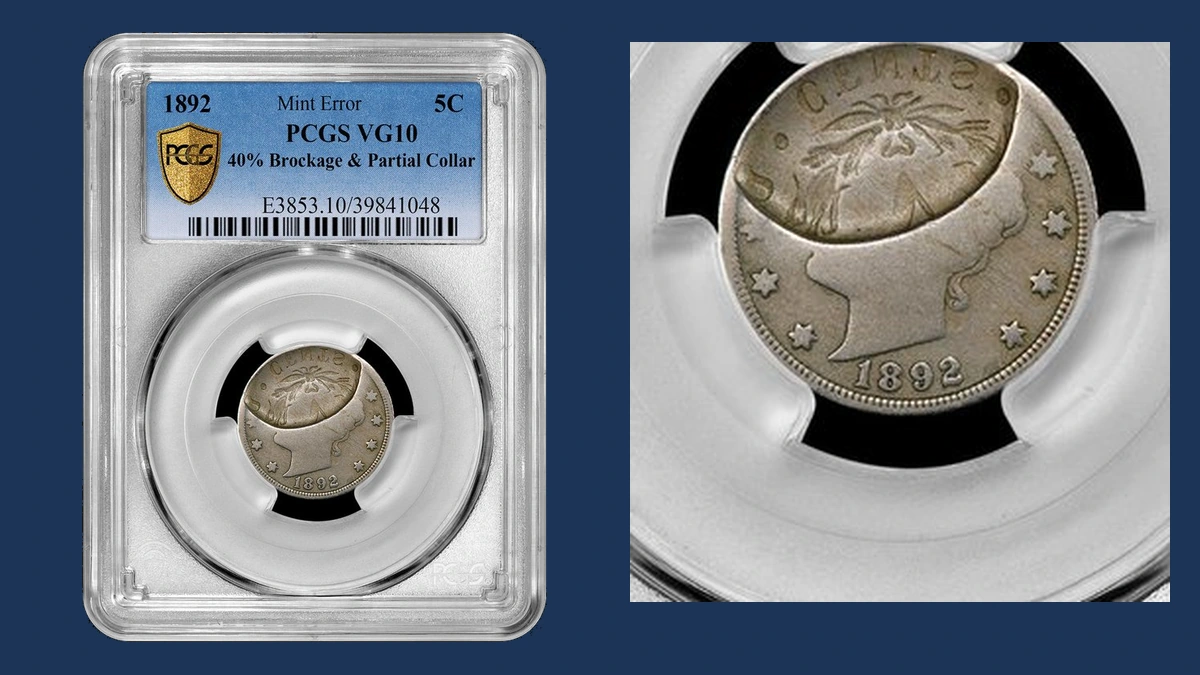
Part of the design appears backward and sinks into the surface instead of standing above it. This is called a brockage, made when an already-struck coin presses its image into another blank.
An owner reported an 1892 example graded PCGS VG10, a heavily worn coin with recognizable major details. Its label describes forty-percent brockage together with a partial collar.
The collar is the ring that controls a coin’s width during striking. When it restrains only part of the edge, it can leave a step around that edge.
Both effects belong to the same coin.
Estimated Value
An estimated $800–$2,500 is appropriate for a genuine, clearly recognizable 1892 partial brockage of this general quality. The visible mirror image matters more than an impressive label alone.
The owner’s account provides no completed sale amount for the VG10 coin. Collector opinions in that discussion are not auction results.
Its edge step adds interest, but the two errors should be priced together rather than given separate full values.
How to Identify
Turn the coin under a lamp and find a recognizable letter or design inside the abnormal area. A 10× magnifier should show that image running backward and lying below the surrounding surface.
A normal second strike can leave overlapping raised details. It does not automatically produce the sunken mirror image needed here.
Examine the edge separately for a step between the restrained and expanded portions. Damage from gripping or squeezing can also disturb an edge, so check for nearby tool marks.
For a loose coin, use a scale and calipers against the normal 5.00 grams and 21.21 millimeters. Partial collar expansion can change its width.
Match the complete 1892 date to the same coin carrying the backward, sunken design.
2. 1892 Liberty Nickel Forty-Percent Off-Center Strike
The date survives, but the word CENTS does not. On a documented 1892 nickel, the design moved so far toward 1 o’clock that part of it missed the blank entirely.
Heritage described the strike as forty percent off center and listed the coin as PCGS AU50. Its gray surfaces showed light hairlines and a mildly grainy texture, with essentially no circulation wear.
The missing word therefore comes from the displaced strike, not a special design made without CENTS. Bare metal beside the remaining image records where the blank sat outside the stamping tools.
Estimated Value
The forty-percent AU50 example sold for $2,585 on January 10, 2013. Its complete date is a strong advantage for collectors of errors by year.
Estimate $500–$3,500 for dated 1892 off-center nickels across smaller shifts and more dramatic examples. This range covers differences in preservation as well as displacement.
A larger blank area does not guarantee a higher price if the year disappears or the surfaces suffer damage.
How to Identify
A loose off-center nickel may have an uneven outline, so measure its widest points with calipers. Compare with the normal 21.21 millimeters and use a scale to check against 5.00 grams.
Find all four date digits on the struck portion. The documented coin retains 1892 even though much of its intended design falls beyond the metal.
Compare both faces for matching evidence of the same misplaced blank. On this example, the reverse word CENTS missed the metal; it was not deliberately removed from the design.
Inspect the struck-to-blank boundary with a 10× magnifier under side lighting. An original bare area should join the displaced strike without grinding marks or scraped-away lettering.
3. 1892 Liberty Nickel Struck on a Bronze Cent Blank
The brown disk belongs to a cent, while Liberty and the reverse design belong to a nickel. The wrong blank entered the nickel press and received a design intended for a larger coin.
The reported 1892 example carries an NGC MS63 Brown grade. That means an unworn coin with noticeable marks and predominantly brown copper-alloy surfaces.
A bronze cent blank contains mostly copper, rather than the usual nickel’s copper-nickel mixture. Its smaller size limits the design that can fit.
Brown color is only a clue. A coating can change color without changing the original blank underneath.
Estimated Value
Mint Error News reports $5,040 for the MS63 Brown example in Heritage’s April 2020 Central States auction. The result appears in its published auction-price table.
Allow an estimated $2,500–$6,500 for genuine 1892 cent-blank nickels, depending on wear, damage, and remaining date detail. The recorded coin sits toward the stronger end because it is unworn.
A brown normal-weight nickel does not qualify for this price range on color alone.
How to Identify
Inspect the outer design through a 10× magnifier before judging the brown color. The smaller blank should limit how much of the nickel’s design can fit, rather than merely recolor a complete normal coin.
Then weigh a loose example on a precise scale. A contemporary bronze cent blank starts near 3.11 grams, well below a normal nickel’s 5.00 grams.
Calipers can compare the cent blank’s starting diameter of 19.05 millimeters with the nickel’s 21.21 millimeters. Striking may spread the smaller disk; those standard figures are not measurements of the cataloged coin.
Look for cutting marks or a coating along the edge. A matching combination of low weight, smaller blank, and original nickel design needs to support the cent-blank identification.
Conclusion
These three 1892 nickel errors have estimated values from $500 to $6,500. The reported $5,040 cent-blank sale and $2,585 off-center sale give useful examples of what collectors have paid.
Keep the date connected to every close-up. For a brown coin, check weight as well as color; for a brockage, look for a design that is both backward and sunken.