1871 Nickel Error List with Pictures

A bright surface does not tell the whole story of an 1871 Shield Nickel. Its date, lettering, and rim can preserve different signs of how it was made.
A repunched-date example brought $4,440 in August 2021, while another sold for $4,148 in July 2026. This 1871 Nickel error list gives estimated whole-coin values of $50–$5,500.
Read on to distinguish repeated digits, doubled designs, tool damage, and small flaws in the coin’s original metal.
1. 1871 Shield Nickel Cracked Stamping Tools
Raised lines in the upper-left area of the front, and beside the left arrow, are reported on 1871 Shield Nickels. They reflect cracks in the steel stamping tool, rather than splits through the coin.
During a strike, coin metal can enter a narrow opening in that tool. The resulting line stands above the surrounding surface.
A cut made after production usually has a groove instead. Corrosion may also roughen the same area without following a tool crack.
The line’s shape and height are more useful than its darkness in a photograph.
Estimated Value
A worn 1871 nickel with a small genuine tool crack has an estimated whole-coin value of $50–$750. The lower end assumes substantial wear, while clearer designs and cleaner surfaces support more.
This estimate mainly reflects the coin’s date and condition; it is not a recorded crack-only auction result. The $4,148 high-grade repunched-date sale discussed below shows a different level of preservation and an additional variety.
A fine crack does not justify importing that higher price.
How to Identify
Locate the left arrow, then inspect the upper-left portion of the front with a 10× magnifier. Rotate the light around each suspect line to see whether it rises above the surface.
A scratch can have raised metal beside a cut, so look for a central groove before calling the entire feature raised. Keep rough corrosion patches separate from thin, continuous ridges.
The original coin should be about 5 g on a scale and 20.5 mm across with calipers, with a plain edge. Beside the arrow, check for a raised line without a cut beneath it or an adjoining edge blow.
2. 1871 Shield Nickel Traces from Colliding Tools
Faint shapes from the opposite design can appear among the normal details on a coin. This can happen after the front and back stamping tools collide without a metal disk between them.
That collision is called a die clash. Damaged tools can then pass extra traces to coins struck afterward.
An 1871 example is reported with extensive, unusual marks on both faces. These marks should be compared with the opposite design, rather than treated as random lines.
A second strike is a different event and cannot be established from a vague shadow alone.
Estimated Value
Estimate $100–$1,500 for a genuine 1871 clash, allowing for wear, surface damage, and the strength of the transferred shapes. This is a whole-coin estimate, not a documented sale of the reported specimen.
The underlying date remains important. Clear, recognizable traces on both faces are more appealing than marks that need a lengthy explanation.
A clash does not automatically carry the premium of a separately identified doubled design or a coin struck twice.
How to Identify
Photograph both faces straight on before examining an isolated line. Compare a suspected extra shape with the design on the opposite face, allowing for how the two tools faced each other.
With a 10× magnifier, separate those shapes from parallel polishing lines and scratches. A loose coin’s normal checks are 5 g on a scale, 20.5 mm with calipers, and a plain edge.
An outline resembling part of the opposite design is stronger evidence than a single unexplained mark. Have the two photographs compared with the identified 1871 clash example; do not assume a shadow is a second strike.
The decisive comparison is whether the extra shape follows the opposite design rather than the design already on that face.
3. 1871 Shield Nickel Doubled Front or Back Design
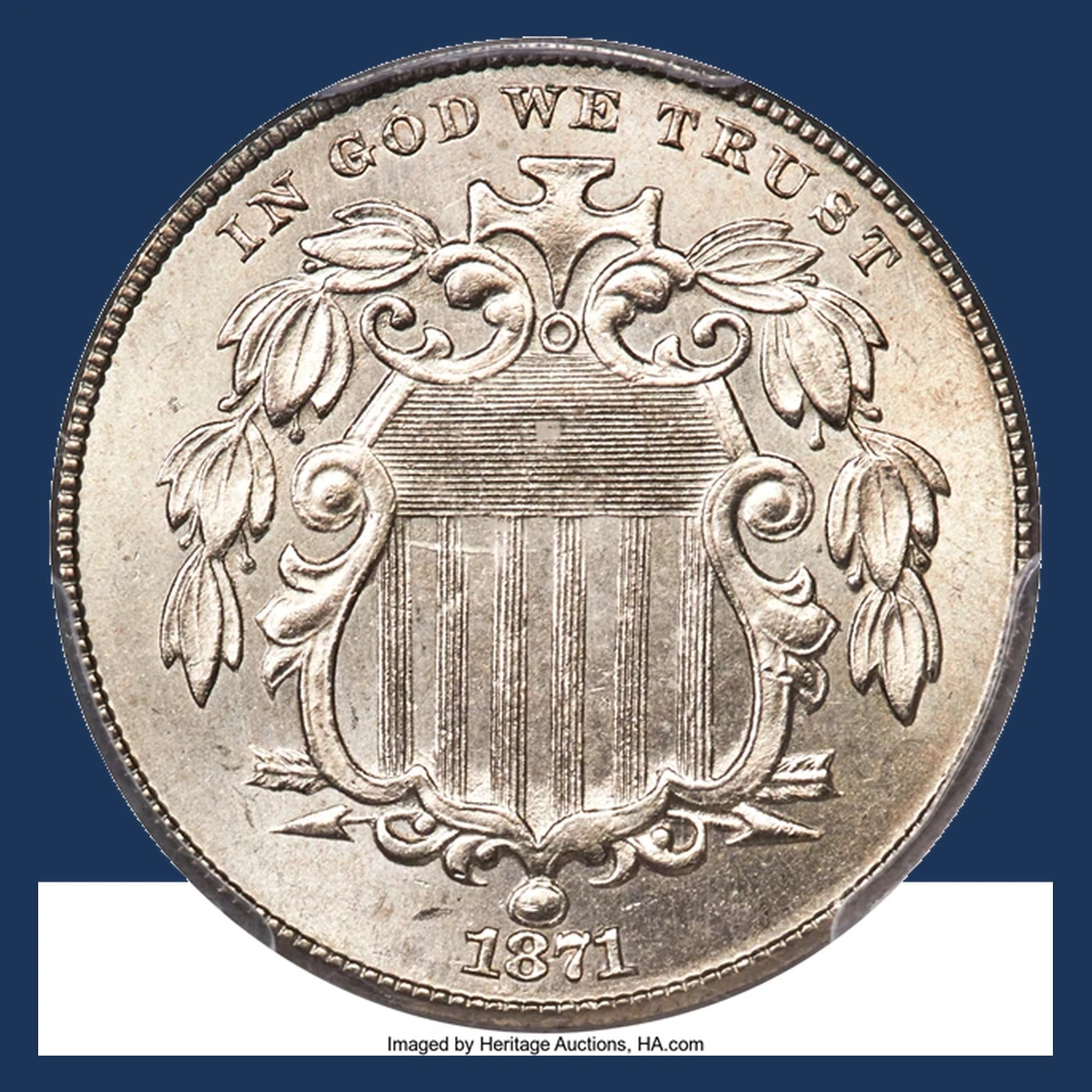
Some back letters show extra outlines spreading outward toward the coin’s edge, with small splits at their ends. Front-design doubling is also listed for 1871, but it belongs to a separate variety.
A doubled die is a stamping tool with a repeated image built into it. One blow from that tool can therefore leave two outlines on a coin.
This differs from a flat shelf caused by movement during striking. Proofs, specially made collector coins, also have separate reports of extra outlines around stars and letters.
Ordinary coins and Proofs need their own comparisons.
Estimated Value
For an identified doubled design, allow an estimated $150–$2,500 across worn through attractive unworn examples. A Proof requires a separate comparison with similar Proof condition.
The 1871 doubled-front catalog gives no auction record. As a different-year comparison, an 1875 doubled-front nickel graded MS63 brought $780 in August 2021.
That sale supports a general comparison only. It does not prove that all 1871 front or back varieties have equal demand.
How to Identify
Choose the correct comparison first: ordinary circulation coin or Proof, and front doubling or back doubling. A mirrorlike surface by itself does not establish Proof manufacture.
For a loose coin, check 5 g with a scale, 20.5 mm with calipers, and the plain edge. These checks help establish the coin type before studying tiny outlines.
On the back, move a 10× magnifier around the outer lettering and look for separation toward the rim. Small split ends can be more revealing than broad letters.
For the front variety, use a photograph of the identified 1871 example instead of assigning a catalog number from thickness alone.
Compare several rounded extra outlines in the same arrangement; flat ledges without that pattern are not enough.
4. 1871 Shield Nickel Small Flaws in the Original Metal
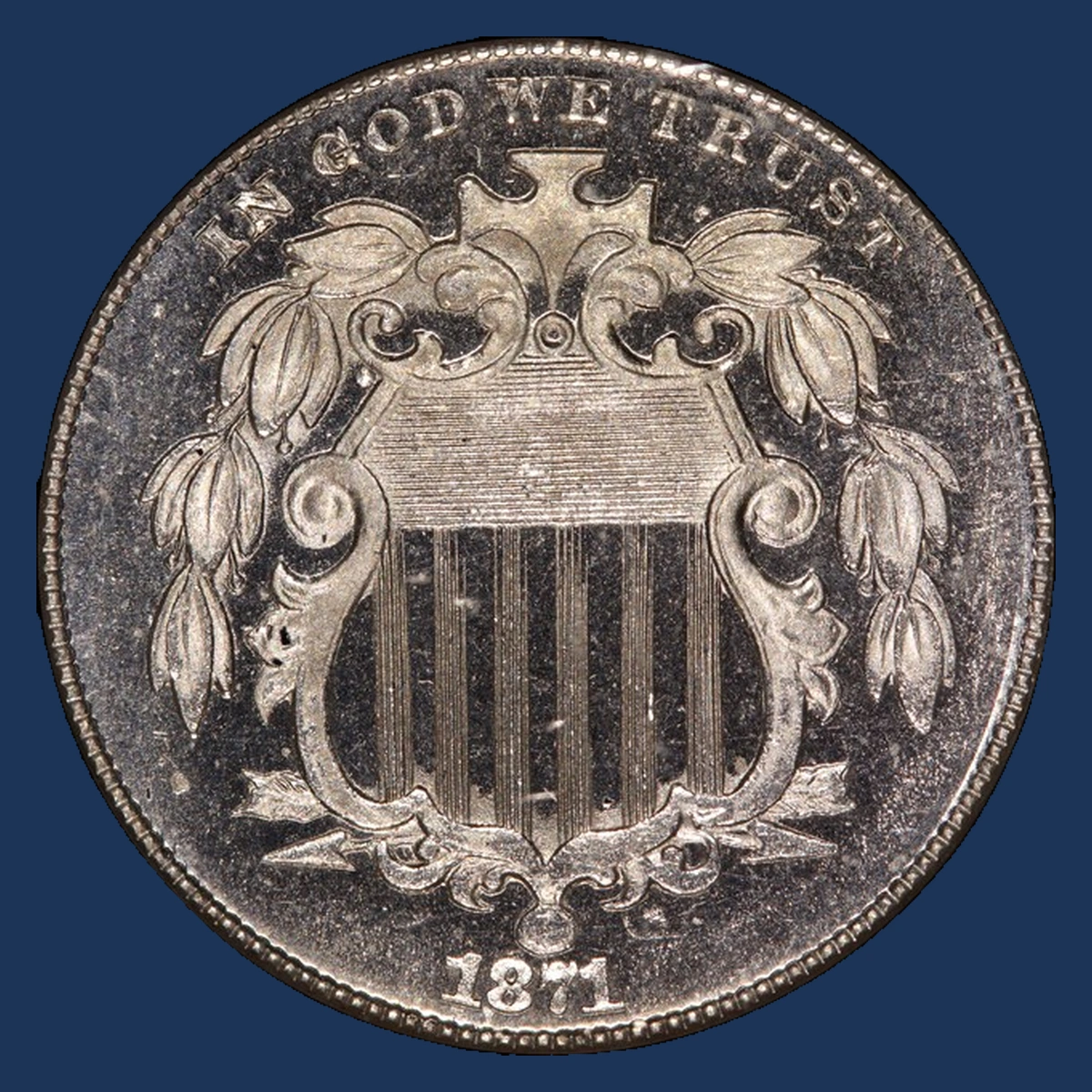
Small irregular areas near the rims appear on a reflective 1871 nickel in the Poe Collection. The collector describes them as flaws in the original metal disk, which is called a planchet.
The coin is an ordinary circulation strike with unusually mirrorlike surfaces. That appearance is called prooflike; it does not turn the coin into a specially made Proof.
The reported defects are minor and do not establish a peeled layer or a split disk. Edge knocks and corrosion can resemble small metal flaws, but occur after the original coin was made.
Estimated Value
The Poe Collection coin is described as MS65 prooflike. Use an estimated $1,000–$5,000 whole-coin range for a similarly preserved, authenticated example.
That range mainly prices the high grade and reflective surfaces. It is not an estimated extra charge for small rim flaws.
The 1871 repunched-date MS66 sale at $4,148 provides a same-year high-grade comparison, although it is a different variety and does not establish the Poe coin’s sale price.
How to Identify
Examine the rim together with the nearby surface, rather than judging a dark spot alone. A recent knock can push metal into a lip, while corrosion may leave several rough pits.
Use a 10× magnifier and gentle side lighting to inspect how the design meets each flaw. Keep the mirrors untouched; cleaning would erase useful surface evidence.
The collector’s report concerns one particular reflective coin. Compare photographs of that specimen before assigning the same origin to another rim defect.
A loose nickel should be about 5 g on a scale and 20.5 mm with calipers, with a plain edge. Minor flaws need not produce a measurable weight loss.
Look for an original metal irregularity beneath the struck surface, rather than freshly displaced metal from an edge impact.
5. 1871 Shield Nickel Repunched Date
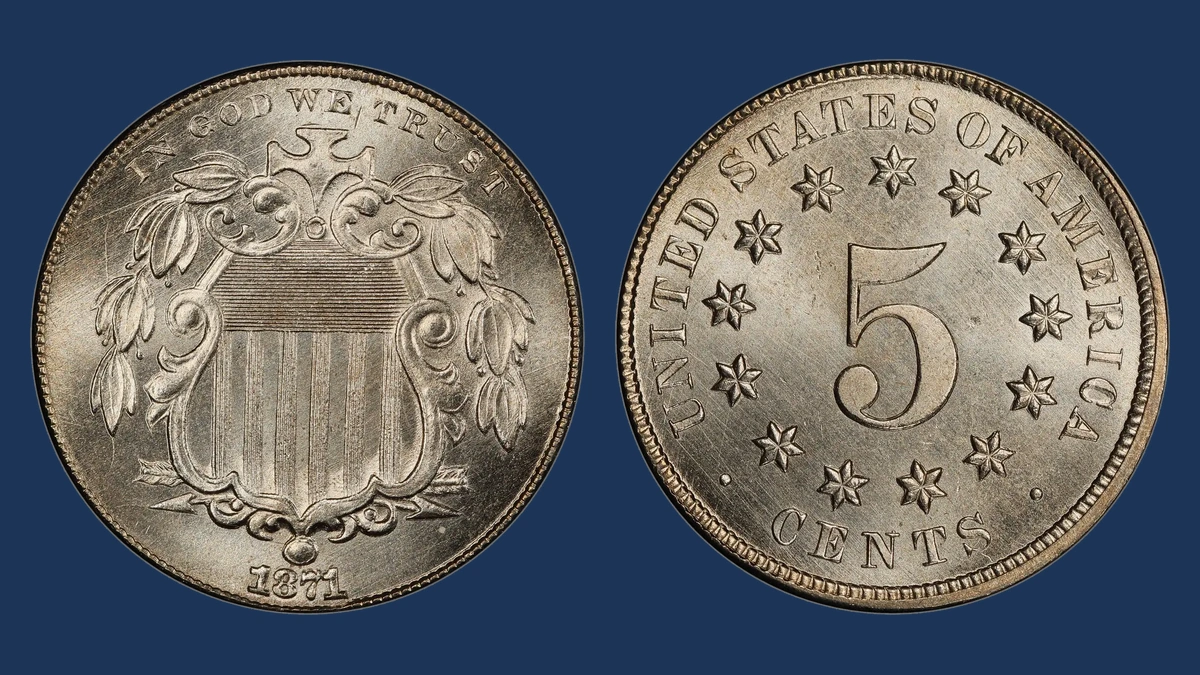
The date can show traces of an earlier position above the digits 871 or above 187. These are different reported arrangements, not a requirement that every coin display both.
A repunched date begins when a worker repeats the date punch in the steel stamping tool. Earlier strokes remain beside the final numerals and appear on coins made with that tool.
A separate Proof report describes an initially low date that was corrected. Its photographs and measurements should not be mixed with the ordinary-coin examples.
An extra numeral stroke is not the same as doubled surrounding lettering.
Estimated Value
A PCGS MS66 repunched-date coin sold for $4,148 on July 17, 2026. Another MS66 example brought $4,440 at Stack’s Bowers in August 2021.
Estimate $100–$5,500 for identified examples across collectible conditions. The highest part applies to exceptionally clean, unworn coins.
The range includes the value of the complete 1871 nickel. A worn coin with visible repunching should not inherit an MS66 price, and Proof examples require matching Proof comparisons.
How to Identify
Leave the date uncleaned, even if dark material partly fills a digit. Removing it can damage the small raised remnants you need to study.
Through a 10× magnifier, inspect above 871 and then above 187. Decide which photographed ordinary-coin arrangement fits, rather than combining the two into a single imagined pattern.
Check the holder or overall finish separately if the coin is described as a Proof. The report of a low initial date applies to a different Proof example.
For a loose coin, use calipers for the normal 20.5 mm diameter and a scale for about 5 g. Its edge is plain.
Trace the extra stroke into the shape of an earlier numeral and compare its position with the matching date photograph.
Conclusion
Check whether an extra mark repeats a numeral, repeats part of the design, or simply forms a raised line. The answer separates the main 1871 varieties from cracks, clash marks, and small metal flaws.
The estimated $50–$5,500 range includes the value of each complete coin. Reflective surfaces and high grades can contribute far more than a minor defect, so identify the finish and condition before comparing prices.