2005 Half Dollar Error List with Pictures

A Kennedy half dollar struck on metal meant for a Taiwan five-dollar coin sold for $2,880 in September 2023. That 1974 example helps price a similar kind of error reported for 2005.
This 2005 Kennedy half dollar error list covers estimated values from $5 to $3,500. Reports range from fine raised lines to interrupted designs and wrong-size blanks.
Read on to learn the visible clues, while keeping normal silver proofs and satin finishes separate from errors.
1. 2005 Kennedy Half Dollar Reported Die Cracks (Estimated Up to $60)
A fine raised line can begin with a crack in the die, the steel tool that stamps a coin. Metal enters the opening during striking and forms a ridge.
The tool may keep working, so later coins can show a longer version of the same line. The coin itself has not necessarily split.
CoinTrackers reports cracks for 2005 without giving one exact route or mint for an example. Examine the line actually present on your coin.
A scratch or piece of dirt can look similar in a photograph, but each has a different surface shape.
Estimated Value
Estimate $5–$60 for small through clearly visible cracks on collectible unworn 2005 halves. A clear continuous ridge is generally more appealing than a tiny mark.
This uses modest guide values for modern Kennedy crack errors. The nearby 2008 guide, for example, allows $5–$20 for minor cases.
Those figures are comparisons, not a recorded sale of a named 2005 example. A scratch does not receive the premium simply because it follows an interesting route.
How to Identify
Use a magnifier and low light to trace the line across changes in the design’s height. Check whether it remains a ridge rather than turning into a cut groove.
A scratch may have raised lips beside its central cut. Inspect both sides of the line and avoid testing it with a needle.
For a loose coin, use a scale against 11.34 g for ordinary layered-metal issues. The silver S proof, a specially made collector coin, normally weighs 12.50 g.
Both measure about 30.6 mm with calipers and have grooves around the edge. An unbroken raised line that belongs to the struck surface gives the quickest first check for a die crack.
2. 2005 Kennedy Half Dollar Reported Die Clash (Estimated Up to $175)
A faint extra outline can be a clash mark if it matches part of the opposite design. The two stamping tools struck each other without a metal disc between them.
That contact marked the tools. Coins made afterward could pick up unwanted pieces of the opposite picture.
Clashes are reported for 2005 without a named example or fixed location. No particular feather behind Kennedy or portrait line on the back is established here.
The shape and its position must make sense together. A scratch can suggest a familiar outline without actually coming from the opposite tool.
Estimated Value
A clear, matching clash on an unworn 2005 half has an estimated value of $20–$175. Recognizable pieces of the opposite picture support more interest than an unexplained line.
A 1973-S proof with strong clash marks brought $720 in October 2022. PCGS graded it PR68 Deep Cameo, describing excellent preservation and strong contrast between frosted design and reflective surfaces.
That older, dramatic proof is a different-year comparison. It does not establish an equivalent 2005 specimen or sale.
How to Identify
Pick one extra outline and compare it with the opposite-side picture at the same size. Its shape and position should agree with the way the two sides line up.
Use a 5×–10× magnifier to see whether the line is physical detail or a reflection. Look nearby for scratches, polishing, or impressions made by pressing two finished coins together.
A loose ordinary layered-metal coin should weigh near 11.34 g on a scale; a silver proof should be near 12.50 g. Check about 30.6 mm with calipers and inspect the edge grooves.
The first useful test is a recognizable opposite-design fragment in the correct place, rather than a line that merely looks unusual.
3. 2005 Kennedy Half Dollar Reported Clipped Planchet (Estimated Up to $300)
A clipped planchet is an incomplete metal disc that was later struck into a coin. Its gap existed before the design appeared.
The cutting punch may have crossed an earlier hole or the edge of the metal strip. Either can leave part of the disc absent.
The 2005 guide reports clips without identifying a particular mint, finish, or gap shape. A precise size or direction must come from the actual coin.
The nearby rim and design can help show that the gap came first. Cutting, filing, and corrosion can also remove metal later.
Estimated Value
A confirmed 2005 clip has an estimated value of $50–$300. Small gaps usually fall toward the lower end, while an attractive, clearly original outline can bring more.
A 1998-D ten-percent triple clip graded PCGS MS63 sold for $99 in March 2025. A forty-five-percent curved clip graded NGC MS66 brought $240 in July 2021.
Those are different-year unworn examples, with MS66 allowing fewer marks. Their particular shapes do not describe the reported 2005 coin.
How to Identify
Look around the entire rim, including the area opposite the gap. Weakness there can support a clip, but it is only one clue.
Use a magnifier at each end of the opening. Compare how the original lettering and border approach it with the same details on a normal coin.
A scale can compare the missing weight with 11.34 g for ordinary layered metal or 12.50 g for a silver proof. Use calipers across intact sections against about 30.6 mm.
Inspect the surviving edge grooves for filing or sharp burrs. Original struck detail flowing toward the gap, without fresh cut marks, gives the fastest useful starting point.
4. 2005 Kennedy Half Dollar Reported Doubled Dies (Estimated Up to $350)
An extra design outline can come from a doubled die, meaning the steel stamping tool already carried repeated detail. Each coin made with it could receive the same pattern.
Proofs are specially made collector coins and may receive repeated blows during normal production. That process alone does not make them doubled dies.
Both front and back doubling are reported for 2005 without specific mint, finish, or numbered varieties established here. Each face needs its own comparison.
Reflective proof lettering can create apparent second edges. Movement during a strike can also flatten a letter without making a true doubled design.
Estimated Value
Estimate $60–$350 for a confirmed unworn variety. A bold repeated feature generally supports greater interest than slight doubling visible only with strong magnification.
This range follows modern Kennedy guide comparisons around $60 and upward, including a 2007 reference. It is not a recorded auction price for a 2005 coin.
The pattern must be real and match a known example. A shiny proof finish does not turn a reflected second edge into an error premium.
How to Identify
Change the viewing angle first, especially when looking through a proof’s holder. A reflection can move or vanish, while a real extra contour remains in the metal.
Use a 10× magnifier to compare the full outline with a normal coin of the same finish. A flat shelf that narrows a letter differs from an added rounded shape.
Check each face separately. Front doubling does not establish back doubling.
On a loose coin, check 11.34 g for layered metal or 12.50 g for silver proof with a scale. Use calipers for about 30.6 mm and inspect the edge grooves.
A fixed extra contour matching another confirmed example is the fastest useful check after reflections are ruled out.
5. 2005 Kennedy Half Dollar Reported Strike-Throughs (Estimated Up to $450)
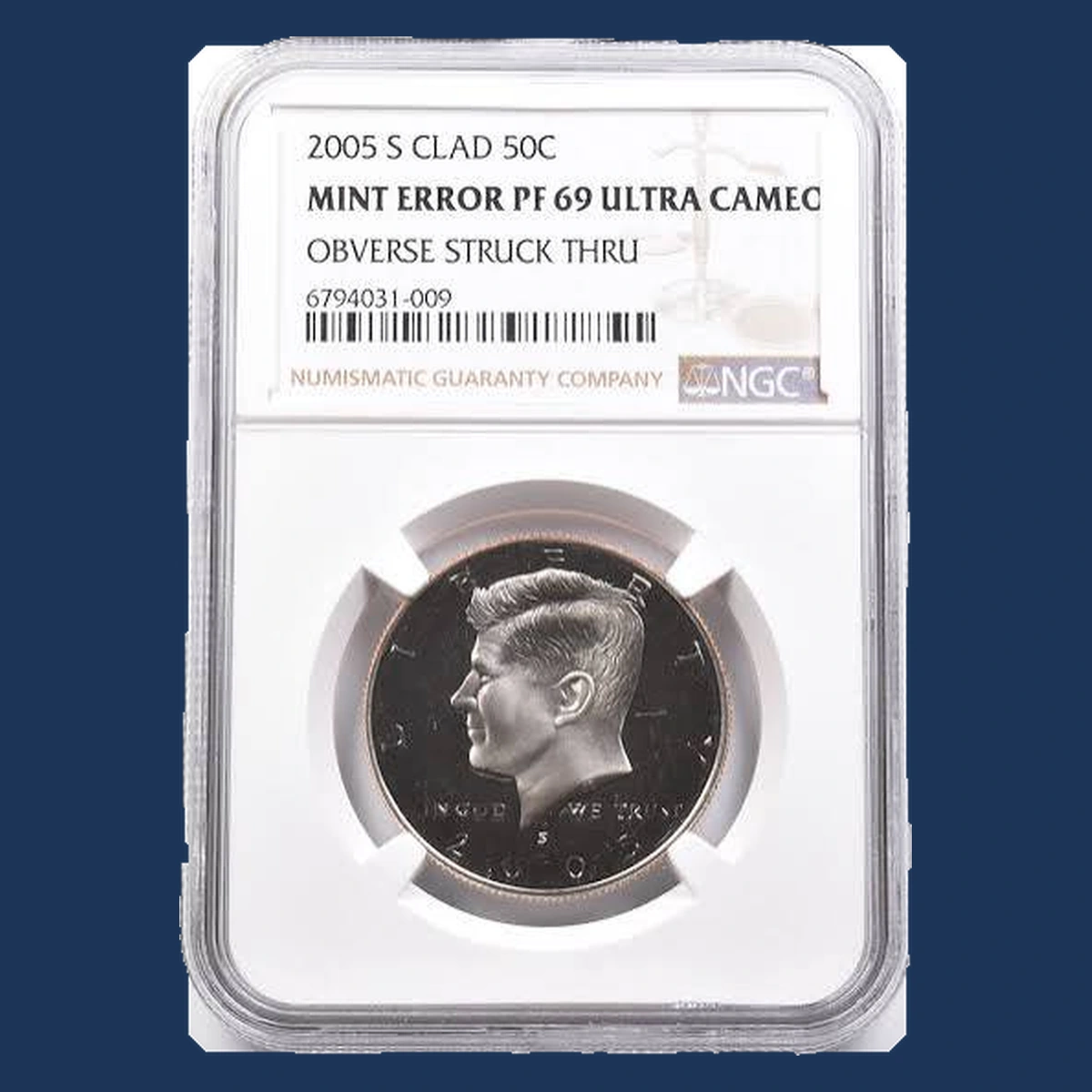
One owner reported grease-related weakness on a half dollar found while opening a 2005 set. The discussion does not identify its mintmark or affected area.
Another owner showed a 2005-S clad proof with an unusual 5 in the date. A strike-through was suggested, but reflections were also considered.
These are different coins. A strike-through occurs when material blocks normal contact between the stamping tool and the coin.
It can weaken detail or leave an impression. On the proof, the first question is whether the irregularity belongs to the metal rather than the holder or reflected light.
Estimated Value
A confirmed 2005 strike-through has an estimated value of $20–$450. Minor weak detail belongs nearer the bottom; a clear impression on a well-preserved proof can support more interest.
Neither owner report provides a sale result used here. A 1992-D struck through a fragment bearing edge grooves sold for $336 in July 2021.
NGC graded that different-year ordinary coin MS64, meaning unworn with some marks. Its known trapped object does not identify what affected the proof’s 5.
How to Identify
For the proof, focus on the 5 and then on the plastic above it. Move the light and viewing angle to separate a holder scratch from a mark on the coin.
Use a magnifier or a sharp close-up to study how the digit meets the affected area. Compare nearby date digits rather than treating every weak stroke as the same problem.
The clad proof normally weighs 11.34 g, while the silver version weighs 12.50 g. Both measure about 30.6 mm and have edge grooves.
Use a scale and calipers only if the coin is loose and accessible. Confirming that the interruption is in the struck 5 itself answers the first question most directly.
6. 2005 Kennedy Half Dollar Broadstrike Candidate (Estimated Up to $500)
A wider-than-normal coin can be a broadstrike if its full design remains intact. The retaining ring failed to limit the metal’s movement as the stamping tools pressed it.
The metal spread outward while still receiving the whole picture. That differs from a shifted strike that misses part of the design.
No correctly dated 2005 specimen is established here, so the category remains a candidate. A wider coin needs more than a diameter measurement.
Later pressure can flatten a normal half dollar and make it wider too. Crushed details or pressure marks can reveal that different history.
Estimated Value
A 1998-P broadstrike on an early-stage blank sold for $106 in January 2010. NGC graded it MS65, an attractive unworn grade.
That older sale concerns a particular combination of blank preparation and striking. It is a different-year comparison, not a 2005 transaction.
For a genuine unworn 2005 broadstrike, estimate $100–$500. The range assumes natural expansion during striking with the complete design remaining; a normal coin flattened afterward does not qualify.
How to Identify
Read the date and outer lettering on both faces before measuring. Compare with a normal half to see whether the whole picture remains inside the widened outline.
Use calipers across several directions against about 30.6 mm. A scale should be compared with 11.34 g for ordinary layered metal or 12.50 g for an S silver proof.
Inspect the expanded margin with a magnifier. Follow any change from normal edge grooves to metal that spread outside the retaining ring.
Crushed existing detail or pressure scars can indicate later flattening. A complete original picture inside a naturally widened edge is the quickest first check for a broadstrike.
7. 2005 Kennedy Half Dollar Reported Off-Center Strike (Estimated Up to $650)
A crescent of plain metal beside an incomplete picture can indicate an off-center strike. The disc sat partly outside the stamping area.
The overlapping portion received the design, while the rest remained unstruck. Both faces should show the effects of that same shifted position.
Off-center striking is reported for 2005 without an individual coin’s mint, finish, direction, or percentage established here. Those details must be read from an actual example.
One uneven border does not settle the matter. A single stamping tool can be misaligned while the other side remains centered.
Estimated Value
The estimated range is $75–$650 for confirmed examples with readable dates. A small shift generally costs less than an attractive, dramatic one.
A 1999-D struck sixty-five percent off center sold for $552 in March 2023. NGC graded it MS66, a well-preserved unworn grade.
That different-year result supports the upper scale of the estimate. It does not establish either a sixty-five-percent shift or a completed sale for a 2005 coin.
How to Identify
Find the date and mintmark before naming the issue. Then follow the boundary between stamped design and untouched metal on both faces with a magnifier.
Check for grinding or polishing that could have erased a design after minting. A genuinely plain area should fit the way the picture missed the disc.
For an ordinary layered-metal half, use a scale against 11.34 g and calipers against about 30.6 mm. Inspect remaining edge grooves and smooth areas outside normal ring contact.
If one picture is centered and complete, consider a shifted tool instead. Matching interrupted pictures on both sides beside original plain metal provide the fastest useful check.
8. 2005 Kennedy Half Dollar Reported Wrong Planchet (Estimated Up to $3,500)
A half-dollar picture that does not fit its metal can suggest a wrong-planchet strike. A planchet is the prepared metal disc meant to become a coin.
The disc must match another intended issue, not just look unusual. The 2005 report names no particular denomination or alloy for such an example.
A heavier 2005-S silver proof is a normal product. The softly textured satin surface on a mint-set coin is normal too.
Neither feature alone proves a wrong blank. The weight, size, metal, and way the design ends must fit the same explanation for how the mistake happened.
Estimated Value
A confirmed 2005 wrong-blank strike has an estimated value of $750–$3,500. The blank’s identity and readable design strongly affect the price.
A 1974 Kennedy on a Taiwan five-dollar blank sold for $2,880 in September 2023. PCGS graded it AU55, meaning only light wear.
That different-year foreign-blank example shows the market for a clearly explained error. It does not identify the metal or intended denomination behind the reported 2005 category.
How to Identify
Check the expected issue first: ordinary layered-metal halves weigh 11.34 g, while S silver proofs weigh 12.50 g. Both normally measure about 30.6 mm and have edge grooves.
Record the candidate’s weight with a precise scale and its size with calipers. Use a magnifier to examine where the original design meets the edge.
Grinding or acid can reduce a normal coin’s size and weight. Plating can also hide its metal color.
If the measurements suggest another blank, a nondestructive metal test can help check that idea. The best first match combines the proposed blank’s weight, size, and metal with a design that ends naturally at its edge.
Conclusion
The estimated range for these 2005 errors is $5–$3,500. Raised lines, interrupted digits, and designs on the wrong metal need different checks.
Satin texture, reflective proof surfaces, and the proper silver composition are normal features of the relevant issues. They are not mistakes by themselves.
Keep each coin’s date, mintmark, and photographs together, then compare the visible feature with a similar example before applying its price.