1993 Half Dollar Error List with Pictures

A small interruption near the top of a 1993-S Proof sold for $124 in July 2022. A reported Philadelphia half struck five times shows a much larger change to the design.
These 1993 Kennedy half dollar errors span estimated $5–$2,500 values. Their prices depend on different features, from a lifting flake to overlapping pictures.
Follow the eight types below, keeping everyday coins separate from Proofs, the specially made collector coins available in different metals.
1. 1993 Kennedy Half Dollar Local Layer Separation (Estimated Up to $100)
Everyday P and D halves have outer copper-nickel layers bonded to a copper center. A weak area can let a small part of the surface lift or peel away.
The 1993 guide describes local separation of this kind. It may leave an attached flap or expose metal after a flake falls off.
Collectors often call surface peeling a lamination. The surviving design can help show whether the opening existed before striking or developed afterward.
This report does not establish an entire face missing its outer layer. A small peel and a whole missing layer are different amounts of metal loss.
Estimated Value
The year guide places small laminations around $5–$25. An estimated $5–$100 extends that modest range to larger, clearly genuine peels on attractive coins.
The upper figure is an estimate for a stronger feature, not a recorded 1993 auction result. A well-defined seam or stable attached flap may attract more interest than general roughness.
Corrosion or an outer layer forcibly removed after minting does not receive the same error value. The actual separation must explain the price.
How to Identify
A scale can help show whether metal is missing. Compare a safely accessible P or D coin with the normal 11.34 grams; calipers should find about 30.61 mm.
An attached flap may leave the weight nearly unchanged. Inspect the seam with a 10× magnifier and follow any design that crosses its boundary.
Do not bend or pull the flap. Moving it can damage the coin and remove evidence of how it separated.
Check the edge grooves and the boundary between outer layers and copper center. Ordinary copper color around the edge is normal.
A real layered seam continuing into original struck detail distinguishes a physical peel from a surface patch that has merely changed color.
2. 1993 Kennedy Half Dollar Clashed Dies Error (Estimated Up to $100)
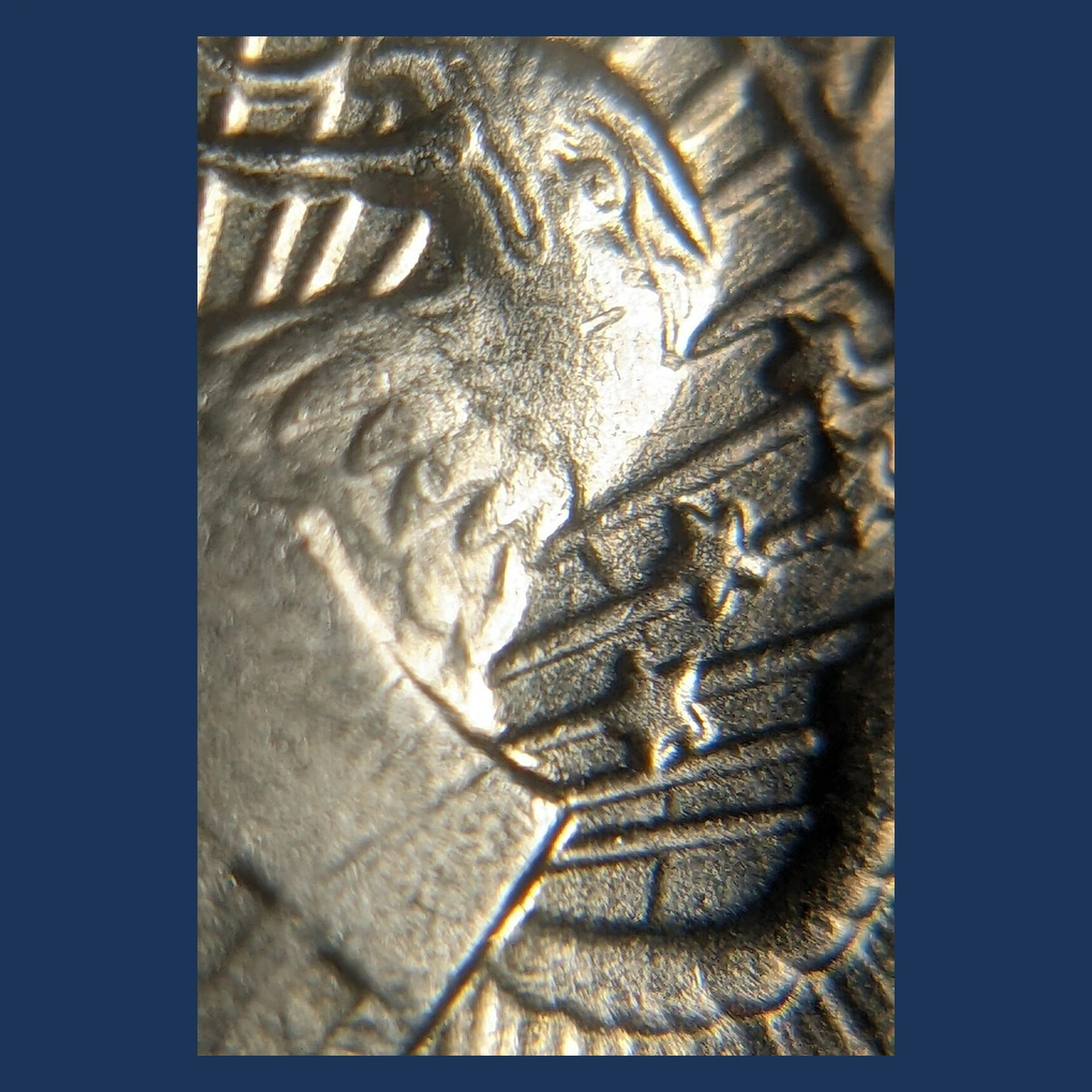
The press sometimes closes without a blank between its stamping tools. The dies, the steel tools that stamp coins, then hit each other.
Each can pick up a small part of the opposing picture. Coins made afterward may carry faint extra traces on their normal designs.
The 1993 report describes subtle marks on both faces of a Philadelphia example. It gives no exact pattern or named tool pair.
A matching relationship between the two pictures is therefore important. Random tool scratches or contact marks from other coins do not automatically show that the two dies clashed.
Estimated Value
The reported Philadelphia example was offered around $45. That is an asking-price reference, not a completed sale.
An estimated $15–$100 fits a light, recognizable clash on an ordinary collector-grade 1993-P. Clear transferred shapes and original surfaces support more interest than marks that are barely visible.
Strongly clashed Proofs can bring larger premiums, but their collector finish differs from everyday coins. A high seller grade does not make a faint line into a valuable clash.
How to Identify
Keep photographs of both faces in their normal relationship. Compare the faint marks with the outline of the opposite picture.
A 10× magnifier and low light can reveal shapes hidden in a straight-on photograph. Ask whether each proposed trace could meet the matching feature when the tools closed.
Confirm the date and P, then inspect the edge grooves for compression or a seam. Those could indicate later alteration.
Use a scale and calipers when safely accessible against the normal 11.34 grams and 30.61 mm. A clash normally changes neither figure much.
The useful match is between recognizable opposing-design shapes, not the darkness or depth of one unexplained line.
3. 1993 Kennedy Half Dollar Curved Clip Error (Estimated Up to $200)
The cataloged 1993-D clip weighs 11.0 grams. That is slightly below the ordinary 11.34-gram standard.
It was graded MS64, meaning unworn with some marks. The curved missing segment is the main feature, while its lower weight offers supporting information.
A curved clip can form when the blank punch overlaps an earlier hole in the metal strip. The incomplete blank then receives the design.
The strike shapes metal around the existing gap. That relationship helps distinguish the mistake from cutting a finished coin, which can also make it lighter and leave a curved notch.
Estimated Value
A 1993-D curved clip graded MS64 sold for $34.74 including fees in August 2025. It should not automatically be treated as the same coin in the separate GreatCollections listing.
Estimated values of $25–$200 cover similar small clips through stronger, attractive examples. Clear boundaries and original surfaces help explain the difference.
The amount of missing weight is not a price formula. A visible genuine clip matters more than a small numerical deficit by itself.
How to Identify
Study both transitions from the intact rim into the curved gap. Under a 10× magnifier, look for natural metal flow around a boundary present before striking.
Inspect the remaining edge grooves and exposed metal layers for fresh cuts or abrasion. A later notch can imitate the curve without the same strike changes.
When safely accessible, use a scale to compare the coin with 11.34 grams. The cataloged example is 11.0 grams; calipers across intact areas should approach 30.61 mm.
The opposite rim may be weak, but that sign is not equally visible on every genuine clip. Record the complete date and D.
The two rim-to-gap transitions should support an original clip before the weight is used as further evidence.
4. 1993 Kennedy Half Dollar Reported Obverse Doubling (Estimated Up to $300)
Three reports concern the front, but they do not establish one variety. The year list describes extra inscription outlines on separate P and D coins.
A Philadelphia registry owner also describes a doubled ear. That coin’s ordinary MS63 grade means unworn with visible marks; it does not certify the ear as a doubled die.
The inscription reports likewise lack a matched numbered variety. Each feature needs its own comparison with normal design and flat doubling from movement during striking.
The mint letter and affected shape matter. An ear fold and repeated-looking lettering should not be assumed to share one cause.
Estimated Value
Estimate $25–$300 for convincing, identifiable minor doubling. The upper end needs stronger evidence than an owner’s nickname or a blurry extra edge.
The P-and-D inscription pair was offered at $75. That is an asking price for two coins, not a per-coin sale.
A recognized 1974-D FS-101 graded MS64 sold for $49 in May 2026. Its established identity offers a comparison from another year, but does not prove that the three 1993 reports have the same status.
How to Identify
Label every close-up P or D before comparing the lettering. A Philadelphia photograph cannot identify the Denver tool.
For the ear report, place a normal 1993 portrait beside it under the same lighting. Use a 10× magnifier to compare the folds and their edges.
Look for separated raised detail rather than a flat shelf, normal sculpture, or a bright worn edge. Keep complete views of both faces with the enlargement.
These everyday coins weigh 11.34 grams and measure 30.61 mm, with edge grooves. Use a scale and calipers when safely accessible.
A specific extra contour should match a verified same-mint variety before an ear fold or inscription receives a doubled-die name.
5. 1993 Kennedy Half Dollar Proof Obverse Strike-Through (Estimated Up to $350)
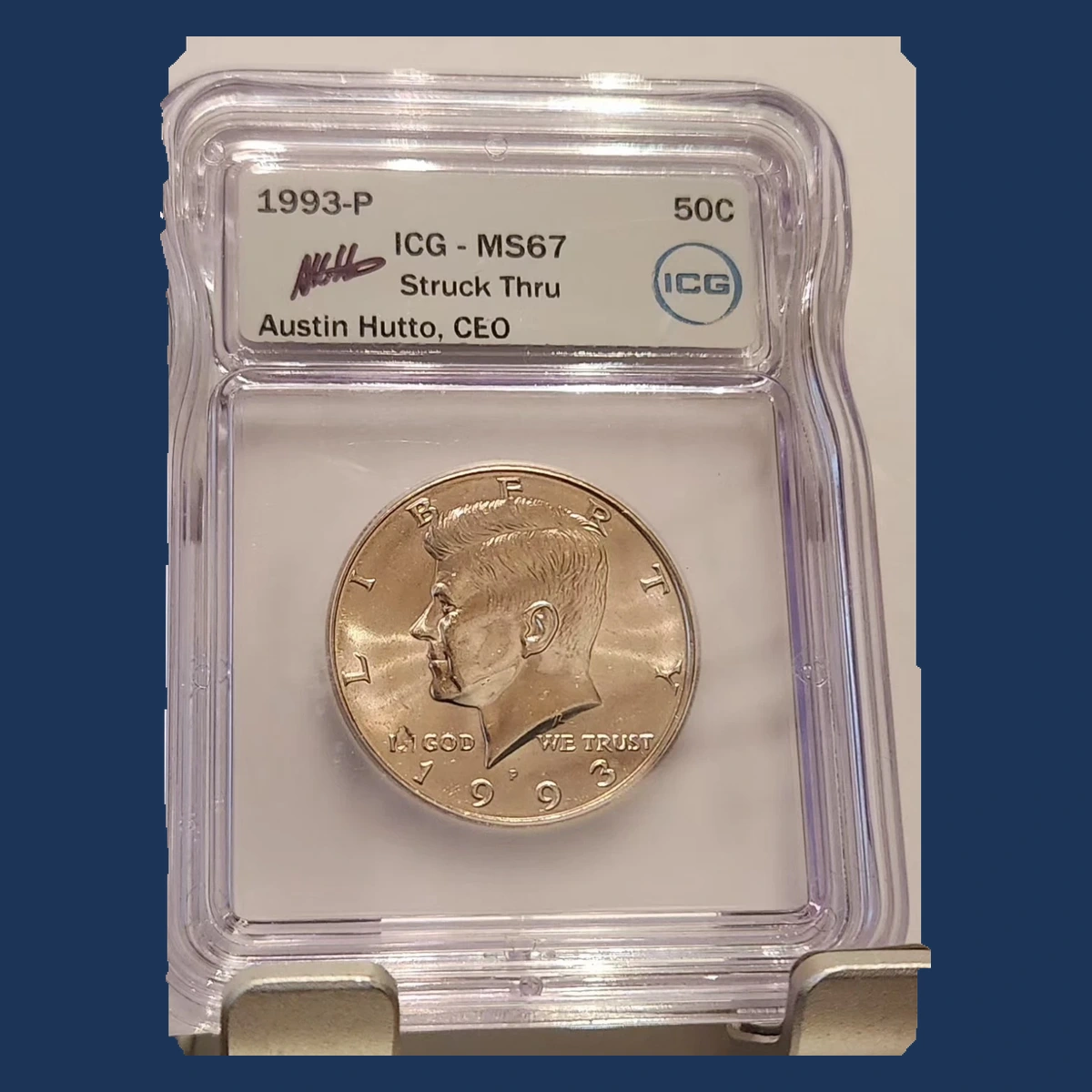
The unusual area sits near the top of the front, at about twelve-thirty. Material between the stamping tool and coin prevented normal contact there.
The cataloged 1993-S is a Proof graded PR69, meaning nearly flawless collector condition. Deep Cameo describes its frosted pictures against mirror-like flat areas.
Neither that contrast nor the shiny finish is the error. The local interruption is the feature to examine.
The auction description does not identify the trapped material. It also does not say whether this is the layered-metal or ninety-percent silver Proof, both of which carried S in 1993.
Estimated Value
The cataloged 1993-S Proof sold for $124 on July 5, 2022. An estimated $75–$350 suits comparable genuine Proof strike-throughs.
The size and clarity of the interruption matter alongside preservation. Deep Cameo is a normal contrast description, not another error to price separately.
The result values one complete coin. Since its metal is not stated in the listing, the comparison should not assume an extra silver value or silently identify it as the silver version.
How to Identify
Check the label or original packaging for metal identity first. An accessible layered-metal Proof normally weighs 11.34 grams, while the ninety-percent silver version weighs 12.50 grams.
Both measure 30.61 mm and have edge grooves. Use a scale and calipers only when safely accessible, protecting the delicate surfaces.
Inspect the twelve-thirty area under a 10× magnifier. A mark on a holder can resemble a coin defect, so change the light to locate the actual surface.
Look at the boundary and surrounding mirror-like areas for scratches that suggest later damage. Do not assume the hollow came from a wire or fiber without evidence.
The cataloged location and untouched surrounding finish provide the direct comparison for this particular strike-through.
6. 1993 Kennedy Half Dollar Broadstrike Error (Estimated Up to $400)
A coin can grow wider while retaining both complete pictures. That happens when its retaining ring fails to control the metal during striking.
The ring normally limits diameter and forms the edge grooves. Without its restraint, metal spreads farther outward under the tools.
Collectors call this a broadstrike. The 1993 guide lists the category without identifying a particular P or D example.
The coin itself must supply the mint and physical evidence. Later hammering or squeezing can also make a half look wider, but it distorts details that had already formed on a normal-size coin.
Estimated Value
The year guide gives $20–$50 for modest broadstrikes. An estimated $20–$400 allows for small spreading through more attractive authenticated examples.
A 1990-P broadstrike graded MS61 sold for $192 in March 2025. MS61 means unworn with noticeable marks.
That different-year sale supports a wider comparison range. It does not establish a 1993 specimen, grade, or transaction, and a slightly uneven ordinary rim should not receive the same value as natural outward expansion.
How to Identify
Use calipers in several directions when the coin is safely accessible. Compare the actual width with the ordinary 30.61 mm.
A scale near 11.34 grams supports a normal full-weight blank that spread instead of losing metal. The measurements need to agree with the pictures, however.
Under a 10× magnifier, follow both designs around the coin. A broadstrike keeps them complete; an off-center strike loses part of the intended picture beyond the edge.
Inspect the edge for absent or unusual grooves where the retaining ring failed to act. Check the expanded surface for hammer marks.
Naturally spread metal carrying intact design gives a stronger explanation than a flattened half whose picture has been crushed.
7. 1993 Kennedy Half Dollar Off-Center Strike Error (Estimated Up to $1,200)
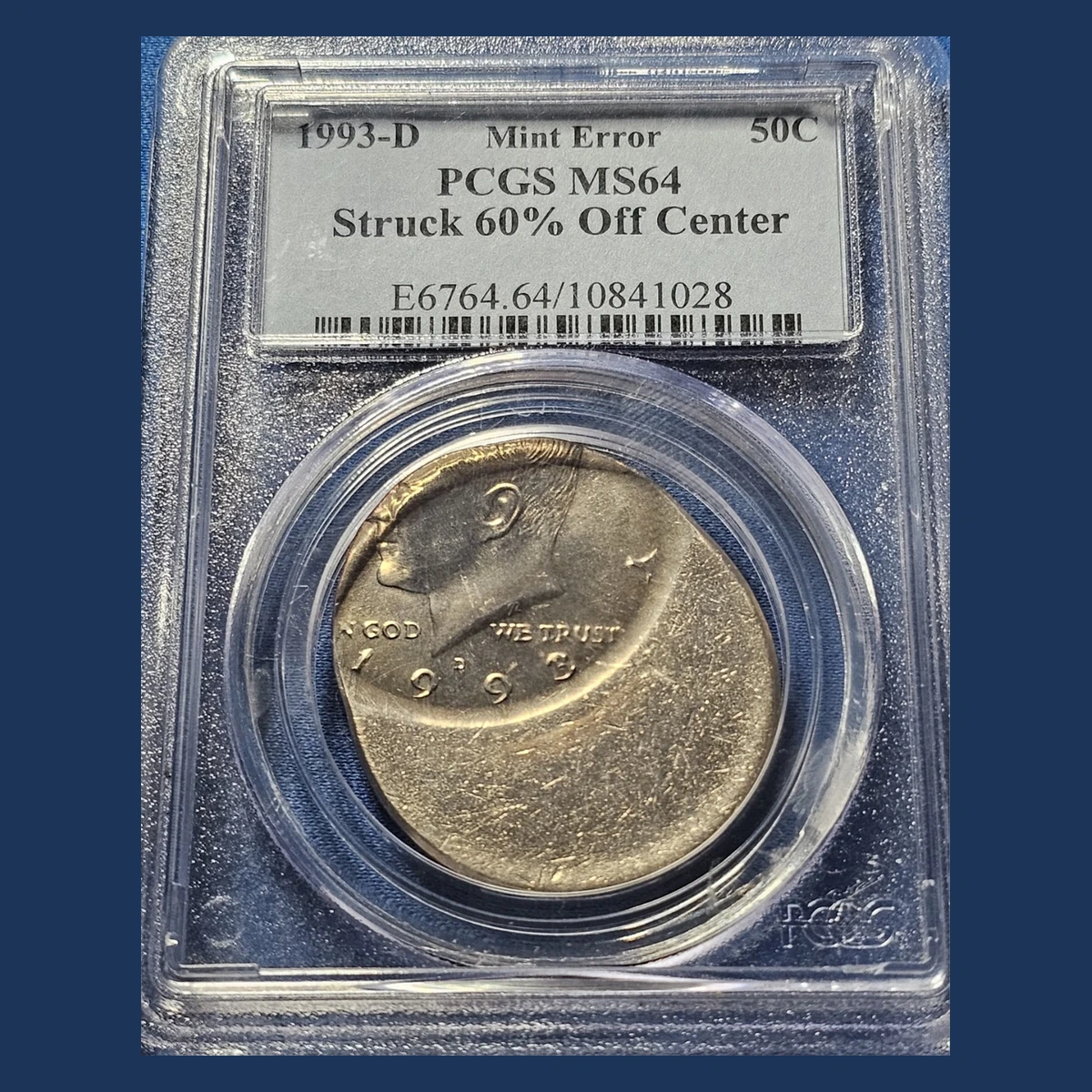
The year list describes a Denver half as sixty percent off center and graded MS64. Its original individual sale record is not supplied, so those details remain the source’s report.
An off-center strike places one picture on a blank sitting well away from its intended position. Missing design should agree with the part of the metal that remained bare.
This is separate from the Denver double strike discussed next. That coin’s second impression was reported eighty-five percent off center.
Check the denomination too. A same-year quarter error cannot provide the identity or price of a Kennedy half.
Estimated Value
For a genuine strongly displaced 1993 half with readable date and mint detail, estimate $100–$1,200. Condition and the balance between remaining design and bare metal affect the price.
A 1991-D struck fifty percent off center sold for $546.25 in 2009. Its MS62 grade describes unworn condition with noticeable marks.
That historical comparison supports the scale of a large error. It does not verify the reported 1993-D grade or turn its sixty-percent description into a confirmed auction result.
How to Identify
Confirm HALF DOLLAR or enough Kennedy design to establish the denomination. Read 1993 and D from the coin itself before comparing the reported percentage.
With a 10× magnifier, inspect where struck design meets bare metal. The boundary should look original, without grinding that removed an existing picture.
Use calipers and a scale when safely accessible against 30.61 mm and 11.34 grams. Record where edge grooves survive and where the blank escaped the retaining ring.
Look for one displaced picture on each face, rather than overlapping impressions from a second blow. Keep both faces visible in photographs.
A single shifted strike beside genuine bare metal establishes the mechanism; readable date and mint detail then identify the coin.
8. 1993 Kennedy Half Dollar Multiple Strike Error (Estimated Up to $2,500)
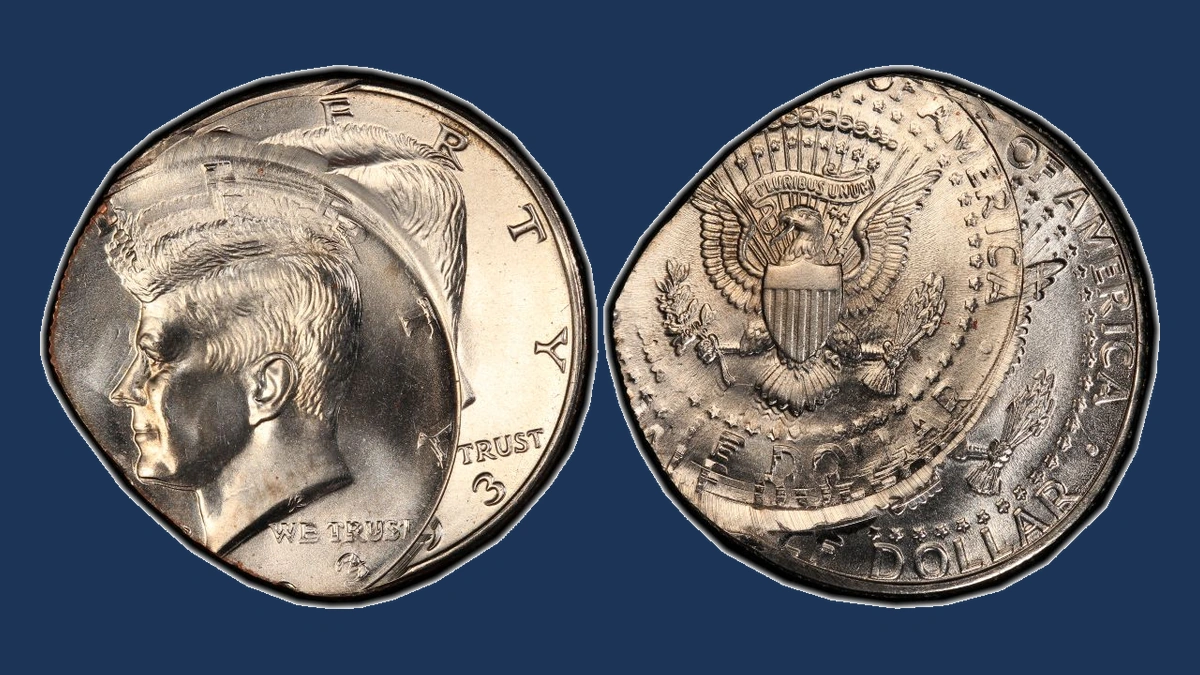
The Philadelphia collector reports a coin struck five times, with four impressions thirty percent off center. It is described as PCGS MS65.
A separate dealer catalog describes a Denver MS62 double strike. Its second impression is eighty-five percent off center and uniface, meaning it did not add a normal picture to both faces.
These are two coins with different sequences. Their surviving portraits and letters must stay with their own examples.
Several extra edges beside one letter do not prove repeated striking. Genuine multiple strikes should show overlapping parts of the design that explain how the coin moved between blows.
Estimated Value
An estimated $300–$2,500 covers a visible double strike through a clear, attractive five-strike example. The collector’s five-strike report supplies no sale price, so the upper end remains an estimate.
A 1998-P double strike sold for $317.20 in June 2026. Its second blow was broadstruck, and its MS64 grade means unworn with some marks.
That different-year sale supports the lower scale. Clearer overlapping pictures, more strikes, and better preservation can bring additional interest.
How to Identify
Trace separate portraits, letters, or date pieces with a 10× magnifier. Follow where one impression covers another instead of simply counting visible lines.
Compare the Philadelphia collector’s example with its own pictures. The Denver dealer coin records a different sequence.
For the uniface second strike, check the corresponding area on both faces. Do not expect every displaced blow to add two complete pictures.
The edge grooves and flowing metal should agree with the overlaps. On safely accessible coins, a scale should stay near 11.34 grams, while calipers may show spreading beyond 30.61 mm.
A consistent sequence of original designs crossing one another is the useful proof of repeated striking.
Conclusion
The estimated $5–$2,500 span begins with small peeling areas and ends with more complicated repeated strikes. A lower price does not make a feature less real; it often means the change is smaller or more common.
Keep each coin’s mint, finish, and metal identity with its photographs. The 11.0-gram clip, top-border Proof interruption, and separate multiple-strike reports each need their own comparison rather than a shared dramatic label.