1912 Half Dollar Error List with Pictures

One half dollar carried both 1902 and 1912 dates—and sold for $5,175 at Heritage in 2012. The Mint had stamped a new design onto an older coin.
Other 1912 half dollar errors are easier to spot: peeling metal or an eagle that faces sideways when you flip the coin. Estimated values run from $50 to $5,175.
Here is how to recognize each error and compare its price.
1. 1912 Barber Half Dollar Lamination Error (Up to $150, Estimated)
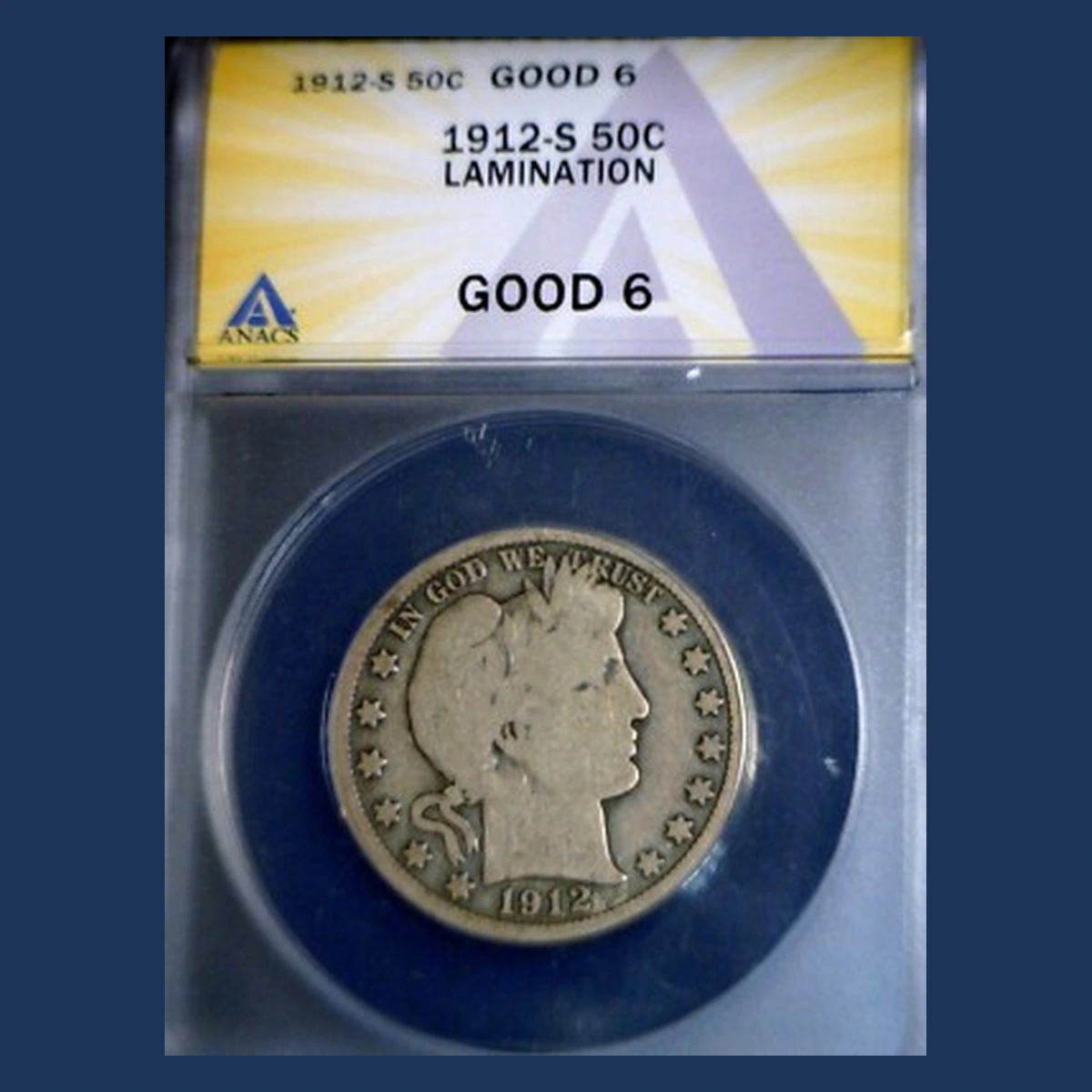
A thin layer of metal is peeling from the front of this 1912 Philadelphia half dollar. This type of error is called lamination.
The metal was weak before the coin was made, often because of impurities or poor mixing. Its surface layer could then split or fall away.
Barber half dollars contain silver mixed with copper; they are not plated. This peeling comes from within that metal mixture.
The auction example was worn and cleaned. ANACS graded it Fine 15 Details, a label that records wear and a condition problem separately from the error.
Estimated Value
A cleaned example with peeling on the front sold for $69 at Heritage on March 23, 2026. ANACS had graded it Fine 15 Details.
For worn coins with a visible lamination, use an estimated $50–$150. Small flakes and heavy wear tend to bring less.
A larger peeling area can attract more interest. Better remaining detail also helps, especially when the surfaces have not been cleaned.
How to Identify
Look at the edge of the peeling patch with a 10× magnifier. You may see a thin flap still attached, or a shallow rough patch where it came away.
Do not lift the flap. It can break off.
Compare the surrounding metal with the rest of the coin. A deep gouge often pushes metal aside, while a crack in the stamping tool leaves a raised line.
Check a loose coin with a scale and calipers. An unworn Barber half dollar weighs 12.50 grams, measures about 30.6 millimeters, and has grooves around its edge.
Wear or missing metal can reduce the weight. To check quickly, compare the lifting layer with these photos of genuine lamination.
2. 1912 Barber Half Dollar Rotated Dies Error (Up to $250, Estimated)
Flip the coin over and the eagle points sideways. That quarter turn is the key feature of this error.
The Barber Coin Collectors’ Society records a worn 1912 Philadelphia example whose back design turns 90 degrees clockwise from its normal position.
The two dies—the tools that stamp the front and back—were not lined up correctly. One was installed at an angle or moved during use.
Each face can still look complete and normal on its own. You only see the problem when you compare their positions.
Estimated Value
A genuine 1912 example with about 90 degrees of rotation has an estimated value of $100–$250 in worn Fine to Very Fine condition.
For comparison, a 2000-P half dollar rotated 75 degrees sold for $79 in March 2025. A rotated 1966 SMS half dollar brought $109 in March 2026.
Those are newer coins. The 1912 estimate allows for its older silver design and larger turn.
How to Identify
Hold Liberty upright and flip the coin from top to bottom, without turning it sideways. A normal coin will show the eagle upright too.
With a 90-degree rotation, the eagle ends up sideways. Repeat the flip to make sure your hand did not twist.
A clear holder with a marked reference line can help. A single photo cannot show whether the coin was held straight.
Use a magnifier to look for seams around the grooved edge, which can suggest an altered coin. Check a loose example against the usual 12.50-gram weight and 30.6-millimeter diameter with a scale and calipers.
The quickest test is one steady top-to-bottom flip that shows both faces without any sideways movement.
3. 1912-D Barber Half Dollar Overstrike Error (Up to $5,175)
There are two readable years on this coin. The older 1902 date sits slightly left of the later 1912 date, and all four old digits remain visible.
A finished 1902 half dollar entered the press again. Denver dies stamped the 1912-D design onto it, leaving parts of the earlier design underneath.
Collectors call this an overstrike. It is different from a single date with doubled edges.
NGC graded the auction example Fine 15, meaning it shows considerable wear. Even so, both dates and other parts of the old design survived.
Estimated Value
Heritage sold the NGC Fine 15 example for $5,175 on March 11, 2012. A similar genuine coin in worn condition has an estimated value of $4,000–$5,175.
The two readable dates are central to that comparison. An ordinary doubled date is a different error and does not belong in this price range.
Use the 2012 sale as a historical reference. Clear surviving details and professional authentication matter here.
How to Identify
Start by finding all four digits of 1902. They should sit slightly left of 1912, rather than form a second outline of the same year.
A 10× magnifier and angled light help separate the overlapping numbers. Next, follow the older design away from the date.
Check for the D on the back, which identifies the later Denver strike. Scratching another date into a coin would not create the remaining older design.
The original coin was also a half dollar, so normal size is expected. A loose example can be checked against 12.50 grams, about 30.6 millimeters, and a grooved edge; wear can lower its weight.
For the fastest comparison, match both years and the surviving older design to photos of the certified auction coin.
Conclusion
These three errors leave very different clues: peeling metal, a sideways eagle, or two overlapping dates. The estimated range runs from $50 to $5,175, with the two-date overstrike at the top.
Begin with the feature you can see. Compare the condition with the examples above, and use a steady flip to check rotation before deciding that your coin has this error.