1898 Half Dollar Error List with Pictures

An ordinary 1898-S half dollar set a $25,300 auction record in 2010 through exceptional preservation. That result was not a documented sale of its upside-down S variety.
These 1898 half dollar errors have estimated values of $150–$10,000. Some involve tiny date or mintmark details; others interrupt the design or expand the coin’s outline.
Read on to compare a small O, an inverted S, and the larger striking mistakes.
1. 1898 Barber Half Dollar Reported Repunched Date (Estimated Up to $500)
An extra curved piece beside 9 or the final 8 may show an earlier date impression. The worker punched the date into a die, the steel stamping tool, more than once.
If the punch moved, parts of the first numbers could remain beside the final date. Those shapes then appeared on coins made with the tool.
An older report points to the last two digits. Another guide mentions San Francisco, but the reports do not establish one shared mint-specific pattern.
Do not assume a downward extra stroke or an S mintmark without seeing the actual coin and a matching example.
Estimated Value
Estimate $150–$500 for matching circulated examples from Fine through Extremely Fine, meaning noticeable through lighter wear. The 1898-S guide gives ordinary values from about $150 at F12 to $500 at XF45.
Those figures are for normal coins, not repunched-date auction results. They provide a condition comparison for San Francisco.
They do not prove that every reported repunched date is from that mint. A visible earlier number shape and the coin’s own mint must agree.
How to Identify
Enlarge the full date, then examine 9 and the final 8 with a 10× magnifier. Move the light to see whether an extra curved shape stays visible.
Compare with a normal half dollar, not an 1898 dime. The same date on different denominations does not mean the tools or varieties were shared.
Photograph the back and record the mint letter separately. A scale and calipers can compare a loose half with 12.50 g before wear and about 30.6 mm; inspect the grooved edge too.
Shadows and flat shelves can imitate extra strokes. Begin with a rounded earlier number piece matching a known half dollar of the same year and mint.
2. 1898 Barber Half Dollar Reported Strike-Through (Estimated Up to $750)
A small hollow or weak patch can show where material blocked the stamping tool. The surrounding design may remain sharper because it received normal pressure.
The 1898 guide includes strike-throughs without naming one particular object or location. The coin’s surface must show what was interrupted.
A hard obstruction may leave a depression, while softer material can suppress detail without staying attached. Neither requires the foreign material to remain on the coin.
The report does not identify grease or another substance. A shallow mark could also come from later damage or ordinary weakness, so its edges and nearby details matter.
Estimated Value
For a genuine modest strike-through on a circulated coin, estimate $150–$750. This values the complete half dollar, including its mint, wear, and surface condition.
An ordinary 1893-O graded PCGS AU55 sold for $840 at Heritage in September 2025. AU55 describes light wear.
That earlier coin is not an 1898 error sale. It provides context for the value already present in a collectible Barber half, rather than establishing a separate price for the interrupted design.
How to Identify
Photograph the affected area under soft light and then with light from the side. Use a 10× magnifier to see whether the design was blocked or cut away later.
A gouge may push metal into a ridge beside it. Corrosion can leave a rough hollow, while ordinary wear generally flattens exposed high points more widely.
Compare the mark with untouched detail immediately around it. Inspect both faces because the report does not establish one side.
For a loose coin, use a scale and calipers against 12.50 g and 30.6 mm, and inspect the grooved edge. The clearest clue is a small interruption in the design beside undamaged, normally struck silver.
3. 1898-O Barber Half Dollar Reported Small O Mintmark (Estimated Up to $850)
The O on a reported Jules Reiver collection coin was described as the size of a dime’s mintmark. The Barber Coin Collectors’ Society recorded the coin as VF35, meaning moderate wear.
This is a claim about the letter’s dimensions. Two photographs enlarged by different amounts can make ordinary letters look unequal.
The reported size suggests a comparison with a dime punch, but does not prove which punch made the mark. Both outside height and width need attention.
This 1898 observation is separate from the well-known 1892-O Micro O variety. The earlier coin’s name and value should not be transferred here.
Estimated Value
Estimate $500–$850 for a matching circulated coin in Very Fine condition, similar to the reported Reiver example. Ordinary 1898-O halves already account for much of that amount.
PriceCharting lists a PCGS VF35 sale at $680 in December 2025. That was an ordinary-coin comparison, not a verified small-O transaction.
The estimate does not borrow the famous 1892-O Micro O premium. A properly measured letter and matching coin history are needed for this specific report.
How to Identify
Compare photographs at the same physical scale. Measure the O’s outside height and width below the eagle’s tail, rather than judging the size of its center hole.
Use a 10× magnifier to check whether wear has flattened or distorted the letter. Compare a regular 1898-O half and an appropriate dime without enlarging each mintmark separately.
The society’s Reiver report gives the historical example. A scale and calipers can check a loose half against 12.50 g and 30.6 mm, with a grooved edge.
Use recorded measurements for a sealed coin. The direct test is a smaller outside O outline at equal scale, not merely a narrow opening inside the letter.
4. 1898-O Barber Half Dollar Broadstrike (Estimated Up to $3,500)
A broadstruck half can be wider than normal while keeping its complete design. The collar, a ring that controls width during striking, did not fully contain the silver.
Metal spread outward beyond its usual boundary. The edge and the design together show the effect.
An 1898-O graded NGC AU58 appears in a dealer list and a Heritage catalog. AU58 means only slight wear.
Neither description provides a measured diameter here. Also, matching date, mint, and grade do not prove that both listings show the same physical coin; photographs are needed to connect those separate appearances.
Estimated Value
The 2007 Al’s Coins list asked $2,250 for an AU58 broadstrike. Estimate $2,250–$3,500 for a comparable 1898-O, using that historical offer and older Barber half guide values around $2,500–$3,000.
A Heritage catalog also identifies an NGC AU58 example of this date and mint. That appearance alone does not provide a completed sale price.
The estimate combines an asking price with guide comparisons. It does not claim that a buyer paid the upper amount.
How to Identify
Trace Liberty, the eagle, and all the outer lettering. A broadstrike should keep the design inside the metal even where the border grows unusually wide.
The AU58 auction listing provides a specific New Orleans example. Use a 10× magnifier along the border and edge to look for natural outward spread rather than crushed detail.
Measure several spans with calipers against the normal 30.6 mm diameter. A scale can compare a loose coin with 12.50 g before wear; spreading metal does not itself remove it.
Check for loss of normal edge grooves. The immediate clue is a complete design within an enlarged outline that has not been flattened afterward.
5. 1898 Barber Half Dollar Reported Off-Center Strike (Estimated Up to $8,500)
A blank crescent remains beside the shifted design on an off-center half dollar. At the opposite side, some intended detail misses the metal entirely.
The blank was in the wrong position when the stamping tools came down. This differs from cutting part of a finished coin away.
The 1898 guide reports a range of shifts without establishing a graded coin at every stated percentage. Each actual example needs its own examination.
The mint must be read from surviving design. If the mintmark area is missing, that does not prove Philadelphia rather than a branch mint whose letter was never struck.
Estimated Value
Estimate $2,500–$8,500 for substantial, genuine off-center Barber halves with readable dates. Small shifts belong below the dramatic examples used for the higher comparison.
An 1894 half struck 40% off center sold for $7,800 at Heritage in December 2022. Its NGC AU53 grade indicates light wear.
That is a different-year auction result, not a documented 1898 sale. The large amount of shift and the coin’s preservation must stay part of any comparison using its price.
How to Identify
Follow the blank crescent toward the struck design with a 10× magnifier. Original untouched metal should differ from grinding marks or an edge cut through finished detail.
Compare both faces without turning one photograph independently. A shifted tool may affect only one side, while a misplaced blank should explain both incomplete designs.
Read every digit of 1898; resemblance to another Barber half cannot replace the date. A scale and calipers can compare a loose coin with the normal 12.50 g and 30.6 mm, recording its changed outline.
Inspect surviving edge grooves for alteration. The clearest combination is a readable 1898 date, missing design on both faces, and the matching original blank crescent.
6. 1898-S Barber Half Dollar Inverted S Mintmark (Estimated Up to $10,000)
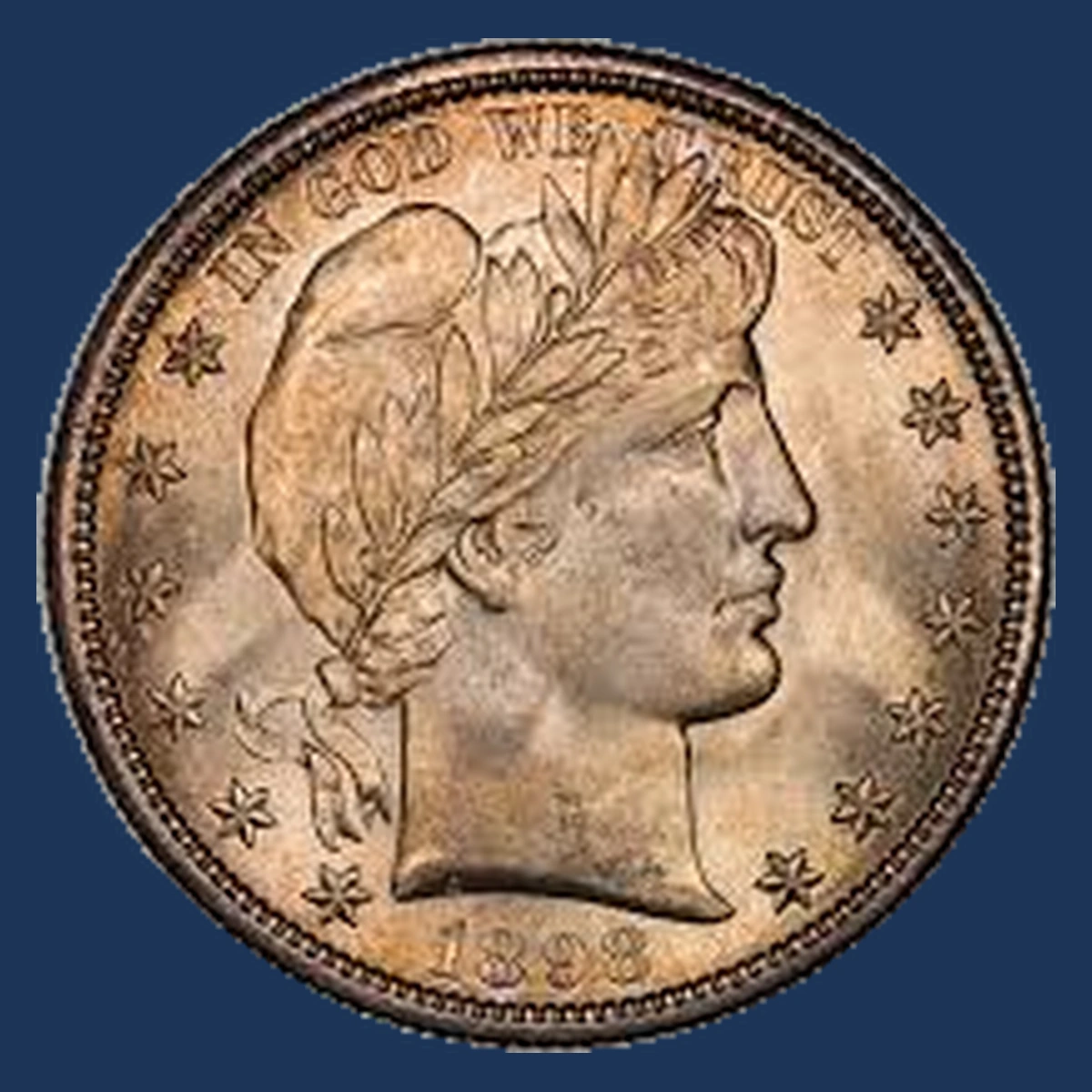
An S does not look exactly the same when turned upside down. Its top and bottom ends have different shapes, which help identify this inverted-mintmark variety.
The mintmark punch entered the stamping tool upside down. Coins made with that tool then copied the reversed letter beneath the eagle.
Collectors catalog the 1898-S half dollar variety as FS-501. It differs from a slightly tilted S or an earlier letter remaining beside a repeated punch.
Look at the whole letter. Wear, lighting, or a damaged end can make one small part misleading without showing a truly reversed S.
Estimated Value
Greysheet’s guide lists MS65 at $8,250 and MS65 CAC at $10,000. These describe unworn coins with few marks, supporting an estimated $8,000–$10,000 at that quality and $200–$1,200 for circulated examples.
The $25,300 ordinary 1898-S record from August 2010 is not an identified FS-501 sale. It reflects exceptional preservation.
The figures for the inverted S are guide comparisons, not that auction result. Confirm the letter before applying them.
How to Identify
Hold the back upright and examine the S below the eagle’s tail with a 10× magnifier. Follow both ends and the curve connecting them.
Turning an image of a normal S upside down helps explain the difference. Identification still requires a match with an actual FS-501 coin, rather than a casually tilted letter.
Inspect nearby silver for disturbance from an added or altered mintmark. Use a scale and calipers for a loose half against 12.50 g and 30.6 mm, checking the grooved edge too.
A sealed example can use recorded measurements. The decisive visible match is both reversed ends and their connecting curve, with the coin itself held upright.
Conclusion
Estimated prices for these 1898 halves range from $150 to $10,000. The small O needs equal-scale photographs, while the inverted S needs a clear upright view of the entire letter.
For the larger striking errors, compare both faces and the edge. Keep ordinary coin values, guide estimates, dealer offers, and completed sales distinct, since they do not all describe money paid for the same feature.