1892 Half Dollar Error List with Pictures

An unusually small O helped a heavily worn 1892 half dollar sell for $8,550 at Heritage in April 2025. That Micro O variety is one of five features covered here.
These 1892 half dollar errors belong to the Barber design, with Liberty’s head and an eagle. The same-year Columbian commemorative is a different coin.
Estimated values range from $200 to $9,500 for the conditions described. Read on to compare extra date strokes, repeated designs, and unusual mintmarks.
1. 1892 Barber Half Dollar Repunched Date Error (Estimated Up to $500)
Traces of an earlier date sit below the main digits on the reported Philadelphia variety. Collectors call that direction south when the coin is held upright.
The date was punched more than once into the die, the steel tool that stamped the coin. Part of the first impression survived below the later one.
The extra strokes are raised. They came from the stamping tool rather than someone cutting another date into a finished coin.
Make sure you have the Barber design. The 1892 Columbian half dollar has repunched dates, but it shows a different portrait and needs reference pictures.
Estimated Value
Estimate $200–$500 for a clearly identified repunched date with only light circulation wear. This condition is often described as AU, or About Uncirculated.
An 1892 tripled-reverse half graded AU50 sold for $336 at Heritage in November 2024. It provides a same-year price comparison for a different variety.
That is not a repunched-date sale. The proposed range depends on clear old date strokes and comparable surfaces, rather than a recorded transaction for this reported feature.
How to Identify
Level the date before taking a close-up. Look below the main digits for raised strokes that could belong to an earlier impression.
Use a 10× magnifier and light from both sides. Flat ledges can come from movement during striking, while a nick may push metal beside a digit.
Keep enough background in the picture to judge the shapes. Confirm Liberty’s Barber portrait, the eagle on the back, and no mintmark.
An unworn coin weighs 12.50 grams and measures about 30.6 millimeters; check with a scale and calipers.
Its edge has ridges. A matching lower date impression on a known 1892 Barber gives the direct identification test.
2. 1892 Barber Half Dollar Doubled Die Obverse Error (Estimated Up to $650)
Repeated edges on IN GOD WE TRUST and the nearby stars are the reported clues on the front. The Barber Coin Collectors’ Society survey names both areas.
These coins were made with a doubled die. The stamping tool already carried repeated design detail before it touched the metal blank.
That differs from a tool slipping during one strike. A prepared doubled design can appear again on other coins from the same tool.
Check more than one letter. A thick date digit alone cannot show this reported pattern, and repunching the date is a separate feature.
Estimated Value
The estimated range is $250–$650 for an identified example with light wear, around AU condition. Clear repeated shapes in the motto and stars help support the identification.
For context, an AU50 1892 tripled reverse sold for $336 in November 2024. That coin has a different pattern on the opposite face.
The comparison is not a sale of this doubled front. Surface condition, remaining detail, and the strength of the visible doubling all matter.
How to Identify
Choose several letters in IN GOD WE TRUST, then compare neighboring stars at the same magnification. A 10× magnifier helps reveal rounded extra outlines or divided star points instead of broad, low ledges.
Check the full coin before deciding on the variety: it should be a Philadelphia Barber half without a mintmark. A ridged edge, a diameter near 30.6 millimeters, and an original weight of 12.50 grams provide basic checks with calipers and a scale.
Movement during striking can create flat doubling that deserves a different explanation. Agreement across the motto and stars with a documented 1892 example is more useful than one mark that happens to look doubled.
3. 1892 Barber Half Dollar Tripled Die Reverse Error (Up to $960)
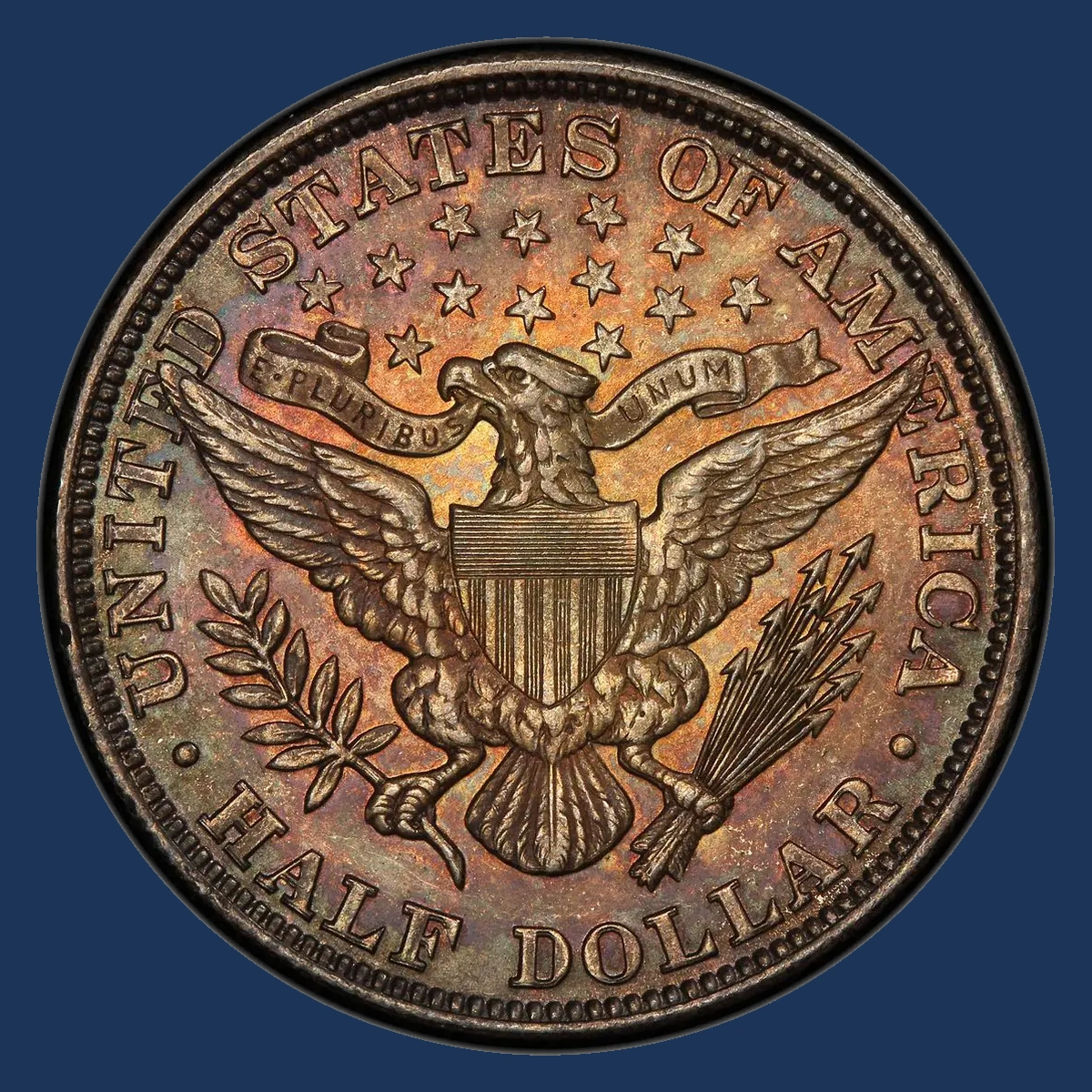
The letters around the eagle, nearby stars, and ribbon ends can show several repeated outlines. The recognized Philadelphia variety is called FS-801, the 1892 tripled die reverse.
Reverse means the back of the coin. Its stamping tool received repeated design impressions while being made, and later coins copied the resulting pattern.
The finished coin was not struck three times. The repetition was already present in the tool.
These back details also stand apart from the doubled motto discussed above. A coin can show the recognized reverse pattern without showing the reported doubling on the front.
Estimated Value
Two lightly worn examples offer useful comparisons. Greysheet records $960 for an NGC AU58 FS-801 at Stack’s Bowers on January 28, 2026, and $336 for PCGS AU50 at Heritage on November 12, 2024.
Estimate $300–$1,000 for comparable AU coins. AU58 generally retains more detail than AU50, although surfaces also affect value.
These are different coins and sales. The $960 result is not an automatic added charge for every tripled reverse.
How to Identify
Keep a photograph of the whole back beside your close-ups. This helps locate repeated details in the outer letters, stars, and ribbon ends.
Compare each area with a photographed FS-801 through a 10× magnifier. Wear can hide some outlines, so three equally clear copies need not appear everywhere.
The Philadelphia coin has no mintmark. Its normal specifications are 12.50 grams and about 30.6 millimeters, checked with a scale and calipers, with ridges around the edge.
Shiny reflections and flat ledges should not be counted as extra design impressions. Agreement at several known points on the back is a more reliable quick check than counting outlines on one letter.
4. 1892-S Barber Half Dollar Repunched Mintmark Error (Estimated Up to $1,600)
Look at the small stroke at the top of the S, called its serif. On the reported 1892-S/S, a trace of an earlier serif appears to its left.
The mintmark punch had been applied in more than one position. A piece of the first S remained visible beside the final letter.
West means left with the back upright. Keeping that direction fixed helps when comparing close photographs.
The shape matters as much as the position. A bump caused by damage can sit beside the S without copying any part of an earlier letter, so a lump alone is not enough.
Estimated Value
For an identified S/S with light wear around XF condition, estimate $800–$1,600. PriceCharting lists ordinary PCGS XF45 eBay sales of $1,071.50 in August 2025 and $1,207.50 in April 2026.
Those sales concern normal 1892-S coins, not confirmed S/S examples. They show that the date and mint already carry substantial value.
The estimated variety range also requires a convincing earlier serif. It does not assume every extra mark adds a large premium.
How to Identify
Find the S below the eagle and hold the back upright. Through a 10× magnifier, compare the upper serif with the earlier trace just to its left.
Keep that orientation fixed.
A scale and calipers check the usual 12.50 grams and 30.6 millimeters, allowing for wear; the edge has ridges. Look around the S for disturbed metal or signs of a mintmark added later.
A broken spot in the stamping tool can leave a lump, but the lump may not resemble any part of an S.
Shape and position must agree. Match the leftward upper-serif trace with a documented example for the most focused identification test.
5. 1892-O Barber Half Dollar Micro O Mintmark Error (Estimated Up to $9,500)
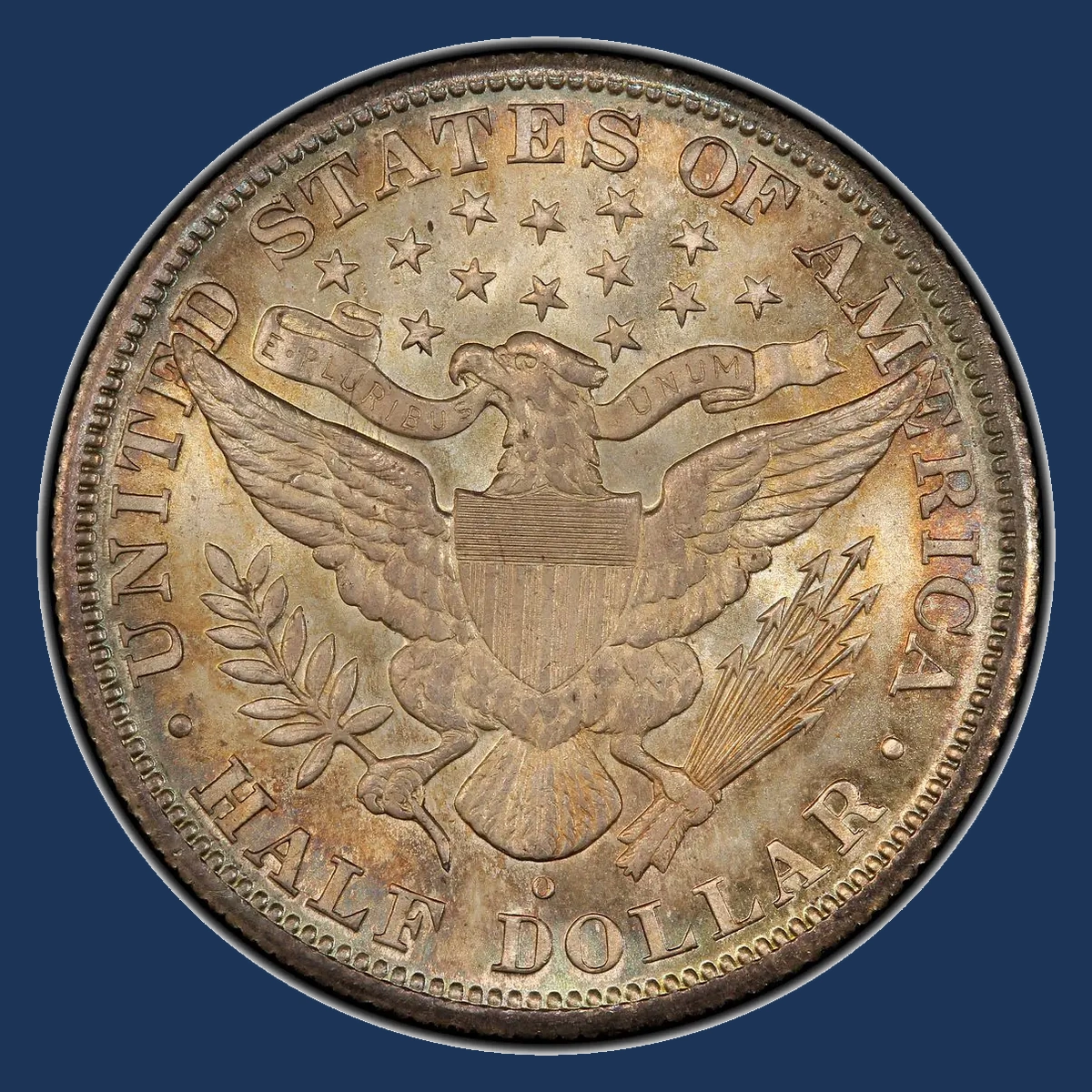
The O below the eagle is noticeably smaller than normal. It came from a punch intended for a quarter, used by mistake on one half-dollar stamping tool.
NGC describes this wrong-size punch as the source of the Micro O variety. The O still identifies New Orleans.
The coin itself is full-sized. It was not struck on a quarter’s metal blank.
Compare the complete letter with a normal O at the same scale. Weak striking, wear, or a shadow can hide part of an ordinary mintmark and make it seem smaller in a photograph.
Estimated Value
Greysheet’s auction records list Heritage sales of $5,760 for PCGS Good 4 in June 2025 and $8,550 for PCGS VG8 CAC in April 2025. Both are heavily worn grades.
An estimated $4,000–$9,500 covers comparable lower-grade Micro O examples. Better-preserved coins need their own comparisons.
The mintmark must be the recognized small shape. An ordinary O partly hidden by wear does not receive the same value simply because it looks tiny.
How to Identify
Use equally enlarged photographs of a suspected Micro O and a normal 1892-O. Different image sizes can create a false difference or hide a real one.
Examine the complete outline with a 10× magnifier. Do not judge only the bright part of a worn or shadowed letter.
A scale and calipers should still show the half dollar’s usual 12.50-gram unworn weight and approximate 30.6-millimeter diameter. The edge has ridges; the small mintmark does not mean a smaller coin.
Inspect the O for cuts that could have reshaped it. Matching its full size and shape to an authenticated Micro O is the clearest way to confirm the variety.
Conclusion
Estimated values run from $200 to $9,500 for the grades and varieties discussed. The Micro O has the highest range here, but its small letter needs a careful size comparison.
For the other features, follow the extra strokes below the date, around the motto, across the back, or beside the S. Always confirm the Barber design, mint, and condition before using a sale as your price guide.