1855 Half Dollar Error List with Pictures

Two unusual features share the 1855/54 half dollar that sold for $17,825 in August 2011. Its date has an extra-looking mark, and a thin depression lies near Liberty’s chest.
Stack’s Bowers sold that finely preserved PCGS MS65 coin. It is very different from a worn New Orleans half with small raised cracks.
The 1855 half dollar errors below span estimated values of $200–$18,000 across those conditions. Follow the letters, date, and chest area to see what each feature means.
1. 1855-O Liberty Seated Half Dollar Reverse Die Crack Error (Estimated Up to $500)
Two small raised lines join letters on the back of an 1855-O half. One connects the last S of STATES with the O of OF.
The other joins D in UNITED with the first S of STATES. These locations helped specialists recognize the reported example.
The lines began as cracks in a die, the steel tool that stamps coins. Silver entered the openings during striking and formed narrow raised ridges.
The coin itself did not crack. Both letter connections belong to one pattern, so a similar line beside another S is not enough to identify it.
Estimated Value
For worn but detailed examples around XF to AU grades, estimate $200–$500 for the whole coin. XF coins show some wear, while AU coins have only slight wear.
Two 2022 New Orleans comparisons sold for $311.28 in NGC XF45 CAC and $444 in PCGS AU53 CAC. CAC summarizes those results.
They price ordinary coins of the date and condition. They are not sales of the specific crack pattern, so no separate crack premium is established by them.
How to Identify
Read UNITED STATES OF AMERICA before enlarging the letters. Locate both gaps so you know which S belongs in each comparison.
A magnifier should reveal raised connections at those points. Dirt between letters or a scratch nearby can close the gap visually without showing a real die crack.
Check the O below the eagle. It identifies New Orleans; arrows beside the date are normal for 1855, while rays around the eagle are not.
The unworn standard is 12.44 grams and about 30.6 millimeters, with grooves around the edge. Use a digital scale and calipers when safely accessible, then compare both letter connections with the discovery photos rather than relying on one line.
2. 1855/54 Liberty Seated Half Dollar Traditional Overdate Error (Up to $17,825)
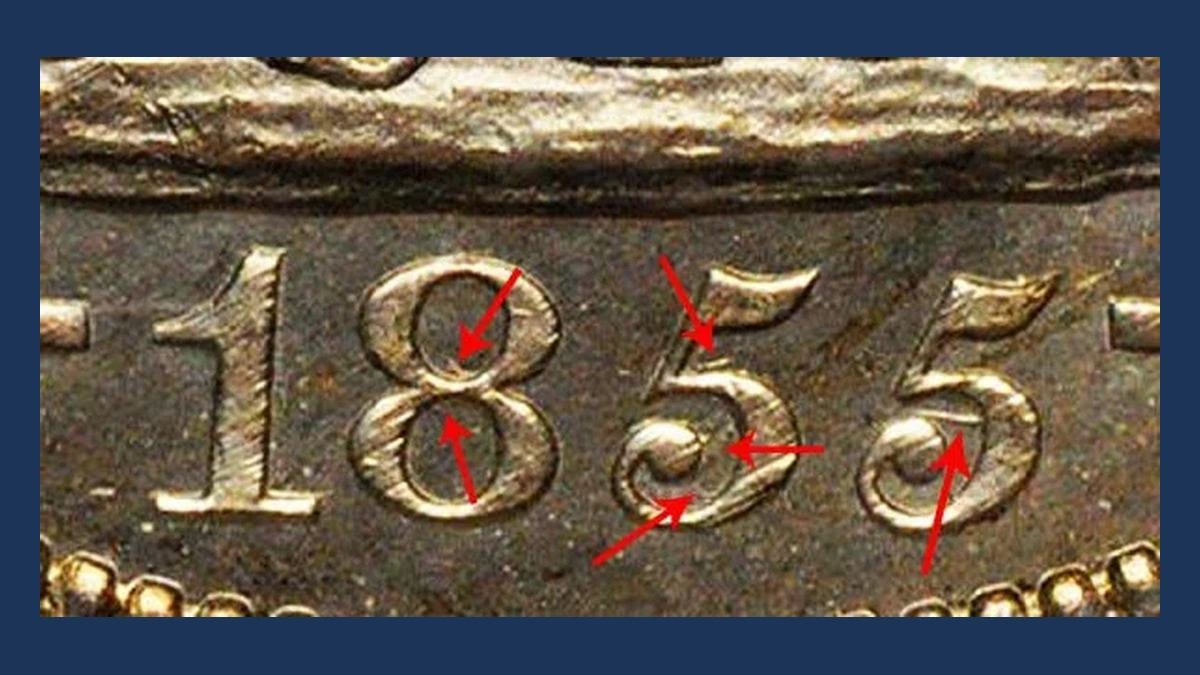
A short crossbar-like mark inside the last 5 led collectors to call this variety 1855/54. Auction catalogs have described it as a trace of an earlier 4 beneath the final number.
The name remains widely used, but the explanation has been questioned. A CAC-published analysis says the visible marks do not conclusively prove an underlying 4.
An overdate means one date was punched over an earlier date in the die. The familiar label identifies this Philadelphia variety without settling that debate.
Compare the actual number shapes. The name does not mean the finished coin was struck twice.
Estimated Value
Worn examples around XF have an estimated $400–$800 range. A PCGS XF40 sold for $468 in September 2025.
Very fine unworn examples have a separate $8,000–$18,000 estimate. The PCGS MS65 sold for $17,825 in August 2011 and appeared again for $10,200 in May 2025.
That same coin has the chest-area depression described next. Its two features do not produce two sale prices to add together.
How to Identify
Enlarge the final 5 and compare the mark inside it with a clear photo of the recognized variety. Then check the nearby numbers, rather than deciding from one horizontal line.
The cataloged MS65 also showed faint earlier outlines around the first 5. Change the light to separate raised detail from a scratch or a bright reflection.
Philadelphia coins have no mintmark below the eagle. The arrows beside the date belong to the normal design.
For a safely accessible coin, use a scale and calipers against 12.44 grams when unworn and about 30.6 millimeters, and inspect the edge grooves. Matching the known date pattern identifies the traditional variety without requiring you to decide what caused every mark.
3. 1855 Liberty Seated Half Dollar Struck-Through Error (Up to $17,825)
Just above and left of Liberty’s chest, a thin depression interrupts the smooth surface. Stack’s Bowers used it to help identify the particular MS65 1855/54 half.
Something lay between the die and the blank when the coin was struck. It blocked normal contact and left a narrow mark after the material was gone.
This is called a struck-through error. The catalog did not identify the object, so the shape should not automatically be called wire or thread.
The mark formed during minting. A later scratch can also look thin, but it damages an already finished surface in a different way.
Estimated Value
The estimated $8,000–$18,000 range applies to a similarly fine unworn 1855/54 coin, not every half with a thin depression. The documented MS65 sold for $17,825 in 2011 and $10,200 in May 2025.
These are the same transactions discussed with the date variety. One coin carries both features.
Its condition and recognized date variety contribute heavily to the price. A small struck-through mark on an ordinary worn half does not create the same five-figure value.
How to Identify
Find Liberty’s chest and keep the nearby folds visible. Inspect the area above and to the left with side lighting and a 10× magnifier.
The reference shows a narrow depression in that location. A normal fold can look like a line if the close-up loses the surrounding design.
Look along the boundary for later damage. Scratching often leaves a sharp cut and displaced metal, while the auction catalog identified this mark as part of manufacture.
Do not try to name the trapped object from its shape alone. When safely accessible, check the edge grooves, 12.44-gram unworn weight, and roughly 30.6-millimeter diameter with a scale and calipers; the same chest-area depression in the reference is the key match.
Conclusion
The date and chest photographs can show two features on the very same half dollar. Remember that when reading its $17,825 and $10,200 sale history.
Estimated comparisons begin at $200 for worn New Orleans coins and reach $18,000 for exceptionally preserved Philadelphia examples. The raised letter connections, disputed overdate explanation, and narrow struck-through mark each require a different visual check, even when their stories overlap.