1851 Half Dollar Error List with Pictures

One 1851 half dollar has an extra 8 hidden among the small teeth below the date. Another, with repeated date strokes and raised cracks, sold for $4,800 in January 2025.
These four 1851 half dollar errors have estimated values of $1,200–$5,500 in the conditions discussed. Read on to compare stray numbers, a flaw beside the cap, and lines left by damaged stamping tools.
1. 1851 Liberty Seated Half Dollar Misplaced Date Error (Estimated Up to $2,000)
The extra 8 sits below the normal date, among the small rim teeth called denticles. It interrupts the border’s regular pattern.
A worker placed the date punch too low on the die, the steel tool that stamps the coin. Part of that misplaced number remained after the normal date was added.
The auctioned example was graded PCGS XF40, indicating light to moderate wear. It is known as WB-8, previously called WB-104.
Those names describe the same variety. Looking only at the four main date digits would miss the extra number in the border.
Estimated Value
The collectors’ auction report records $1,560 for the PCGS XF40 WB-8 in August 2019. Estimate $1,200–$2,000 for similarly worn examples with a clear match.
The whole coin’s condition matters alongside the extra number. Cleaning or damaged metal around the date can reduce its appeal.
An odd-looking rim tooth does not automatically receive this value. The visible curve needs to match the known misplaced 8 on the correct variety.
How to Identify
Photograph the complete date and the border directly below it. Then use a 10× magnifier to find the curved piece of 8 among the rim teeth.
Compare it with a confirmed WB-8 image. A bent tooth, rim dent, or small raised chip can interrupt the border without forming a number.
The extra 8 is separate from the repeated final 1 discussed later. Check that the Philadelphia coin has no mintmark on its back.
Use a scale against 13.36 grams and calipers against about 30.6 millimeters. Inspect the edge grooves for damage.
The quick match is a recognizable extra 8 in the same border position as the known example.
2. 1851 Liberty Seated Half Dollar Planchet Flaw Error (Estimated Up to $4,000)
A small irregular area lies beside Liberty’s cap, just right of star eight. Stack’s Bowers described it as a flaw in the original coin blank.
The blank is the metal disc placed between the stamping tools. A defect already in that disc can remain visible after striking.
The catalog did not call this particular flaw a clip or peeling layer. Its broad description should not be turned into a more specific error without visible evidence.
NGC graded the coin Uncirculated Details for staining. That means no circulation wear but a surface problem, separate from the original metal flaw.
Estimated Value
Estimate $2,500–$4,000 for a similarly unworn 1851 with a small original flaw and comparable surface problems. No completed sale price is supplied here for the cataloged example.
The better-quality repunched-date coin below sold for $4,800 in 2025. It provides a same-date comparison, not a sale of this flaw.
The lower estimate allows for staining and Details condition. Size, surface damage, and the remaining appearance affect the value of the complete coin.
How to Identify
Find star eight and the nearby edge of Liberty’s cap. Use light from the side to show the small irregular area without losing its position.
A magnifier can reveal the boundary and nearby struck detail. A later gouge may leave sharp cuts and pushed-up metal, while corrosion can eat across neighboring designs.
Compare with the cataloged coin instead of assuming every cap-area mark began at the Mint. Staining by itself does not prove the metal was defective.
Use a scale and calipers against 13.36 grams and about 30.6 millimeters, and inspect the edge grooves. Use existing measurements for a sealed coin.
The useful visual match is the original flaw beside the cap, independently of any surrounding stain.
3. 1851 Liberty Seated Half Dollar Repunched Date Error (Estimated Up to $5,500)
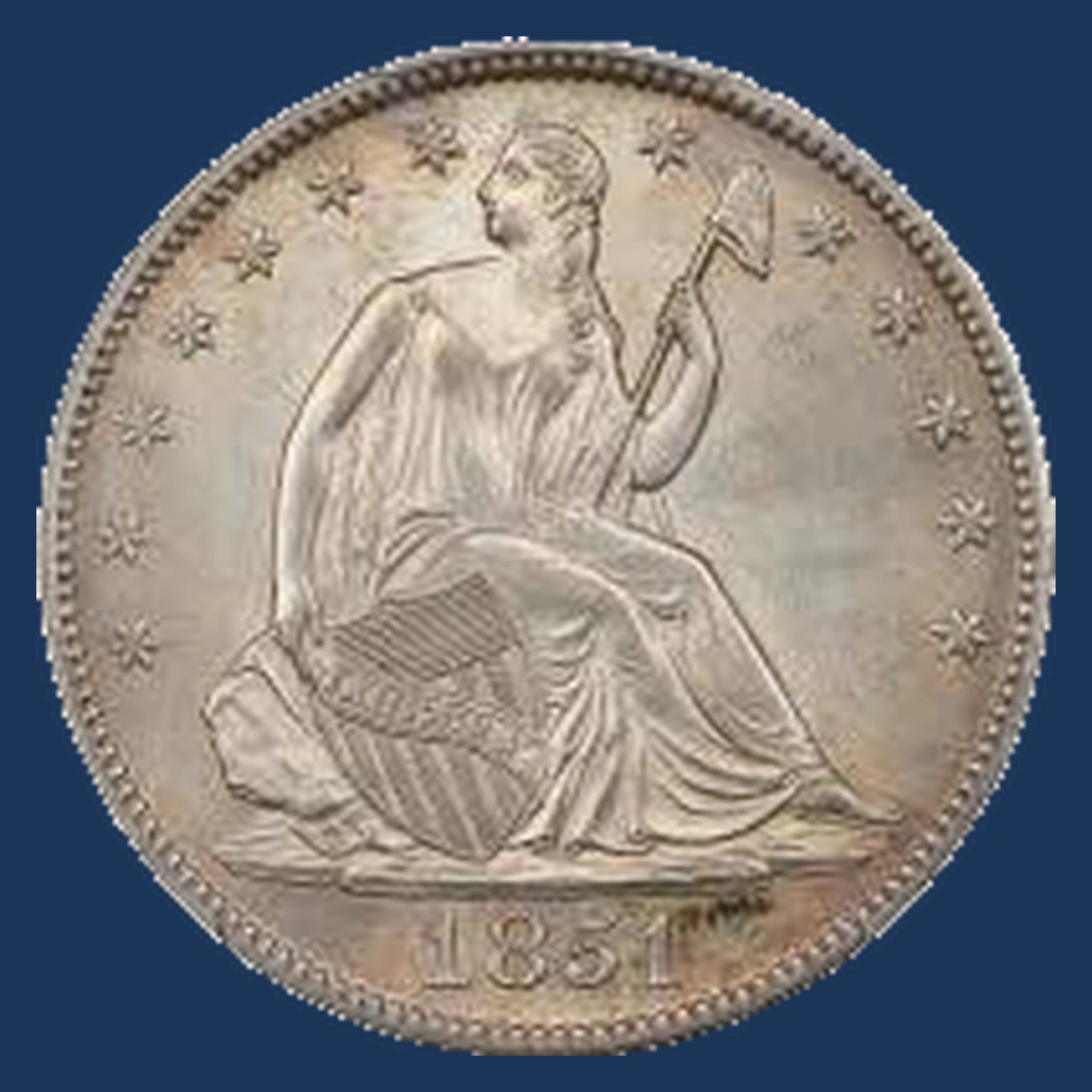
The final 1 has an extra stroke at its upper left on WB-2. It marks an earlier position of the date punch.
The worker applied the punch again after it shifted slightly. The steel tool kept part of the first impression and copied it onto later coins.
The March 2020 catalog describes this feature on a lightly worn EF45 example. Other repunched-date tool combinations need their own picture comparisons.
A nearby pressed-in lint mark appears on another documented coin. It is not part of the raised earlier numeral simply because it lies near the date.
Estimated Value
A PCGS MS62 example sold for $4,800 at Heritage in January 2025. MS62 means no circulation wear but noticeable marks; CAC also approved its quality.
Estimate $4,000–$5,500 for a comparable unworn coin. Worn examples need comparisons in their own grades.
The auctioned coin also carries the cracks described below. Its price covers the complete coin once, rather than a separate payment for each repeated date stroke and raised line.
How to Identify
Bring the final 1 and neighboring 5 into view together. On WB-2, look for a small raised piece of an earlier 1 at the upper left.
Use a 10× magnifier and move the lamp. The extra stroke should form part of a number, not just a thickened edge or changing shadow.
A scratch or pressed-in lint mark cuts below the surface. Keep those separate from the raised numeral.
Compare a loose coin with 13.36 grams on a scale and about 30.6 millimeters using calipers. Check its edge grooves for alteration.
The direct check is a matching earlier number shape at the correct upper-left position on the same repunched-date variety.
4. 1851 Liberty Seated Half Dollar Die Crack Error (Estimated Up to $5,500)
Two raised paths appear on the front of the auctioned MS62 half dollar. One follows the bottom of the date.
The other crosses Liberty’s head between stars seven and eight and reaches the cap’s top. The auction description identifies both on the repunched-date coin.
Cracks opened in the stamping tool, allowing silver to enter during striking. Those narrow spaces became ridges on the finished coin.
The same description mentions a lint impression near the date. That pressed-in mark has a different cause and should not be connected to the raised crack network.
Estimated Value
The $4,800 January 2025 sale belongs to the same PCGS MS62 coin discussed above. An estimated $4,000–$5,500 applies to similarly preserved complete examples.
The price includes the scarce date, condition, repeated date strokes, and cracks together. It does not establish a separate bonus for either raised path.
A heavily worn coin needs a lower-grade comparison even if its cracks remain clear. Do not add this estimate to the repunched-date range for the same coin.
How to Identify
Trace the bottom of the date before moving to Liberty’s head. Both locations need to appear in your photographs.
With a magnifier and light from opposite sides, check that each line rises above the silver. The head crack should match the route between stars seven and eight toward the cap.
Cleaning scratches and the separate lint impression do not follow the same raised pattern. Compare the whole front with the recorded coin.
Check the date and absence of a Philadelphia mintmark. Use a scale and calipers against 13.36 grams and about 30.6 millimeters, then inspect the edge grooves.
The useful match combines both raised paths with the correct repunched-date front.
Conclusion
Estimated values of $1,200–$5,500 cover the different conditions discussed here. Start below the date for the extra 8, beside the cap for the metal flaw, and at the final 1 for repunching.
The raised cracks need their own two-location check. They share one $4,800 auction coin with the repunched date, so identifying both features does not double that coin’s value.