1827 Half Dollar Error List with Pictures

A tiny curve beside the final 7 can reveal an older 6 underneath. An exceptional 1827/6 half dollar sold for $28,200 in January 2013.
Other 1827 half dollar errors show unexpected stars, displaced border teeth, or metal left unstamped. The eight groups below have estimated ranges from $100 to $35,000 across very different conditions.
Read on to compare each feature in its proper place, including a reported coin with more than one error.
1. 1827 Capped Bust Half Dollar Obverse Planchet Flaw (Estimated Up to $600)
A flaw in the metal can interrupt an otherwise normal design. GreatCollections lists an 1827 half dollar with such a defect on the front, graded PCGS VF25, a worn condition.
It calls the feature a planchet flaw. A planchet is the metal disc that receives the coin’s design.
The listing identifies the variety as O-124a, a catalog number for its design details. It does not specify the flaw’s location or describe a peeling sheet.
The name does not explain every hollow on a coin. Compare the actual example’s boundary and texture before calling it a more specific type of defect.
Estimated Value
Estimate $150–$600 for a modest natural flaw on a worn 1827 with much of its detail visible. No sale price is assigned to the listed VF25 here.
An 1832 with a minor rim-metal flaw sold for $263.25 including fees at Pristine Auction in July 2025. It was graded ANACS XF45.
That recent comparison has a different date and flaw location. Larger defects or much finer coins need their own adjustments.
How to Identify
Begin with the listed VF25 photographs, keeping the complete front visible. A close-up of an unidentified hollow cannot establish which coin or defect it shows.
This Philadelphia half has no mint letter and has words around its edge. Calipers and a digital scale can check an accessible coin against approximately 32.5 millimeters and the original 13.48 grams.
Under a 10× magnifier, inspect where the flawed metal meets the design. A later gouge may leave cut surfaces or sharply pushed-up edges.
Match the flaw’s natural-looking boundary and shape on the correctly identified coin. How the original design meets that boundary is more useful than the size of a hollow alone.
2. 1827 Capped Bust Half Dollar Reverse Die Crack Error (Estimated Up to $750)
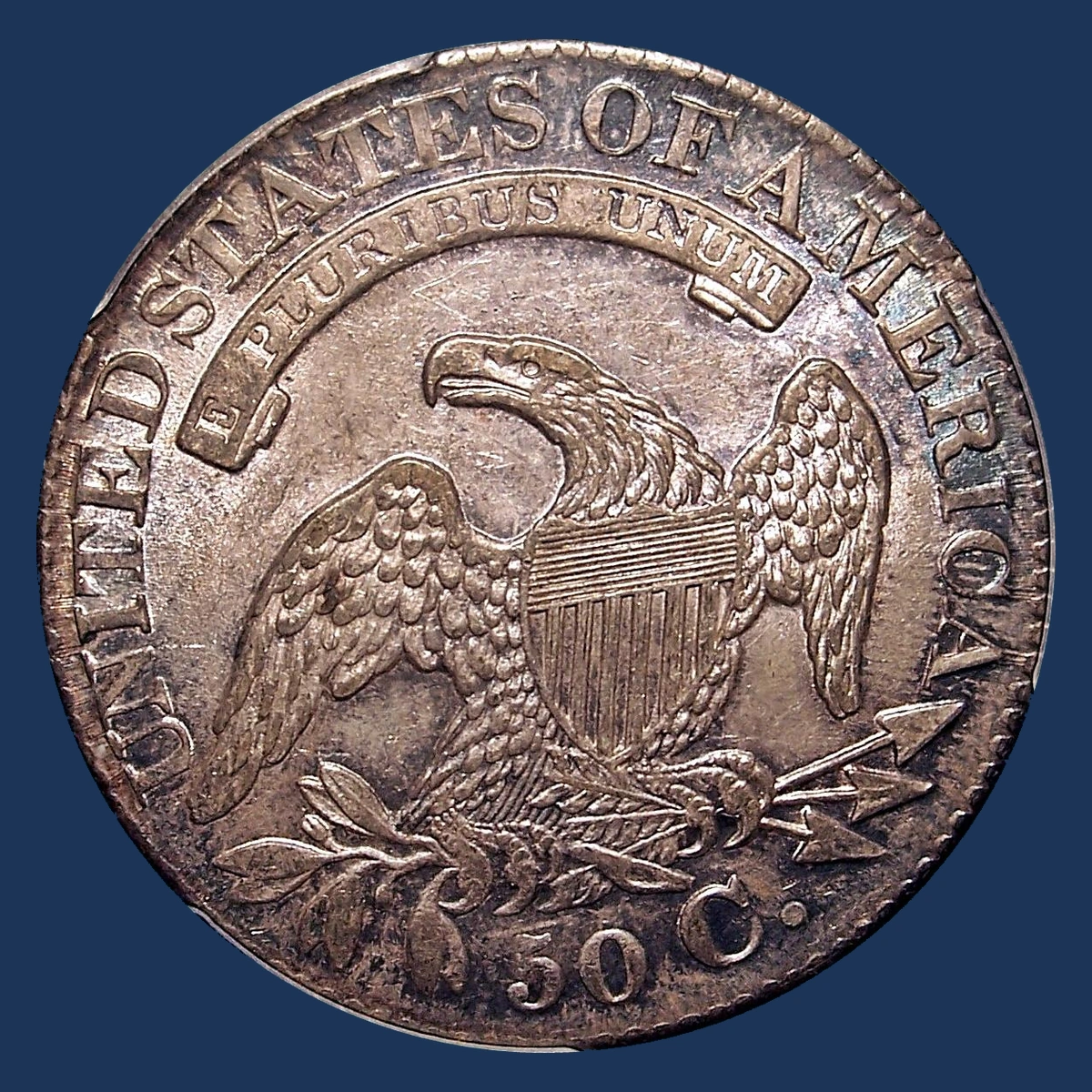
A raised line above UNITED STATES can show where a stamping tool began to split. The tool, called a die, gave the coin both its normal design and this unwanted ridge.
Silver entered the crack during stamping. It therefore stands above the surface, unlike a scratch cut into the finished coin.
The reported examples belong to the O-120 family of cataloged varieties. Their crack lies by the upper back inscription, not beside the date.
The line may grow or become harder to see with wear. Its route across the lettering matters more than how dark it looks in a photograph.
Estimated Value
An estimated $100–$750 covers worn examples with identifiable back-side cracks and no exceptional variety rarity. Remaining detail and surface quality explain much of the range.
A cracked 1826 O-104 graded PCGS AU58 sold for $1,020 including fees in August 2025. Early Cents Auctions sold that almost unworn coin.
Its higher grade supplies context above the ordinary circulated range. It does not make every cracked 1827 worth four figures.
How to Identify
Keep the eagle upright and look above UNITED STATES. Marks beside the front date are in the wrong place to confirm this particular crack.
Use a 10× magnifier while changing the direction of a small light. A ridge should rise from the original surface rather than cut a fresh channel across the design.
Photograph the whole back before making a close-up. Inspect the lettered edge and confirm the Philadelphia coin has no mint letter.
A digital scale and calipers can compare an accessible coin with 13.48 grams and about 32.5 millimeters. The raised route above the correct words is the feature to match; one unrelated line elsewhere is not enough.
3. 1827 Capped Bust Half Dollar Incomplete Planchet Cut (Estimated Up to $900)
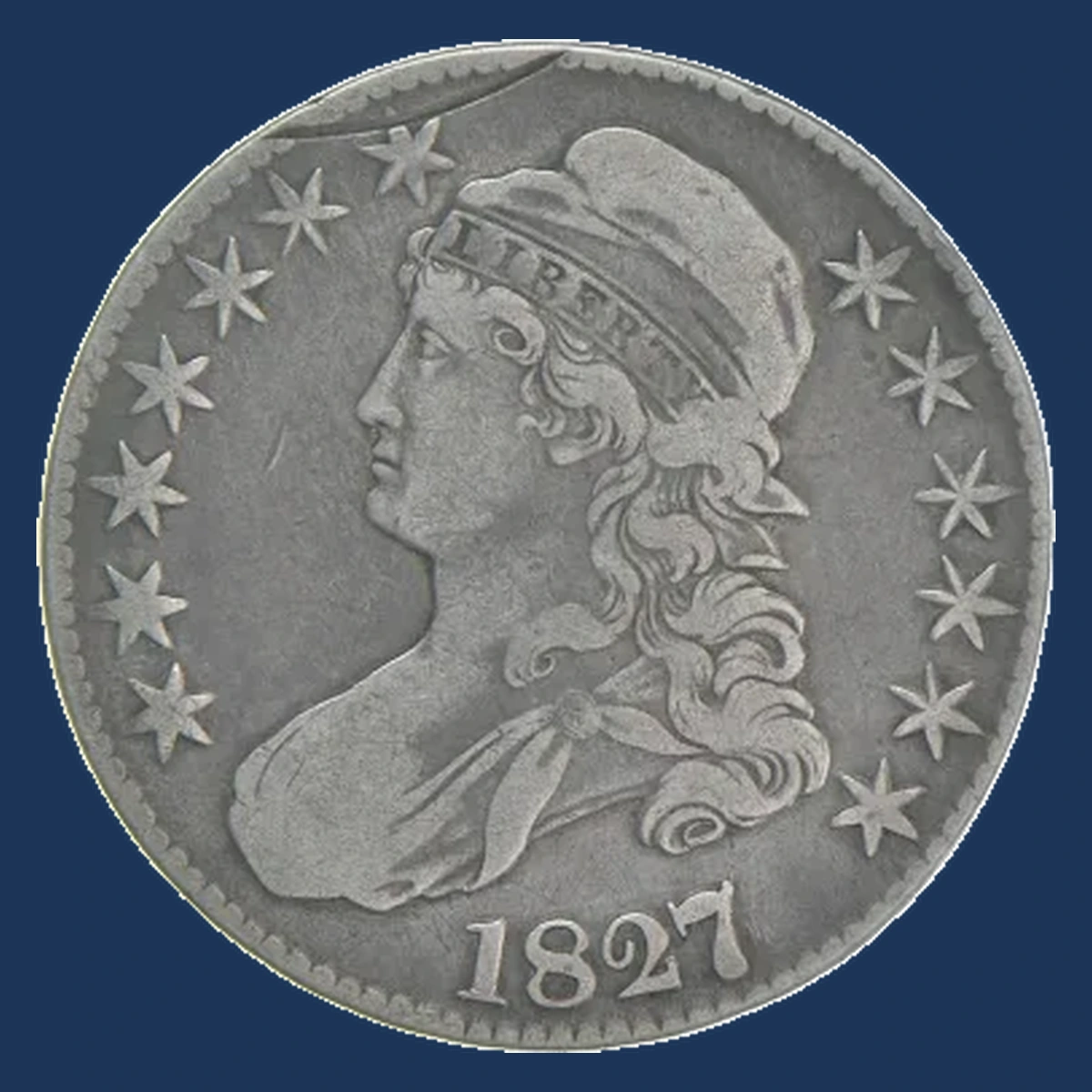
The cutting tool left a trace but did not remove a piece. A collector describes an 1827 O-138 with an incomplete cut at the edge.
Coin blanks were punched from metal strip before stamping. If a punch stopped short of cutting through, a later blank could retain the arc from that earlier attempt.
This explanation fits retained metal rather than a completed clip. A clip would leave part of the intended circle physically absent.
The report gives no clock position for the trace. Inspect the whole edge instead of searching a spot borrowed from a different coin.
Estimated Value
Estimate $200–$900 for a worn 1827 with convincing evidence of an incomplete cut. This is a comparison-based allowance, not the collector’s sale price.
A more ordinary rim-metal flaw on an 1832 graded ANACS XF45 sold for $263.25 including fees in July 2025. That provides a recent starting comparison.
A clear curved punching trace can attract specialist interest. An ambiguous notch or damaged edge does not justify the stronger prices.
How to Identify
Turn the coin slowly under a 10× magnifier and follow any curved edge trace. The question is where the cut stops inside metal that remains attached.
Use low light to reveal its depth and take overlapping photographs. Saw lines, a straight tool cut, or crushed edge words can point to damage after minting.
Check the rest of the lettered edge and the Philadelphia faces without a mint letter. A digital scale and calipers can compare accessible coins with the original 13.48 grams and roughly 32.5 millimeters, allowing for wear.
An unfinished curved cut continuing into attached metal supports the reported punching error. Missing metal alone would describe a different feature.
4. 1827 Capped Bust Half Dollar Clashed Dies (Estimated Up to $1,200 for Circulated Coins)
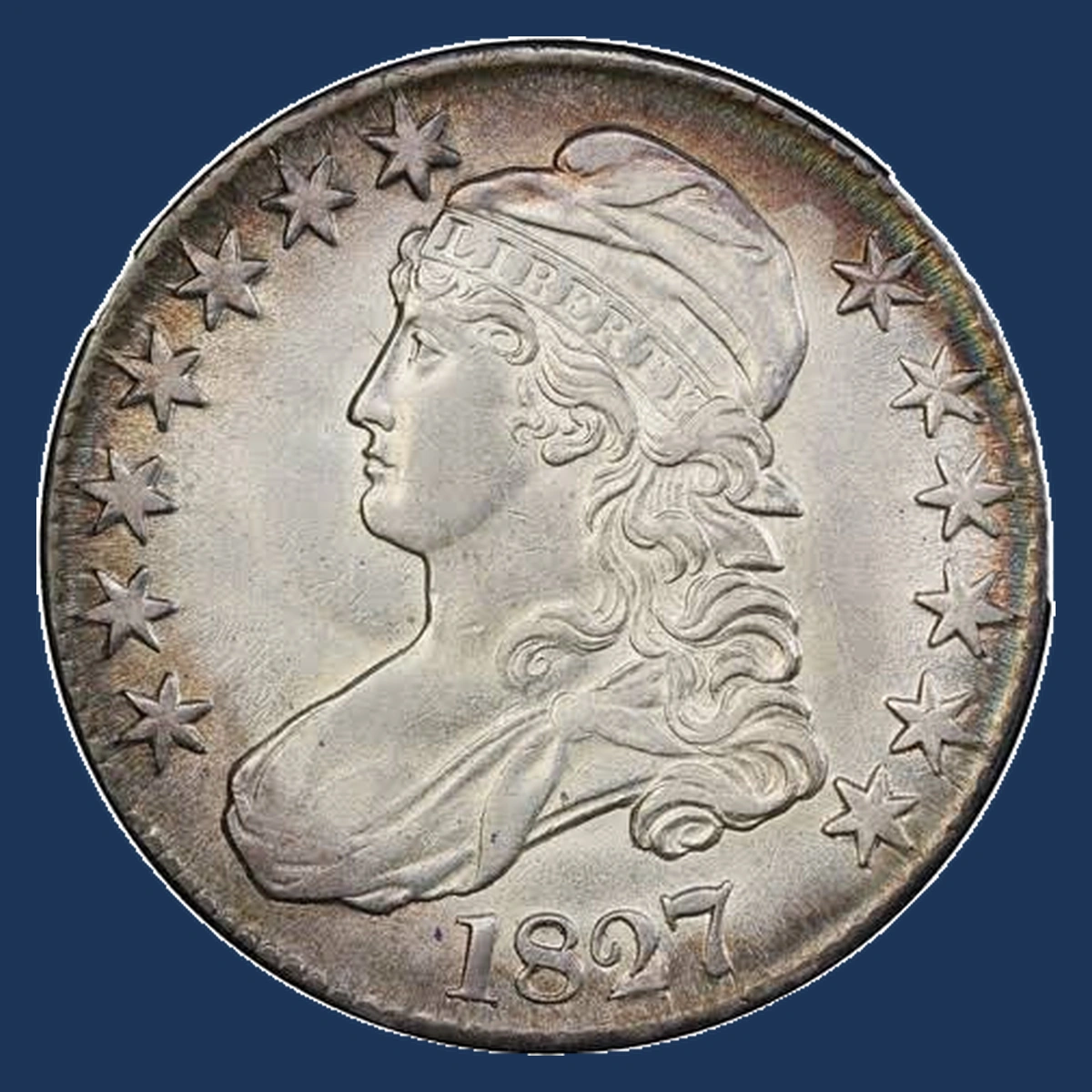
A faint bar beneath Liberty’s ear appears on the exceptional 1827/6 example. Another coin, cataloged as O-129 in the Pogue collection, has traces around the eagle’s wings and head.
Both are described as die clashes. The stamping tools hit each other without a blank between them, leaving extra shapes that later coins picked up.
Polishing the tools could remove some traces while leaving others. Each coin therefore needs comparison with its own photographs.
The ear mark and the eagle-side marks are not one universal pattern. Combining them would suggest details that an individual 1827 may never have carried.
Estimated Value
Worn through attractive nearly unworn examples with clear clash traces have an estimated $100–$1,200 range. The variety and visibility of the extra shapes affect the comparison.
The 1827/6 graded NGC MS67 sold for $28,200 in January 2013. That was an exceptionally preserved overdate from famous collections.
Its sale does not assign thousands of dollars to the faint ear mark alone. Ordinary worn clash examples belong in a different price comparison.
How to Identify
Choose the right example first: beneath the ear for the overdate, or around the wings and head for the Pogue coin. The Pogue catalog illustrates the latter.
Photograph the date and lettered edge, then check accessible coins with a digital scale and calipers against 13.48 grams and about 32.5 millimeters. These Philadelphia halves have no mint letter.
Use a 10× magnifier and angled light to separate shallow extra design from scratches. Compare the shape with the opposite side, oriented as the tools would face each other.
A recognizable piece of that opposite design supports a clash. Its location must match the specific example, not a mixture of two coins’ features.
5. 1827 Capped Bust Half Dollar Off-Center Strike Error (Estimated Up to $4,500)
Even heavy wear leaves this error easy to see. On the documented NGC VG8 example, the front design sits about 10% too high on the blank.
An unstamped strip remains below it. The matching strip appears at the top of the back when the coin is turned in normal orientation.
These bare areas show where the dies failed to cover the metal. The blank entered the press out of position.
A separate PCGS AU50 example was described as 5% off center. Its smaller shift and much lighter wear belong to another coin, not a second measurement of the VG8.
Estimated Value
The heavily worn NGC VG8 sold for $2,640 at Heritage on September 29, 2025. An estimated $1,800–$4,500 covers worn 1827 examples with similarly obvious displacement.
The sale shows that clear positioning errors can matter despite heavy wear. A 5% off-center AU coin needs a separate comparison of condition and shift.
An uneven rim alone does not qualify for this range. The metal and design must show that the blank was struck off center.
How to Identify
Locate the bare strip below the front design, then find the corresponding strip above the back. Keep the coin’s orientation consistent in the photographs.
Use a 10× magnifier to compare unstamped metal with the shifted design. A clip removes metal; this error leaves it present but outside the stamped area.
Early half-dollar outlines can vary slightly. Record the lettered edge and check accessible coins with calipers and a digital scale against about 32.5 millimeters and 13.48 grams.
Confirm the 1827 date and absence of a mint letter. The paired lower-front and upper-back bare strips provide the direct visual match for the documented 10% example, rather than a thick rim on just one side.
6. 1827 Capped Bust Half Dollar Double-Strike Error (Estimated Up to $20,000 for O-148 Examples)
Border teeth appear inside the coin beneath stars six and seven. The reported example also has part of an earlier portrait outline near the right edge, around 3 o’clock.
Together, those clues are described as evidence of two strikes with a small shift between them. The same coin has reported backward-image traces on its back, discussed next.
The account places it in the rare O-148 family of varieties. That catalog label alone does not prove a double strike.
Heritage specifically says its Fine 15 O-148 auction coin shows no doubling. Its price therefore cannot be called a double-strike sale.
Estimated Value
A confirmed worn O-148-family double strike has an estimated $8,000–$20,000 range. The rare variety is a major part of this estimate.
Heritage sold a PCGS Fine 15 O-148 for $12,650 in January 2011. That coin showed no doubling, so it provides variety context only.
The reported coin with several errors must be valued as one object. Its surfaces, correct variety identification, and clear second impression matter together rather than as separate prices to add.
How to Identify
Follow the extra teeth beneath stars six and seven toward the portrait remnant at the right edge. Their positions should fit a single shift between two blows.
With a 10× magnifier, compare the spacing with the normal border and the extra outline with Liberty’s portrait. Short impact dents or carved lines do not establish a second design.
Keep the date, both complete sides, and lettered edge in the photographs. This Philadelphia coin has no mint letter; a digital scale and calipers can check accessible examples against 13.48 grams and about 32.5 millimeters.
The interior border teeth and displaced portrait need to explain each other. That combined pattern is more persuasive than either isolated mark.
7. 1827 Capped Bust Half Dollar Reported Partial Brockage (Estimated Up to $25,000 for the Compound Example)
A star reportedly appears about three millimeters left of the shield’s bottom on this compound-error coin. Another star tip lies beneath the eagle’s left wing.
The collector interprets them as a partial brockage. This happens when a struck coin presses its design into another blank, leaving a sunken, backward image.
Only small remnants are reported here, not a complete second portrait. The same example also carries the repeated-strike clues described above.
The collector’s explanation needs the right depth and direction in those stars. Clashes or later pressure between coins can look similar in a flat photograph.
Estimated Value
Estimate $10,000–$25,000 for the worn O-148-family compound example if the partial brockage is confirmed. This includes its rare variety and repeated-strike evidence.
Do not add this range to the preceding estimate. Both descriptions concern one coin.
The $12,650 Fine 15 O-148 sale from January 2011 supplies variety context, not a brockage result. The extra allowance is an estimate that depends on convincing sunken transferred detail rather than ordinary clash traces.
How to Identify
Look beside the shield’s lower left, then beneath the eagle’s left wing. Use a 10× magnifier and light from opposite directions to see whether the star traces sink into the surface.
Compare their orientation with stars on the front. A vague star-shaped outline does not establish that a struck coin transferred a backward image.
Inspect both sides for later impact damage and record the lettered edge. A digital scale and calipers can compare accessible coins with the original 13.48 grams and about 32.5 millimeters; Philadelphia examples have no mint letter.
Sunken transferred stars in the reported positions provide the relevant test. Their physical depth and reversed relationship matter more than their silhouette in one photograph.
8. 1827 Capped Bust Half Dollar 1827/6 Overdate (Estimated Up to $35,000)
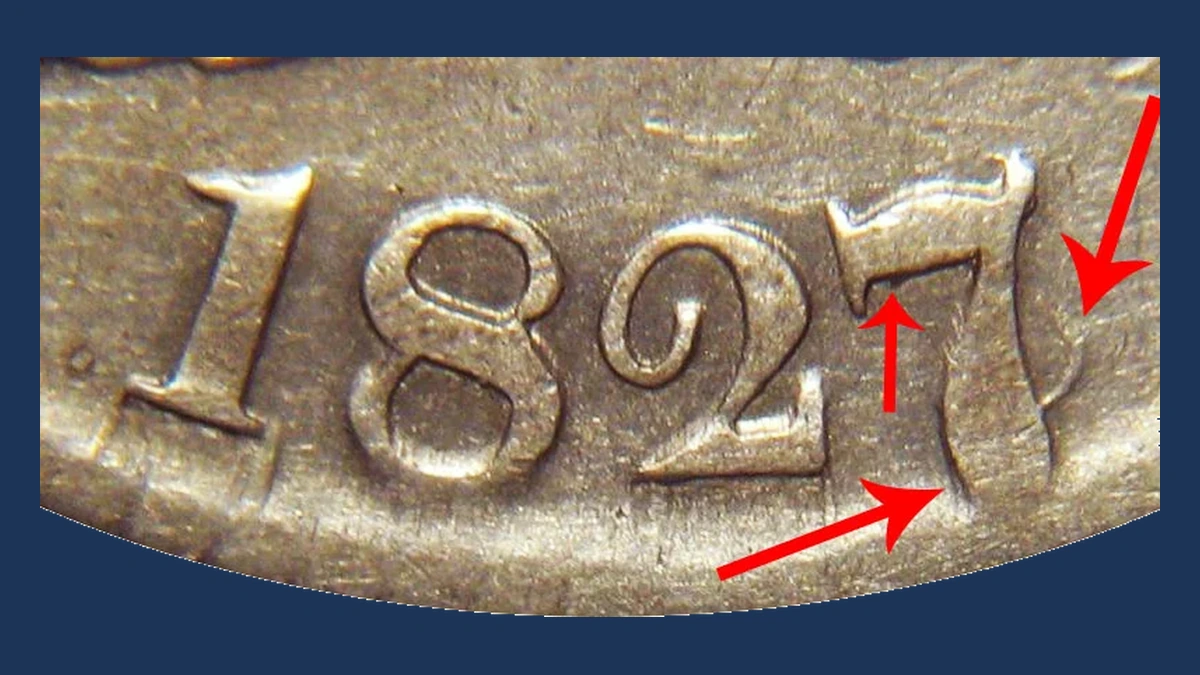
A small curved piece beside the 7 belongs to an older 6. The die’s date was changed for 1827, but part of the previous digit remained visible on coins made from it.
This is called an overdate. Its key clue is the surviving curve, not simply an unusual-looking final digit.
That front die was paired with three different back dies. Several cataloged varieties can therefore share the same overdate.
Names such as Square Base 2 and Curl Base 2 describe the shape of another numeral. Neither proves that a 6 lies beneath the final 7.
Estimated Value
The NGC MS67 Eliasberg/Kaufman coin sold for $28,200 at Heritage in January 2013. Estimate $20,000–$35,000 only for exceptional unworn pieces with comparable appeal.
For moderately worn through nearly unworn coins, use $300–$1,800. An 1818/7 graded NGC AU53 sold for $1,320 in April 2025.
That different-year overdate offers context for the lower range. Date, variety, and condition still need comparison before applying its price.
How to Identify
Center the final 7 under a 10× magnifier and look beside its lower-right base. Part of the earlier 6 should curve upward there.
Compare with a confirmed 1827/6 before sorting out which back die was used. A rare back variety or attractive numeral shape cannot replace evidence of the old digit.
Confirm the half-dollar design, lettered edge, and Philadelphia origin without a mint letter. A digital scale and calipers can check accessible coins against 13.48 grams and roughly 32.5 millimeters.
Change the light to distinguish raised metal from a scratch in the surrounding surface. The upward-curving remnant at the 7’s lower right is the small feature that answers the overdate question.
Conclusion
Location gives these small marks their meaning: the curve beside 7, stars near the back shield, and border teeth beneath front stars tell different stories. Keep enough of the whole coin visible to show those relationships.
Estimated values span $100–$35,000. The reported O-148 compound example combines a rare variety and several possible striking effects in one object, so overlapping descriptions never create separate amounts to add together.