1823 Half Dollar Error List with Pictures

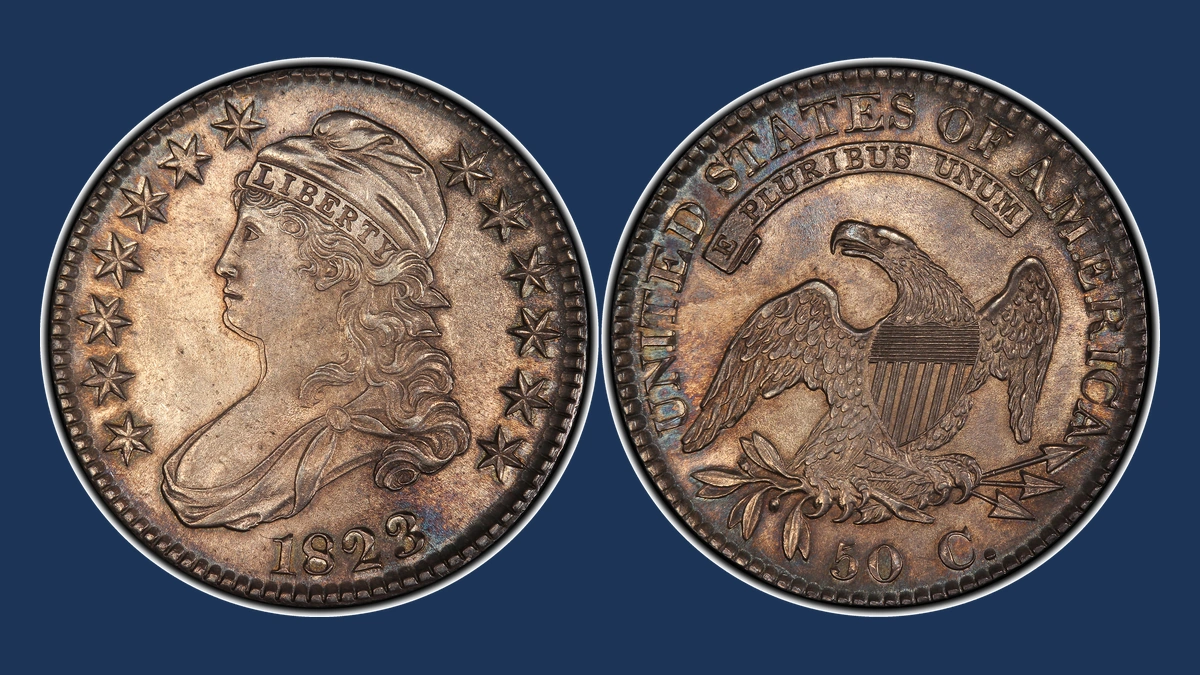
The last digit gives several 1823 half dollars their nicknames: Broken 3, Patched 3, and Ugly 3. An exceptionally well-preserved Broken 3 sold for $64,625 in February 2016.
These 1823 half dollar errors also include a faint shield beneath Liberty’s ear and overlapping strikes. Worn examples in the five groups below have estimated ranges of $200–$3,000, far below that outstanding auction coin.
Read on to compare the visible clues and find out why an odd-looking 3 does not always have the same cause.
1. 1823 Capped Bust Half Dollar Clashed Dies (Estimated Up to $700)
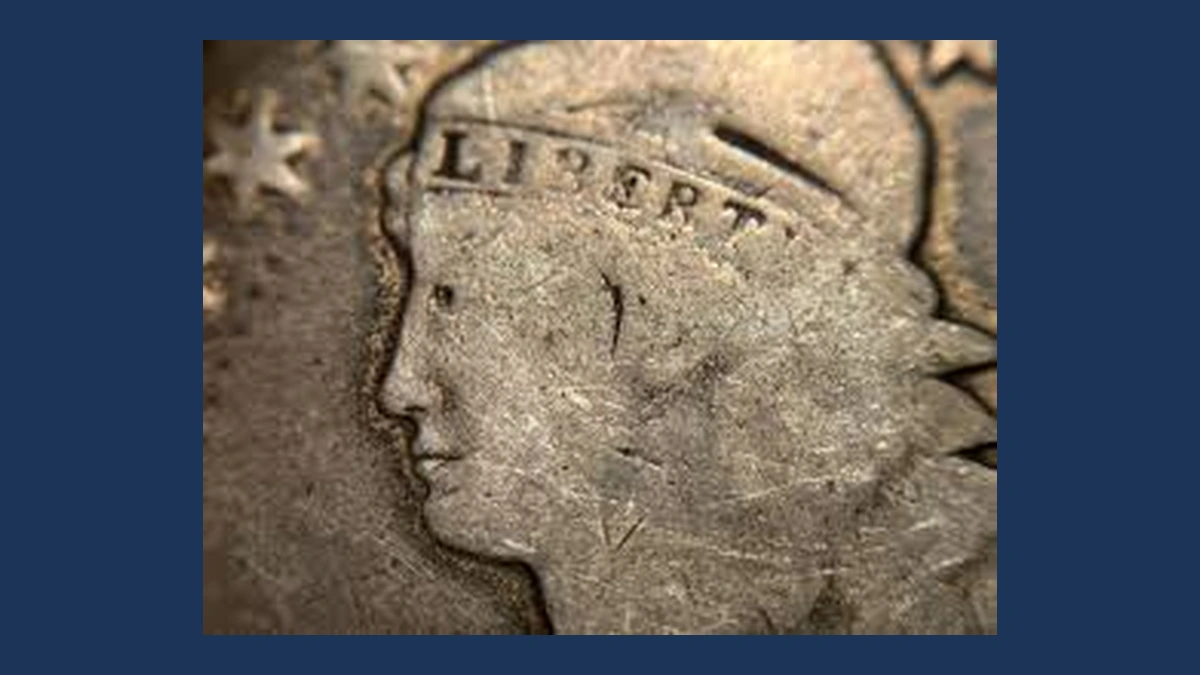
A shield belongs on the back of this half dollar, not under Liberty’s ear. Yet a collector’s illustrated 1823 example shows a faint trace of it beside her portrait.
The steel tools that stamp coins are called dies. Here, they hit each other without a metal disc between them, leaving part of one design on the other tool.
Later coins picked up that unwanted shape. This is called a die clash.
The shield’s position is the useful clue. Extra lines elsewhere near Liberty’s head do not identify this particular clash by themselves.
Estimated Value
An estimated $200–$700 covers worn examples with a recognizable shield trace. This is a price for the whole half dollar, with wear and surface condition included.
For context, 2026 sold listings show an ordinary PCGS XF40 at $350 and an XF45 at $449.99. Both grades describe lightly worn coins; neither listing is a recorded sale of the illustrated shield-clash example, so they provide general same-year comparisons only.
How to Identify
Find Liberty’s ear, then examine the area just below it with a 10× magnifier. Compare the faint outline with the shield on the coin’s back and with the illustrated clash example.
Try lighting from more than one direction. A real transferred shape should remain recognizable, while a bright scratch or shadow can look convincing from just one angle.
Include the whole front in a photograph so the small mark’s location stays clear. Several connected parts of the shield tell you more than one isolated line.
Check the 1823 date and lettered edge as well. A digital scale and calipers can compare an accessible coin with the original 13.48-gram weight and approximately 32.5-millimeter width.
A shield-shaped trace beneath the ear is the most useful first match.
2. 1823 Capped Bust Half Dollar Off-Center First Strike (Estimated Up to $2,000)
The first strike was far off center; a later strike covered much of it. That is the sequence reported for an 1823 half dollar described as PCGS VF Details.
The report puts the first impression about 60% off center. VF Details means a worn coin with a problem that prevents a normal numerical grade.
Pieces of the first design should survive beside or beneath the later impression. The coin’s final outline alone cannot show how far it moved.
This reported piece is separate from the NGC XF40 double strike below. The 60% figure belongs only to this account.
Estimated Value
The year guide reports a $1,495 asking price for this coin. A comparable worn example with clear first-strike remains has an estimated $1,000–$2,000 range.
An asking price is not a completed sale. Another 1823 double strike sold for $1,645 in 2016, but it was a different coin; its sale price and the reported 60% displacement should not be combined into one specimen’s history.
How to Identify
Search for pieces of an earlier design outside or underneath the later one. Together, they should explain a first blow far off center and a second blow in a different position.
A wide rim alone cannot show that sequence. Use a 10× magnifier to follow the overlap and photograph both sides.
An object pressed into a finished coin can leave sunken, backward details. Cutting a crescent from the edge also fails to explain two genuine stamped designs.
For an accessible example, record weight with a digital scale and the actual outline with calipers. Compare with the normal 13.48 grams and about 32.5 millimeters, and examine the edge lettering for damage that could explain the unusual shape.
The key is two related design positions, with visible remains of the far-off-center first strike.
3. 1823 Capped Bust Half Dollar Double Strike (Estimated Up to $2,500)
On Heritage’s NGC XF40 example, the design appears twice in slightly different positions on both sides. The coin received another blow after a small movement.
This is a double strike. The shift need not be large if enough repeated detail remains to show what happened.
An older error catalog describes repeated stars and date details on another 1823 example. Those are useful areas to inspect, but the two listings have not been shown to describe the same coin.
An unusual date digit alone is a different matter. It does not establish that the whole coin received two strikes.
Estimated Value
The NGC XF40 example sold for $1,645 in October 2016. A comparable worn 1823 double strike has an estimated $1,500–$2,500 range.
A later Heritage description cites that result alongside an 1819/8 double strike that sold for $2,280 in July 2025. The latter provides a more recent comparison from the same series, but it is a different year and grade, not an updated sale of the 1823 coin.
How to Identify
Lay out photographs of both sides together. For the described XF40 example, each side should show a small shift between design impressions.
With a 10× magnifier, follow one repeated detail into the next. Their positions should fit the same movement, rather than form unrelated extra lines or flat shelves along one edge.
The stars and date are useful starting points on other examples. Their appearance varies, and the separate report of a 60% off-center first strike does not describe this XF40 coin.
For an accessible coin, use a digital scale and calipers to compare with 13.48 grams and roughly 32.5 millimeters. Check the complete date and the lettered edge before relying on a tightly cropped image.
Start by matching the slightly shifted impressions on both sides to the documented XF40 coin.
4. 1823 Capped Bust Half Dollar Ugly 3 (Auction Example $35,250)
The right side of the 3 looks swollen and misshapen. This gives the Ugly 3 variety its memorable name.
In his illustrated study, Lance Keigwin explains the shape as damage from a die crack rising from the rim into the digit. Other published accounts describe engraving work, so that cause is not explained the same way everywhere.
The visible shape is the place to start. Compare the whole 3 and the nearby rim rather than deciding from one bump.
Broken and Patched 3 have different shapes at the digit’s middle. Their names should not be used interchangeably with Ugly 3.
Estimated Value
Worn examples have an estimated $400–$3,000 range. Ordinary 1823 XF sold listings around $350–$450 and a $1,550 Patched 3 listing offer nearby market context, not direct Ugly 3 sales.
The exceptional Pogue collection example, graded MS65, sold for $35,250 in February 2016. Its unusually fine, unworn condition puts it well above ordinary examples; a distorted 3 on a heavily worn or damaged coin does not justify that price.
How to Identify
Keep the rim in your close-up of the date. The illustrated study of the different 3s compares Ugly, Broken, Patched, and normal forms side by side.
Use a 10× magnifier to inspect the enlarged right side and any raised line leading toward the border. Match the entire digit rather than one isolated patch of metal.
A blow after minting can flatten a normal 3. Look for pushed metal nearby, and change the light angle to check that a shadow has not exaggerated the shape.
The original coin weighs 13.48 grams and measures approximately 32.5 millimeters across. Check an accessible example with a digital scale and calipers, and inspect its lettered edge.
The fastest comparison is the entire swollen 3 beside its nearby rim, rather than one bump.
5. 1823 Capped Bust Half Dollar Broken and Patched 3 (Auction Record $64,625)
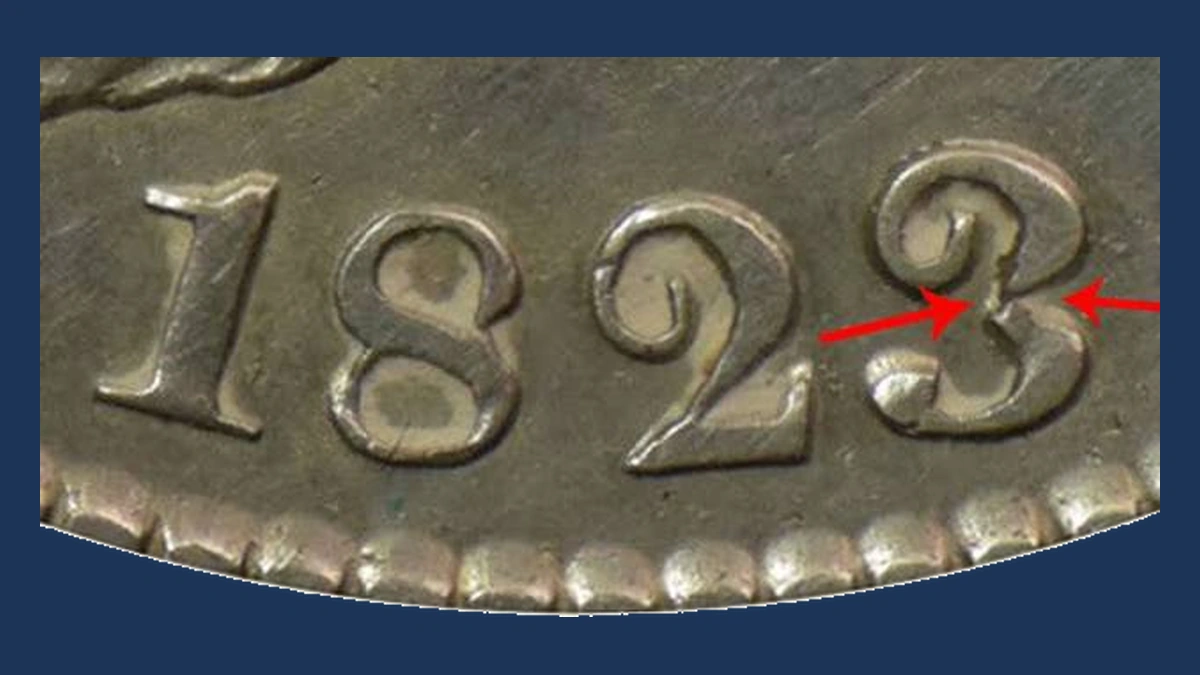
The top and bottom of the Broken 3 do not meet cleanly. A poor original impression of the digit in the die left a weak or disconnected-looking middle.
Repairing that same die produced the form called Patched 3. Its join is stronger but uneven, showing where the earlier problem was corrected.
Side-by-side photographs make the change easier to see. One shows the weak original connection, while the other shows the repair.
Neither is an 1823/2 overdate. An overdate has an older digit underneath a newer one; these names concern the shape and repair of the 3 itself.
Estimated Value
Estimated prices for worn Broken or Patched 3 coins run from $300–$2,000. A PCGS XF45 Patched 3 sold listing reached $1,550 in April 2026.
The Broken 3 MS65+ record is $64,625, from February 2016. A separate Patched 3 graded MS66 brought $40,250 in April 2009; both coins were exceptionally well preserved and unworn, so those results are not ordinary prices for a misshapen digit.
How to Identify
Compare photographs showing similar amounts of wear. A worn connection can be hard to judge against a very sharp reference coin.
Under a 10× magnifier, inspect the center of the 3. The Broken form has the weak join; the Patched form has the uneven repair in its place.
Look at the rest of the date and surrounding surface too. A scratch through a normal 3 can interrupt its shape, but it cuts the metal rather than repeating a feature from the die.
Check the lettered edge and compare accessible coins with the normal 13.48 grams and about 32.5 millimeters. Use a digital scale and calipers.
The middle of the 3 is the quickest clue: a weak join for Broken, an uneven repair for Patched.
Conclusion
The three nicknames for the 3 make more sense when their shapes sit side by side. Elsewhere on the coin, a faint shield or two overlapping designs tells a different story about stamping.
Estimated worn-coin ranges span $200–$3,000. Keep the $1,495 asking price separate from the $1,645 actual sale, and remember that the $64,625 record belongs to an exceptional Broken 3, not every odd-looking date.