2008 Presidential Dollar Error List with Pictures

Imagine reading 2008 on a dollar’s edge while both faces remain blank. A contemporary sales report recorded $20,000 for one such edge-lettered blank in 2008.
This 2008 Presidential dollar error list ranges from shallow edge words to that unusual unfinished coin. Estimated values span $15–$20,000, with ordinary and satin collector finishes considered separately.
A Monroe dollar missing its golden outer layer gives a very different clue. Explore the six types below to see what belongs on each face and edge.
1. 2008 Presidential Dollar Weak Edge Lettering
A date digit or part of a motto may appear barely pressed into the edge. The lettering equipment can leave weak impressions even when the portrait and Liberty design remain clear.
The reports cover Philadelphia and Denver Monroe dollars and Philadelphia Van Buren dollars. A Denver Monroe Position B graded PCGS MS66 appears in a specialist auction collection.
MS66 means the coin has no circulation wear and few marks. That condition can make a shallow original inscription easier to examine.
The face and edge were formed in different steps. A sharply detailed portrait does not guarantee equally deep edge words.
Estimated Value
Weak-edge examples have an estimated range of $15–$400. Strong condition and an obvious contrast between normal and shallow strokes can make a coin more appealing.
The Denver Monroe MS66 example provides a condition comparison, although its price is not public. A lightly marked coin usually presents shallow lettering better than a worn one.
The president, mint, and letter depth should match the comparison used. Worn edges or photographs with glare can make ordinary inscriptions appear more unusual than they are.
How to Identify
Put a normal Monroe or Van Buren dollar beside the candidate, keeping both edges under similar light. Compare matching letters rather than the general brightness of the metal.
Use a magnifier to locate the bottom of each faint stroke. Turning the lamp slightly can reveal lettering that an overhead photograph makes nearly invisible.
Check the mint letter before comparing Philadelphia and Denver examples. Position A or B merely tells you which way a single inscription faces.
Finally, examine the adjacent metal for wear, scraping, or rounding that may explain the lost depth. A genuine weak-edge comparison needs shallow original strokes, not just a smooth-looking patch where the metal has been rubbed away.
2. 2008 Presidential Dollar Monroe Partial Edge Lettering
A partial-edge Monroe has a mixture of lettered and unlettered stretches. Some of the intended inscription failed to form, while the remaining text still identifies part of the coin.
The reported type is a Denver Monroe in Position B. That normal direction of reading does not explain or measure the missing section.
A blank stretch should be examined alongside the letters at its ends. Extremely faint lettering may disappear in a photograph without being truly absent.
This error concerns an already struck Monroe dollar. A blank piece of metal carrying partial edge text belongs to the separate unfinished-blank type below.
Estimated Value
An authenticated partial-edge Monroe has an estimated value of $50–$750. A substantial gap beside clearly formed words is generally easier to appreciate than a short ambiguous interruption.
The range reflects comparable modern-dollar lettering errors rather than a recorded sale of the Denver Position B listing. Preservation and the amount of original text both influence the comparison.
A missing stretch caused by filing does not belong in this range. The edge should retain its original shape where the inscription stops.
How to Identify
Begin with a full view of Monroe’s portrait and Liberty on the other face, confirming that the coin received both designs. Then locate a surviving section of edge text and read the D and date wherever they remain.
Follow the text toward the blank section under a magnifier, searching for faint stroke bottoms along the way. Inspect the opposite end of the gap too, because the transitions reveal more than its smooth middle.
A locally flattened edge or a group of parallel scratches may show that someone removed lettering after the coin was made. Look for original letters meeting unchanged blank metal, with no sign that the edge was filed down.
3. 2008 Presidential Dollar Denver Monroe Doubled Edge Lettering
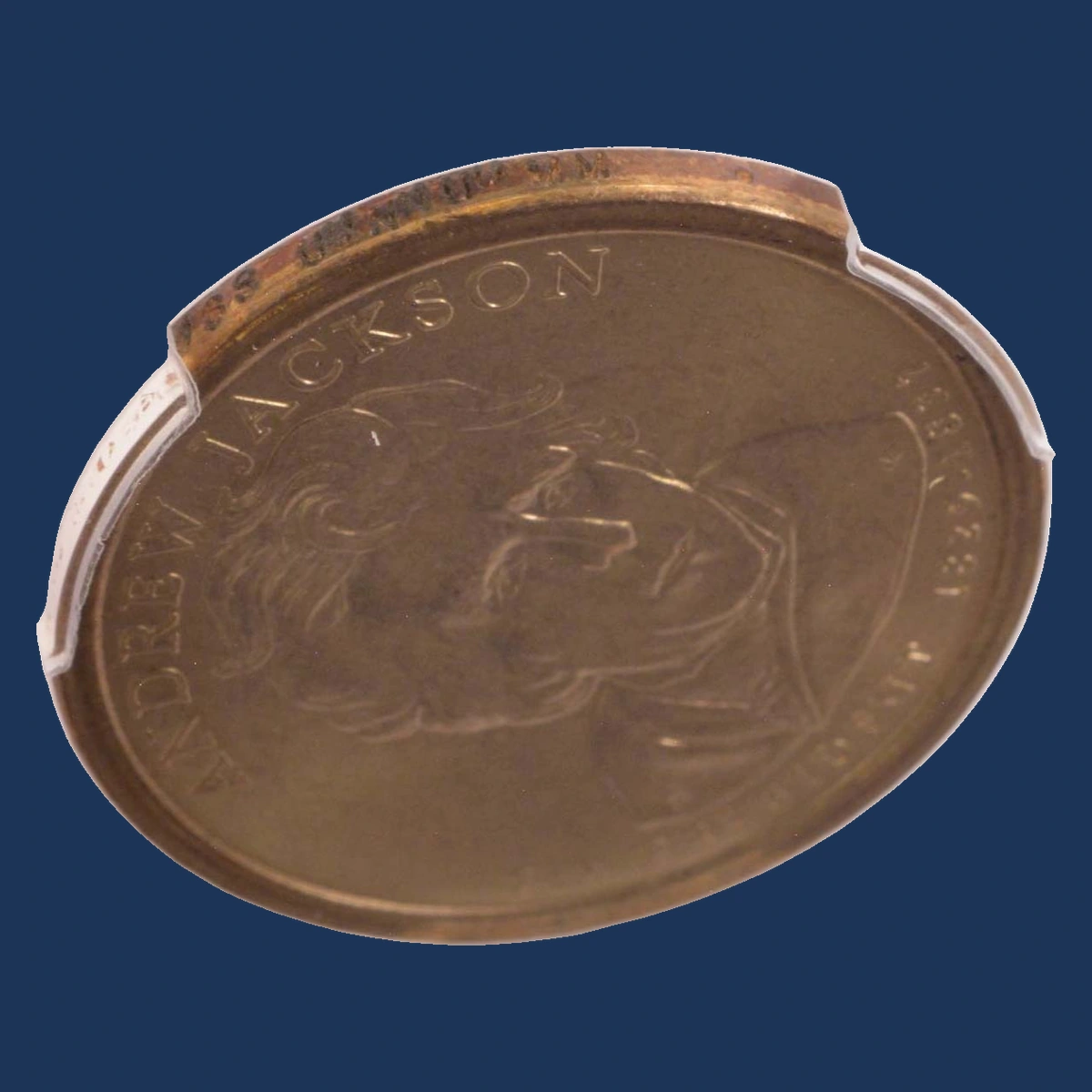
The Denver Monroe overlap variety carries a second set of edge text over the first. Both inscriptions face the same direction.
A dollar passing through the lettering equipment again can receive this extra impression. Letters and digits from the two passes may cross or partly hide one another.
The documented catalog report applies to 2008-D Monroe. It does not establish a Philadelphia counterpart merely because Philadelphia also made Monroe dollars.
One inscription facing upward and another coin’s inscription facing downward is normal variation. The error requires two sets on the edge of one coin, not two reading directions across coins.
Estimated Value
For an authenticated same-direction Denver Monroe overlap, estimate $100–$1,500. Clear repeated characters across several neighboring words give a stronger display than an extra line beside one letter.
This range is an estimate for the reported variety, not a quoted auction result. The strength of the second impression and the condition of the faces affect collector interest.
Random contact marks should not be priced as a second inscription. Compare readable duplicated text before attaching a large premium to the coin.
How to Identify
Read one edge inscription as far as possible, then find where another set crosses it. A magnifier helps separate the recessed grooves where the impressions overlap.
Check several neighboring letters and digits to see whether the second set follows the same reading direction.
Now inspect Monroe’s portrait and any readable 2008-D edge markings. They connect the repeated text with the reported Denver issue.
Change the lighting while watching one overlapping pair, since reflected highlights can imitate an extra outline. Real impressions remain cut into the edge as the bright reflections move.
An isolated mark shaped like a letter can come from contact with another coin. Two continuing same-direction inscriptions distinguish the overlap from that ordinary damage.
4. 2008 Presidential Dollar Completely Missing Edge Lettering
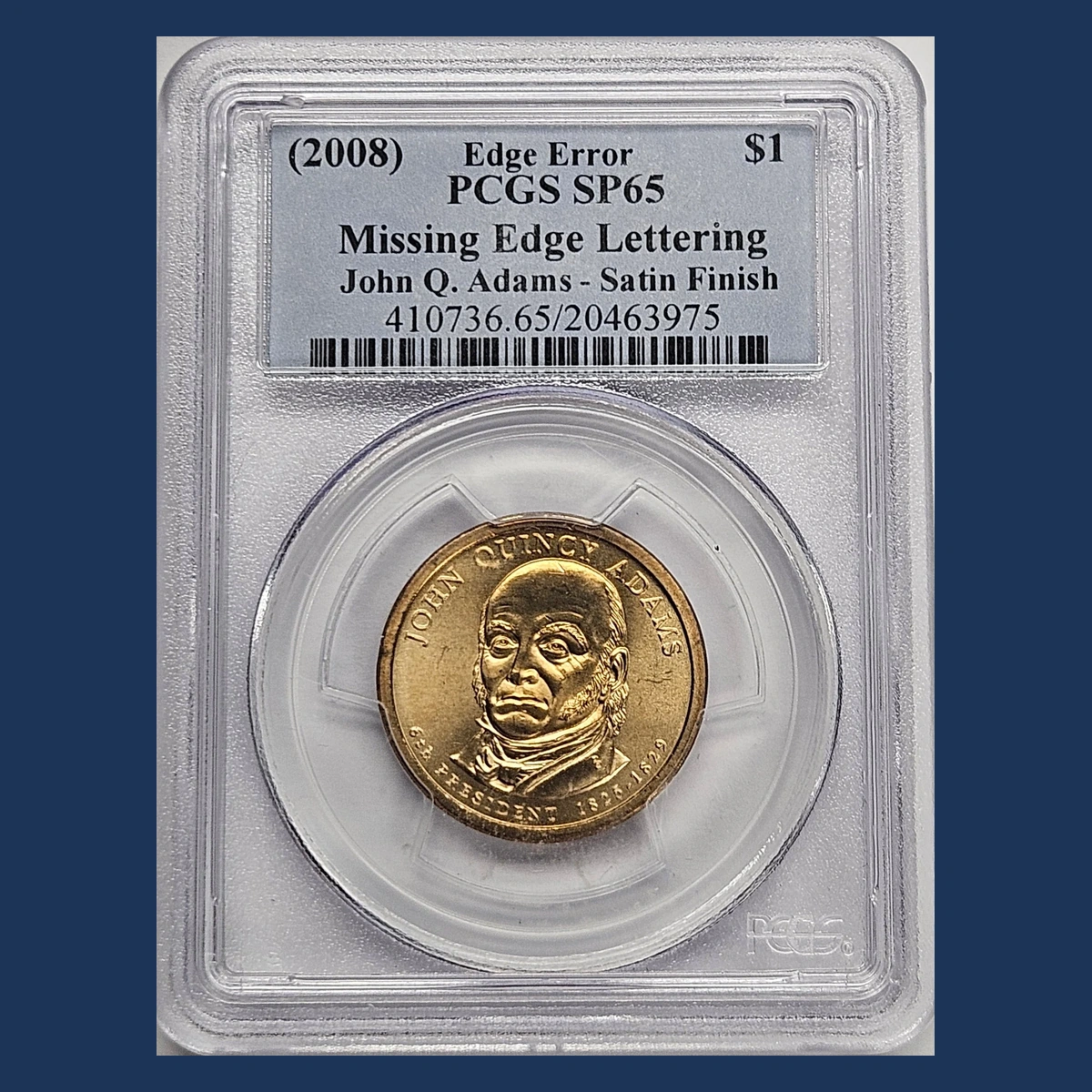
A normal 2008 dollar carries its date, mint letter, E PLURIBUS UNUM, and IN GOD WE TRUST on the edge. A fully unlettered example loses that entire inscription.
Missing-edge reports cover Monroe, John Quincy Adams, Jackson, and Van Buren. Ordinary strikes and satin collector versions must be compared separately.
Satin coins have a deliberately softer surface texture. They were made for Mint Sets and are not the reflective San Francisco Proofs.
Without an edge mint letter, the coin itself cannot reveal P or D directly. The president’s face identifies the issue, while reliable packaging or certification may supply further information.
Estimated Value
Estimate $25–$1,500 for ordinary missing-edge dollars and $50–$2,500 for comparable satin examples. Prices depend on the president and preservation, not simply a plain edge.
A satin John Quincy Adams graded PCGS SP67 sold for $207.98 at Heritage in February 2014. In the same sale, a satin Jackson SP65 brought $74.
Those are separate coins and grades. Their different results show why a price for one president and finish should not automatically be transferred to another.
How to Identify
Confirm the president by reading the name on the face. John Quincy Adams belongs to 2008, while John Adams is a different 2007 issue.
Compare the finish with an ordinary or satin example of that president before considering its value.
Inspect the whole edge under magnification, including the places where both mottos should appear. A surviving original letter means the inscription is partial or weak rather than entirely missing.
For a loose coin, use a scale and calipers to compare against about 8.1 grams and 26.49 millimeters. Correct measurements cannot prove authenticity, but reduced dimensions can suggest removed metal.
Look for scraping, grooves, or a flattened band around the plain edge. A convincing omission needs original surfaces throughout the full circumference.
5. 2008 Presidential Dollar Monroe Missing Front Outer Layer
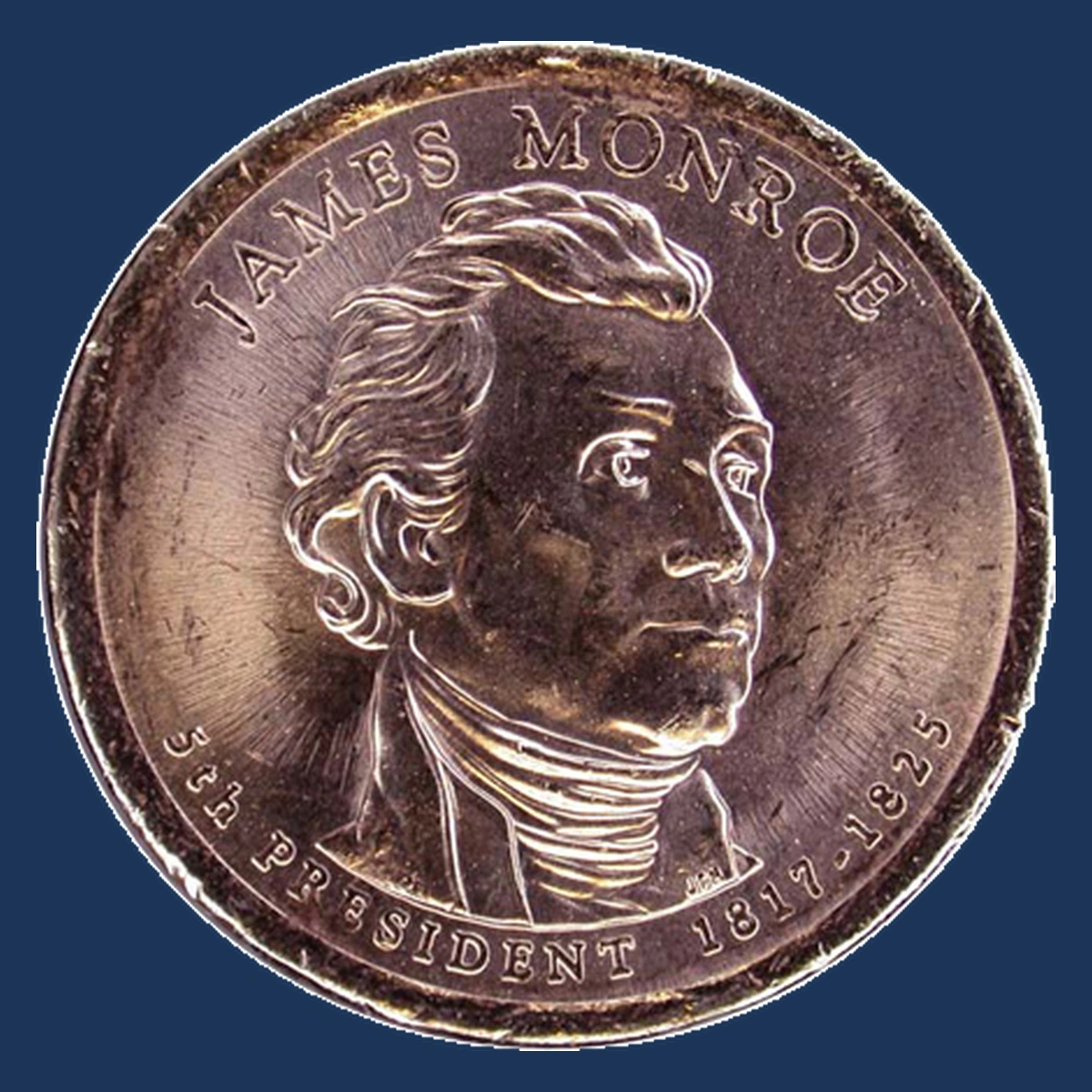
This Monroe dollar has a copper-colored front instead of the usual golden surface. Its outer layer is missing, exposing the copper center beneath it.
The opposite face retains its outer metal but shows weak detail near the rim. A thinner blank does not fill the stamping tools as fully under pressure.
NGC certified the example, but the published account does not identify its mint. Read any surviving edge mint letter before choosing a Philadelphia or Denver comparison.
Surface color alone cannot establish layer loss. Staining, chemical damage, and altered coatings can change a dollar’s appearance after manufacture.
Estimated Value
A comparable authenticated front-layer error has an estimated value of $300–$3,000. A broad copper-colored face with intact struck detail makes the missing layer easier to understand.
The estimate applies to the reported Monroe type without claiming a sale price for that specimen. Condition and the amount of missing outer metal affect the comparison.
A darkened golden surface is not equivalent to an absent layer. Buyers should distinguish actual loss of metal from a color change before applying this range.
How to Identify
Compare the two faces under neutral light before examining the edge. Look for a copper-colored front beside a back that retains the normal golden outer metal.
Use a magnifier along the rim to inspect the layered structure and any damaged areas. Chemical attack or grinding can leave rough surfaces and tool marks that explain a changed color.
Weigh a loose candidate on a digital scale against the normal 8.1 grams. A missing layer should reduce weight, although weight alone cannot show why metal is missing.
Check the weak back detail near the rim together with the exposed front. The combination of missing metal, copper color, and related strike weakness is more useful than color alone.
6. 2008 Presidential Dollar Edge-Lettered Blank
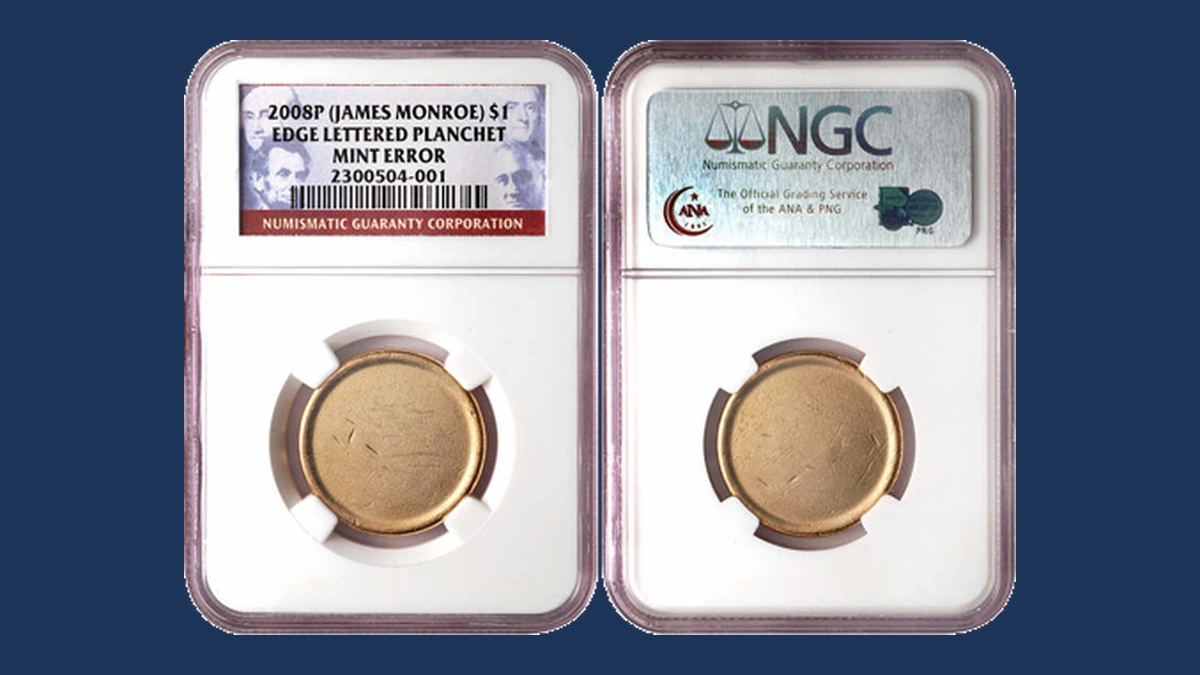
The edge has words, but neither face has a portrait or the Statue of Liberty. An unstruck blank reached the edge-lettering equipment without first receiving the normal face designs.
NGC described complete and partial edge inscriptions on these blanks. One example shows 2008 and P, while another lacks a readable mint letter.
The early discoveries were linked to Monroe because they appeared before the next president’s release. A later discovery cannot be assigned to Monroe solely from its 2008 edge date.
The blank is slightly smaller before striking, which can help explain why its edge words were applied weakly.
Estimated Value
A contemporary Mint Error News sales report lists two edge-lettered blanks at $20,000 and $1,791.67 during April–June 2008. Those reported eBay results show a wide difference between individual offerings.
Use an estimated $1,000–$20,000 for comparable authenticated examples. The historic discovery price is not a guarantee for every lettered blank found later.
Complete readable edge information, untouched faces, and a documented early history strengthen the comparison. Partial lettering needs its own assessment.
How to Identify
Inspect both faces with a magnifier to establish that they were never struck, rather than ground smooth afterward. Look for sanding lines, lowered surfaces, or remnants of the erased portrait and Liberty design.
Read the edge carefully for 2008, any mint letter, and the mottos. Partial inscriptions may not preserve enough information to name the mint.
Use a digital scale to check a loose blank against the usual 8.1-gram dollar standard. Its pre-striking diameter can be slightly smaller than a finished dollar’s 26.49 millimeters.
Keep any dated discovery records with it. The decisive physical combination is genuine lettering on the edge with original unstruck metal on both faces, not merely two faces that look smooth.
Conclusion
On a 2008 dollar, the edge should carry both mottos as well as the date and mint letter. Missing or repeated text must be distinguished from normal lettering direction.
The copper-faced Monroe and the blank with edge words require different physical checks. Across these types, estimated values span $15–$20,000.
Identify the president and finish wherever possible, and keep early discovery records with an otherwise faceless blank.