1981 Dollar Coin Error List with Pictures

Grease blocking part of a design helped a 1981-S dollar bring $149 in June 2025. Despite its S mintmark, that coin was an ordinary strike, not a specially made collector Proof.
This 1981 Susan B. Anthony dollar error list separates small star details from larger changes to the coin’s shape. Estimated values span $20–$10,000, including conditional ranges for types still needing a confirmed 1981 example.
Start with the visible feature. The nine sections below explain the checks and price comparisons.
1. 1981 Susan B. Anthony Dollar Weak Detail from Grease Blocking the Tool
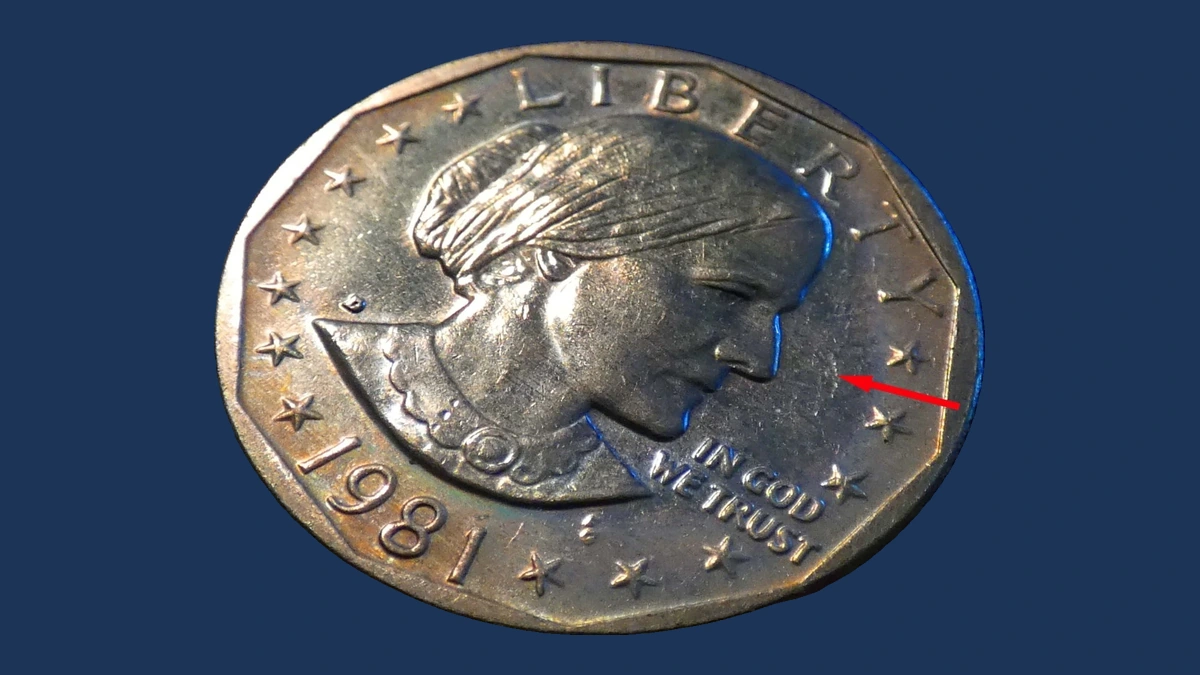
A patch of lettering or part of the picture may remain weak while nearby details form normally. Grease blocking the recesses in a stamping tool can prevent metal from filling them.
A 1981-S example was certified PCGS MS63 with this error. That grade describes an unworn ordinary coin with visible marks.
San Francisco made both ordinary and Proof dollars in 1981. The S alone therefore cannot identify the finish.
This example should not be treated as a Type 2 Proof or a silver dollar. Its normal metal is copper-nickel outer layers over a copper center.
Estimated Value
The PCGS MS63 example sold for $149 at Heritage in June 2025. It provides a same-year ordinary-strike comparison rather than a price for a Proof variety.
Estimate $20–$500 for comparable authenticated grease-blocked dollars. A broad, clearly interrupted design usually attracts more attention than one slightly weak letter.
The surrounding surfaces also matter. Wear or later rubbing can reduce detail without creating a minting error, even when the coin carries an S.
How to Identify
Compare the weak area with the nearest complete letters or raised parts of the portrait. Grease can block a local recess while neighboring features remain sharply formed.
Use a magnifier to look for rubbed surfaces, fine scratches, or flattened high points. Those signs may explain missing detail through later handling rather than an obstruction during striking.
Read the S and compare the surface with an ordinary 1981 dollar, remembering that a bright finish alone does not prove a Proof. For a certified candidate, retain the full holder photograph with a close-up of the weak area.
The useful clue is detail that failed to form amid otherwise normally struck surroundings.
2. 1981 Susan B. Anthony Dollar Doubled Stars on the San Francisco Type 1 Proof
Five stars on a 1981-S Type 1 Proof show extra outlines in Wexler’s catalog. They are the third through seventh stars between the date and LIBERTY on the portrait side.
The repeated shapes come from the stamping tool’s design. Collectors call this a doubled die, using die to mean the steel tool that makes the picture.
The coin needs only one impression from that tool to reproduce the star pattern. It is not evidence that the dollar moved between two strikes.
Type 1 and Type 2 are normal Proof mintmark styles. Their difference alone is not a doubled-star error.
Estimated Value
A matched example of the five-star variety has an estimated value of $50–$500. The visibility of the extra outlines and the preservation of the Proof surfaces affect collector interest.
This is an estimate for the star pattern, not a quoted sale price. A clear match to the catalog photographs matters more than calling the S a scarce type.
Haze, scratches, and glare can obscure the details. A normal Type 1 Proof without the doubled stars needs its own ordinary-coin valuation.
How to Identify
Use Wexler’s star photographs to orient the front of the coin before counting from the date toward LIBERTY. Compare the third through seventh stars individually under a magnifier.
Look at the points and edges of each star for the same extra shapes shown in the photographs. Several matching stars are more useful than one thick point.
Check that the mintmark is the Type 1 S used on the listed Proof. A different S shape alone does not reproduce the star variety.
Tilt the lamp to see whether the extra outline stays in the metal. A reflected bright edge will move or disappear.
The five-star pattern on the correct Proof is the match to seek.
3. 1981 Susan B. Anthony Dollar Curved or Straight Clips
A missing piece can begin with the blank itself. If a circular cutter overlaps an earlier hole, the resulting disc has a curved gap before it receives the dollar design.
A straight missing section can instead reflect the end of the metal strip. The two shapes share incomplete metal but do not require the same cutting path.
A collector reported a clipped 1981-D dollar, while the year guide also discusses curved and straight forms. Neither report establishes a fixed clock position for every example.
The original struck rim around the gap helps separate a genuine clip from a later cut.
Estimated Value
Estimated values for authenticated 1981 clips range from $30–$750. Larger gaps can make a stronger display, provided the date, mint letter, and original surfaces remain recognizable.
For an older comparison, a 1979-S curved-clip and rim-clip dollar graded ANACS MS63 brought $72 in March 2023. That is a different-year coin, not the reported 1981-D specimen.
The number of gaps does not determine value by itself. Natural metal flow around them and the coin’s overall condition remain important.
How to Identify
Inspect the missing section from the edge rather than relying only on its outline in a face photograph. Saw grooves or fresh-looking file marks can expose later metal removal.
With a magnifier, follow the raised rim into each end of the gap. A genuinely incomplete blank may leave weakened or stretched details as it is struck.
Check across the coin for a weak rim opposite the clip. That is a supporting clue rather than a feature every genuine specimen must show clearly.
Weigh a loose candidate against the normal 8.1 grams, using a digital scale. Lower weight cannot distinguish a clip from later cutting without those original struck transitions beside the gap.
4. 1981 Susan B. Anthony Dollar Expanded Strike without Full Edge Support
A dollar can spread wider than normal if the surrounding metal ring fails to contain it during striking. That ring is called the collar, and this error is a broadstrike.
The complete intended design remains on the coin even if it sits unevenly within the expanded border. An off-center strike instead loses part of the picture beyond the blank.
A year guide reports a 1981-P broadstrike graded MS64. Its exact diameter is not provided, so that measurement must come from the coin itself.
The usual fine grooves around an Anthony dollar’s edge may also be affected by the missing support.
Estimated Value
An authenticated 1981-P broadstrike has an estimated range of $100–$1,000. The amount of expansion, original condition, and visibility of the complete picture help determine its appeal.
As a different-year comparison, a 1979-P broadstrike graded CACG MS64 sold for $119 in June 2026. It should not be confused with a normal wide-rim design variety.
A broad border made by flattening a finished coin is damage. The estimate assumes the expansion occurred while the original design was struck.
How to Identify
Trace the outer lettering on both faces before measuring the coin. Every part of the intended design should fit on the metal, although the blank border may be uneven.
Use calipers to compare a loose candidate with the normal diameter of about 26.5 millimeters. A broadstrike spreads outward, so also inspect the edge for interrupted or absent grooves.
A digital scale can check against the normal 8.1-gram weight. Expansion moves the original metal outward instead of requiring a different blank.
Look for crushing, repeated edge dents, or flattened raised details that might show later hammering. A wide coin with a complete original strike needs a different explanation from a normal coin beaten flat.
5. 1981 Susan B. Anthony Dollar Off-Center Strike
A blank positioned partly outside the stamping tools receives only part of their design. One side of the finished dollar has untouched metal, while the opposite side loses outer details.
The year guide reports 1981 examples displaced by roughly five to twenty percent. Those figures describe its reported range rather than a particular certified coin presented here.
Both faces should show the effect of the misplaced blank. The same explanation must account for the portrait and the eagle.
A tilted photograph or a single uneven rim can look misleading. The important combination is blank metal beside an incomplete struck picture.
Estimated Value
For an authenticated 1981 off-center dollar, estimate $100–$1,500. A readable date and an obvious untouched crescent usually make the error easier to collect and display.
A 1979-P dollar struck fifteen percent off center, graded NGC MS66, sold for $439.20 in March 2026. It is a useful mechanism comparison from another year, not proof of a 1981 sale.
Condition and the amount of missing artwork affect the comparison. A normal coin with only an uneven border does not qualify.
How to Identify
Locate the blank crescent and then inspect the design on the opposite edge. Some intended lettering or artwork must run off the available metal, rather than end inside a broad border.
Photograph the date with the whole coin so that the year can be connected with the displaced impression. An unreadable date cannot be replaced by the year of a seller’s description.
Turn the coin over while keeping the same orientation and compare the eagle-side shift. A problem limited to one face may indicate a misplaced tool.
Under a magnifier, inspect the boundary between struck and untouched metal. Smooth original blank texture beside the incomplete picture is more useful than an estimated percentage alone.
6. 1981 Susan B. Anthony Dollar Two or More Displaced Strikes
A second date or another part of Anthony’s portrait can remain when the coin moves and is struck again. A third blow may leave another overlapping set of features.
Year guides report multiple-strike errors for 1981. They do not establish a particular mint, angle, or number of surviving impressions on a certified specimen.
The extra picture must show movement between blows, rather than simple thickening at one letter. The two processes leave different patterns.
Normal Proof production can involve repeated blows with the design held in place. That routine step does not turn every 1981-S Proof into a multiple-strike error.
Estimated Value
If authenticated with clearly displaced impressions, a 1981 multiple-strike dollar has an estimated value of $300–$4,000. Readable dates and recognizable parts of successive designs make the striking sequence easier to follow.
The range is an estimate for the reported type, not a sale assigned to an unnamed 1981 specimen. The degree of movement and the coin’s preservation both matter.
Counting every doubled-looking line as another blow can exaggerate the error. Price the demonstrated impressions on the complete coin.
How to Identify
Try to pair one date digit with its repeated counterpart, then follow nearby letters from each image. Their positions should fit the same shift or turn.
Inspect the portrait and eagle for additional parts of those impressions. A true second strike involves a picture, not just one wider letter.
Use a magnifier to check whether the earlier raised detail survives beneath the later blow. A backward sunken copy may come from squeezing finished coins together after manufacture.
Keep photographs of both faces aligned while comparing the overlapping patterns. Do not rotate each image separately to make the pictures appear to match.
Only count a further strike when another consistent group of details supports it.
7. 1981 Susan B. Anthony Dollar Possible Mirror-Image Impression
A backward portrait or eagle pressed into the surface can result when a struck coin remains between a fresh blank and a stamping tool. The stuck coin acts like a stamp itself.
This mirror-image impression is called a brockage. The receiving coin has a sunken copy rather than a normal raised picture on that area.
A brockage remains a possible 1981 type requiring a confirmed specimen. Examples from 1979 or 1999 cannot establish a 1981 date on their own.
The depth, reversed lettering, and relationship to the normal face matter. A mirrored photograph alone does not describe a physical brockage.
Estimated Value
For an authenticated 1981 dollar with a clear brockage, a conditional estimate is $500–$6,000. A large, readable mirror image generally makes a stronger display than a small indistinct impression.
The estimate draws on comparable dollar-error forms without claiming a known 1981 transaction. How much normal design survives also affects whether the date and mint can be established.
A later squeeze can imitate backward detail. The upper range requires an original Mint-made impression and well-preserved surfaces, not merely unusual lettering.
How to Identify
Check whether the extra lettering is both backward and sunk into the coin. Move a low lamp across it while looking through a magnifier to distinguish a recess from a raised outline.
Compare the normal face with the copied design, including any surviving date. The relationship should explain how another struck coin contacted the blank.
Photograph the rim and edge before interpreting the impression. Later squeezing can leave flattened borders or contact marks unrelated to a Mint strike.
An undated mirror image does not establish 1981, even if it resembles an Anthony dollar. Keep the readable identity visible in the same set of photographs.
A specialist should examine the reversed recess and surrounding metal before accepting the candidate.
8. 1981 Susan B. Anthony Dollar Possible Cup-Shaped Die Cap
A coin that sticks to a stamping tool can keep receiving blows as blanks enter beneath it. Its metal spreads and may curl around the tool like a shallow cup.
That stuck coin is the die cap. It is different from another coin that merely receives an impression from the cap.
A 1981 Anthony dollar cap remains a candidate without a confirmed same-year example in the cited account. A bent dollar cannot be identified by its cup shape alone.
The base design and stretched wall need to show the effects of continued striking. Later bending leaves a different physical story.
Estimated Value
A genuine, date-identifiable 1981 die cap would have a conditional estimated range of $1,000–$8,000. Wall development, recognizable dollar details, and intact surfaces would strongly affect its appeal.
This proposed range uses comparable major dollar errors and is not a recorded 1981 price. A deep cup with a clear base design offers more information than a slightly bent disc.
The cap should be valued as one coin. It should not be priced as though an unlocated matching receiving coin were included.
How to Identify
View the side profile before focusing on the picture at the base. Look for metal stretching upward around the tool’s shape, with a transition from the original coin into the wall.
Use a magnifier to follow letters or design fragments as they stretch toward that wall. Sharp folds, plier marks, or a crushed edge may instead indicate later bending.
Inspect the base and opposite face separately, since a cap’s changing surfaces need not show a sharp mirror image. Preserve whatever date and mint details remain.
Do not flatten the cup to measure its diameter. A specialist can examine the base, stretched design, and wall together without destroying the feature.
Those connected features must support repeated striking, rather than cup shape by itself.
9. 1981 Susan B. Anthony Dollar Possible Strike on a Different Coin’s Blank
A dollar picture on a smaller or differently colored disc may point to the wrong blank entering the press. Its size and metal need to agree with a plausible blank intended for another denomination.
The 1981 wrong-blank claim remains hypothetical in the year guide. Its illustrated comparisons involve other dates, including a later golden-dollar blank.
Those examples cannot supply a mint or a sale for 1981. The date must belong to the Anthony design being examined.
A 1981 Lincoln cent struck over an older Anthony dollar is a cent error. It does not make the older dollar a 1981 issue.
Estimated Value
A 1979-S Anthony dollar struck on a cent blank, graded PCGS MS64, brought $6,300 in April 2021. That older, unworn copper example provides a comparison without establishing a 1981 discovery.
For an authenticated 1981 wrong-blank dollar, estimate $1,000–$10,000, depending on the blank, surviving identity, and condition. A quarter blank and a much smaller cent blank need different comparisons.
Color by itself cannot support this range. The original strike, weight, and metal must establish what entered the dollar press.
How to Identify
Weigh a loose candidate on a digital scale and record its diameter with calipers. The ordinary copper-nickel-clad Anthony dollar is about 8.1 grams and 26.5 millimeters across.
A quarter blank normally weighs 5.67 grams, while a 1981 copper-rich cent blank weighs 3.11 grams. These are comparison standards, not measurements of a confirmed 1981 dollar error.
Inspect the outer lettering and edge for cuts or grinding that could have reduced a normal dollar. An added coating can change color without changing the blank beneath it.
Look for a readable 1981 within the Anthony design, then arrange an alloy check. A different coin’s date or a seller’s proposed year cannot replace that identity.
Conclusion
An S identifies San Francisco, but it does not make every 1981 Anthony dollar a Proof. The star pattern, weak design, and larger striking mistakes each need their own checks.
Estimated values range from $20–$10,000, with the major unconfirmed types priced conditionally. The $149 grease-strike result belongs to a specific ordinary 1981-S coin.
Keep dates and mint letters visible, and do not straighten a cup or alter an unusual edge.