1867 Dollar Coin Error List with Pictures

A worker began this dollar’s date with a punch meant for a smaller denomination. Traces of those smaller digits remained after the correct-sized date was added.
One identified 1867 example sold for $2,400 in November 2021. This 1867 Liberty Seated dollar error guide explains what to look for around the first date digits.
Read on to distinguish a wrong date punch from a wrong metal disc, with estimated whole-coin values of $800–$20,000.
1867 Liberty Seated Dollar Large Date over a Smaller Date
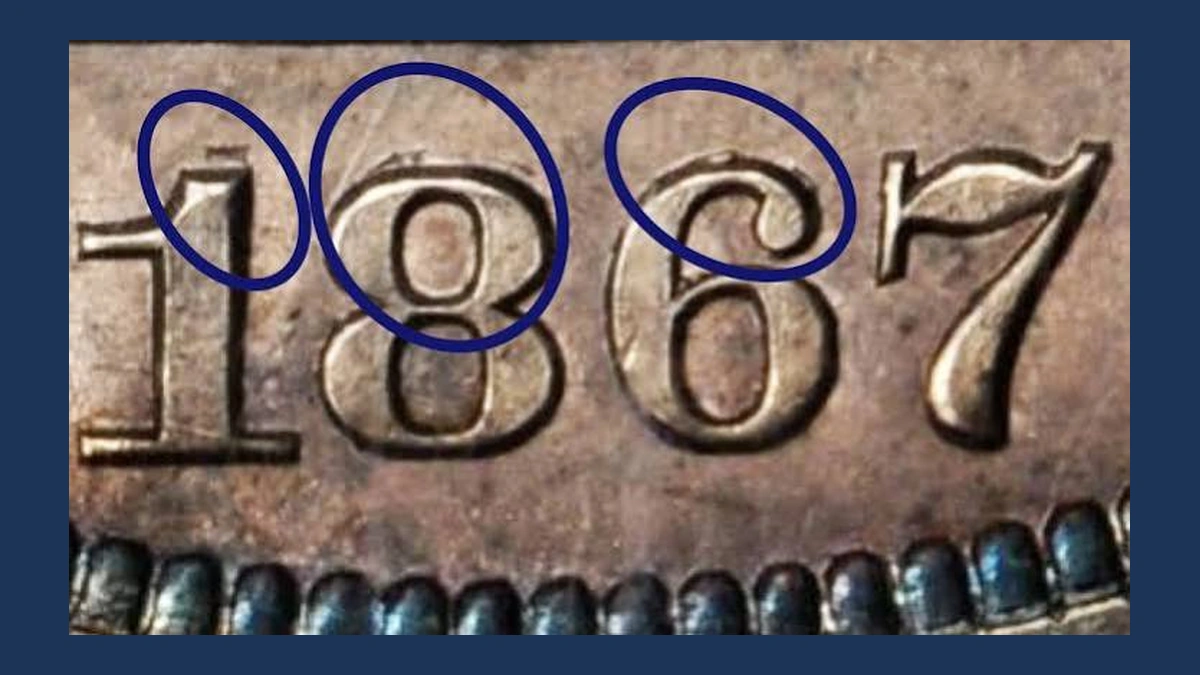
The smaller strokes belong to an earlier date impression in the steel stamping tool. A punch intended for half dollars was used before the correct dollar-sized punch.
The resulting variety is called Large over Small Date or a repunched date. It repeats the same year, rather than changing an older year to 1867.
An ordinary-strike example is cataloged as OC-1. That name identifies its pairing of front and back tools.
This concerns the date punch, not a dollar made from a half-dollar disc. Proofs, specially made collector coins, need comparison with a matching Proof example.
Estimated Value
The PCGS auction record lists $2,400 in November 2021 for an OC-1 graded MS60. That grade means an unworn coin with substantial marks.
Estimate $800–$20,000 for ordinary examples across worn and attractive unworn conditions. The scarce date and surviving surface contribute much of the complete dollar’s value.
Clear small-digit remnants help identification, but they do not remove cleaning or contact marks. Compare preservation as well as the extra strokes before applying the upper estimate.
How to Identify
Frame the entire date in a close photograph before enlarging the first two digits. A 10× magnifier can reveal strokes that disappear in a normal-sized picture.
Look around the top of the final 1 and into its middle for remnants of the smaller impression. Continue above 8 and 6, comparing the visible traces with a named Large over Small Date example.
The earlier small digits need not survive equally strongly. The documented early-stage coin shows the first two date digits especially clearly.
Change the light angle and inspect nearby silver for fresh cuts or disturbed metal. A genuine smaller stroke belongs to the original raised date, while later engraving can leave a cut through the finished surface.
Conclusion
The 1867 Large over Small Date tells the story of a stamping tool prepared with two sizes of date punch. It does not indicate a different year or a half-dollar blank.
Estimated whole-coin values run from $800–$20,000, with the documented MS60 example bringing $2,400. Inspect the smaller digit remnants and the surrounding surface together, keeping the full date visible in comparison photographs.