1866 Dollar Coin Error List with Pictures

One 1866 dollar combines a repeated date with doubled words on the back. An MS64 example, an unworn coin with relatively few marks, brought $7,800 in April 2019.
This 1866 Liberty Seated Dollar error guide explains those two features and a separate small blank flaw beside a star. Estimated whole-coin values span $600–$30,000.
Follow the close-up checks below, keeping ordinary coins separate from Proofs, the specially made collector versions.
1. 1866 Liberty Seated Dollar Small Blank Defect beside Star Thirteen
Two points of the thirteenth front star meet beside a reported small defect in the blank. A collector describes this feature on an 1866 dollar graded PCGS AU58, meaning slight wear remains.
The account identifies a planchet flaw, using the collector term for a fault in the blank metal. It does not establish a peeling layer or an object pressed into the surface.
That distinction matters when comparing photographs. A dent added after the dollar left the Mint may lie beside the same star but have a different shape and origin.
Estimated Value
For an authenticated ordinary 1866 dollar with a small original blank flaw, estimate $600–$6,000 in worn through lightly worn condition. The reported AU58 is a condition example, not a disclosed auction result.
The little defect should not be priced as a large missing piece or a split coin. Most of the value comes from the dollar’s date and preservation.
An unobtrusive flaw may attract a specialist, while harsh cleaning can reduce the complete coin’s appeal.
How to Identify
Locate star thirteen on the front before judging the small mark. Keep the whole star visible in an enlarged photograph so its two meeting points can be identified.
Use low-angle light from more than one direction to see the feature’s outline. A magnifier can help separate the original surface from later scratches, dents, or corrosion.
Compare its position with the collector’s AU58 example, rather than choosing any mark near the outer border.
Do not scrape or probe the area to test whether metal will lift. If its shape and depth remain unclear, ask a grader to examine it.
The meeting point beside star thirteen is the specific place to compare.
2. 1866 Liberty Seated Dollar Extra Date-Punch Strokes
An earlier date-punch position can leave a second stroke beside the final digits. This happens on the stamping tool before it makes the coin, rather than from someone striking a finished dollar again.
Ordinary 1866 dollars cataloged as OC-1 have a repunched date. Some Proofs also show repunching at the bottom of the 1.
Other Proof combinations have a 1 without that extra base stroke. A low or slanting date alone is not the same feature.
Look for a surviving piece of the earlier numeral, not simply a different position for the whole date.
Estimated Value
An ordinary PCGS MS64 OC-1 sold at Heritage for $7,800 in April 2019, as recorded in NGC’s auction archive. That coin also has doubled back lettering.
Estimate $600–$12,000 for ordinary repunched-date examples and $1,500–$30,000 for matching Proofs, depending on preservation. These are whole-coin ranges, not amounts to add together.
A clean numeral outline is useful, but scratches or polishing across the surrounding silver can matter more to the final price.
How to Identify
If examining a Proof, begin at the bottom of the 1 with a ten-power magnifier. Compare the main base with any extra raised stroke that follows its shape.
For an ordinary OC-1 dollar, use a labeled date photograph and compare all four digits. The visible remnants must match that coin’s pattern rather than a guessed direction.
Shift the light to distinguish a raised remnant from a scratch cut into the silver. Then step back and check whether an apparently repeated line is only the ordinary edge of a numeral.
Identify the coin’s production style before applying a Proof comparison. A second base stroke on the 1 is the useful Proof feature; date placement by itself is not.
3. 1866 Liberty Seated Dollar Doubled Words above the Eagle
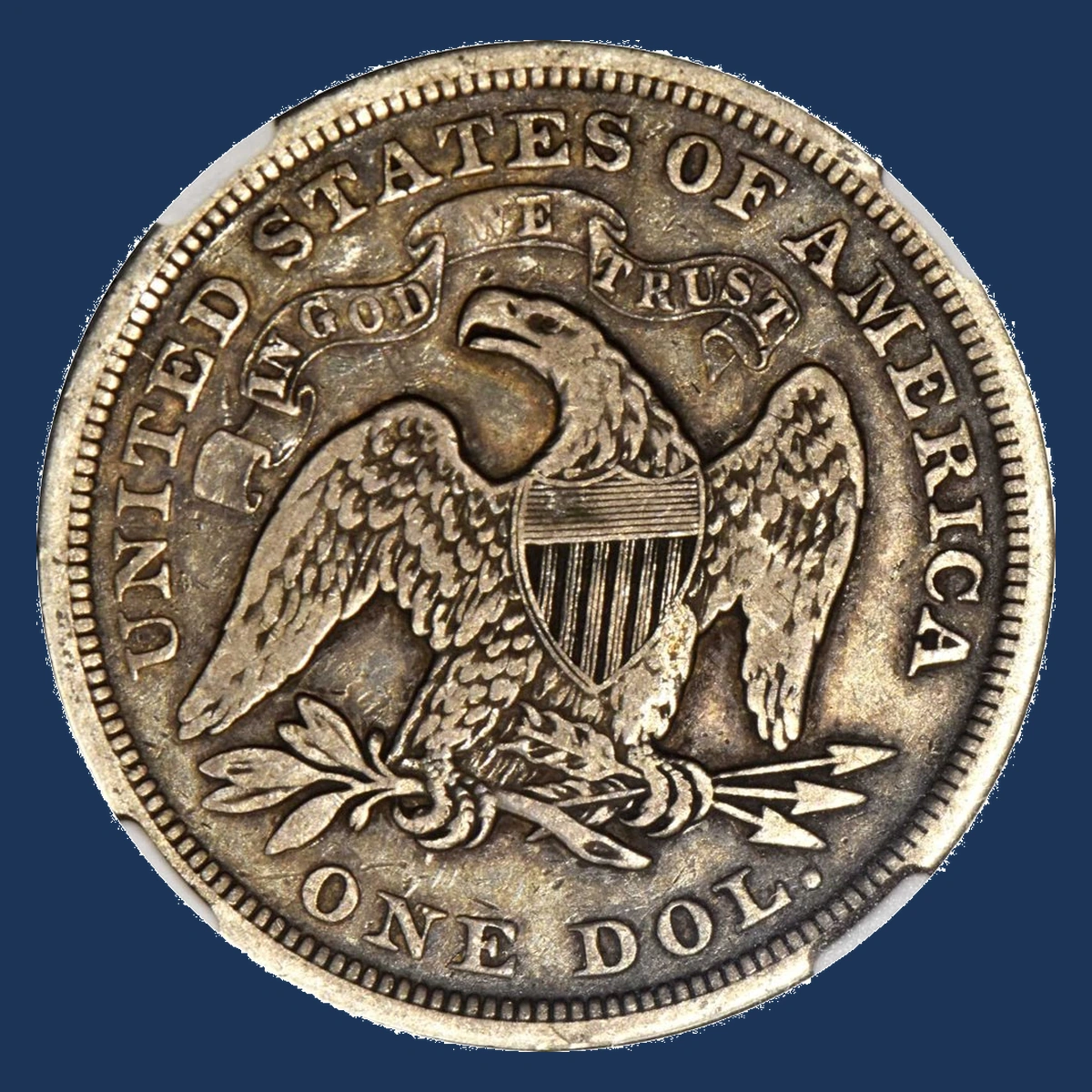
The words GOD WE TRUST can carry extra outlines on the back of an 1866 dollar. The ordinary OC-1 auction descriptions recognize this repeated lettering alongside the repunched date.
Proof references trace their doubling to the hub, the master tool used to put a design into a die. A die is the tool that then stamps the coin.
That shared origin can make the feature appear across more than one stamping tool. It does not mean the coin received two misplaced strikes.
The Proof description specifically excludes IN from the doubled words.
Estimated Value
A cleaned OC-1 with both date repunching and back doubling brought $1,980 in February 2025, according to PCGS’s Stack’s Bowers record. Its grade indicates no circulation wear but a cleaning problem.
Estimated whole-coin prices are $600–$12,000 for ordinary examples and $1,500–$30,000 for Proofs. Strong preservation supports the upper levels.
The $7,800 ordinary MS64 comparison in the date section is another coin with both features; its price cannot be counted twice.
How to Identify
Read GOD WE TRUST above the eagle under a magnifier. On the described Proof pattern, compare those words with IN, which the reference does not list as doubled.
Tilt the dollar gently under a fixed light and follow the outlines of several letters. Rounded second edges differ from a thin, flat shelf caused by movement as a coin was struck.
For ordinary OC-1 examples, match a labeled photograph of the same production style. Do not assume every letter must look exactly like the Proof comparison.
Cleaning scratches may run through both letters and background rather than following the letter shapes.
Trace the repeated raised edges across the motto, checking that their positions remain consistent as the light changes.
Conclusion
An extra date stroke, repeated motto, and tiny star-side flaw call for different close-up views. The first two can occur together on one ordinary 1866 dollar.
Estimated whole-coin values range from $600–$30,000, with Proof status and preservation affecting the comparison. Count a coin’s sale price once, even when it shows both varieties.
For the small blank flaw, compare the exact location beside star thirteen before deciding what caused it.