1856 Dollar Coin Error List with Pictures

Liberty can appear to have tiny whiskers on an 1856 silver dollar. Those fine lines came from the stamping tool, and they can disappear on coins made later.
Other examples carry raised cracks near the date and around the back. An unworn MS63 dollar with tool cracks sold for $16,800 in August 2025.
Our 1856 Liberty Seated dollar error list explains what these marks look like and why condition still drives the price. Read on for estimated whole-coin values of $500–$20,000 and simple ways to compare the details.
1856 Liberty Seated Dollar Chin Whiskers
A few thin lines below Liberty’s chin can look like short hairs. They are called “Chin Whiskers,” but nothing was trapped on the coin to make them.
The lines copied small marks left on the steel stamping tool during its preparation. Early coins show them more clearly; continued use gradually weakened the detail.
This is a named tool feature on ordinary 1856 dollars. It does not mean Liberty’s portrait was redesigned or that every coin should have obvious whiskers.
Wear and lighting can also hide fine lines that remain on a particular coin.
Estimated Value
For an ordinary 1856 dollar showing the whiskers, estimate $500–$15,000 across worn and attractive unworn examples. The coin’s condition matters more than the nickname.
A different 1856 dollar with cracks brought $16,800 in August 2025. That same-year sale illustrates the value of a scarce, well-preserved silver dollar, not a separate whisker premium.
Do not price a scratched or cleaned coin like a smooth unworn example. Fine chin lines alone cannot make their preservation equal.
How to Identify
Keep the coin upright and examine the empty area directly beneath Liberty’s chin. A 10× magnifier should show whether the apparent hairs belong to the surface or are loose material.
Compare their arrangement with a clearly photographed early 1856 ordinary strike. Proofs were specially made for collectors and used a different pair of tools, so they are poor substitutes here.
Move the light while holding the coin still. Reflections can make one scratch seem to split into several lines, especially in a sharply enlarged photograph.
Then check whether the chin itself is worn smooth. Missing fine lines on a worn coin do not tell you when its stamping tool was used.
A matching group of fine lines immediately below the chin is more useful than a single isolated mark.
1856 Liberty Seated Dollar Raised Tool Cracks
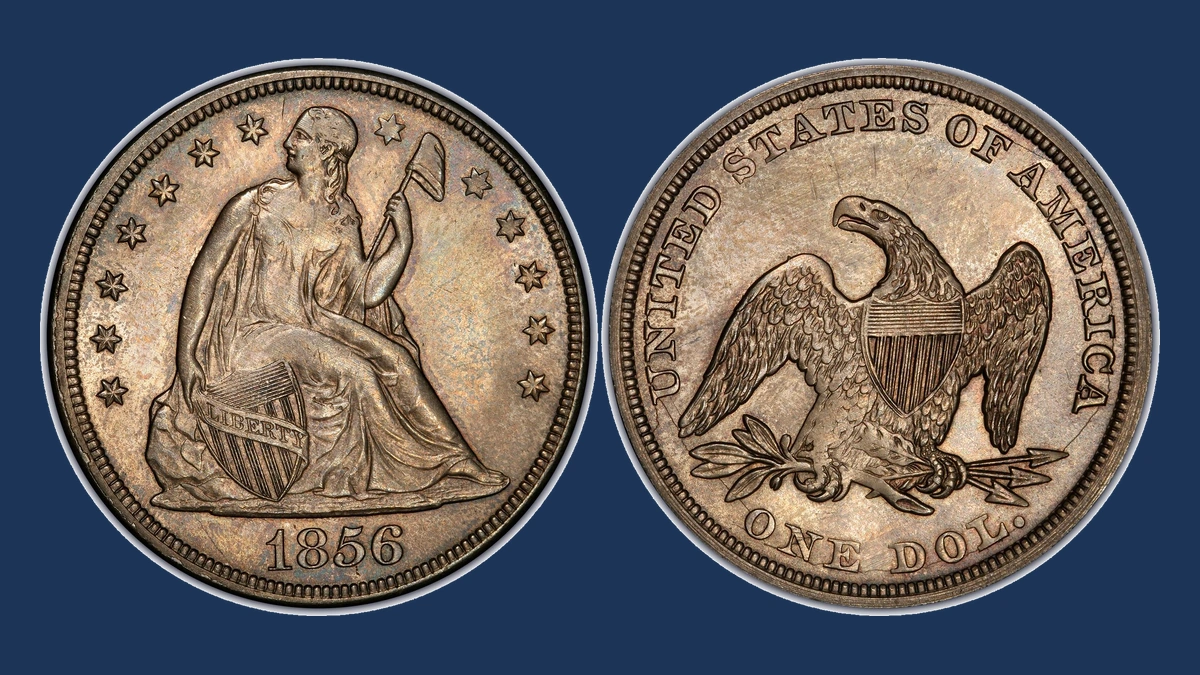
The 5 can have a fine raised line running through it. Another crack rises from the small border beads at the very bottom of the coin toward the seated design.
These features appear on the well-known Hansen/Pellegrini example. Other cracks occur on the back, although their paths should be compared coin by coin.
A split in the steel stamping tool leaves a raised line when silver enters it. The coin itself has not necessarily split.
The 5 normally leans on 1856 dollars. Its slant alone is not a date error or a crack.
Estimated Value
The PCGS record lists a PCGS MS63 example with cracks at $16,800 in August 2025. MS63 means an unworn coin, though marks remain visible.
An estimated $500–$20,000 covers identified examples from worn pieces through desirable unworn dollars. Strong original surfaces can matter far more than the length of a fine crack.
This is a whole-coin range. Several cracks on one dollar are not separate items whose prices can be added together.
How to Identify
Check the lower border first. At the six o’clock position, compare any raised line with the one running upward toward the seated design on the Hansen/Pellegrini coin.
Follow that line without changing the coin’s position. A normal border bead stops within the border, while this crack continues into the adjacent design area.
Now inspect the 5 separately under magnification. Distinguish a thin raised thread from the number’s normal slanted body and from a scratch cut across it.
The back may show other cracks, so compare a full photograph before tracing a particular line. Dark toning alone is not proof of a split tool.
Angled light should reveal raised silver along the suspected crack, rather than a trench below the surface.
Conclusion
The 1856 dollar’s whiskers are fine lines copied from a stamping tool. Raised cracks tell a different story, and the slanted 5 is a normal part of the date.
Estimated whole-coin values span $500–$20,000. The $16,800 auction example shows how much a well-preserved dollar can bring, rather than setting a price for every small crack.
Inspect the chin and lower date area without cleaning either surface.