1853 Dollar Coin Error List with Pictures

Extra detail on an 1853 silver dollar can sit beneath Liberty’s chin, beside a date digit, or within the shield lettering. Each location needs its own comparison.
A Proof with a repunched 1 reached $65,000 before fees in October 2025. Proofs are specially prepared coins, and this example was cataloged as a later restrike.
This 1853 Liberty Seated dollar error guide covers estimated whole-coin values of $500–$150,000. Read on to separate the reported features and their different price ranges.
1. 1853 Liberty Seated Dollar Reported Extra Outlines in LIBERTY
An indexed collector article mentions doubling in LIBERTY and extended shield lines on an 1853 dollar. The visible area to examine is the lettered band across Liberty’s shield.
The reference identifies a topic for comparison, but does not establish how the extra detail formed. A repeated design built into the stamping tool, movement during striking, or tool reworking can produce different appearances.
These causes leave different clues on the silver. A match to the reported coin’s photograph is needed before calling this a doubled die, meaning a stamping tool with repeated design outlines.
Estimated Value
For an ordinary 1853 dollar with a confirmed original lettering variety, use a conditional whole-coin estimate of $500–$15,000. The actual pattern and state of preservation determine the useful comparison.
The article-index reference does not provide a completed sale for its example. This range should not be applied to a coin merely because LIBERTY looks thick in a photograph.
A flat shelf, added scratches, or damage across the shield can have a different cause and little extra collector value.
How to Identify
Frame the shield’s whole lettered band before enlarging one character. Keep the lines above and below LIBERTY visible with the letters.
Under a magnifier, compare the extra outlines with the main letters. Note whether they copy the letter shapes or instead form flat shelves and unrelated scratches.
Use light from more than one side to judge their height. An enlarged photograph taken at one angle can make a reflected edge look like a second outline.
A line extending beyond the band is not automatically a second design impression. Match its course and nearby lettering to the pictured 1853 example before deciding what the feature represents.
2. 1853 Liberty Seated Dollar Whisker-Like Lines below Liberty’s Chin
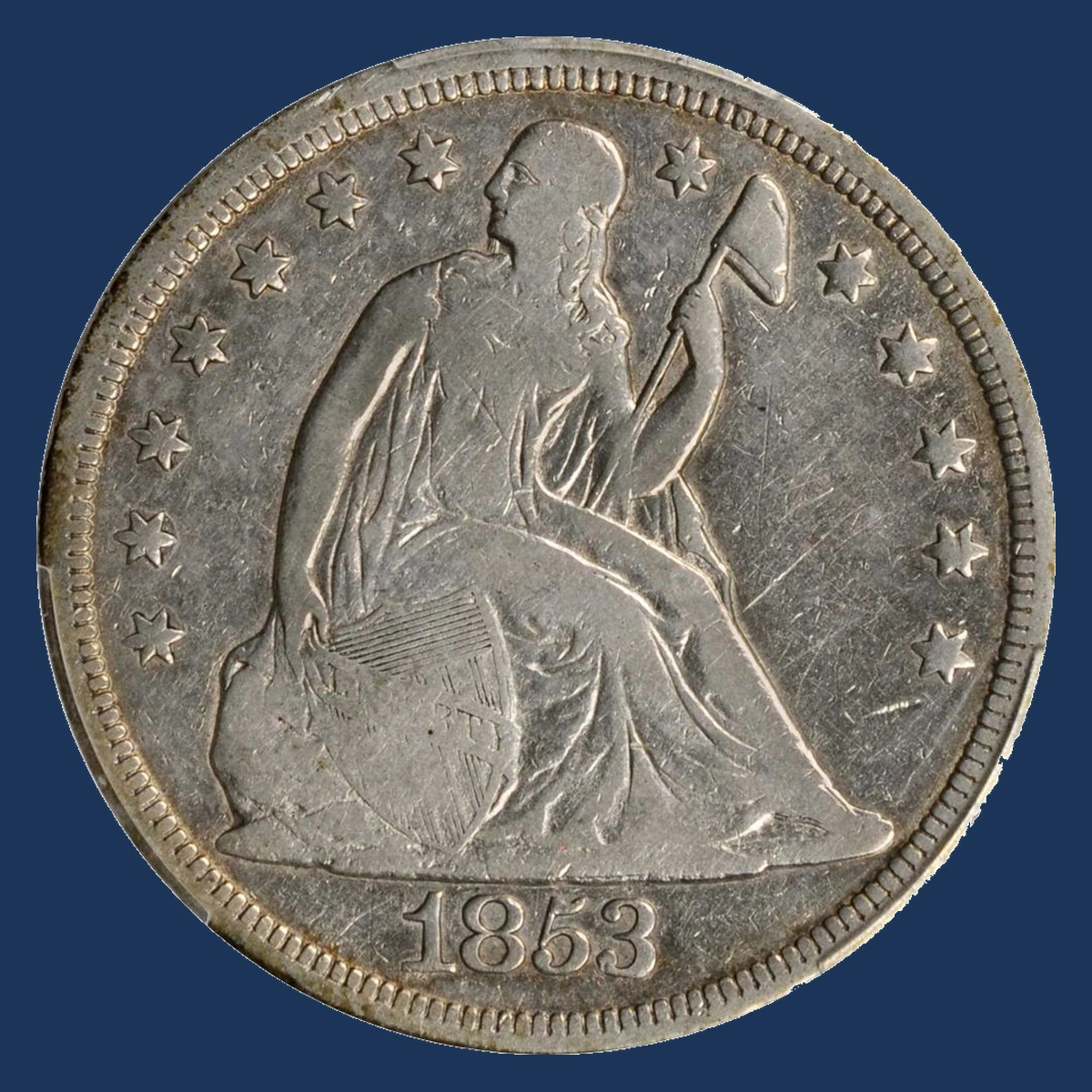
Fine lines extending below the chin can make Liberty appear to have whiskers. They are associated with finishing work on the steel stamping tool, called a die.
The tool copied its small marks onto the silver rather than leaving a piece of hair or wire embedded in the coin. Early impressions can show these lines more clearly than later ones.
The feature is reported on ordinary 1853 dollars. It is a small tool characteristic, not proof of a major accident in the press.
Handling scratches near the chin can imitate short lines and need separate examination.
Estimated Value
Estimate $500–$20,000 for 1853 dollars with matching chin lines, from worn coins through unworn examples. The lines identify a feature; the coin’s condition supplies much of the value.
For context, an ordinary 1849 MS65 sold for $41,400 in May 2003. MS65 means well-preserved and unworn; that different-year result does not price the 1853 chin lines.
A sharp portrait can make the tiny lines easier to see. Cleaning or deep marks may reduce appeal even when the tool feature is genuine.
How to Identify
Use side lighting to examine the small space directly under Liberty’s chin. Identify where each line begins instead of looking for any scratch near the face.
Compare the arrangement with a known early 1853 impression at the same magnification. Other years can have chin lines too, so the date must stay tied to your photograph.
Watch for cut edges or disturbed metal beside a line. Those can reveal later scratching rather than a mark copied from the stamping tool.
Tilt the lamp without touching the surface to distinguish actual relief from reflected glare. Do not wipe the silver to bring out a faint feature.
Wear and later tool changes can weaken the lines. Their absence alone should not be used to identify a different coin type.
3. 1853 Liberty Seated Dollar Repeated Date Details on Separate Issues
A slight extra stroke can remain where a date punch entered the stamping tool more than once. The resulting coin repeats that small leftover outline.
A year guide reports repetition at 5 and 3 without assigning a precise tool variety. That account is separate from the clearly cataloged Proof OC-P2, which has slight repunching at the flag of 1.
The flag is the short stroke at the top of that digit. The Proof was sold as a restrike, meaning a coin made later with an earlier date.
The two descriptions should not become one coin with all those extra strokes.
Estimated Value
Use an estimated $500–$20,000 for confirmed ordinary examples and $25,000–$150,000 for identified Proof examples, depending on preservation. The two kinds of coins need separate pricing.
The NGC PR65 OC-P2 reached $65,000 before buyer’s fees in Heritage’s October 2025 sale, as listed in the published auction record. PR65 describes a well-preserved Proof with relatively few marks.
This is the value of the complete scarce Proof, not a price for its tiny repeated 1 alone.
How to Identify
For the cataloged Proof, center the top of 1 under a magnifier. Compare its small repeated flag with an identified OC-P2 photograph rather than assuming any thick digit is repunched.
Keep the other digits and nearby border teeth in the same view. Their positions help an examiner match the complete date pattern.
The reported 5-and-3 example requires its own photographs. Do not borrow the Proof’s close-up to supply a direction or shape missing from that separate report.
Examine each extra stroke under changing light for a rounded, raised remnant. Scratches and flat shelves can create other kinds of apparent repetition.
Before using a Proof price, have the coin’s special manufacture assessed. Bright reflections on an ordinary dollar are not enough.
Conclusion
The 1853 dollar offers three different areas to inspect: chin lines, date remnants, and the reported shield-lettering feature. Keep ordinary coins separate from the cataloged Proof and match the actual visible details.
Estimated whole-coin ranges run from $500–$150,000. The $65,000 before-fee result belongs to a well-preserved Proof, so it should not be transferred to a worn coin with one suspicious line.