2013 Dime Error List with Pictures

A cent stamped over a 2001 dime sold for $1,320 in September 2025. A different 2013-D example carrying both designs has appeared with a much higher $20,000 asking price.
That seller’s price is not a completed sale. The nine 2013 dime errors below span an estimated $5–$20,000, including small metal bumps and shifted designs.
Read on to learn what each feature looks like, how to check it, and which prices are estimates or actual sales.
1. 2013 Roosevelt Dime Die Chip (Estimated Up to $100)
A small bump beside a letter may be extra metal from a chipped die. A die is the steel tool that stamps the design onto a blank metal disc.
When a piece breaks from that tool, it leaves a small hollow. Metal fills the hollow during stamping and forms a raised lump on the coin.
For 2013-P dimes, chips are reported near letters and numbers on either face. They do not all share one shape or position.
A chip inside the design differs from a large break joined to the rim. Collectors call that rim-connected form a cud.
Estimated Value
Expect an estimated $5–$100 for minor through prominent 2013-P chips. Tiny bumps on worn coins usually attract little extra money.
A larger feature that clearly changes a letter or number can be more appealing. Clean surfaces help buyers see the defect without confusing it with dirt or corrosion.
These are estimates for the error’s appearance and condition, not proof that every raised spot has a premium. Loose material stuck to the coin adds no mint-error value.
How to Identify
Is the bump part of the coin? Examine its base with a 10× magnifier, without scraping or picking at it.
A genuine chip forms a raised shape that joins the surrounding surface. Dirt may have a dark border, while impact damage can leave a crater beside pushed-up metal.
Look at both faces, since these bumps are not limited to one side. Compare any repeated shape on another 2013 dime.
Check 2.268 g with a scale and 17.91 mm with calipers. The edge should have its normal grooves unless something else has damaged it.
Find the same raised shape in the same place on another coin to support a die-chip identification.
2. 2013 Roosevelt Dime Grease Struck-Through (Estimated Up to $150)
A letter can look faint or partly missing even when nearby detail stays sharp. Grease packed into a die can prevent metal from filling part of its design.
The coin then leaves the press with a weak patch. Collectors call this a struck-through error because material came between the die and the blank.
This type is reported for 2013-D dimes. The hair, lettering, and torch bands are useful places to compare sharp and weak detail.
Wear can also erase high points, but it follows the exposed design. A grease-filled area can interrupt one detail while its neighbors remain clear.
Estimated Value
A small missing letter may bring an estimated $10–$30, while a larger clear struck-through area can reach $30–$150. These figures cover genuine grease-related errors on ordinary circulation coins.
The strongest candidates show a sharp contrast between the weak patch and the rest of the design. General softness, heavy wear, or a polished surface lowers collector interest.
The full estimated range is $10–$150; the upper figure is not an identified 2013 auction result.
How to Identify
Start with the sharpest nearby letter, then move toward the weak patch. Under a 10× magnifier, compare how much of each detail remains.
Grease can leave one area faint while its neighbors stay clear. Ordinary wear usually smooths the highest exposed parts across the design.
Watch for scratches or shiny smoothing where a letter should be. Those marks may show that someone removed the detail after the coin was made.
Turn the dime over and inspect the back and the grooves around its edge. Check normal measurements near 2.268 g and 17.91 mm with a scale and calipers.
Look for a faint, smooth patch surrounded by sharp detail, without scrape marks explaining the missing design.
3. 2013 Roosevelt Dime Lamination and Clamshell Split (Estimated Up to $200)
An opening along the edge can make a dime look like a partly opened shell. This metal separation is often called a clamshell split.
Part of the coin separates while another section still holds it together. Smaller peeling areas on the surface are usually called laminations.
A 2013-P seller listing uses the clamshell label for an ungraded coin. That label alone does not prove how the opening formed.
Heating, prying, or cutting can also separate metal. Color does not prove that a split happened during coin production.
Estimated Value
The ungraded 2013-P clamshell listing asks $15, with offers accepted. That is a seller’s price, not a completed sale or independent authentication.
For genuine examples, an estimated $10–$200 spans small peeling flaws through a stronger attached split. The upper end allows for a clear, well-preserved error with an opening that collectors can easily see.
A damaged coin forced apart after minting should not receive the same premium, even if it looks dramatic.
How to Identify
Do not widen the opening or press the halves together. Either action can break the joined section.
Follow the split from the edge with a 10× magnifier. Look for separation along a metal layer, then search for cuts, pry marks, or signs of heating.
A normal dime has clad construction: bonded outer layers around a copper center. Check whether the opening follows those layers rather than a cut made across them.
A scale may read near 2.268 g if all metal remains attached. Carefully compare caliper measurements with 17.91 mm and inspect the edge grooves.
Trace the opening to its attached end; a separating layer without cut or pry marks is the key feature to examine.
4. 2013 Roosevelt Dime Double Clip (Estimated Up to $250)
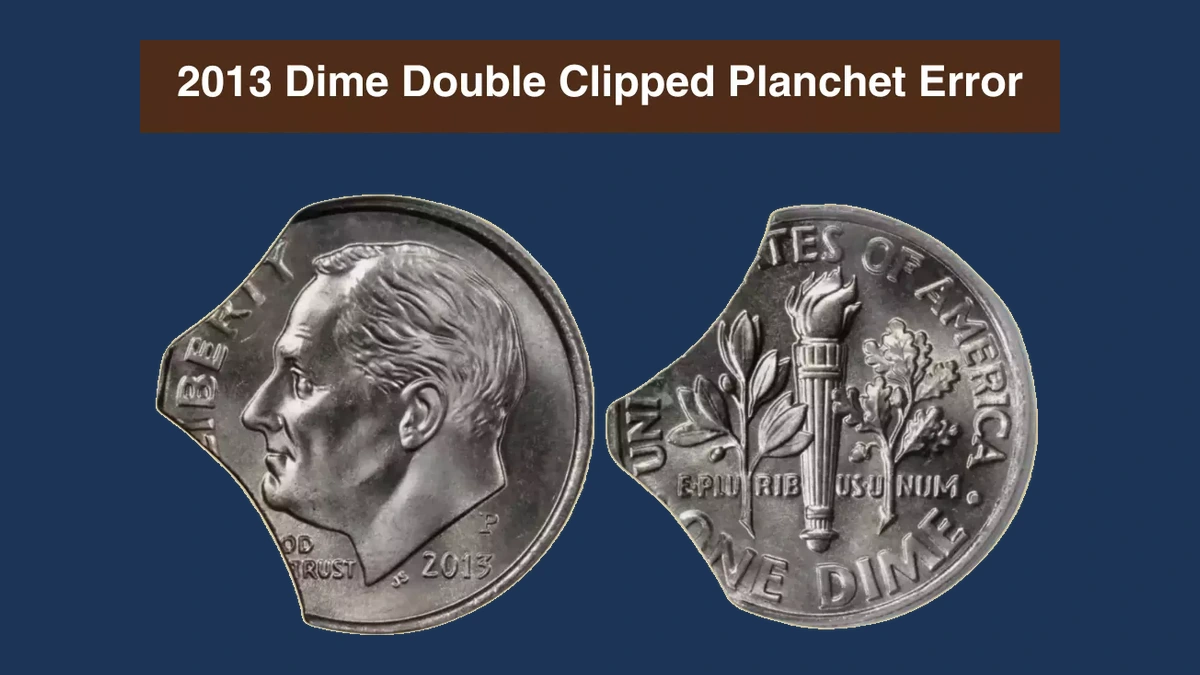
Two missing pieces give this dime an incomplete outline. Both gaps were present in the metal disc before the design was stamped.
An identified 2013-P example weighs 1.83 grams. GreatCollections offered this ANACS MS65 coin, an unworn example, in December 2025.
Two gaps do not require two separate accidents. One cut through the metal strip can overlap more than one existing hole.
The rim opposite a clip may look weak, but that sign is not guaranteed. The shape of nearby letters can also show how the incomplete disc responded to stamping.
Estimated Value
An estimated $40–$250 covers modest through more striking 2013 double clips. The certified 1.83-gram coin is a useful example, but its sale price is not publicly displayed.
A different 2002-D straight-clip dime sold for $61 in September 2024. Its NGC MS67 Full Bands grade describes an unworn coin with clearly separated torch bands.
That comparison has a different date and clip shape. Two gaps do not automatically double a single clip’s value.
How to Identify
The known example weighs 1.83 g, well below a normal dime’s 2.268 g. Use a scale for a loose coin or the recorded weight for a sealed, graded coin.
Low weight alone cannot prove a mint error. Cutting pieces away later also makes a dime lighter.
Examine each gap with a 10× magnifier for saw marks and filing. Look for letters stretched toward the missing area and weakness in the opposite rim.
Inspect the remaining edge grooves, and compare caliper measurements across intact portions with 17.91 mm. Avoid measuring through the gaps.
Compare both cut edges and nearby design with a confirmed double clip, rather than relying only on the outline.
5. 2013 Roosevelt Dime Partial Collar (Estimated Up to $250)
A step around the edge can be easier to spot than anything unusual on the faces. It forms when only part of the disc sits inside the collar.
The collar is the ring that holds a coin’s edge during stamping. Metal outside it can spread wider than the section held inside.
The resulting ledge is sometimes called a railroad rim. On a dime, compare that ledge with the nearby edge grooves.
This error is reported for 2013-D coins. Groovelike marks on a flat face alone do not prove that the coin partly missed the collar.
Estimated Value
An estimated $40–$250 fits genuine 2013-D partial-collar errors with a visible edge step. A small, subtle change generally costs less than a bold ledge on an attractive coin.
This is a guide range, not a verified price for one certified 2013 example. Buyers need a clear side photograph to judge what they are paying for.
If the edge has been squeezed or damaged later, a railroad-like shape alone should not command this premium.
How to Identify
View the dime from the side under a 10× magnifier. Rotate it slowly and follow any step between two edge levels.
One level should show where the holding ring shaped the edge. The wider part can have different or missing grooves.
Calipers used in several directions can reveal where the metal spread beyond the normal 17.91 mm. A scale reading near 2.268 g supports an intact disc, though it does not prove the cause.
Now inspect both faces beside the ledge. Later squeezing often crushes the design or leaves contact marks.
Look for a natural step from the grooved section to the expanded edge, without damage explaining the change.
6. 2013 Roosevelt Dime Die Misalignment (Estimated Up to $300)
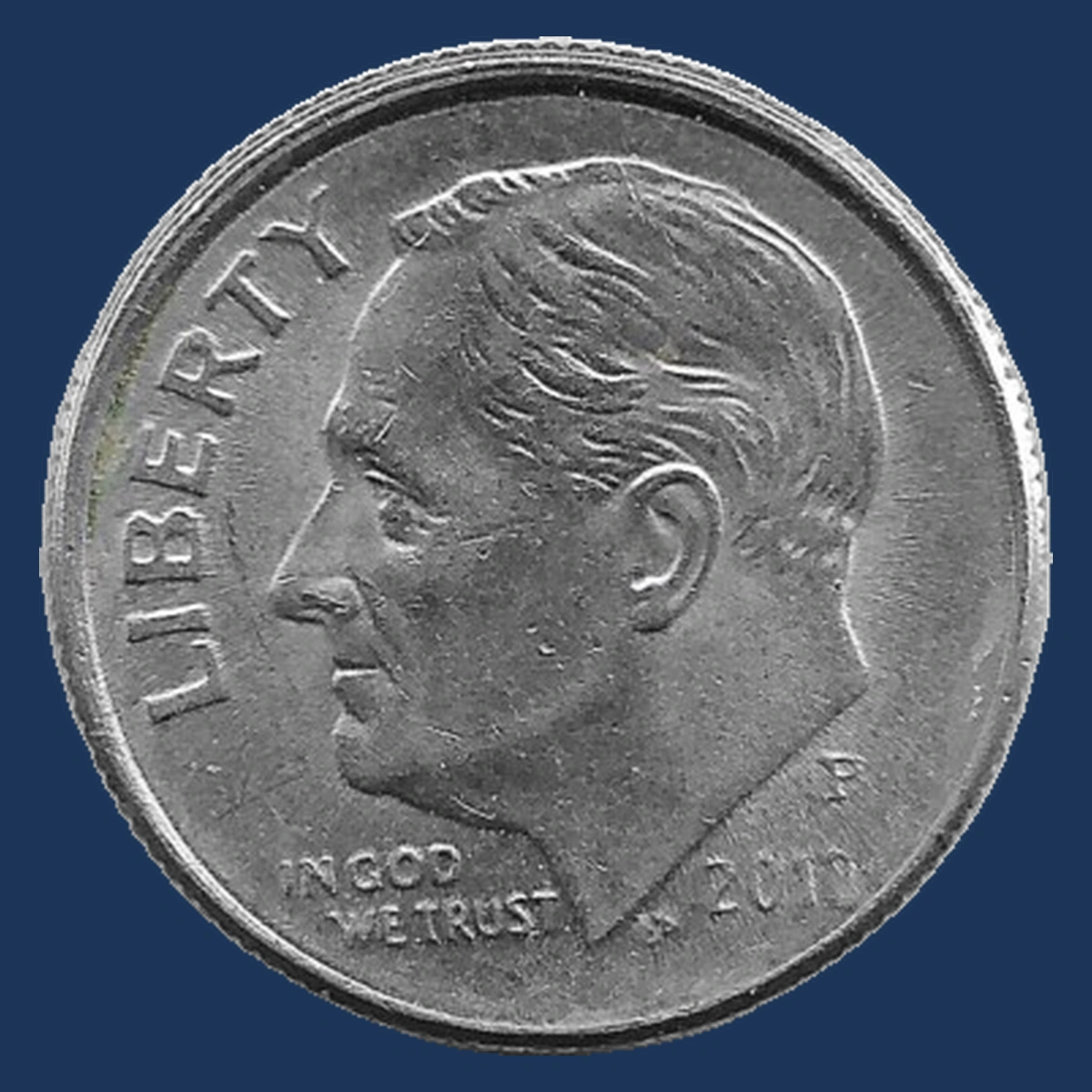
One face may have a wide border while the other stays centered. That can happen when a stamping tool shifts sideways over the disc.
A rotated tool causes a different result. One design faces the wrong direction compared with the other.
These problems need separate checks, even though both are called alignment errors. A sideways photograph cannot show whether the back design is truly rotated.
Compare the widths of both borders for a sideways shift. To test rotation, hold Roosevelt upright and flip the coin top to bottom without turning it sideways.
Estimated Value
Estimate $5–$50 for modest sideways misalignment and $50–$300 for a strong, genuine alignment error. A slightly uneven border often attracts little extra money.
The combined $5–$300 estimate depends on what actually moved. A rotated design needs a clear demonstration of its angle.
Condition matters too. A seller’s label or an unsupported claim of a large auction result should not set the price of a dime with an ordinary uneven rim.
How to Identify
Hold Roosevelt upright, then flip the dime top to bottom around a horizontal axis. The back design should appear upright too.
If recording this test, keep the camera fixed. Turning two photographs independently can create a false rotation.
For a sideways shift, use a 10× magnifier to compare border widths on both faces. One face may remain centered while the other moves toward the edge.
Check the edge grooves for crushing or damage. Compare scale and caliper readings with the normal 2.268 g and 17.91 mm.
A centered face opposite a shifted face points to sideways misalignment; an upright front with a tilted back after the proper flip points to rotation.
7. 2013 Roosevelt Dime Off-Center Strike (Estimated Up to $500)
A broad plain crescent beside a cut-off design can show where a dime missed the stamping tools. Both faces received only part of their designs.
Philadelphia examples around twenty percent off center are reported for 2013, along with Denver examples. The amount and direction of the shift vary between coins.
The plain crescent still contains metal. A clip instead has part of the disc missing.
An uneven rim alone is not enough to identify this error. Check both faces, since a shifted tool can move one design while the other remains centered.
Estimated Value
For readable-date 2013 examples, estimate $30–$500. A bold offset and attractive surfaces tend to bring more than a slight shift on a worn coin.
A 1977 Roosevelt dime struck ten percent off center brought $109 in June 2026. NGC graded that comparison MS64 Full Bands; it is a recent sale of a different date.
The estimate is not a price per percentage point. Retaining the date and mintmark can matter as much as size.
How to Identify
Find the date and any surviving mintmark before assigning the coin to 2013-P or 2013-D. A missing mintmark area cannot identify the mint.
Follow the end of the design with a 10× magnifier. Then turn the coin over and look for a matching boundary on the back.
The empty-looking arc should contain metal, rather than a gap left by cutting. Check that area and the remaining edge grooves for filing.
A normal dime starts at 2.268 g and 17.91 mm. Record scale and caliper readings, allowing for an uneven outline after stamping.
Both faces should have corresponding plain areas beside the displaced designs, showing that the whole disc was out of position.
8. 2013 Roosevelt Dime Partial Missing Clad Layer (Estimated Up to $600)
A copper-colored patch on the front can mark a missing outer layer. The pale outer metal of a clad dime is bonded to its copper center.
The reported 2013-D type involves only part of the front layer. The border between pale and copper-colored areas is worth a close look.
Color is only a starting clue. Stains can turn an ordinary dime brown, while acid can remove metal and reduce its weight.
A genuine error needs evidence of missing metal and the design stamped into the exposed area. Brown color plus low weight does not settle the question.
Estimated Value
An estimated $75–$600 covers small through extensive genuine missing-layer errors. Large, clear areas on attractive coins usually draw more attention.
A 2019-P dime missing eighty percent of its front outer layer sold for $139 in September 2024. PCGS graded it MS61 Full Bands, meaning unworn with separated torch bands.
That is a different year with a stated missing area. It does not establish a price for every copper-colored 2013 dime.
How to Identify
Compare the two colors at their meeting point with a 10× magnifier. A missing layer should have a physical boundary, rather than only a change in surface color.
Look at the design inside the copper-colored patch. It should fit the way the coin was stamped, without scraping or rough chemical damage explaining the loss.
Weigh it against the normal 2.268 g with a scale. Acid can also reduce weight, so a low reading is not conclusive.
Compare caliper measurements with 17.91 mm and inspect the grooves and layers around the edge. Check the back for damage too.
Locate the missing-layer boundary and confirm that the design continues naturally across the exposed metal.
9. 2013 Roosevelt Dime Double Denomination (Estimated Up to $20,000)
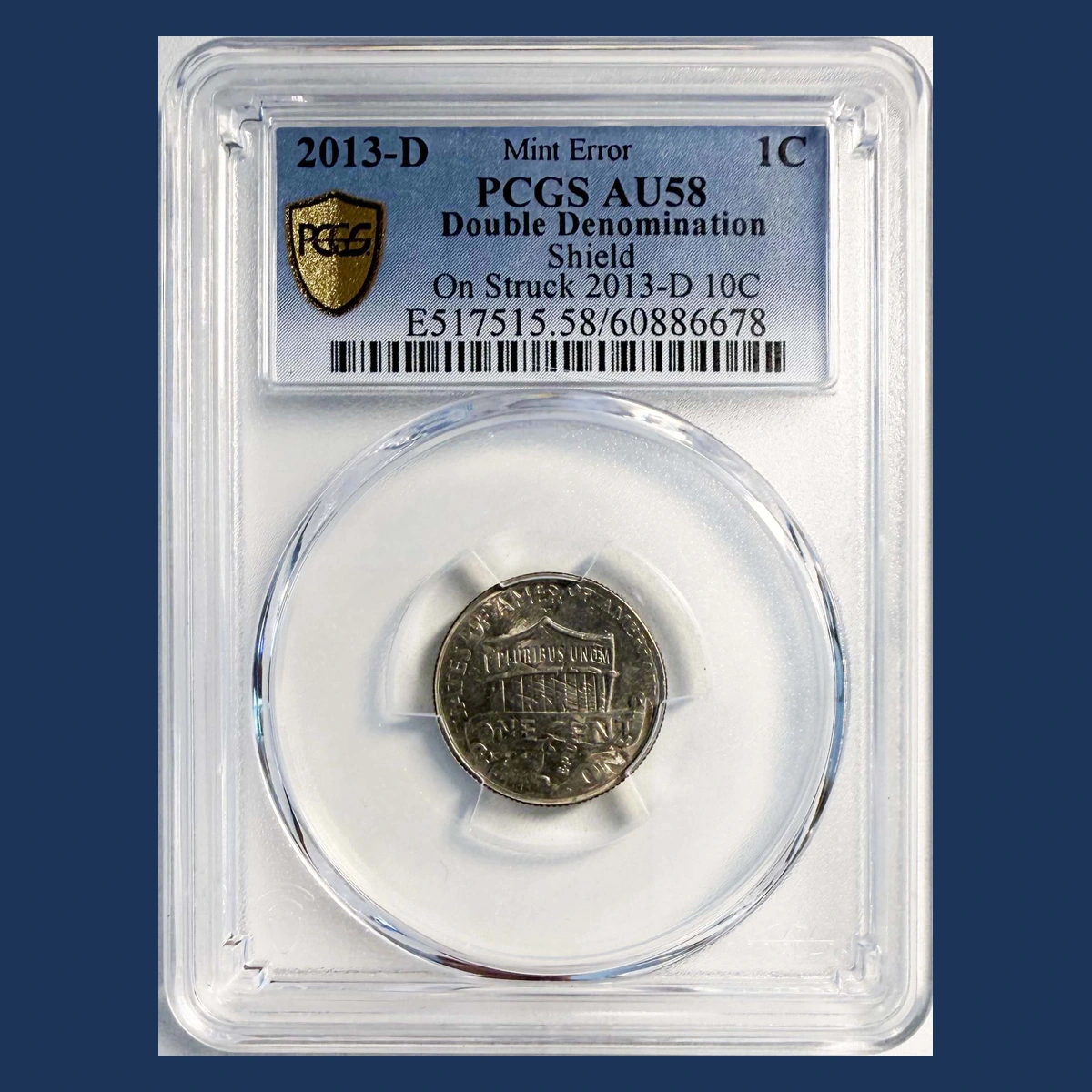
Lincoln and Roosevelt can share one small coin when a finished dime receives a second design. Cent stamping tools leave their design over traces of the original dime.
Mike Byers documented a PCGS AU58 example with 2013-D dates and mintmarks for both designs. AU58 means only slight wear.
The remaining dime details include Roosevelt, the date, the torch, and ONE DIME. This combination is called a double denomination.
It differs from a cent stamped onto an unused dime disc. That mistake produces no earlier dime design underneath Lincoln.
Estimated Value
The 2013-D example has appeared at a $20,000 asking price. That is not a confirmed sale.
A 2001 cent stamped over a 2001-P dime sold for $1,320 in September 2025. This PCGS MS66 comparison has a different cent design and less wear.
The estimated $1,500–$20,000 range allows for those differences. Its upper end reflects the seller’s much higher expectation, rather than proven bidding for the 2013 coin.
How to Identify
Find Roosevelt or the torch beneath the cent design with a 10× magnifier. A pale Lincoln coin alone could simply be a cent made on the wrong unused disc.
Compare both dates and the surviving D mintmarks with the documented example. The faint older details should form a recognizable dime design.
A dime begins at 2.268 g and 17.91 mm. Use a scale and calipers for a loose coin, or recorded measurements if it is sealed in a grading holder.
The second stamping can widen the outline. Check the edge for remaining dime grooves and later damage.
Trace a recognizable dime feature underneath Lincoln’s design, then match both designs to the grading record.
Conclusion
Begin with the feature you can see, then choose the right check. An edge split, a blank crescent, and a copper patch can look dramatic for very different reasons.
Estimated prices range from $5 for small die defects to $20,000 at the asking end for the double-denomination coin. Keep sale prices separate from seller expectations, and compare the condition and exact error before deciding what to pay.