1989 Dime Error List with Pictures

How can one unusual dime sell for $45 while another reaches $2,160? The first was a 1989-P off-center strike; the second had been struck again with a 1990 cent design and sold in September 2025.
The difference is the accident, not just the amount of visible damage. Estimated 1989 dime error values below range from $5 to $3,000.
Read on to distinguish small raised defects, missing metal, and coins carrying two sets of designs.
1. 1989 Roosevelt Dime Die Chips
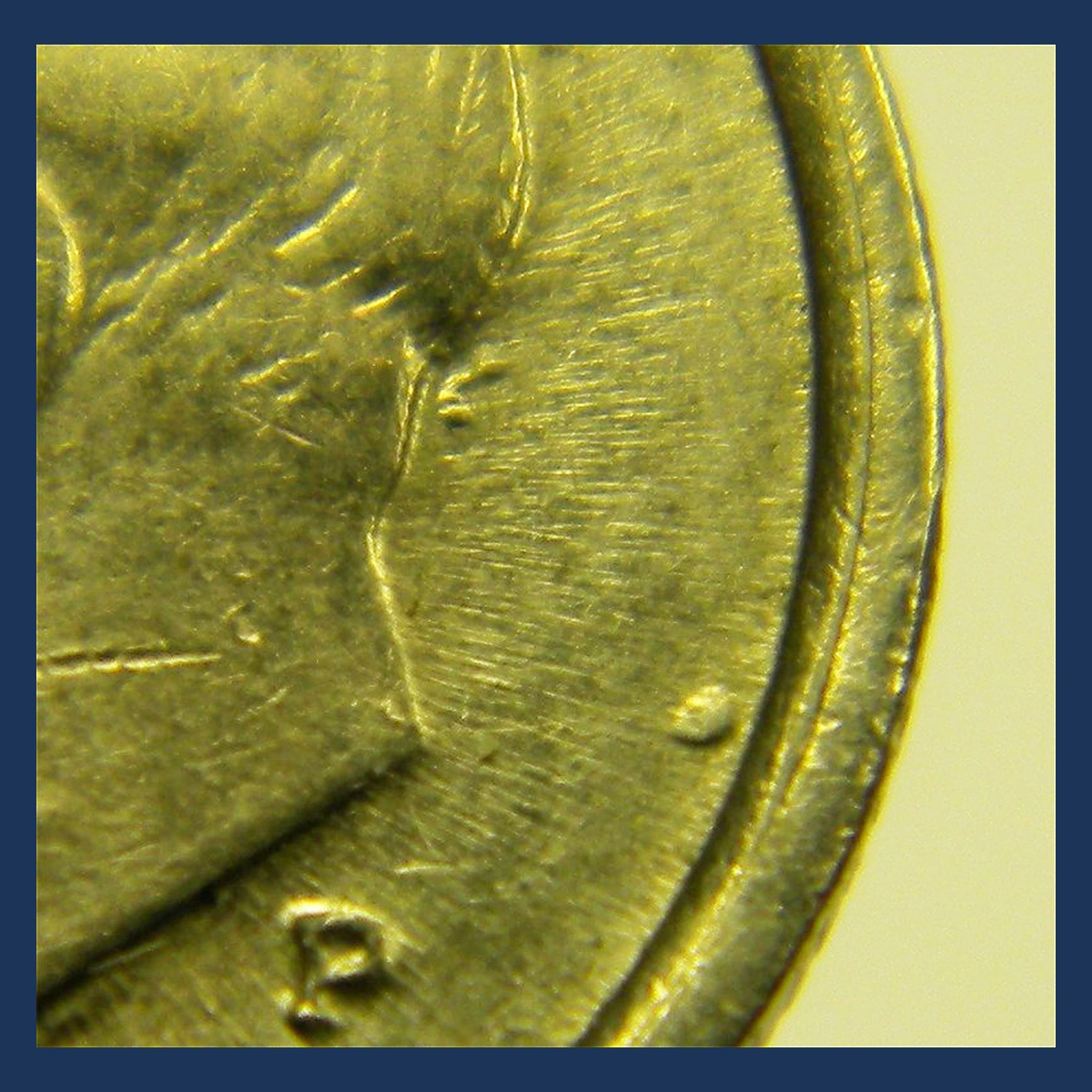
A small extra lump can form when a piece breaks away from a die, the steel tool that stamps coins. Metal fills the opening during striking and produces a raised chip-shaped mark.
The 1989-D report describes this kind of die chip. It mentions areas around the portrait and lettering without identifying a single fixed position.
A chip does not automatically mean a long crack or a large break at the rim. The actual shape needs to be seen, and several possible locations should not be treated as several confirmed coins.
Estimated Value
Minor genuine chips have an estimated value of $5–$75. A tiny bump on a worn dime commonly stays near the low end.
A clear lump that noticeably changes a letter or part of the portrait is easier to collect. Good surrounding detail helps show the difference from a normal coin.
The premium belongs to metal raised during striking. Dirt, solder, corrosion, or displaced metal from a later blow should not receive the same value simply because it looks raised.
How to Identify
Compare the raised area with the same location on a normal dime. Use a 10× magnifier to examine whether it is part of the struck metal or material sitting on top.
For a loose clad example, a scale and calipers provide checks against 2.268 grams and 17.91 mm. Examine the edge grooves for unrelated impact damage.
Tilt the coin under side lighting. An attached deposit may show a separate boundary, while a blow can leave a dent beside the metal it pushed upward.
Record the D and the exact affected location in a whole-coin photograph. The year report does not establish one cheek, neck, hair, or letter position that every genuine chip must match.
2. 1989 Roosevelt Dime Reported Doubled Die
LIBERTY and IN GOD WE TRUST are the reported inspection areas on Philadelphia examples. A true doubled die has repeated design detail in the stamping tool before the coin is made.
That repeated shape differs from a flat ledge created by movement during striking. A ledge can make lettering look doubled without identifying a doubled die.
The 1989-P report does not establish one exact letter or direction of spread. It also does not provide a confirmed Denver example, so the Philadelphia description should not automatically be applied to a D-mint coin.
Estimated Value
For a genuine minor doubled-die example, use an estimated $15–$100. Strong, recognizable extra detail on an unworn dime is easier to compare than a vague feature on a worn coin.
Flat mechanical ledges generally do not command the same premium. The extra shape needs to come from the stamping tool itself.
Photographs of the actual lettering are more useful than a broad doubling claim. Two thick-looking words do not establish either two separate varieties or a larger value.
How to Identify
Locate the P before applying this particular report. A loose ordinary dime should be checked against 2.268 grams and 17.91 mm with a scale and calipers, including its grooved edge.
Inspect LIBERTY and IN GOD WE TRUST under a 10× magnifier. Photograph any extra shapes with the light coming from two directions.
Compare the same letter on a normal dime. A flat shelf along one side can result from movement rather than repeated detail in the tool.
Do not use a claimed doubling direction from another year to fill in the missing detail. A useful comparison needs a matching letter shape and nearby design, not just equal thickness or a similar reflection.
3. 1989 Roosevelt Dime Reported Repunched Mintmark
A repunched mintmark comes from a mint letter entered into the stamping tool more than once in slightly different positions. The finished coin then receives both outlines during one strike.
Year guides list this type for 1989 dimes without a specific identified pattern. They do not establish one mint letter, direction, or catalog number for every reported coin.
A rounded bump beside P or D is therefore only a starting clue. Damage, a small tool break, and ordinary striking movement can create shapes that need to be excluded before naming a repunched letter.
Estimated Value
Estimate $20–$150 for a genuine repunched-mintmark variety with a clear match. A weak secondary stroke on a worn coin belongs below a complete, recognizable earlier outline.
The coin’s overall condition also matters. Clean surfaces around the mint letter make comparison easier and improve its presentation.
The general year listing does not establish rarity or a fixed value for an unnamed pattern. A seller’s claim of multiple punches needs visible letter-shaped evidence before it supports a premium.
How to Identify
Follow the suspected extra stroke around the mint letter with a 10× magnifier. Try to fit it to another position of the same letter rather than stopping at one isolated bump.
Look at neighboring lettering for flat ledges caused by movement. Similar shelves across nearby details can challenge a claim based only on the mintmark.
For a loose clad dime, use a scale against 2.268 grams and calipers against 17.91 mm. Check the edge grooves, though ordinary measurements do not prove a repunched letter.
Photograph the complete mintmark under steady light. A matching catalog image or another identified coin should agree in the extra outline and surrounding details before a specific variety name is assigned.
4. 1989 Roosevelt Dime Clipped Planchet
A clipped blank lacks metal before it receives the coin design. The missing section may be curved, straight, or irregular depending on where the disk was cut from the metal strip.
The 1989 reports describe the clipped-blank category, including a Philadelphia report. They do not establish three separately certified examples simply by naming three possible gap shapes.
The design beside the gap is important. It formed around an existing shortage on a genuine clip, whereas a later cut slices through a coin whose details and rim were already complete.
Estimated Value
For genuine clipped examples, estimate $15–$200. A small shortage on a worn coin normally costs less than a large, clear gap with the date still readable.
The exact shape is only part of the comparison. Remaining design, surface condition, and clear evidence of a pre-strike shortage also affect appeal.
A dramatic cut made after minting does not receive this premium. Multiple gaps should be valued as features of the complete coin, not assigned separate prices and added together.
How to Identify
Photograph both ends of the gap where the intact rim starts again. Under a 10× magnifier, inspect the adjacent design for changes caused by missing metal during striking.
Weigh a loose coin against the normal clad 2.268 grams. Use calipers to compare intact spans with 17.91 mm and inspect the remaining edge grooves.
Now compare the rim opposite the shortage. Some genuine clips show weakness there, but the absence of that feature does not automatically prove damage.
Look directly at the cut surface for file tracks, sharp fresh cuts, or squeezed metal. The year report gives no fixed gap position to follow, so the physical boundary must support the identification on your own coin.
5. 1989 Roosevelt Dime Broadstrike
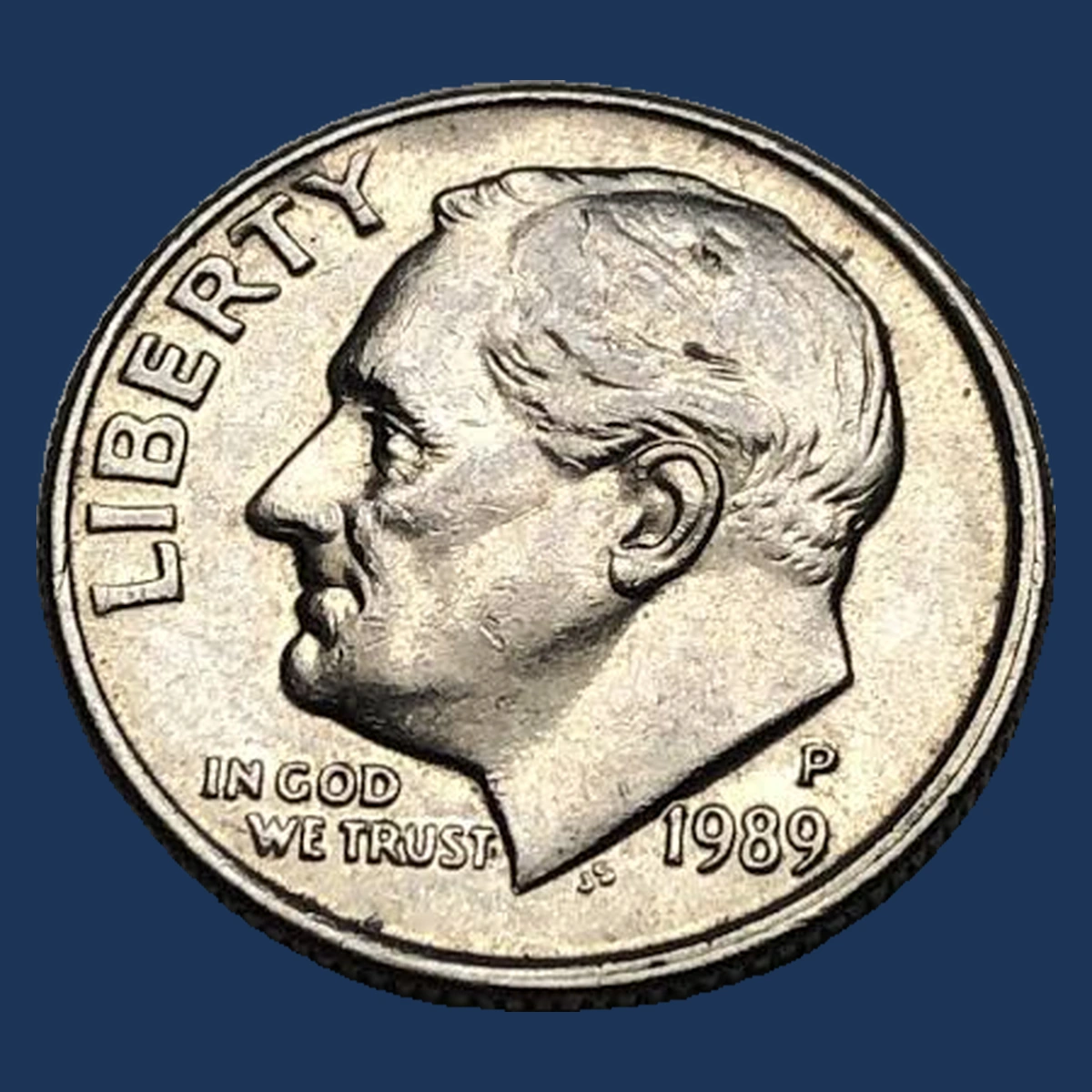
A broadstrike lets coin metal spread beyond the width normally controlled by the surrounding ring. It can create a wide outline while retaining the complete design.
The 1989 error list includes broadstrikes without one established mint or measured specimen. A claim that the coin is Philadelphia-made should therefore come from its own mint letter.
A larger outline also occurs when a finished coin is flattened later. That damage can crush existing details, while genuine broadstriking involves the metal spreading as the design is being formed between the two stamping tools.
Estimated Value
An estimated $30–$300 covers genuine broadstrikes of different strength and condition. A wide, clear border can attract more interest than a modest increase in diameter.
A different 2000-P dime combining multiple strikes and broadstriking sold for $159 in September 2025. That is a compound-error comparison rather than a sale of the reported 1989 type.
Check the actual coin’s complete design and original surfaces. Size alone cannot establish the error or place a flattened dime in this price range.
How to Identify
Measure a loose coin at several points with calipers against 17.91 mm. A scale can show whether its weight remains near the standard clad 2.268 grams.
Follow the lettering around the expanded border with a 10× magnifier. If the design is missing beside a blank arc, compare off-center errors instead.
Inspect the edge grooves and the metal immediately beyond the design. Later flattening can leave pressure marks across details that had already been struck.
Compare both faces for that damage. An uneven border alone does not establish a broadstrike.
Photograph the date and mint letter with the full outline. Use those visible details to identify the example rather than assigning the Philadelphia mint from a general year listing.
6. 1989 Roosevelt Dime Off-Center Strikes
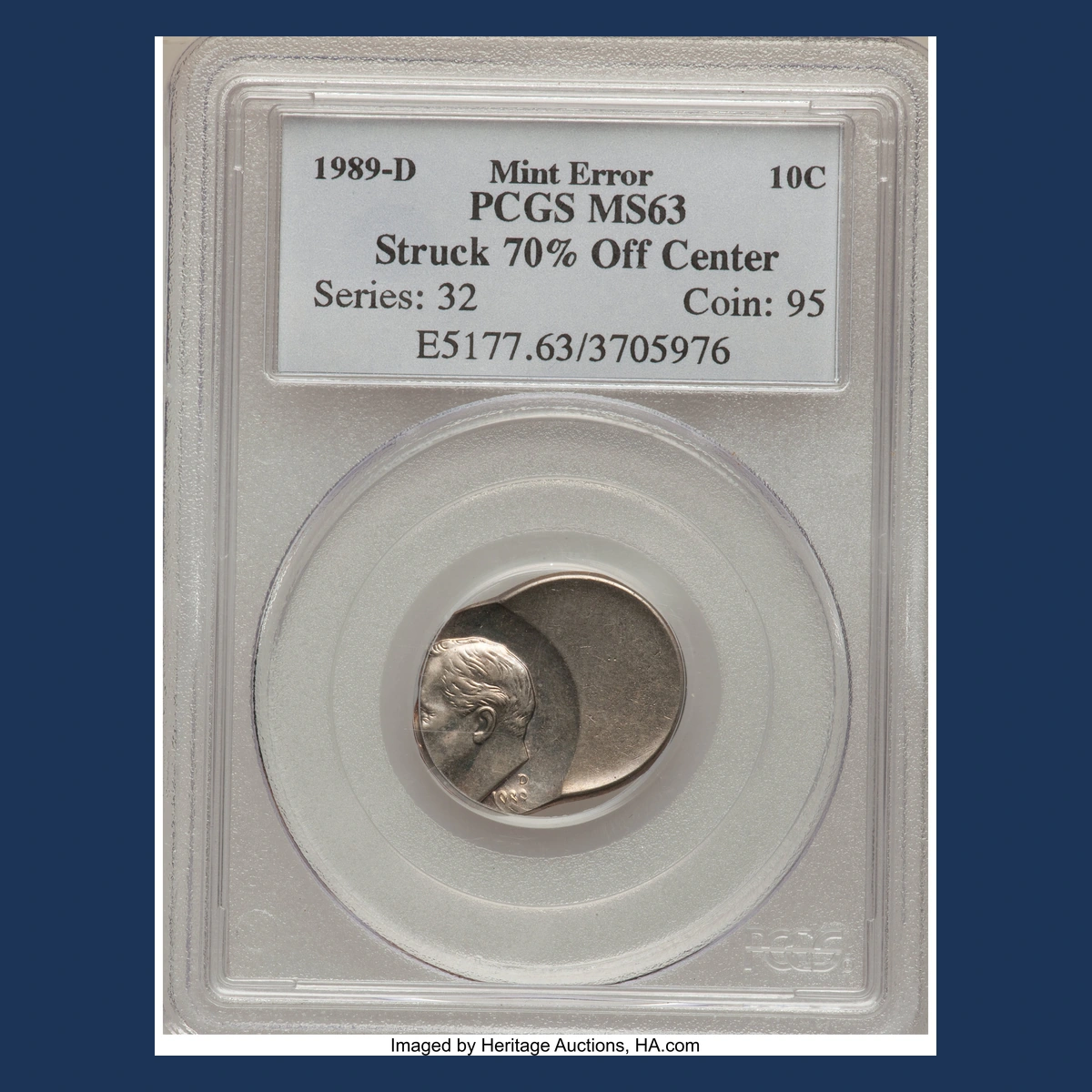
These coins show how a misplaced blank leaves a large unstruck area. Part of the design falls outside the blank instead of filling a normal centered dime.
The Denver example is described as 50% off center toward one o’clock and graded ANACS MS64. It appeared in a two-coin lot with a separate, higher-graded 1986-D dime.
A Philadelphia example is 70% off center and graded PCGS MS65. Both are unworn grades, but their mint letters, percentages, and condition numbers belong to different coins and should not be combined into one description.
Estimated Value
The Philadelphia 70% off-center dime sold for $45 on July 13, 2014. Estimate $30–$350 across comparable genuine examples, depending on condition and how clearly the date survives.
That modest result shows why displacement alone does not determine value. A larger blank area does not automatically produce a higher price.
The Denver example was sold with a 1986-D dime. Any price for that two-coin lot must remain a group price rather than a standalone 1989-D result.
How to Identify
Start by reading the surviving year and mint letter. Then orient the front upright before comparing the Denver example with its reported one-o’clock displacement.
For a loose clad piece, check weight against 2.268 grams and measure the blank with calipers against 17.91 mm. Examine the boundary of the unstruck area and surviving edge grooves through a 10× magnifier.
Compare both designs to see whether they fit the same displaced blank. One shifted face with a centered opposite face suggests a tool-alignment problem.
Later grinding can also create a smooth patch. Check that the boundary shows natural struck and unstruck metal rather than design removed afterward.
7. 1989 Roosevelt Dime Missing Clad Layer
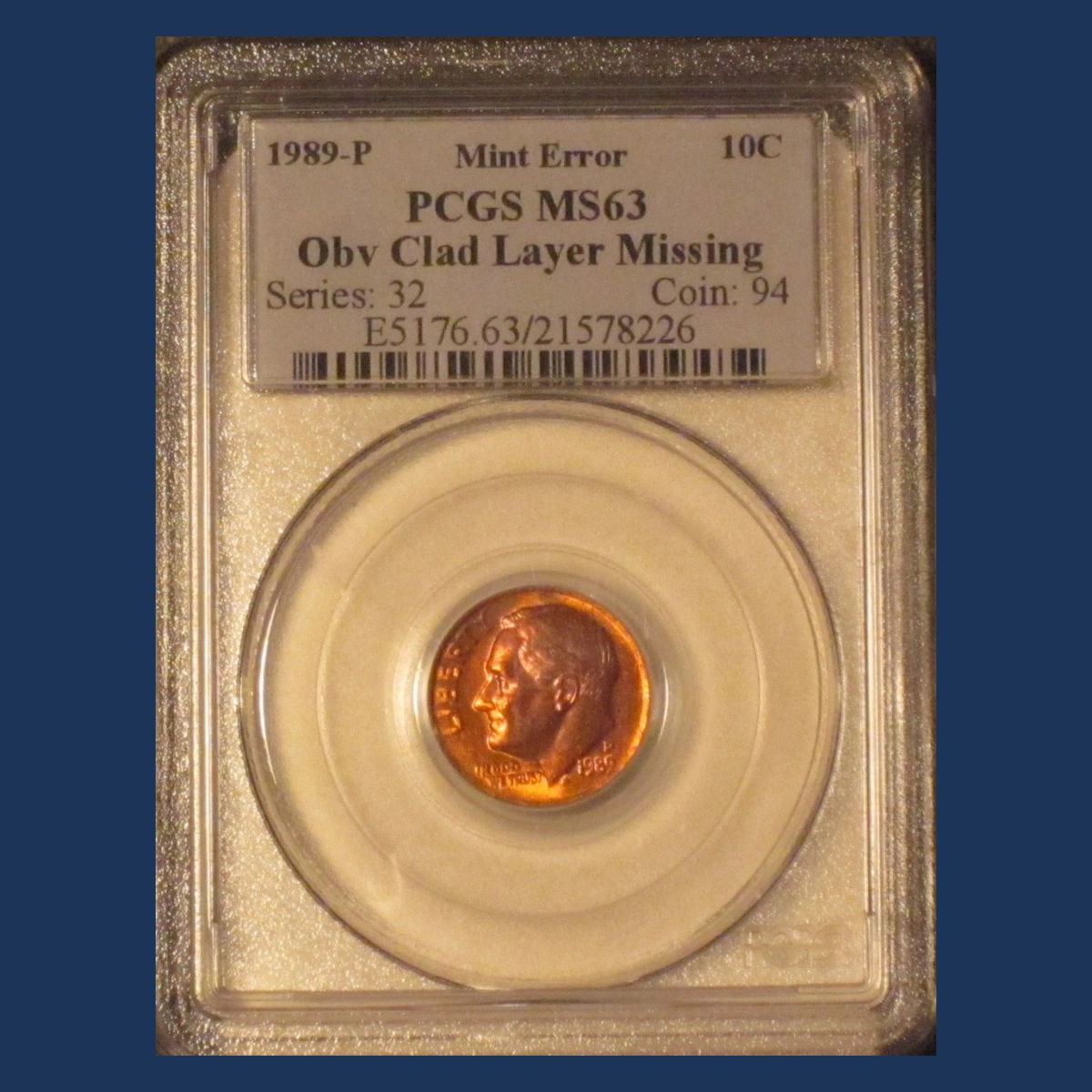
The Philadelphia coin has an orange-red front where the copper center is exposed. Its missing outer layer also left the blank thinner, helping explain weak detail around the border.
Heritage described this ANACS MS63 example with a fine scratch below the date. MS63 means unworn with noticeable marks; the scratch is later damage rather than a feature that proves layer loss.
A Denver missing-layer coin is separately reported without a specified face or measured weight. It should not inherit the Philadelphia front description or a generic weight borrowed from another example.
Estimated Value
The Philadelphia example sold for $92 on August 23, 2004. Estimate $60–$400 for genuine single-layer losses, with surface condition and clarity affecting the comparison.
A clean copper face can be more appealing than a scratched or spotted one. The documented scratch below the date is a reason to distinguish that coin from better-preserved examples.
The Denver report has no sale price or weight. Its value needs the same physical identification rather than an automatic copy of the Philadelphia result.
How to Identify
Look at the edge layers before relying on a copper color. A normal clad dime has pale outer metal around a copper center, and the surviving layers should fit the missing-face explanation.
For a loose piece, use a scale against 2.268 grams and calipers against 17.91 mm. The standard weight printed in a generic coin table is not a measurement of this error.
Use a 10× magnifier to compare the copper surface, struck details, and edge grooves. Chemical attack can also reduce weight while leaving pitting or etched detail.
The Philadelphia border weakness is consistent with its thinner blank, but the scratch below the date is unrelated damage. Do not use that scratch as a required marker for every genuine missing-layer dime.
8. 1989 Roosevelt Dime Flip-Over Double Strike
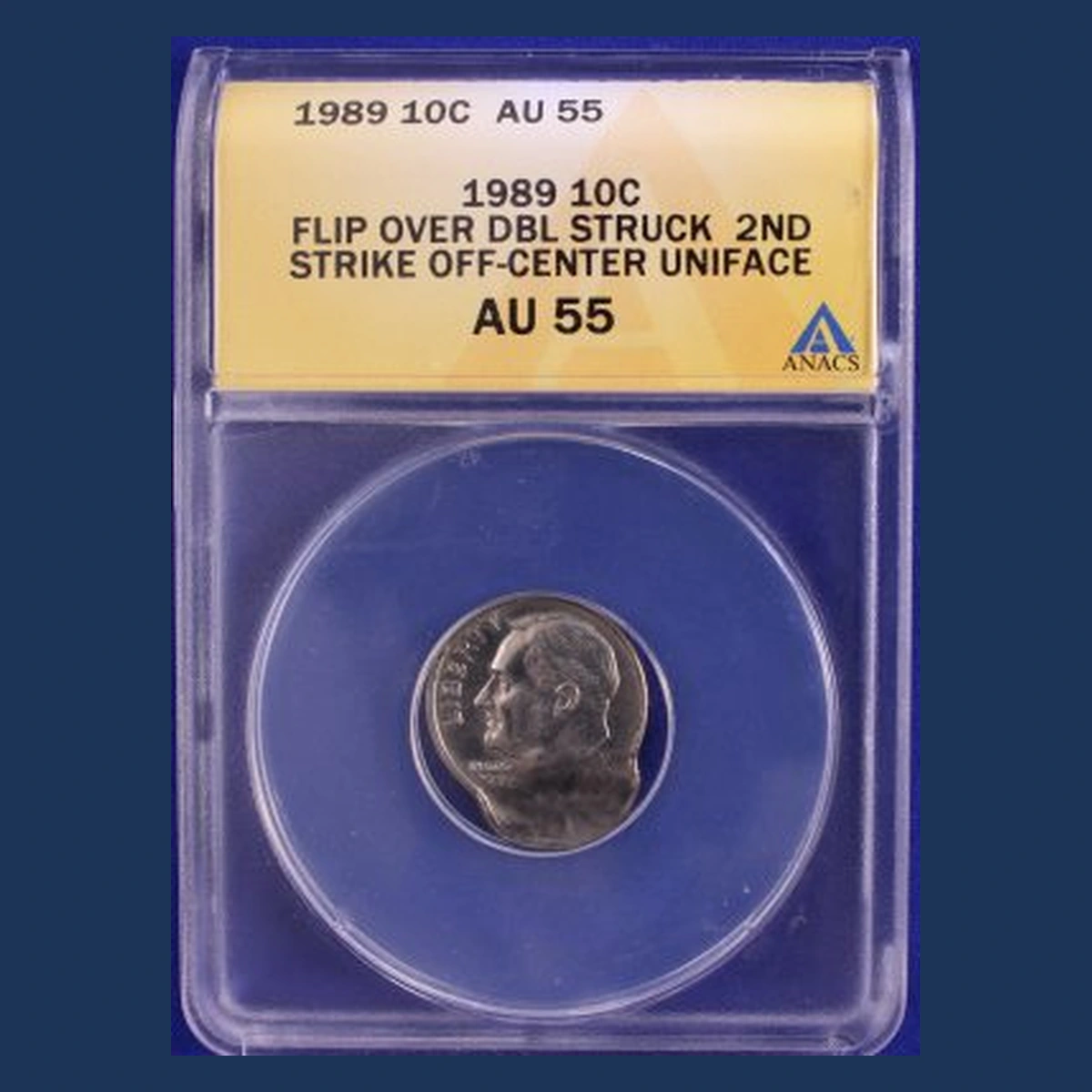
The date appears on an unexpected face of this coin. A collector’s 1989 example was struck, turned over, and struck again off center.
The owner describes a strong date near the upper back. On the front, the earlier date lies beneath an area blocked during the second strike.
This is described as a flip-over double strike with one face blocked in the later blow. The report does not establish the mint or displacement percentage, so the visible dates and overlapping designs provide the useful starting points.
Estimated Value
Estimate $250–$1,200 for a genuine example with a readable flip-over sequence. The reported coin has some wear, so it should not be priced as an untouched high-grade specimen.
A clear date on the unexpected face helps explain the accident. The amount of visible earlier design can matter more than a small difference in condition grade.
Compare the remaining detail on both faces rather than one dramatic fragment. The range values the complete coin, including its off-center and blocked-face features together.
How to Identify
Locate the date near the top of the back in the owner’s photographs. Compare that with the blocked region over the earlier front date.
Use a 10× magnifier to follow which design lies above the other. A flip should put opposite-side detail on a face that already carried the earlier strike.
For a loose clad coin, weigh it against 2.268 grams and record dimensions with calipers against the normal 17.91 mm. Inspect the surviving edge grooves without squeezing thin or spread metal.
Photograph both faces in their original orientation before marking the strike sequence on copies. Do not assign a mint letter or percentage from a different double-struck dime.
A few faint opposite-side outlines may instead be tool-clash marks. The actual overlapping strikes need to explain the displaced date and blocked area together.
9. 1989 Roosevelt Dime Overstruck with a Cent Design
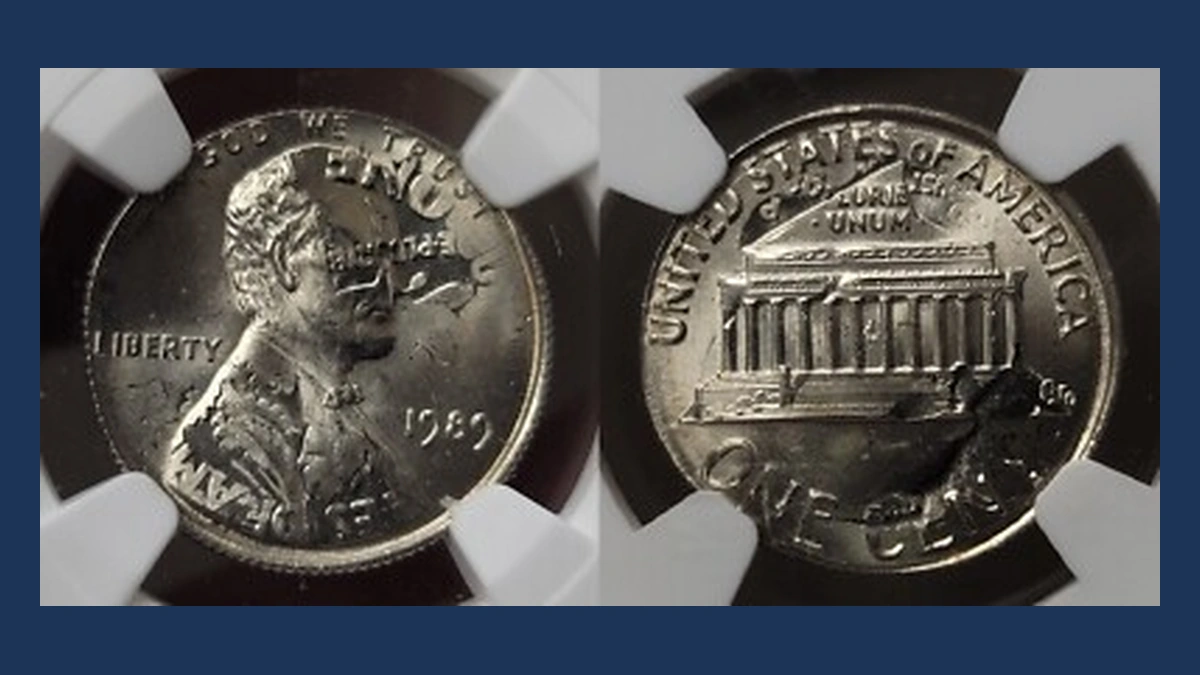
Lincoln’s design can cover a dime that had already received Roosevelt’s portrait and the torch. The finished dime entered a cent press and was struck with a second denomination’s design.
One listed example combines a 1989 cent with a 1989-P dime. A different example combines a 1990 cent with an earlier 1989-P dime.
Both have ANACS MS63 descriptions, meaning unworn with noticeable marks. The same grade does not make them the same coin, and neither should be confused with a dime design struck onto an unused cent blank.
Estimated Value
The 1990 cent over a 1989-P dime sold for $2,160 on September 29, 2025. Estimate $900–$3,000 for comparable identified cent-over-dime errors.
Readable pieces of both designs make the accident easier to understand and can support a stronger price. Heavy marks or poorly visible earlier details weaken the comparison.
The separate same-year 1989 combination has no sale amount in its listing. Its matching grade is not a reason to assign it the other coin’s exact result.
How to Identify
Identify the cent portrait and Memorial, then search for remaining Roosevelt and torch details. Use a 10× magnifier to follow the earlier design beneath the later one.
Check both dates. The 1990-over-1989 combination must retain evidence of the earlier dime rather than merely a date that looks unusual.
For a loose coin, a scale should be compared with the clad dime standard of 2.268 grams, not the cent’s 2.50 grams. Calipers record its dimensions against the dime’s original 17.91 mm size.
Inspect any surviving edge grooves and the outline altered by the cent strike. The second design does not change which coin supplied the original metal.
Photograph each recognizable design together with its date or mint clues. That combination establishes the direction of the overstrike.
Conclusion
Estimated 1989 dime error values run from $5 to $3,000. A small chip, a missing layer, and a dime overstruck as a cent belong at very different points in that range.
Use the actual design, metal layers, and strike sequence to choose a comparison. Keep two-coin auction prices separate from individual results, and remember that normal 1989 Proof collector dimes are clad too; there was no silver Proof version that year.