1967 Dime Error List with Pictures

A 1967 dime later received a penny design and sold for $5,170 in June 2017. Both Roosevelt and Lincoln remained visible on that unusual coin.
The 1967 dime errors below include much smaller changes too, with estimated values from $5–$35,000. Some involve the original dime strike; others happened when a finished dime entered a different press later.
Ordinary dimes and Special Mint Set collector coins both lack a mintmark this year. Read on for checks of the actual defects, rather than the empty mintmark area.
1. 1967 Roosevelt Dime Raised Die Crack
A thin raised line can appear when the stamping tool develops a crack. Metal enters that opening during the strike, leaving a raised line on the dime.
The tool is called a die, so this feature is known as a die crack. The 1967 report places it on the lower front without defining one exact path.
Roosevelt’s normal portrait lines should not be mistaken for the defect. A small chip above the head also helps identify one Special Mint Set doubled die, but it is not the same reported lower-front crack.
Estimated Value
A genuine small raised crack has an estimated whole-coin value of $5–$100. A clear line crossing recognizable detail is easier to appreciate than a faint ridge hidden by wear.
The remaining surfaces affect the price as well. Scratches and dark deposits can make a small defect difficult to show.
This range concerns an original tool crack. A groove with metal pushed up along one side is damage and does not qualify merely because part of it is raised.
How to Identify
A normal portrait has many raised lines already, so put a clear ordinary-dime photograph beside your coin. Compare the lower front to find the extra ridge you want to examine.
Follow it through the nearby design under a small light, then reverse the direction of the light. A genuine tool crack leaves a raised line, while a scratch usually cuts a groove beside any metal it pushes up.
Leave dark deposits and surface marks untouched while taking photographs of the full line. A matching recorded example can help identify its path, but a random line elsewhere on the coin does not establish the same defect.
2. 1967 Roosevelt Dime Reported Blocked Detail with a Shifted Design
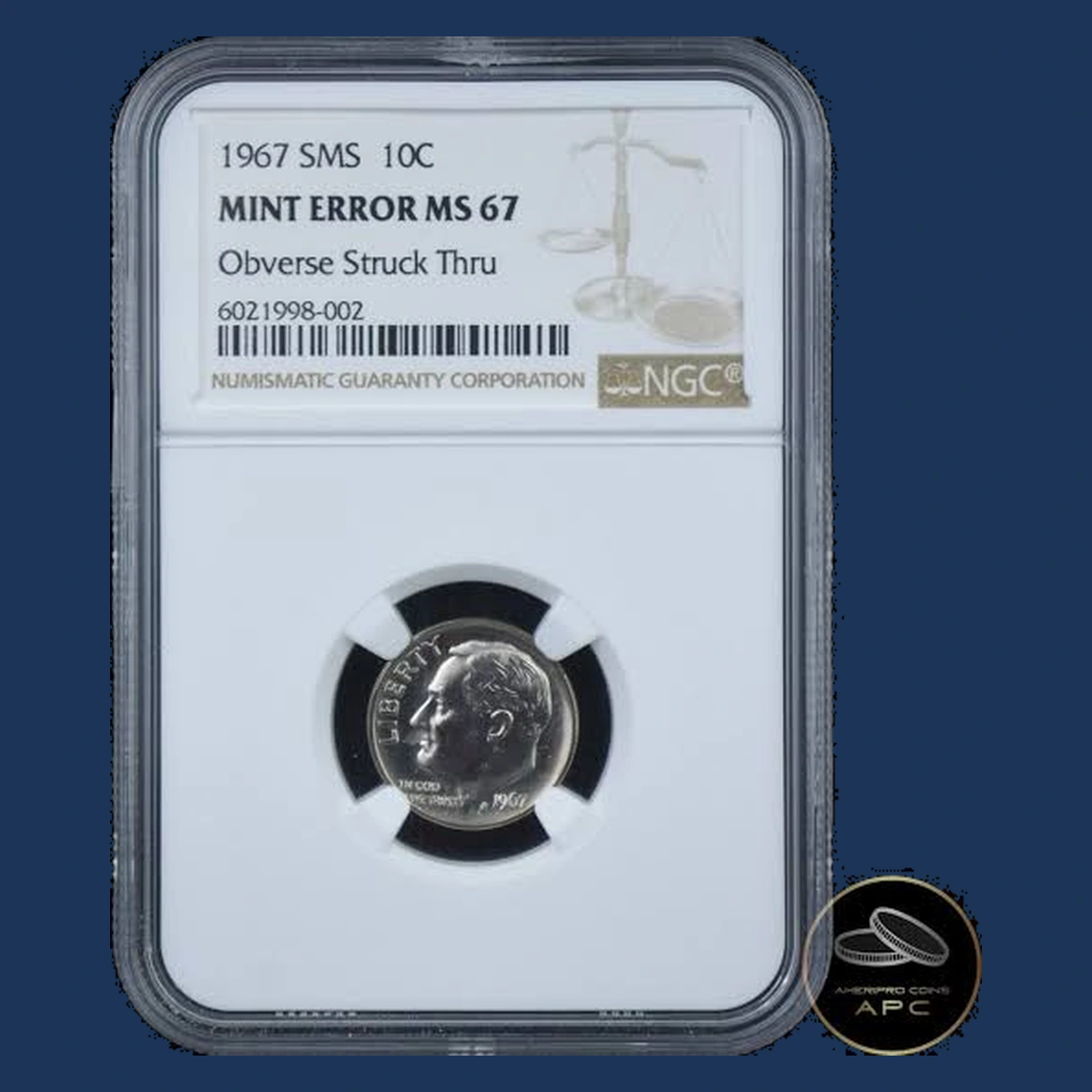
One offered 1967 dime was described as having both grease-blocked detail and an off-center strike. Those two observations need to be examined separately on the actual coin.
Grease filling a recess in the stamping tool can prevent a letter or small detail from forming. A shifted border, however, can have more than one explanation.
If only one face is displaced, a misaligned tool may explain it instead of an off-center blank. The seller’s combined description does not establish that both designs moved together or that the trapped material was definitely grease.
Estimated Value
For genuine localized grease blockage, estimate $5–$75. If the same coin also has an identified off-center strike, a conditional combined estimate is $30–$200.
The overall estimate is $5–$200, depending on which features the coin actually supports. Do not add the highest figures together as separate charges.
A weak letter with later scraping, or a slightly uneven border alone, does not establish the advertised combination. Clear views of both faces matter more than the listing’s error names.
How to Identify
Compare the front and back positions before deciding that the blank was off center. A shifted front paired with a centered back can come from one misplaced stamping tool.
Look for plain metal beside the shifted designs and missing design at the opposite edge. An uneven border alone does not establish that the blank sat outside its correct position.
Examine the weak patch separately.
Nearby sharp letters can help show that only a local area failed to form. Rubbing, scratches, or a rough etched surface suggest other explanations for lost detail.
Take straight-on photographs of both complete faces and the weak area. The combined description is useful only when the coin shows both original blocked detail and a genuine off-center strike.
3. 1967 Roosevelt Dime Weak Strike
A light strike may leave much of Roosevelt and the torch shallow at the same time. The metal did not fully enter the design cut into the stamping tools.
Such pieces are sometimes advertised as die-adjustment strikes. That name suggests a press test, but shallow detail alone does not prove that the Mint intentionally made a trial coin.
The useful observation is a weak strike affecting both faces. Circulation wear and later surface damage can also reduce detail, so the surviving texture needs to fit weak formation rather than the removal of a finished design.
Estimated Value
Estimate $20–$250 for an identified weakly struck 1967 dime with original surfaces. Broad, clear weakness can be more interesting than slight softness in one ordinary design area.
The estimate does not assign an extra premium for an unproven Mint experiment. A seller’s use of “adjustment” is not evidence of that history.
Wear and chemical damage can create a similarly flat appearance. The original surface and the relationship between strong and weak details support the identification and value.
How to Identify
Look at protected spaces between letters before judging the highest parts of Roosevelt’s portrait. Wear usually affects those areas differently.
Turn to the torch side and compare how broadly the weakness extends. A light strike can leave both faces shallow without the scratch pattern of later rubbing.
Under side lighting, inspect the remaining surface for normal struck texture. Corrosion or an etched, rough finish can explain loss of detail another way.
If the coin is loose, weighing it against the normal 2.268 grams can reveal major metal loss. A normal weight still cannot prove a press test or replace the surface comparison.
4. 1967 Roosevelt Dime Curved and Straight Clips
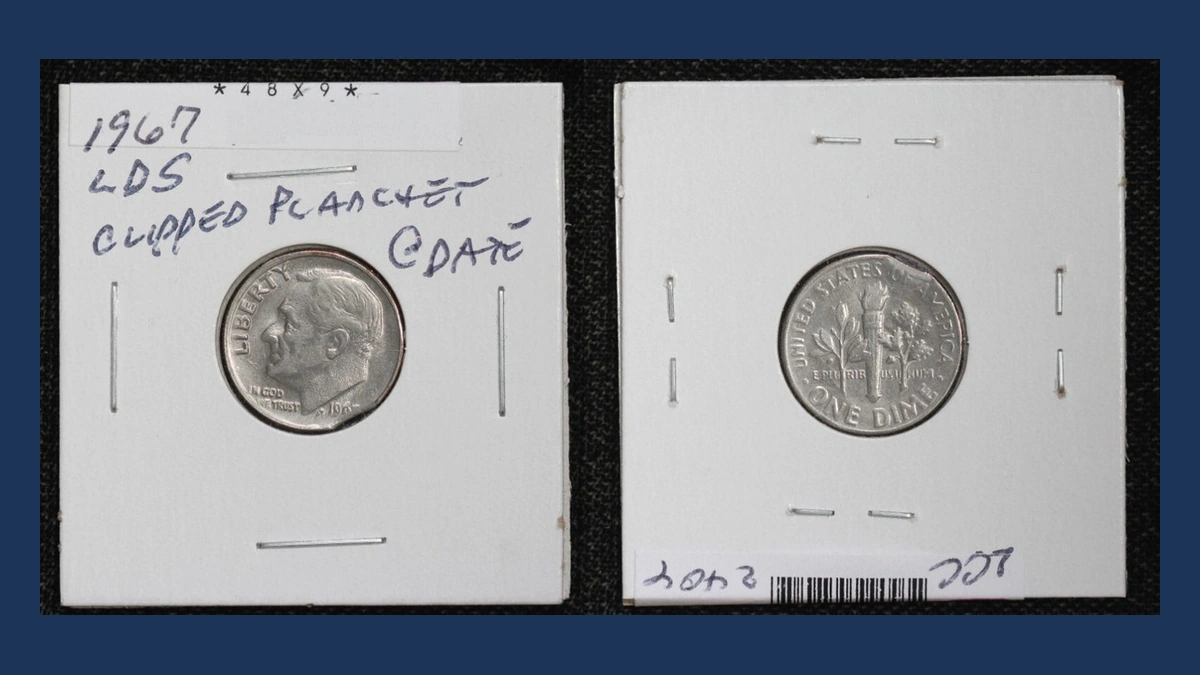
A blank is the metal disk prepared for striking. If cut from an incomplete part of the metal strip, it can enter the press with a section missing.
One 1967 dime has a curved clip plus a small rim clip and weighs 2.05 grams. Separate large curved-clip examples weigh 1.16 grams and 0.92 gram; those are different coins.
A straight-clip piece attributed to 1967 weighs 0.9 gram and lacks a readable full date. Its reported sixty-percent loss should not be confused with the similarly described large curved clips.
Estimated Value
The 2.05-gram ANACS AU58 coin sold for $30 in March 2022. A separate 1.16-gram NGC MS64 curved clip brought $79 in July 2021.
Use an estimated $20–$300 for identifiable clips of this year, allowing for shape, size, and condition. AU58 means slight wear; MS64 describes an unworn coin with some marks.
A larger missing area is visually striking, but a lost date can weaken a year-specific comparison. Later cutting does not qualify as an original clip.
How to Identify
Read the surviving date before comparing the shape of the gap. The large straight-clip example is attributed to 1967; it does not display a complete year.
Examine the edge at both ends of the missing portion. Struck metal should meet a gap that existed before the designs were applied.
On a curved clip, a weak opposite rim can support the identification, but it is not required in every case.
Use an edge photograph to look for filing or cutting through finished detail. A low weight documents missing metal but does not establish when it disappeared.
Keep each specimen’s weight with its own outline. The 0.92-gram and 1.16-gram curves are not measurements of the 2.05-gram double-defect coin.
5. 1967 Roosevelt Dime Expanded Broadstrike
A dime can spread wider than intended if the ring around the blank fails to contain it. That ring, called the collar, normally controls the coin’s edge and diameter.
A broadstrike keeps the intended design on the metal while allowing an expanded outline. This differs from an off-center strike, where some of the design misses the blank.
Broadstrikes are reported for 1967 without one measured diameter defining the category. A wide border can be uneven, so the completeness of both designs matters more than whether Roosevelt sits exactly in the middle.
Estimated Value
An identified simple broadstrike has an estimated value of $20–$300. More obvious expansion around a complete, readable design can draw greater interest than a slight widening.
An attractive original surface also helps display the error. Heavy marks or later flattening can obscure how the metal spread.
There is no universal width that automatically earns the upper estimate. A coin widened by a hammer or other pressure after minting is damage, even if its diameter is unusually large.
How to Identify
Measure a loose coin across several directions with calipers, using 17.91 millimeters as the ordinary dime width. An uneven spread is possible, so one larger measurement does not explain the entire outline.
Next follow the outside lettering on both faces to check that the design fits on the metal. A missing section of words beside a plain crescent points toward an off-center strike instead.
View the edge from the side and compare its spread with the wider border. Then inspect Roosevelt and the torch for crushed high points or hammer marks, which can reveal a normal dime flattened after striking.
6. 1967 Roosevelt Dime Missing or Separated Outer Layers
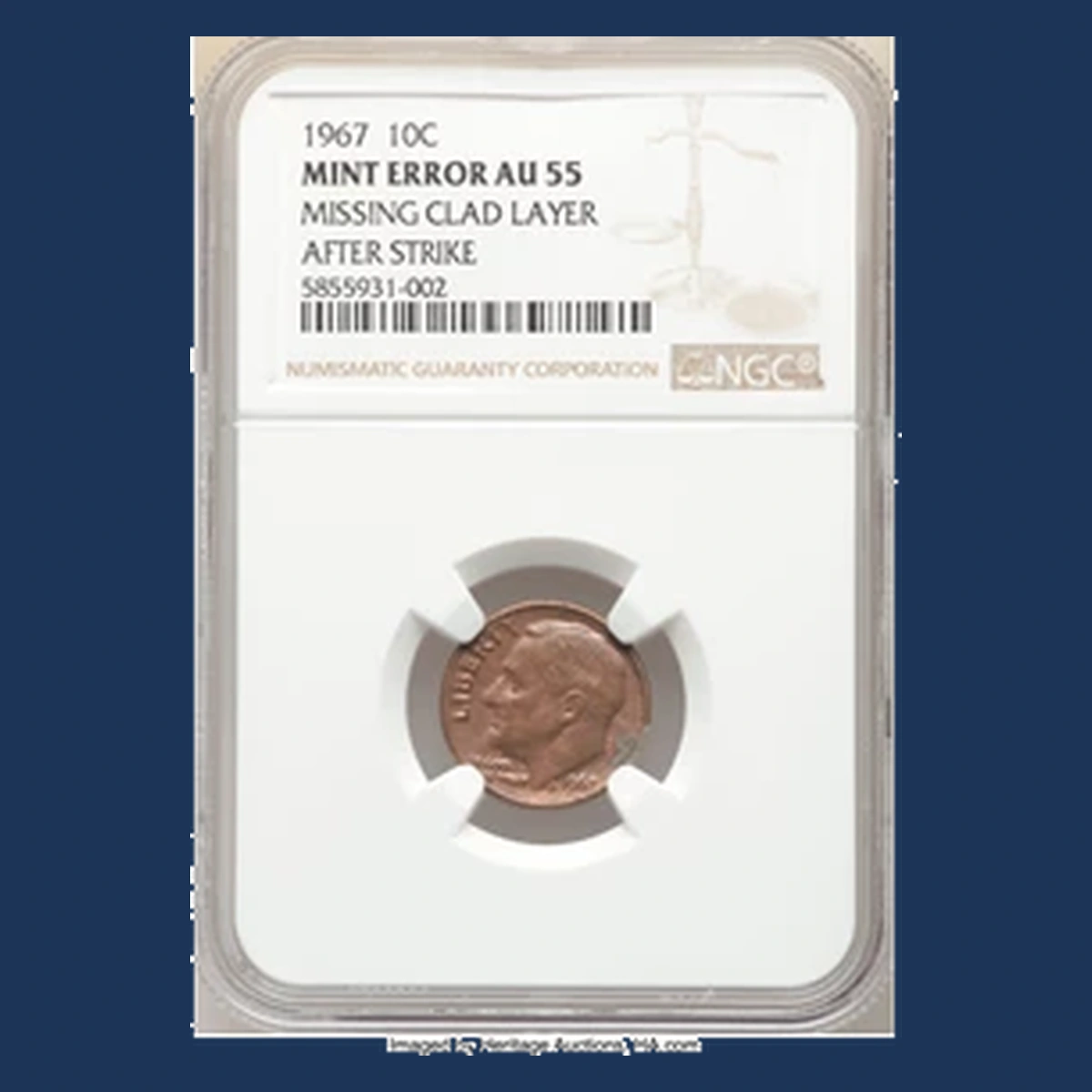
A normal 1967 dime has silvery outer layers bonded to a copper center. Losing one layer can expose copper on the front or back.
A PCGS MS62 example is recorded with the front layer missing. A different MS62 coin lacks the back layer, while another dime graded NGC AU55 lost a layer after it was struck.
A layer absent during striking can leave different detail from one that separates afterward. Study the exposed surface and surviving design together, since the three recorded coins illustrate different faces or stages of separation.
Estimated Value
The front-layer MS62 coin sold for $159 in December 2024. The separate back-layer MS62 example brought $51 in February 2006.
The NGC AU55 after-strike separation sold for $61 in September 2020. These recorded results support an estimated $40–$350 for comparable identified layer-loss examples.
The exposed surface, remaining detail, and preservation affect the comparison. Brown staining alone does not establish a missing layer or justify the same range.
How to Identify
Weigh the coin if it is loose, and keep that reading with its photographs. The normal 2.268-gram dime is only a comparison; it is not the measured weight of a layer-loss example.
Examine the edge to see which pale outer sheets remain around the copper center. Compare them with the copper-colored area on the face, since staining can change color without removing metal.
Look for a boundary where a covering ends, but do not lift any loose flap. Inspect the exposed metal for remaining design, tearing, scrape marks, or chemical pits.
A specialist can compare those details to judge whether separation happened before or after striking. Keep the three recorded coins separate when comparing their surfaces and condition.
7. 1967 Roosevelt Dime Clashed Tools with a Blocked Strike
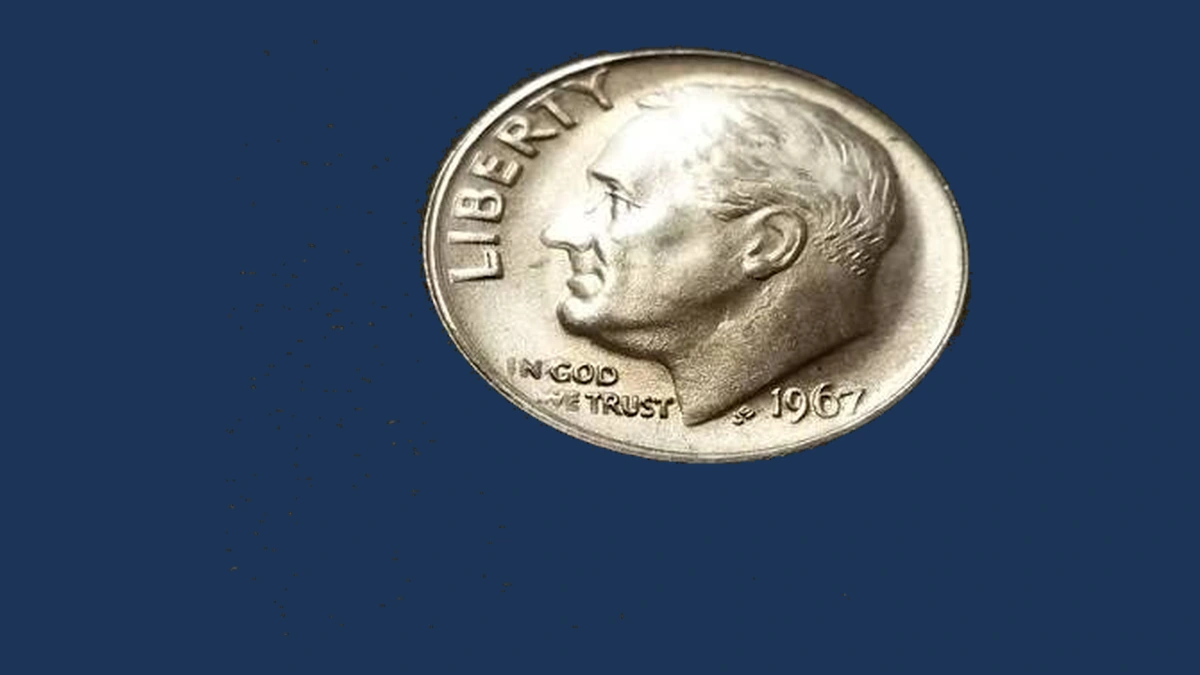
Two different effects appear together on one recorded 1967 dime: heavy tool clash marks and a strike through debris. Neither requires the coin itself to have been struck twice.
A clash happens when the stamping tools hit each other without a blank between them. Their damaged surfaces can then leave faint traces of the opposite design on later coins.
Debris between a tool and this dime also blocked part of its strike. The ANACS AU58 description identifies the combined error but does not establish the exact trapped material or a universal position for its impression.
Estimated Value
The ANACS AU58 combined-error dime sold for $67 in March 2023. AU58 describes a coin with only slight circulation wear.
Estimate $40–$400 for a comparable genuine combination with recognizable clash traces and a clear blocked area. The estimate applies to the whole coin, not separate fees for each feature.
Heavy scratches can make faint transferred outlines difficult to follow. A dramatic description is less useful than photographs showing both effects on the same specimen.
How to Identify
Find the blocked patch first and look at how its boundary interrupts the surrounding design. A smooth dent cut across finished detail needs a different explanation from detail blocked during the strike.
Next compare faint outlines elsewhere with the opposite face’s design. A recognizable transferred shape supports a clash more than a few unexplained lines.
Tilt the dime under light from two sides to separate raised traces from scratches cut into the surface.
Examine the obstruction’s impression for any recognizable texture before naming its material. The auction description does not identify wire, cloth, or a particular metal.
Check that both effects occur on the same coin. Its complete faces and their close-ups should show where the clash traces and blocked patch meet the normal design.
8. 1967 Roosevelt Dime Off-Center Strike
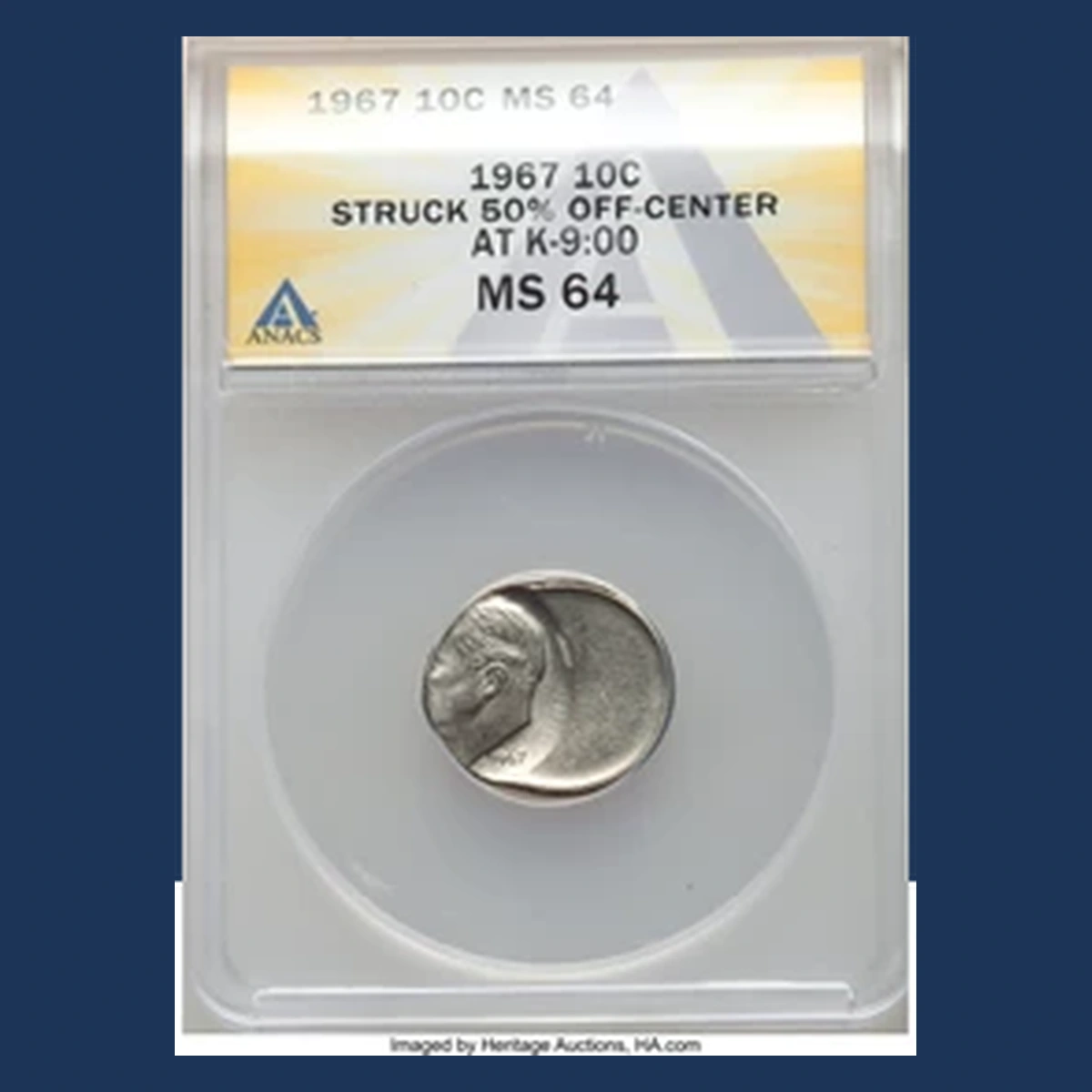
Only part of Roosevelt and the torch can reach the metal when a blank sits far to one side of the press. The remaining part of the blank stays unstruck.
A recorded ANACS MS64 dime is fifty percent off center toward nine o’clock. That describes its sideways displacement, not a coin that rotated ninety degrees between two strikes.
The large bare crescent makes this example easy to recognize. A coin with a complete design inside an uneven wide border instead calls for a broadstrike comparison, while a shift on only one face may involve a misaligned tool.
Estimated Value
The ANACS MS64 fifty-percent off-center dime sold for $93 in January 2022. MS64 means an unworn coin with some visible marks.
Estimate $30–$500 for identifiable 1967 off-center examples across different amounts of displacement and preservation. A readable date matters when comparing coins from a specific year.
A large error that loses its year can be less useful for a date collection. Later scratches or damage across the remaining design can also reduce interest.
How to Identify
Find the plain crescent and the opposite place where the design runs beyond the metal. Together, they show why part of the image never formed.
Compare the front and back to confirm that the blank’s position affected both designs. A shifted front with a normal back can have another explanation.
Locate all four date digits wherever they survive, then inspect the untouched metal for sanding or erased detail.
For the documented fifty-percent example, use the pictured nine-o’clock direction as a specimen-specific feature. It does not identify every 1967 off-center dime, and its percentage alone cannot determine the direction of another coin’s displacement.
9. 1967 Roosevelt Dime Doubled Designs on Ordinary and SMS Coins
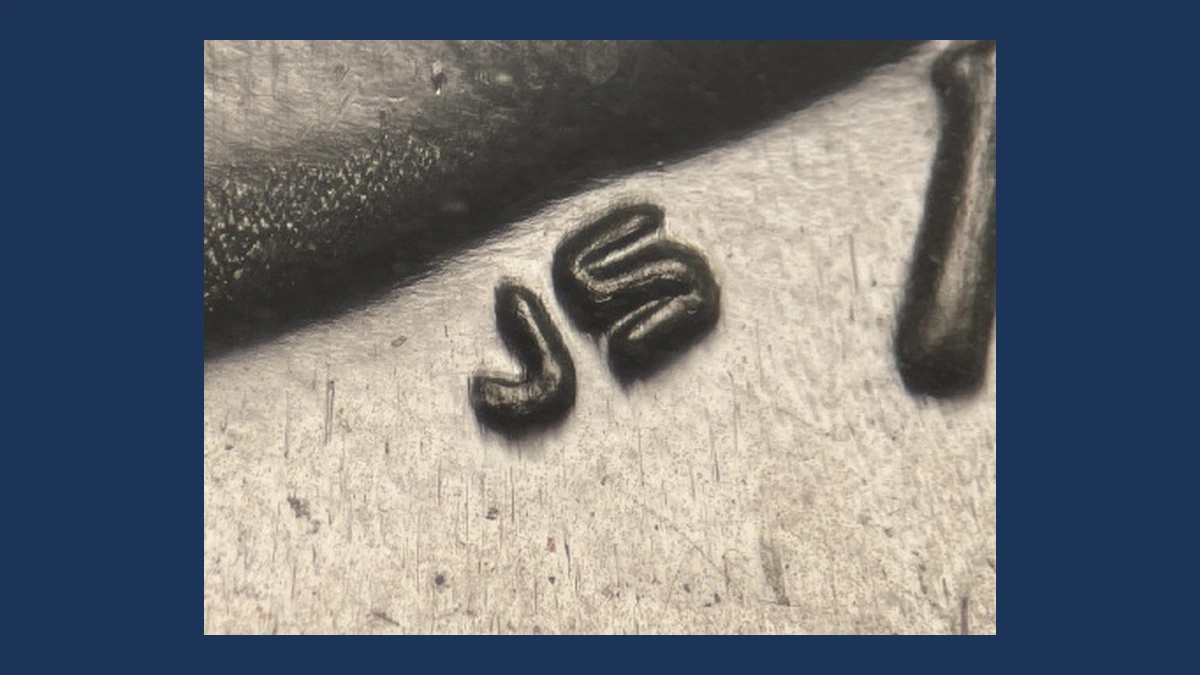
Extra outlines in a stamping tool can repeat on the coins it makes. The ordinary 1967 FS-101 doubled die affects the motto, JS initials, and date.
Special Mint Set coins, called SMS coins, have separate patterns. WDDO-001 shows mild front doubling, while WDDR-001 affects words on the back.
Another SMS entry, CONECA DDR-001, describes weak doubling around ONE DIME. Compare its photographs separately with WDDR-001: similar names or doubled words alone do not show whether both labels describe the same tool.
Estimated Value
An ordinary FS-101 example graded PCGS AU53 sold for $600 in May 2019. AU53 describes a lightly worn coin.
Estimate $100–$1,000 for identified ordinary FS-101 pieces, and $15–$250 for the minor SMS patterns described here. The overall group range is $15–$1,000.
Each estimate requires the right pattern and finish. The ordinary coin’s auction price should not be transferred to an SMS dime merely because both have the same date and no mintmark.
How to Identify
Decide whether the coin is an ordinary issue or an SMS example before choosing a reference. Neither has a mintmark this year.
For ordinary FS-101, compare the extra outlines in IN GOD WE TRUST, the JS initials, and the date. Several matching details are stronger evidence than one thick letter.
For SMS WDDO-001, compare JS, IN GOD WE TRUST, and LIBERTY for slight inward doubling. A head chip and a vertical forehead tool line provide supporting clues.
On SMS WDDR-001, inspect UNITED STATES OF AMERICA and ONE DIME. A tiny raised dot above and right of the second S in STATES helps locate that tool.
Compare the separate CONECA listing independently. A similar name or doubled word does not establish a cross-reference without matching photographs.
10. 1967 Roosevelt Dime Reported One-Sided Strike
A dime with one normally struck face and an unformed opposite face is often described as uniface. The word describes the appearance, rather than proving one particular press accident.
Another blank can block a stamping tool from reaching one side. Other circumstances can also leave a one-sided impression, so the surfaces need to explain the actual event.
The same appearance can also be imitated by grinding away a finished face. Examine the full coin and its edge before treating the empty side as original, especially if the piece looks unusually thin.
Estimated Value
For an authenticated 1967 one-sided strike on an otherwise normal dime blank, use a conditional estimate of $100–$1,000. Strong surviving identity and an original unformed face support the comparison.
Original surfaces and an undisturbed edge help explain where an example fits within that range. Damage or wear can make the blank face harder to interpret.
A face erased by grinding or altered with added metal does not qualify. The empty appearance must agree with how the coin was struck.
How to Identify
Inspect the apparently blank face before concentrating on the good portrait or torch. Look for faint remaining letters, sanding lines, or a depressed center that could reveal later removal.
Compare the edge all the way around. A seam or an added face would suggest an altered coin rather than a one-sided strike.
Photograph the complete design on the other face with any surviving date readable. Keep both views at the same scale so their rims and outlines can be compared directly.
If loose, record the actual weight and thickness for an error specialist. Those observations help separate a normal blank blocked on one side from a much thinner detached layer.
11. 1967 Roosevelt Dime Second Strike Far from the First
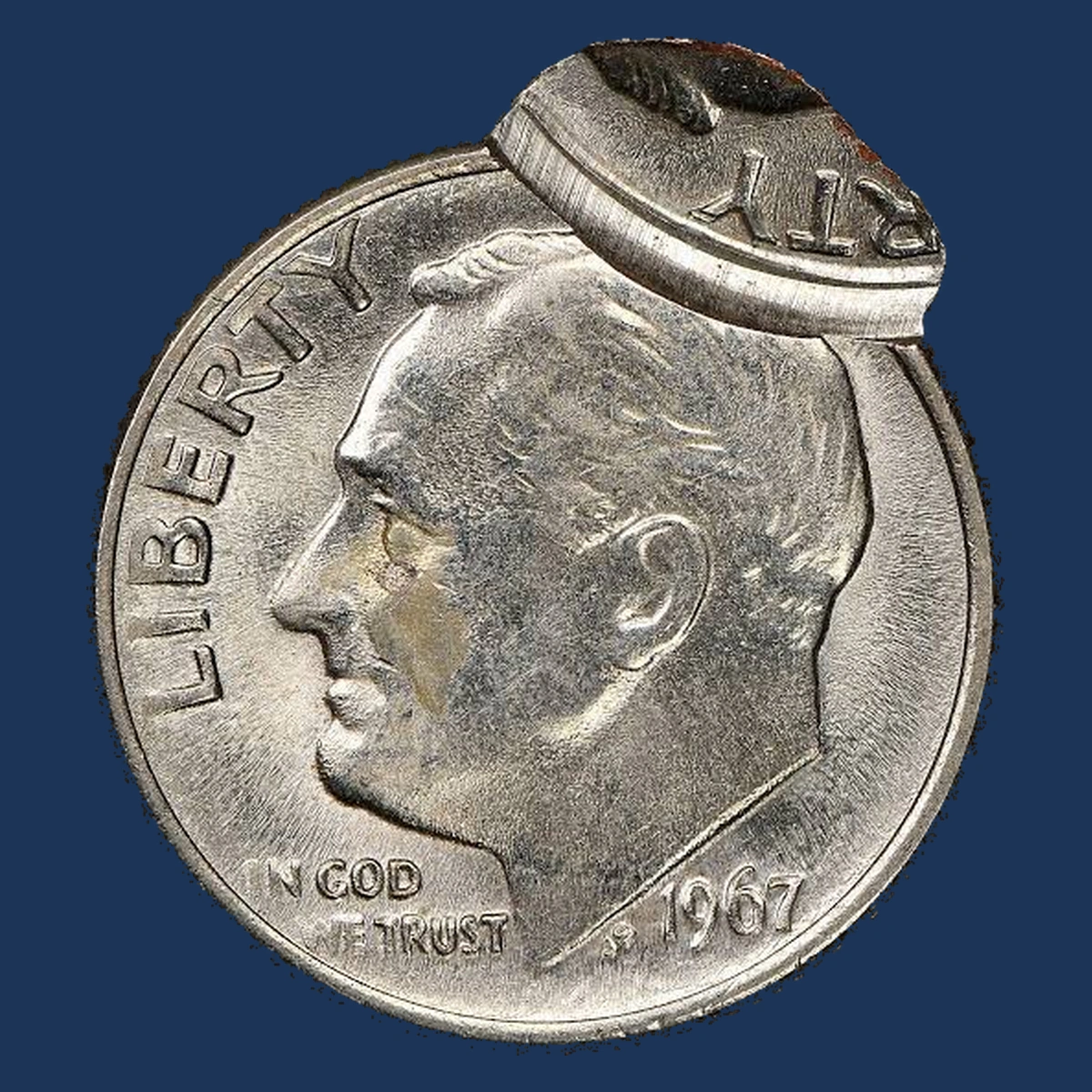
A dime that remains in the press can receive another strike in a new position. Its first portrait and lettering may survive beside part of the second impression.
An October 1968 coin advertisement described a 1967 dime with a normal first strike and a second strike ninety percent off center toward three o’clock. That percentage measures displacement, not rotation.
A separate modern listing identifies an NGC MS65 double strike. The two descriptions should not be joined into one specimen without matching evidence, and the older coin’s direction should not be assigned to every double-struck dime.
Estimated Value
Estimate $150–$1,200 for an identified 1967 double strike, depending on separation, readable identity, and surface condition. A large second impression can be easier to understand than a tiny extra rim segment.
For a different-year comparison, a 1976 flipover double strike brought $423 in January 2017. That coin turned over between strikes and is not the same sequence as every 1967 example.
The comparison supplies context, not a recorded sale for the older advertised 1967 coin.
How to Identify
Begin at the outer edge, where a second strike that nearly missed the coin may leave only a small extra impression. Trace any surviving letters or rim back to a design separate from the first one.
Compare the other face for evidence of the same second contact. One thick letter without a separate design can come from a doubled stamping tool or another cause.
The older advertised example places its second strike toward three o’clock, ninety percent off center. This describes position, not a ninety-degree turn.
Check the overlapping metal for signs of squeezing or joined pieces. Compare each reported coin with its own photographs, since the old advertisement and the modern MS65 listing do not establish one shared specimen.
12. 1967 Roosevelt Dime Off-Center Strike on a Detached Layer
A layer can separate from clad coin metal before it reaches the press. If that thin piece is struck by itself, it can carry a dime design without the normal copper-centered blank beneath it.
A reported 1967 example combines this thin material with an off-center, one-sided strike. Fine lines on its unstruck front area were identified as evidence of the original inner bonding surface.
Those lines support separation before striking in this particular account. They distinguish the explanation from a complete dime that lost its outer layer afterward, although exact weight and displacement were not supplied.
Estimated Value
Use an estimated $200–$1,500 for an authenticated detached-layer strike with readable 1967 identity. The thin material and unusual one-sided impression need to be established together.
This range is a type estimate rather than a recorded sale of the reported specimen. A clear original bonding surface can help explain its appeal.
A shaved dime or a layer peeled from an already finished coin represents a different event. Thinness alone does not place either within the same valuation.
How to Identify
View the edge before handling the piece further: a separated outer layer is much thinner than a complete dime. Keep it flat and do not bend it to test its strength.
On the unstruck part of the front, use angled light to find the fine parallel lines described in the account. Compare their position with the boundary of the displaced strike.
The explanation depends on those lines belonging to the original inner surface before the design was stamped. Scratches added later do not show the same sequence.
Photograph both faces and record any actual weight for an error specialist. The surfaces must support a thin layer struck alone, rather than metal peeled from a finished dime.
13. 1967 Roosevelt Dime Reported Silver-Blank Strike
A 1967 dime struck on an older silver blank would have the wrong metal for the regular issue. Ordinary and SMS dimes use pale outer sheets bonded to a copper center.
The silver-blank claim needs an authenticated example with the correct alloy and a genuine 1967 strike. A bright edge alone cannot separate a true silver blank from altered ordinary coin metal.
The older silver dime standard is ninety percent silver and a nominal weight of 2.50 grams. A pale edge or a heavy-looking coin alone does not establish that identity, and plating can imitate the color.
Estimated Value
For a professionally authenticated 1967 dime on a genuine silver dime blank, use a conditional estimate of $5,000–$20,000. This is a proposed type range, not a claimed 1967 auction result.
A different-denomination comparison is the 1965 quarter on a silver quarter blank that sold for $9,300 in July 2022. Its size and denomination differ, so it supplies broad context rather than an exact match.
The estimate applies only after the candidate’s wrong-metal identity is established.
How to Identify
Check the design first: Roosevelt belongs on the front and the torch above ONE DIME on the back. A Canadian 1967 silver dime has a different design and is not this proposed error.
For a loose candidate, record its weight and diameter before drawing a conclusion from color. The silver dime standard is 2.50 grams, compared with 2.268 grams for a normal clad dime.
Ask a specialist for a nondestructive metal test and an examination for plating or alteration. Do not scratch the edge to expose metal.
A correct silver alloy still needs to agree with a genuine 1967 strike. Certification of another year’s transitional error cannot establish this coin’s identity.
14. 1967 Roosevelt Dime Later Penny and Quarter Overstrikes
A finished 1967 dime can become the base for a later coin design. These double-denomination errors preserve parts of the dime beneath another set of images.
One PCGS MS65 piece received a 1980s Lincoln cent strike twenty percent off center toward three o’clock. Its dime date is complete, while the final cent digit is not established.
A separate NGC PF67 coin carries a 1976-S Bicentennial Proof quarter design over a 1967 dime. Its later date belongs to the quarter strike; neither example means both designs were applied during 1967.
Estimated Value
The PCGS MS65 cent-over-dime sold for $5,170 on June 9, 2017. Estimate $3,000–$8,000 for comparable examples.
The Byers NGC PF67 quarter overstrike has no disclosed sale price. Its estimate remains $10,000–$35,000; the overall group spans $3,000–$35,000.
Heritage sold an NGC PR67 1976-S Proof-over-1967-dime example for $15,000 on January 21, 2021. That auction provides a useful comparison without establishing whether it was the same coin listed by Byers.
How to Identify
Find the older dime date first, then trace the design placed over it. On the cent example, Roosevelt lies above Lincoln relative to the cent’s normal orientation.
Read the cent date only as far as the surviving digits allow. Do not fill in an exact year when the last digit is not established.
For the quarter example, compare the remaining 1967 dime features with the 1776–1976 quarter design. PF67 identifies its Proof grading, not the original dime’s finish.
Inspect the overlapping relief on both faces for a genuine struck relationship. Two coins squeezed together, engraved extra dates, or joined pieces do not reproduce the same metal flow and original design overlap.
Conclusion
The estimated $5–$35,000 range includes small raised cracks, unusual blanks, and later designs struck over finished dimes. A missing mintmark is normal for both ordinary and SMS 1967 issues.
Begin with the feature you can actually see, then follow its specific checks. Keep different specimens and finishes separate, and preserve the surface so that original striking clues remain available for comparison.