1954 Dime Error List with Pictures

A tiny extra outline beneath the date can be more useful than a bright silver shine. PCGS records a 1954 doubled-die Proof dime graded PR67 at $257 in March 2021.
The 1954 dime errors below also include peeling metal and a coin that turned over before being struck again. Estimated values range from $10–$2,000.
Look for the affected feature first, then use its specific checks. Ordinary dimes and specially prepared Proof collector coins need different comparisons.
1. 1954 Roosevelt Dime Reported Missing JS Initials
The designer’s initials on a Roosevelt dime are JS, found just below the cut-off neck on the front. They are small enough to become difficult to see on a worn coin.
A reported 1954-S variety has weak or missing initials. Blocked detail or treatment of the stamping tool could explain missing letters, but the surface needs to support the proposed cause.
A blank-looking patch alone does not prove excessive polishing of the tool. Look for the actual JS location below the neck, since initials from another coin design do not belong here.
Estimated Value
For an identified Mint-made loss of the JS initials, use a conditional estimate of $10–$100. Sharp nearby detail and an undisturbed surface make the local absence more meaningful.
An ordinary worn dime does not receive that range just because its tiny letters are hard to read. Scraping can remove them too.
Compare original examples with the same loss of detail and similar wear. A photograph of the area is more useful than the words “No JS” in a seller’s title.
How to Identify
Compare a normal dime’s tiny JS below the cut-off neck with the same area on your coin. Tilt the surface under a small light before deciding that the letters have disappeared.
Inspect the neck and nearby date for wear, then check the initials’ area for scraping or smoothing. Missing letters among flattened details suggest ordinary wear, while sharp surrounding detail makes a local problem worth closer examination.
Find the S beside the torch on the back to check the reported mint. A specialist can compare identified coins from the same tool before deciding whether blockage, tool polishing, or later damage explains the missing initials.
2. 1954 Roosevelt Dime Head Cracks and an Upper-Lip Chip
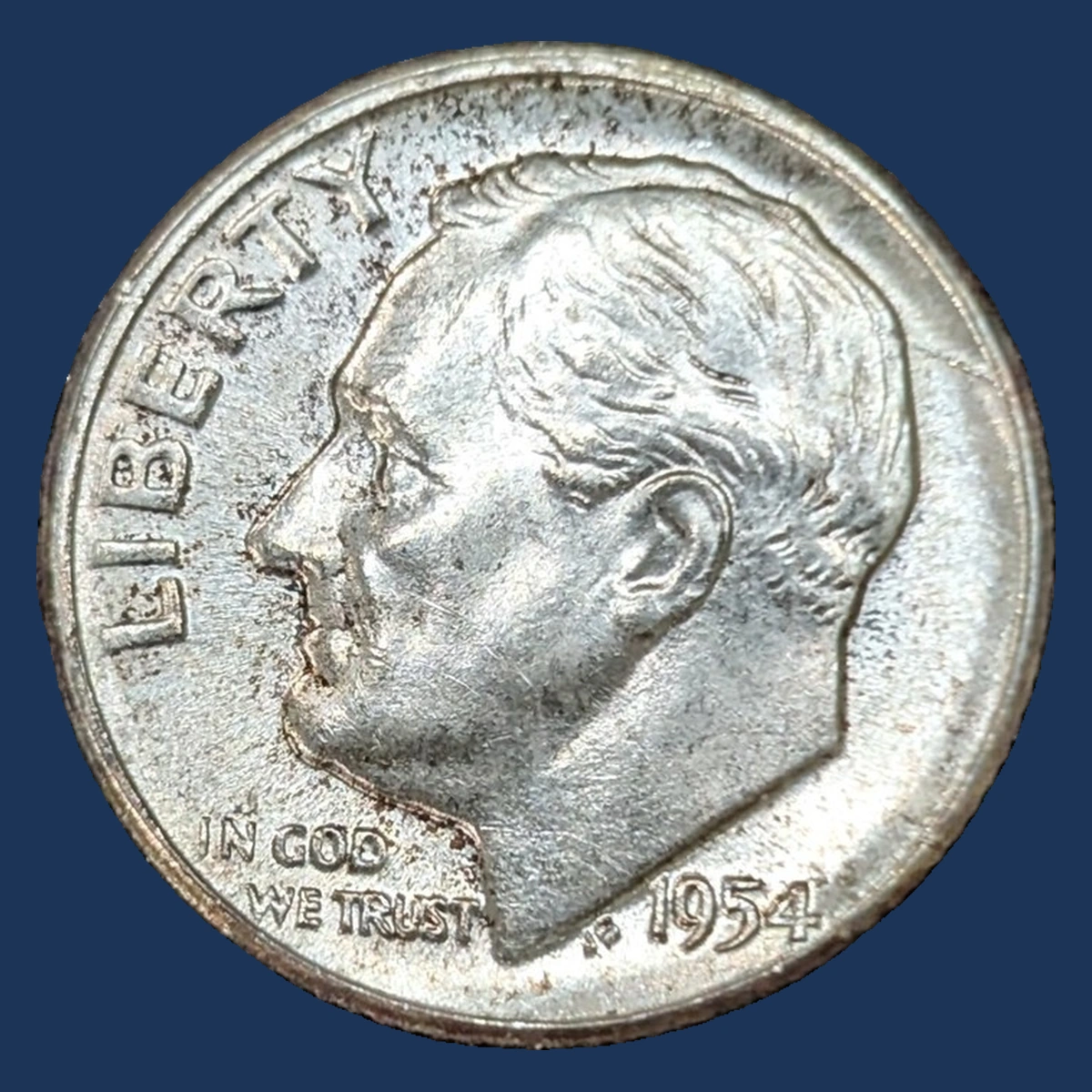
A raised line reaching from Roosevelt’s head toward the rim can resemble a spike. Such lines come from cracks in the stamping tool, called a die.
Metal entering a narrow crack forms a ridge on the coin. If a small piece of the tool breaks away instead, the coin can receive a broader raised patch.
Several Philadelphia head-crack examples are recorded for 1954. A separate upper-lip chip has also been reported, giving a mustache-like appearance; its mint and exact finish should not be assumed from the Philadelphia crack examples.
Estimated Value
Small genuine head cracks can be estimated at $10–$75. An identifiable upper-lip chip can fit an estimated $15–$150, giving the group a range of $10–$150.
A distinct original shape is easier to display than a ridge lost among scratches. Wear can hide where the added metal meets the normal portrait.
The nickname describes appearance, not a separate price guarantee. Deposits, corrosion, or metal pushed upward by a later hit do not qualify as original tool breaks.
How to Identify
Decide which feature you are comparing before enlarging the portrait. A line from the head and a patch above the lip are different locations.
For a head crack, follow the raised path toward the rim and compare it with the corresponding Philadelphia example. The recorded cracks do not all have to take one identical route.
For the lip patch, inspect its connection to Roosevelt’s normal outline. Added material can sit on top of the design without belonging to the original coin.
Move the light to distinguish a raised ridge from a scratch and its pushed-up edge.
Keep the complete date and both faces in photographs. The upper-lip report does not establish the same mint as the head-crack examples.
3. 1954 Roosevelt Dime Reported Weak Strike
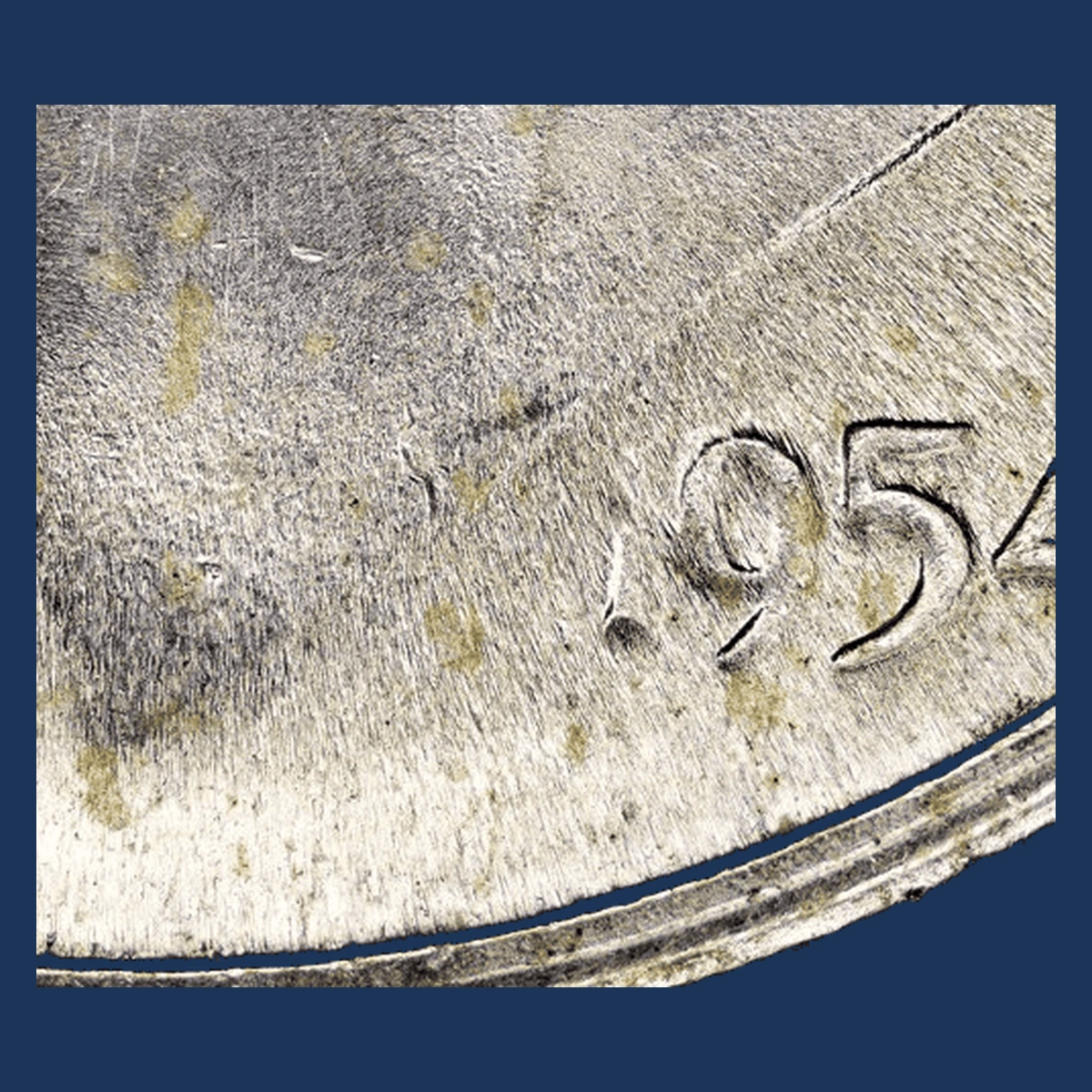
Some design details can remain shallow because the strike did not press the metal fully into the tools. This original softness differs from detail rubbed away during circulation.
A weak-strike example is reported for 1954, without one confirmed affected area or mint defining the category. Its actual surfaces need to show where the design failed to form.
A dime without the Full Bands designation is not automatically an error. That designation concerns separation in the torch bands, and an ordinary coin can lack the sharpness required for it without showing an unusual press accident.
Estimated Value
Estimate $15–$200 for an identified weak strike with original surfaces. Broad noticeable softness can be more interesting than one slightly incomplete band on an otherwise ordinary dime.
The estimate depends on distinguishing original weak formation from wear and later damage. A high grade or a reference to a grading company does not establish the cause of every shallow area.
Compare the actual coin’s surfaces and surviving detail. Missing a Full Bands label alone does not justify an error premium.
How to Identify
Examine the torch bands first if their weakness is what caught your eye. Soft bands alone can be an ordinary difference in strike quality, so check how the rest of the dime compares.
Look at protected spaces between letters and then the high points of Roosevelt’s portrait. A weak strike may leave protected details shallow, while wear tends to smooth the exposed parts first.
Use low side lighting to inspect the surface for rubbing, scratches, or chemical pits. These can remove details that were present when the coin left the Mint.
Keep sharp and weak areas together in your photographs. Their relationship helps explain the strike more than the presence or absence of a Full Bands label.
4. 1954 Roosevelt Dime Incomplete Blanks with Missing Edge Metal
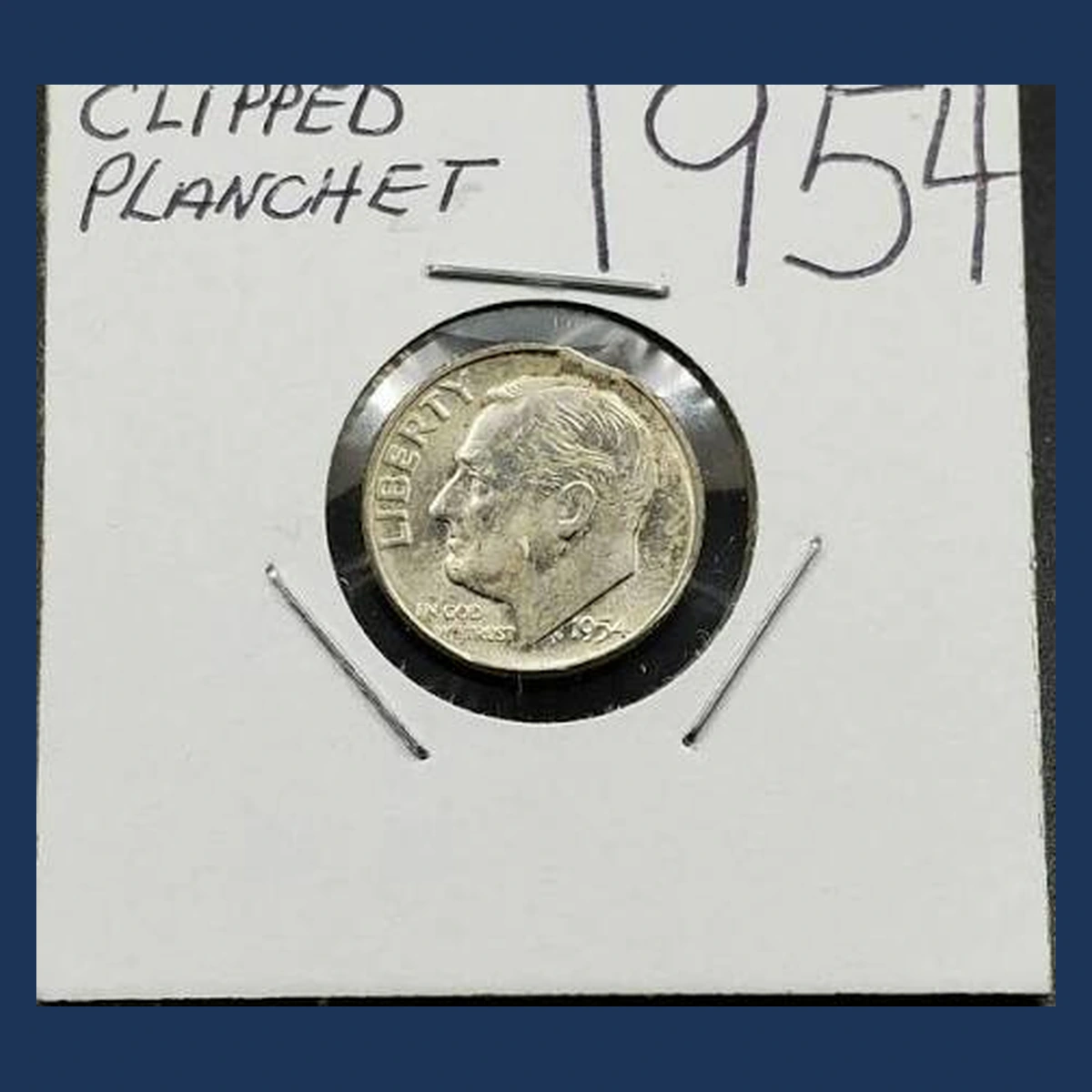
A blank is the plain metal disk that receives the dime design. If it is cut where part of the strip is already missing, its outline can contain a gap before striking.
A Philadelphia clipped dime is listed by a dealer, while a separate San Francisco example is described with a curved gap. These are different coins, not two views of one example.
The Philadelphia description does not establish that its gap is curved too. A later cut can imitate either outline, making the struck rim and the exposed gap surface more useful than the silhouette alone.
Estimated Value
Use an estimated $20–$300 for a genuine 1954 clipped dime. Larger original gaps with readable identity can be more appealing than tiny rim losses hidden by wear.
A different-year silver-dime comparison is a 1963 ragged clip graded NGC MS65, recorded at $109 in July 2021. Its irregular edge is not a measurement or grade for either 1954 seller-listed coin.
Inspect the actual gap and surrounding surfaces. An attractive color does not establish that the missing metal is original.
How to Identify
Ask for the whole outline and a close side view of the missing section. The Philadelphia dealer example and the San Francisco curved clip need separate comparisons.
Follow the struck rim into both ends of the gap. Original missing metal can affect nearby formation, while a later cut may slice through completed rim detail.
Look for saw marks, filing, or bent letters along the boundary. A weak opposite rim can support a clip but need not appear on every example.
A loose coin can be weighed against the normal 2.50 grams. Reduced weight documents metal loss; the edge and design must still show whether it happened before striking.
5. 1954 Roosevelt Dime Denver Reverse Lamination
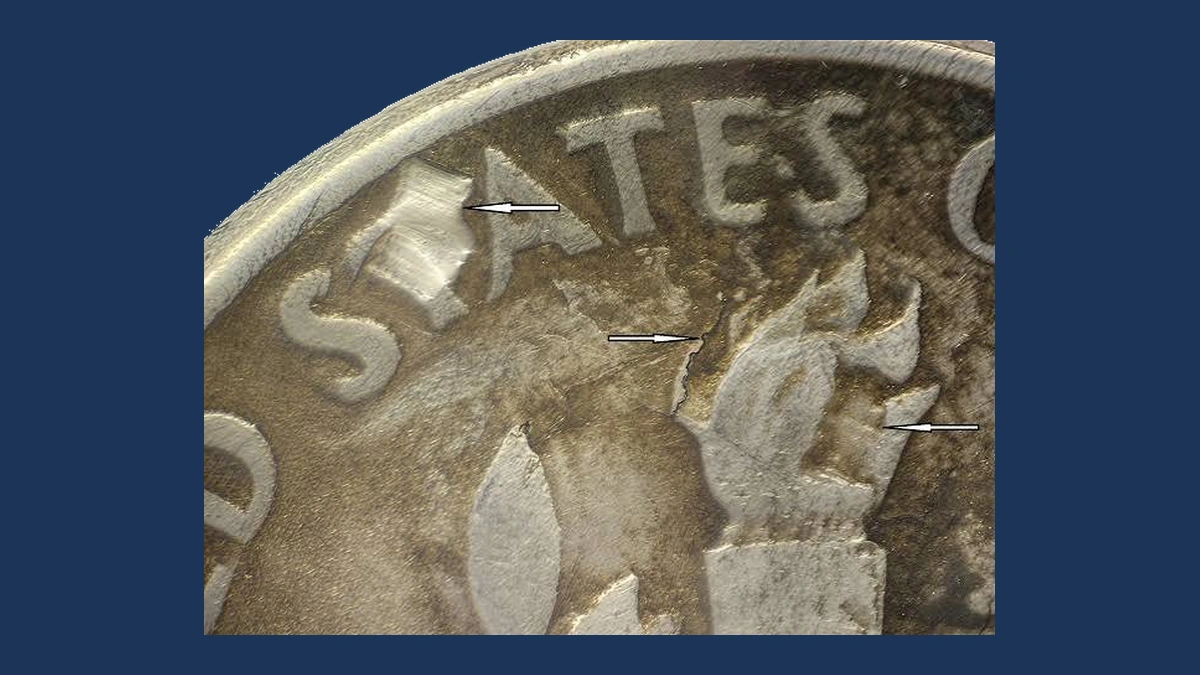
A broad area of silver has separated across the back of one reported Denver dime. The old auction description places the lamination from two o’clock to ten o’clock.
Lamination means a weak layer within the metal has opened or peeled. A thin piece can remain attached, or it can detach and leave a recessed surface.
The coin was described as VF, a circulated grade with substantial remaining design. Its defect belongs to a ninety-percent-silver alloy, so it should not be described as the missing copper-nickel covering of a modern clad dime.
Estimated Value
Estimate $20–$400 for an authenticated 1954 lamination, from a small separation to a broader well-preserved example. The old Denver listing carried a $2 minimum bid, which was not a selling price.
A wide original separation can be easy to appreciate when its boundary and surrounding design remain clear. Heavy wear or cleaning may hide those details.
An attached flap should stay untouched. Lifting it can reduce the coin’s appeal and remove the evidence that explains the original defect.
How to Identify
Confirm the D beside the torch base before comparing the reported separation. With the back upright, find the broad area extending between about two and ten o’clock.
Examine its boundary rather than expecting a perfectly straight band. The surrounding letters and torch detail can show how the defect meets the original design.
Leave any attached silver flap in place.
Use angled light to examine exposed metal without inserting anything beneath a loose edge. Scraping can create a groove through finished detail, while separation within the alloy leaves a different surface.
Photograph both ends of the affected area and any connection to the edge. A natural silver-alloy split should be judged from those surfaces, not from a brown color or a modern clad-dime comparison.
6. 1954 Roosevelt Dime Repunched S and D Mintmarks
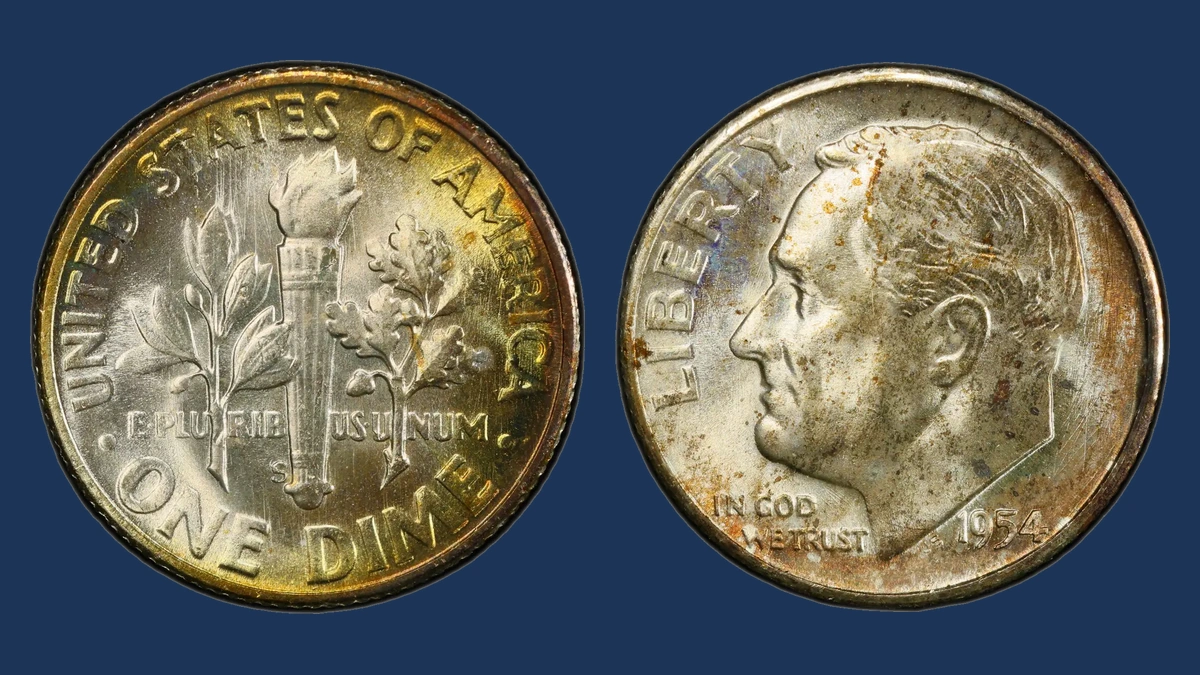
The small mint letter was added to the stamping tool with a separate punch. A second blow in a slightly different position could leave remnants of the first letter beside the final one.
For 1954, both S-over-S and D-over-D examples are listed. The Denver report places the earlier D toward the north, meaning above the main letter.
The San Francisco pattern requires its own photograph rather than the Denver direction. A second letter curve is different from a scratch, a broken-tool patch, or a flat shelf left beside the mintmark during striking.
Estimated Value
An identified minor repunched mintmark has an estimated value of $20–$400. Clear surviving letter parts and attractive surfaces help a collector see what makes it different.
The Denver and San Francisco coins need separate condition and pattern comparisons. A strong S-over-S example does not set the value of every thick Denver letter.
The range is an estimate across recognizable original varieties. Wear, scratches, and an incomplete match can reduce appeal or prevent a reliable identification altogether.
How to Identify
Find the mint letter on the back, to the lower left of the torch. Trace its normal shape before searching for extra metal.
For the Denver example, look above the D for a surviving part of the earlier letter. Keep the dime upright while comparing the relative position.
For San Francisco, compare the extra curves and ends with an attributed S-over-S photograph. Do not force the same northern direction onto that separate pattern.
Use a magnifier and light from opposite sides to check whether the extra outlines stay fixed and raised. A flat shelf, a scratch, or a single unrelated lump does not establish a second punch.
7. 1954 Roosevelt Dime Doubled Designs on Proof and Ordinary Dimes
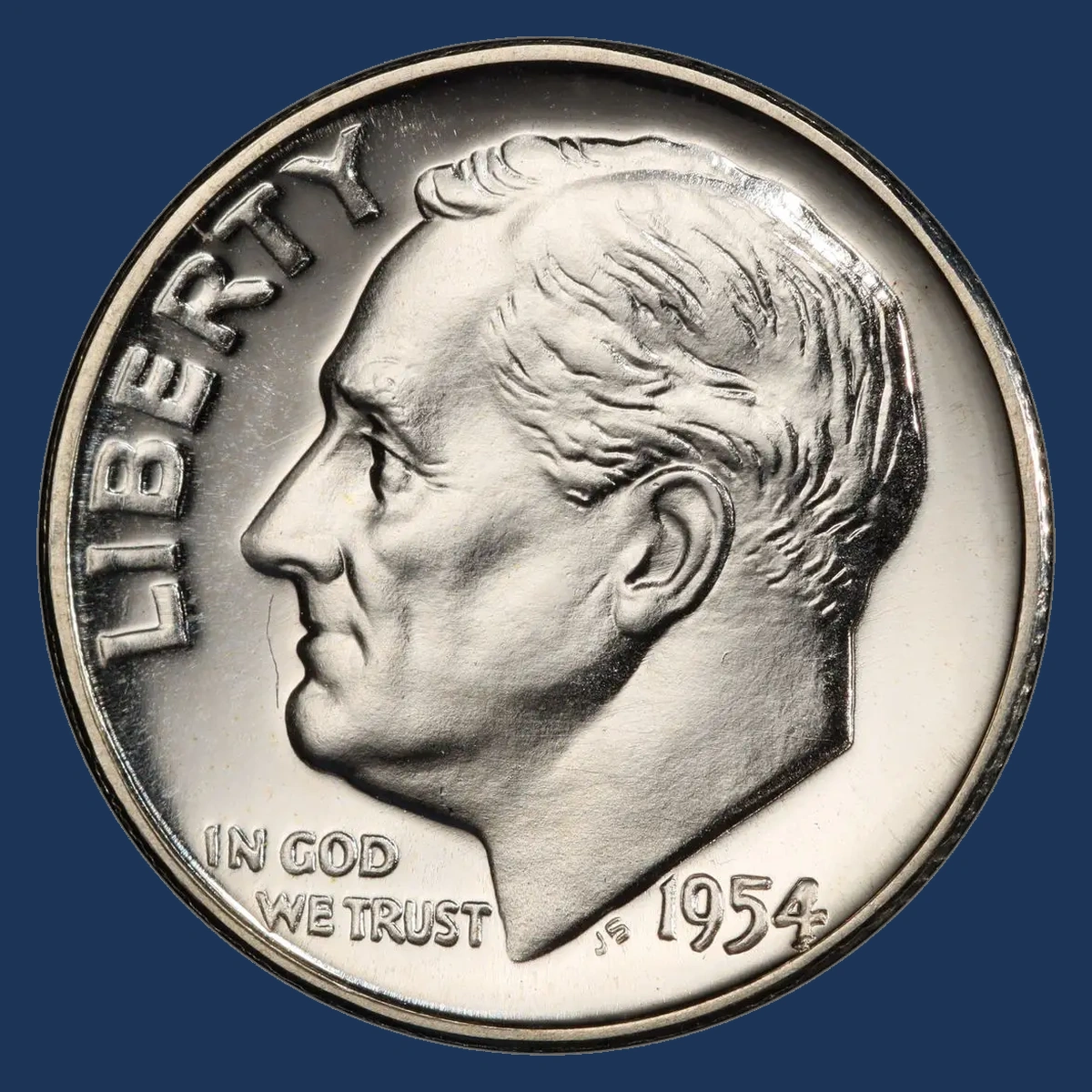
The base of the final 4 can show an extra outline on the 1954 Proof doubled-die front. Other reported affected areas include the designer’s JS initials and the motto.
A doubled die contains repeated details before it stamps the coin. The recognized Proof front variety is FS-101, and it is separate from an ordinary Philadelphia back-doubling report.
That back report points to ONE DIME, the country name, and torch details. A Proof’s normal repeated blows during manufacture do not by themselves make a doubled die, and the two finishes require different matching patterns.
Estimated Value
PCGS records the Proof FS-101 in PR67 at $257 on March 31, 2021, through eBay. PR67 describes a well-preserved specially made collector coin.
Estimate $75–$500 for identified Proof front examples and $25–$300 for an authenticated minor ordinary back pattern. The combined range is $25–$500.
Clear separated edges and undamaged surfaces support the comparison. A shiny finish or thick letter alone does not establish either variety.
How to Identify
For a Proof candidate, use an identified FS-101 front photograph and compare the extra outline beneath the final 4. Continue to JS and IN GOD WE TRUST to look for several matching details.
Tilt the coin so reflections move while the actual raised design stays fixed in place. A low flat shelf beside a letter can come from movement during striking instead of repeated detail in the stamping tool.
The ordinary Philadelphia back report requires a separate comparison of ONE DIME, UNITED STATES OF AMERICA, and the torch. Its location and finish differ from the Proof front, so the same catalog label cannot identify both.
8. 1954 Roosevelt Dime Reported Off-Center Strike
A blank that sits partly outside the striking area can receive only part of the intended dime design. The rest of its silver remains plain.
The 1954 reports include this off-center category without an established percentage, mint, or direction for one particular specimen. Those details must be read from the actual coin.
The missing image and the unstruck crescent belong to opposite parts of the same outline. A complete design surrounded by uneven extra metal may instead be a broadstrike, while displacement on just one face can result from a misplaced stamping tool.
Estimated Value
For an authenticated, identifiable 1954 off-center dime, estimate $40–$750. A clear date and attractive surfaces can be more useful than a large displacement that erases the year.
For comparison, a later clad 1967 dime fifty percent off center sold for $93 in January 2022. Its percentage and direction do not describe a 1954 silver example.
The original plain metal should remain undamaged. Grinding away a normal design can imitate an empty crescent but does not create the same error.
How to Identify
Read the surviving date before estimating how far the strike moved. A large blank area alone cannot establish 1954.
Follow the design to the edge where part of it is missing, then find the untouched silver opposite it. Compare the same relationship on the other face.
Check any surviving mint letter beside the torch. If that area was never struck, the absence of D or S does not prove Philadelphia origin.
Inspect the plain area for partly erased letters, sanding, or added metal. Both faces should support one blank misplaced during the strike, rather than a finished dime altered later to resemble an off-center coin.
9. 1954 Roosevelt Dime San Francisco Flip-Over Double Strike
A second strike can mix the front and back designs when a coin turns over between blows. Parts of the first image survive under a new design from the opposite tool.
A reported 1954-S dime from Edgar Murphy’s collection shows this flip-over double strike within the collar. The collar is the ring that normally contains the coin’s edge.
Traces of the back appear within the front design, and front details survive on the back. This is a second strike on the same dime, not merely a single doubled letter or a claim that its normal design alignment is rotated.
Estimated Value
Estimate $500–$2,000 for an authenticated 1954-S flip-over double strike with recognizable overlapping designs. Clear pieces of both designs help a collector follow what happened during the two strikes.
A different-year example offers context: a 1976 dime with a widely off-center flip-over second strike brought $423 in January 2017. That displaced strike differs from the 1954 coin’s reported strike within the collar.
Readable identity and a clear sequence support stronger interest. Later surface damage can hide the overlapping details.
How to Identify
Place photographs of a normal dime’s front and back beside the suspected double strike. Use them to recognize torch-side shapes among Roosevelt’s portrait and front-side shapes among the back design.
Check both faces.
Two shifted Roosevelt portraits alone do not show that the coin turned over. Recognizable pieces of the opposite design are needed to explain a flip between the blows.
Compare the overlaps with the reported Murphy specimen, keeping each image upright. Follow the actual shapes instead of assigning them an assumed clock position.
An error specialist should inspect the struck surfaces and edge before confirming the sequence. Coins squeezed together later can also carry misleading impressions, but their surfaces need a different explanation.
Conclusion
Estimated values of $10–$2,000 cover small missing initials, raised tool defects, unusual blanks, and the reported flip-over strike. A coin’s surface and exact pattern matter more than a dramatic nickname.
Check JS below the neck, mint letters beside the torch, and the correct face for each feature. Keep Proof and ordinary examples separate, and preserve loose silver or overlapping design details while making comparisons.