1904 Dime Error List with Pictures

A 1904 dime that flipped over before a second strike sold for $4,025 in February 2009. PCGS graded it XF45, a worn coin with much detail remaining.
This 1904 dime error list covers eight categories with estimated whole-coin values of $20–$6,000. Some leave faint outlines; others shift or overlap whole pictures.
Use the comparisons below to tell small date remnants from repeated strikes, and check the mint letter before comparing prices.
1. 1904 Barber Dime Lamination Report (Estimated Up to $400)
A thin flap or shallow missing patch can begin with a weakness inside the metal. Part of the surface separates, either staying attached or falling away.
This process is called lamination. A Philadelphia year guide lists it for 1904 without identifying one particular graded coin or location.
The Barber dime is silver mixed with copper throughout. It does not have the separate outer layers and copper center of a modern dime.
Look at the exposed boundary itself. A scrape cut into finished silver has a different cause, even if it leaves a similarly shaped hollow.
Estimated Value
The estimated whole-coin range is $30–$400 for worn through lightly worn Philadelphia examples with clear original peeling. Larger visible separations can attract more attention.
A separate 1902-S report describes a $150 asking price for peeling on both sides. That is another year and an asking price, not a completed 1904 sale.
An attached flap can be especially useful for understanding the error. Do not remove it merely to make the missing area look bigger.
How to Identify
First check that the coin has no mint letter below the back bow, matching the Philadelphia report. The normal dime is 90% silver, 2.50 g, and 17.9 mm across.
Use a scale and calipers when safely accessible, and inspect the edge grooves. Detached metal can explain some weight loss.
Follow the boundary with a 10× magnifier and light from a low angle. Keep nearby struck detail visible in photographs.
Do not touch or lift an attached flap. A natural layer boundary differs from a scraped hollow with pushed-up metal or fresh tool marks.
The useful evidence is a thin piece separating from the alloy itself, rather than the size of a shallow recess by itself.
2. 1904 Barber Dime Repunched Date (Estimated Up to $700)
The 0 carries the clear extra outline on a Philadelphia coin described by its owner as RPD-L101. The 2017 discussion shows a PCGS MS63 example, an unworn coin with noticeable marks.
A separate annual guide mentions marks on 1 and 9. Those should not be assumed to identify the same tool.
A repunched date begins when the date punch enters the die more than once. The die is the steel tool that stamps coins.
Earlier pieces of the numeral remain and appear on later coins. The finished dime did not need another complete strike to receive them.
Estimated Value
The estimated whole-coin range is $30–$700, from worn examples through about MS63. The owner’s pictured MS63 provides a comparison for the shape, without a transaction price.
A 2026 marketplace entry summarized by CoinValueChecker records $399.95 for a seller-described unlisted repeated date in PCGS MS64. That entry does not identify the coin as L101.
Treat it as nearby market information rather than a price for the exact pictured variety. Condition and the matching numeral still matter.
How to Identify
Photograph the full date before enlarging the 0. The owner’s L101 pictures give a comparison for its lower extra contour.
Use a 10× magnifier and move the light across that edge. Look for a curved raised remnant that follows the numeral, rather than a flat shelf.
Record any marks on 1 or 9 separately instead of adding them to the L101 description automatically. Keep the surrounding date position visible.
The 90% silver dime normally weighs 2.50 g and measures 17.9 mm. Check with a scale and calipers when safely accessible, and inspect the edge grooves.
A matching lower outline on 0 is the useful starting feature; a generally fuzzy date is not enough.
3. 1904 Barber Dime Die Clash (Estimated Up to $1,200)
Faint pieces of the wreath or portrait can appear where they do not normally belong. They can come from a clash between the stamping tools.
The tools met without a blank between them and picked up parts of the opposing design. Later coins received those unwanted traces.
PCGS specifically notes clashing on some Philadelphia 1904 dimes, separately from soft detail caused by worn tools. Softness alone is not evidence of a clash.
A guide also reports San Francisco clashing. That example needs its own comparison; the Philadelphia discussion does not identify a particular S-mint tool.
Estimated Value
Estimated whole-coin ranges are $20–$500 for Philadelphia and $75–$1,200 for San Francisco. They cover worn through lower unworn Philadelphia coins and worn through lightly worn San Francisco examples.
The stronger underlying S-mint value helps explain the difference. Faint marks on a worn coin usually attract less interest than a clear transferred shape.
These are estimates, not sales of the pictured clashed examples. Compare the actual marks and condition before choosing a price.
How to Identify
Compare the extra marks with the opposite side’s design. A photograph of the back placed over a front image can help test whether the shapes agree.
Use a 10× magnifier to inspect each trace directly too. Random scratches should not assemble into a matching part of the portrait or wreath.
Separate the marks from the soft upper lip and rounded back detail noted by PCGS. Those can result from tool wear.
When safely accessible, check weight and diameter with a scale and calipers against 2.50 g and 17.9 mm. Inspect the edge grooves of the 90% silver dime.
The useful match is an outline borrowed from the opposite design in the right place, rather than softness by itself.
4. 1904 Barber Dime Rotated Die Report (Estimated Up to $1,200)
Both sides can look normal by themselves while their directions do not line up correctly. That is the relationship tested for a rotated die.
A year-specific listing includes rotation for 1904 without naming a mint, measured angle, or particular coin. It does not establish a specific number of degrees.
Hold the front upright and turn it from top to bottom. A normal back should then appear upright too.
A sideways turn changes the test and can make an ordinary dime look upside down. A coin sitting diagonally in a holder also says nothing about the angle between its designs.
Estimated Value
The estimated whole-coin range is $75–$1,200 for genuine substantial rotations on worn through lightly worn coins. Mint and condition must be assessed on the individual example.
This is an estimate, not a recorded sale of a named 1904 rotation. A small departure generally attracts less interest than a strong repeatable angle.
The upper end assumes a clear effect on a desirable coin. A seller’s unsupported angle claim should not add value by itself.
How to Identify
Hold Liberty upright in a stable transparent holder so the coin cannot spin. Turn it from top to bottom without twisting sideways.
Photograph the resulting back beside a vertical line. A protractor can measure how far it leans from upright.
Repeat the movement to rule out handling mistakes. A genuine rotation should return to the same angle each time.
Use a 10× magnifier around the edge to look for a seam from joined coin halves. When safely accessible, compare scale and caliper readings with 2.50 g and 17.9 mm, and inspect the grooves.
The coin is normally 90% silver. The important test remains a consistent back angle after the same controlled turn, rather than the angle of one photograph.
5. 1904 Barber Dime Off-Center Strike (Estimated Up to $1,500)
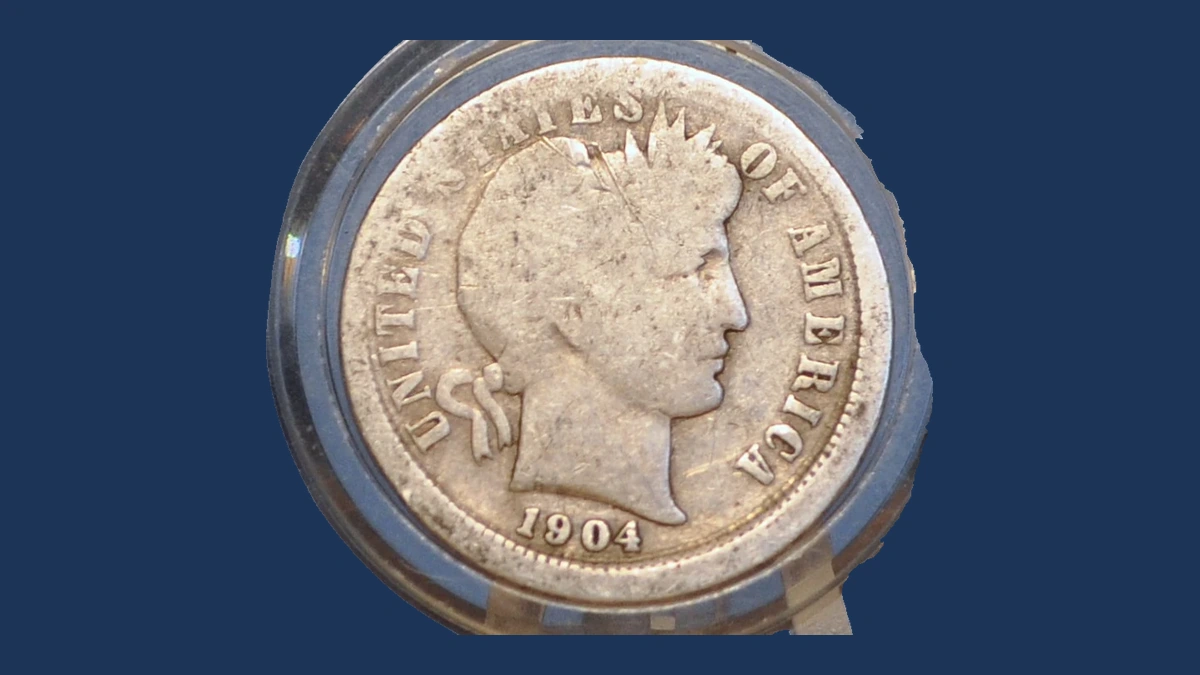
The recorded PCGS AU50 Philadelphia coin is struck 10% off center toward one o’clock. Heritage sold it from the Larry Rausch collection in 2005.
AU50 means light wear. A separate reported NGC MS63 dime is also described as 10% off center, but it is not the same specimen.
An off-center strike begins when the blank fails to settle into its intended position. Part of the design misses the metal, leaving an untouched area on the opposite side.
Matching percentages do not merge two coins’ histories. Keep the direction, grade, and sale attached to the actual example.
Estimated Value
The PCGS AU50 brought $373.75 on February 26, 2005. The estimated range is $250–$1,500 for worn through lower unworn examples with a readable date.
No extra sale price is assigned to the reported MS63 coin. Its grade identifies another condition level, not a second transaction.
Compare the missing design and original surfaces before choosing a price. A larger offset does not automatically outweigh damage or a date that cannot be read.
How to Identify
For the AU50 comparison, hold Liberty upright and examine the shift toward one o’clock. Use a 10× magnifier along the struck boundary on both faces.
Identify which letters or picture elements are actually missing. Do not estimate the error from a blank crescent alone.
A wide uneven margin can also come from a broadstrike, which keeps the complete design. Check that the missing area and untouched metal belong to the same displaced strike.
When safely accessible, compare scale and caliper readings with 2.50 g and 17.9 mm. Inspect the remaining edge grooves of the 90% silver dime for later cutting.
The useful match is missing design opposite genuine unstruck metal, visible in full pictures of both sides.
6. 1904 Barber Dime Broadstrike (Estimated Up to $2,000)
The San Francisco broadstrike is recorded as NGC AU55, a coin with slight wear. Its S mint letter belongs with that specific auction example.
A broadstrike forms when the collar, the ring controlling the coin’s width, does not contain the metal normally. Pressure pushes silver outward while the whole design remains on the coin.
The outline can therefore be uneven without losing part of the picture. This differs from an off-center strike.
A Philadelphia guide also lists broadstriking for 1904. That separate report does not inherit the San Francisco coin’s grade, appearance, or auction history.
Estimated Value
The NGC AU55 1904-S sold for $460 on September 28, 2007. Estimated values are $400–$2,000 for worn through lightly worn San Francisco examples and $150–$700 for Philadelphia in comparable condition.
These are whole-coin estimates, not evidence that the old auction coin resold at a higher price. Original surfaces and the visible spread affect the comparison.
Keep the S-mint sale attached to the S-mint coin. The Philadelphia report needs a separate assessment.
How to Identify
Measure the outline in several directions with calipers when safely accessible. Compare with 17.9 mm and weigh the coin against the original 2.50 g.
A wider outline alone cannot distinguish an original broadstrike from a dime hammered afterward. Inspect the design and edge with a 10× magnifier.
The metal should show spreading from the strike, rather than flattened pictures or later impact marks. This 90% silver coin normally has edge grooves, which collar failure can interrupt.
Locate the S below the wreath bow before applying the recorded auction comparison. A Philadelphia example has no mint letter.
The central check is a complete design inside originally spread metal, supported by the edge and surface rather than diameter alone.
7. 1904-S Barber Dime Struck-Through Report (Estimated Up to $2,000)
A guide describes a 1904-S MS60 struck-through example. MS60 is an unworn grade allowing many marks, but the report does not provide an original auction lot or exact affected location.
A struck-through error occurs when something blocks the stamping tool from reaching part of the blank. That area can lose detail or receive a hollow shaped by the obstruction.
The report does not identify cloth, grease, or a metal fragment. Those possibilities should not be assigned without visible evidence.
A generally weak portrait is also insufficient. The useful feature is a local interruption surrounded by normal struck detail.
Estimated Value
The estimated range is $300–$2,000 for a genuine 1904-S with a clear local obstruction mark, from worn through lower unworn condition. The annual guide reports $950 in 2018 for an MS60 example.
The $950 figure comes from that guide rather than an original auction record. Treat it as a reported price when comparing coins.
A large distinctive impression generally attracts more attention than ordinary weakness or a tiny indistinct patch.
How to Identify
Confirm the S below the back bow before inspecting the affected area. When safely accessible, check this 90% silver dime with a scale and calipers against 2.50 g and 17.9 mm.
Inspect the edge grooves, then use a 10× magnifier and light from the side. Follow the boundary between interrupted and normal design.
A later scrape can leave torn edges or push metal outward. Look for those signs rather than assuming every hollow formed during striking.
No object texture or clock position is established for the reported coin. Compare what is actually visible instead of searching for an invented cloth or grease pattern.
The useful clue is a local interruption bordered by undamaged struck metal, with no signs that finished detail was cut away afterward.
8. 1904 Barber Dime Flipover Double Strike (Estimated Up to $6,000)
A coin can receive parts of the opposite design if it turns over before being struck again. The recorded Philadelphia PCGS XF45 example has such a displaced second strike.
Pieces of the portrait and wreath or denomination can overlap on the same face. They record two blows on one piece of silver.
That differs from a clash, where the stamping tools acquire extra design traces before another coin is made. It also differs from a tool that already carries a doubled image.
Look for recognizable pieces of both faces within the overlapping strikes, rather than a collection of unexplained lines.
Estimated Value
The PCGS XF45 flipover coin sold for $4,025 on February 8, 2009. The estimated range is $3,000–$6,000 for a similarly recognizable worn example with clear evidence of both strikes.
The result prices the entire combined error. Do not add separate full amounts for the flip and the displacement.
How clearly the two designs survive can matter more than the numerical grade alone. Compare the actual overlapping pictures and the surrounding surface.
How to Identify
Enlarge each face and separate portrait pieces from wreath or denomination pieces. A 10× magnifier should show how one struck impression crosses the other.
A few isolated lines are not enough to establish two blows. Compare the whole arrangement with photographs of the graded example.
Use a scale and calipers when safely accessible against the original 2.50 g and 17.9 mm. Inspect the edge grooves of the 90% silver dime, allowing for a changed outline.
Later squeezing of finished coins can make sunken backward impressions and compress the edges. Check for that damage before accepting an overlapping picture as a mint error.
The useful combination is recognizable opposite-face detail in two struck impressions, including the displaced second design on the same coin.
Conclusion
Estimated whole-coin values for these 1904 errors run from $20 to $6,000. Small date remnants need a close numeral comparison, while a broadstrike or off-center coin needs its full outline examined.
Clash traces borrow shapes from the opposite design. A flipover double strike instead places two struck impressions across the same coin.
Keep the mint and surface condition attached to each price, and preserve both sides in your photographs.