1897 Dime Error List with Pictures

A readable date survived on an 1897 dime struck 12% off center. That lightly worn coin sold for $517.50 in January 2005.
This 1897 Barber dime error list covers four types with estimated values of $30–$2,000. One leaves missing edge metal, another repeats date strokes, and a third creates a step around the edge.
Read on to compare those shapes before choosing a price range.
1. 1897 Barber Dime Rim Clip (Estimated Up to $400)
A small piece of the edge is missing on this Philadelphia dime. ANACS graded it VF35, meaning moderate wear, and recorded a weight of 2.43 grams.
An ordinary dime began at 2.50 grams. The lower weight fits missing metal but does not, by itself, explain how the gap formed.
A clip can begin when the cutting punch overlaps an earlier hole in the metal strip. The incomplete blank then receives the design.
The strike shapes metal around the existing gap. Later cutting or ordinary wear can also lower weight, so the edge still needs close inspection.
Estimated Value
Estimate $40–$400 for worn through attractive, lightly worn rim clips. The VF35 auction entry identifies this coin but supplies no sale price used here.
An undated clipped silver dime blank sold for $59 in March 2025. It had not received a coin design, unlike the 1897 example.
That is only a related metal-flaw comparison. The dated coin’s condition, remaining design, and clearly original edge affect its own price.
How to Identify
Find 1897 on the front and confirm there is no mint letter on the back. Keep both complete faces with any enlarged view of the gap.
Use a magnifier at the gap’s two ends. Natural struck detail should meet the missing boundary without saw marks or a sharply cut finished rim.
The opposite rim may look weak, though that clue is not always clear. Inspect the surviving edge grooves too.
Compare a loose coin with 2.50 grams on a scale and 17.9 mm across intact spans using calipers. Use recorded readings for a sealed coin.
The useful first check is naturally formed metal at both ends of the gap, rather than low weight alone.
2. 1897 Barber Dime Repunched Date (Estimated Up to $900)
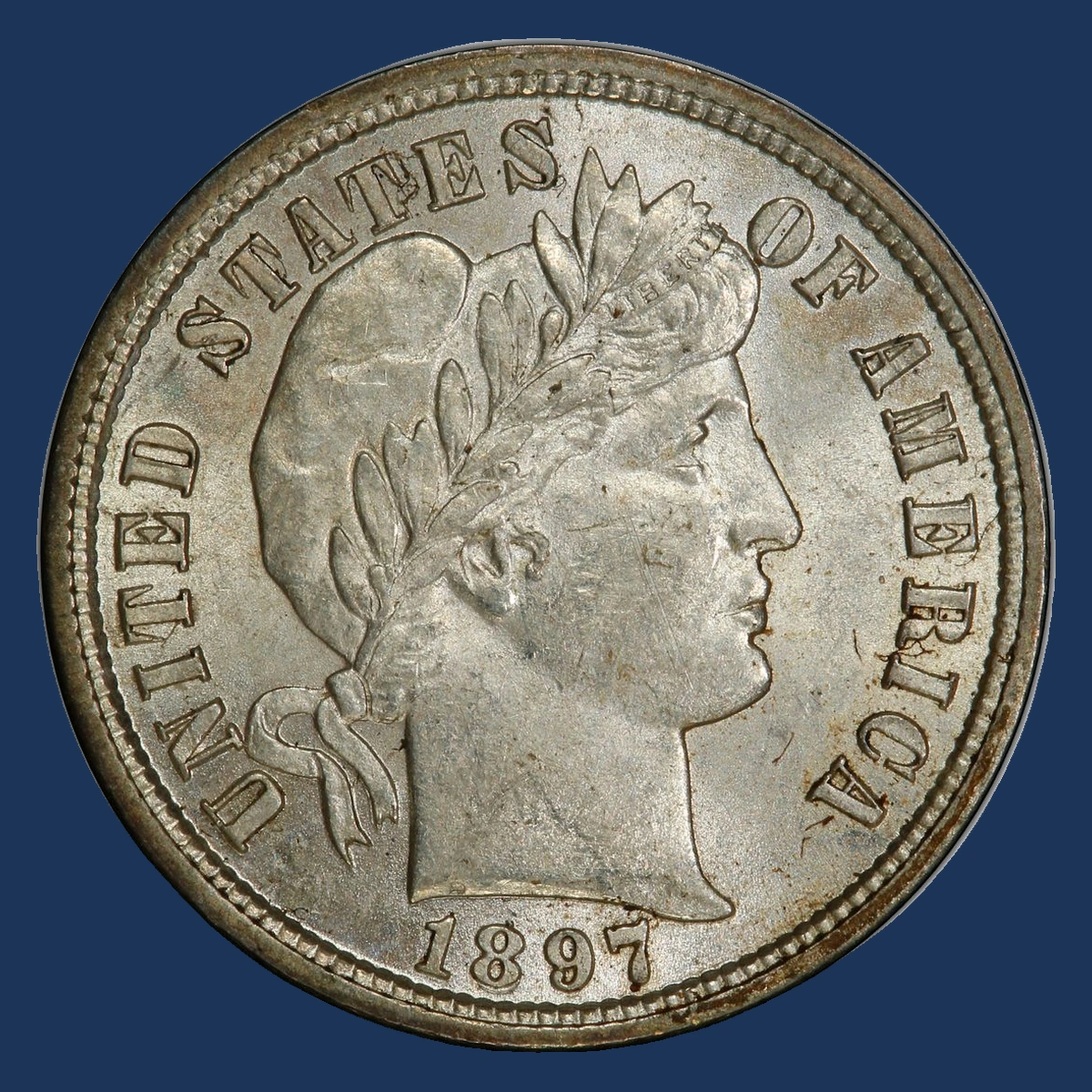
Extra pieces of numbers can remain beside the normal 1897 date. A worker punched the date into a die, the steel stamping tool, more than once.
If the punch shifted, the final impression might not cover every part of the earlier one. Later coins would copy both positions together.
PCGS lists three Philadelphia varieties: FS-301, FS-302, and FS-303. They share the same basic cause but need different photographs for comparison.
The catalog numbers help select the right pattern. They do not mean the finished dime was struck three times or give each extra stroke its own value.
Estimated Value
Estimate $30–$900 from readable worn examples through attractive coins in lower unworn grades. Clear earlier number pieces and better surfaces can support the higher end.
A different-year 1899-O with a repeated O mintmark sold for $115 in May 2023. Its AU Details grade means light wear with a condition problem.
That related variety offers broad price context. It is not a sale of an 1897 repunched date or proof that all three patterns bring identical prices.
How to Identify
View all four date digits with a magnifier before choosing a reference. Compare the extra strokes with one matching entry, such as PCGS FS-301.
Do not assemble a match from different varieties. Each raised remnant should fit the shape and position of an earlier number on that same example.
A flat shelf or scratch beside a digit has a different form. Move the light to distinguish raised detail from a cut.
The Philadelphia back has no O or S below the wreath. Use a scale and calipers against 2.50 grams and 17.9 mm, and inspect the edge grooves.
The direct match is the same earlier numeral piece beside the same date digit.
3. 1897 Barber Dime Partial Collar Strike (Estimated Up to $1,000)
A step around the edge can show that only part of the blank met the collar. The collar is the metal ring that controls width and forms edge grooves.
The supported section stayed within the ring. The other section spread farther during the strike, leaving two different edge levels.
Collectors sometimes call this a railroad rim. Northeast Numismatics lists an 1897 example graded NGC MS62, meaning no circulation wear but noticeable marks.
The listing gives no clock position for the step. The actual edge needs to be viewed, rather than guessing its location from the front alone.
Estimated Value
The dealer asks $575 for the NGC MS62 example. Estimate $250–$1,000 for attractive worn through lower-grade unworn partial-collar dimes.
The quoted amount is an offer to sell, not a completed auction result. A clear step and undamaged surfaces can make the feature easier to appreciate.
A barely visible edge change or a heavily damaged coin needs a different comparison. The whole coin’s condition remains part of its value.
How to Identify
View the edge from several angles with a magnifier. Follow the step between the normally grooved section and metal that spread beyond the ring.
Check that both levels belong to the original struck metal. Filing can make a shelf too, but may leave tool marks and cut grooves.
Inspect both faces for damage from a jewelry mount or later pressure. A stepped edge alone does not rule those out.
Use existing measurements for a sealed coin. For a loose one, compare a scale and calipers with the normal 2.50 grams and 17.9 mm.
The useful combination is a natural change in edge level and matching groove formation, without signs of later cutting.
4. 1897 Barber Dime Off-Center Strike (Estimated Up to $2,000)
The auctioned 1897 dime was struck 12% off center toward three o’clock. PCGS graded it AU53, indicating light wear.
The blank sat too far to one side between the stamping tools. Some design missed the metal, while a blank area remained at the opposite side.
The catalog also notes raised separation at the bases of right-side letters, caused by metal moving during striking. That is not a separate doubled-die variety.
An older report describes a 15% shift toward three o’clock. The shared direction does not prove those descriptions refer to the same coin.
Estimated Value
The AU53 coin sold for $517.50 on January 15, 2005. Estimate $250–$2,000 for readable-date examples from circulated condition through lower unworn grades.
A different-year 1902 dime graded ANACS AU50 brought $561.20 in June 2026. That lightly worn coin provides a more recent comparison.
Neither sale sets a price for the separately reported 15% example. Its condition and the amount of surviving design need their own assessment.
How to Identify
Keep the readable 1897 date beside the blank margin in the same photograph. Compare both faces to see where the missing design and untouched metal line up.
Use a magnifier along that boundary and the right-side lettering on the AU53 example. Do not treat its local letter-base effect as a second valuable variety.
Check remaining edge grooves for filing or flattening. A shift on just one face can come from a moved tool instead.
Use a scale and calipers against the normal 2.50 grams and 17.9 mm, allowing for wear and shape changes.
The quick distinction is incomplete design on both faces opposite original blank silver, rather than a wide rim around complete pictures.
Conclusion
Estimated values of $30–$2,000 cover these four 1897 dime errors. The date varieties repeat number pieces, while the other types change the coin’s edge or the position of its design.
Compare both faces and the edge before choosing a price. Keep the 2.43-gram clip, the dealer’s $575 partial-collar offer, and the $517.50 off-center sale with their own coins rather than combining their details.