1821 Dime Error List with Pictures

An 1821 Large Date dime struck 30% off-center sold for $2,640 in December 2022. Its NGC XF Details grade noted both wear and cleaning.
This 1821 Capped Bust dime error list also covers raised cracks, an edge flaw, a struck-through line, and marks from colliding tools. Estimated whole-coin values span $80–$8,000.
Read on to find each feature and keep the Small Date and Large Date examples separate.
1. 1821 Capped Bust Dime Obverse Die Crack (Estimated Up to $1,200)
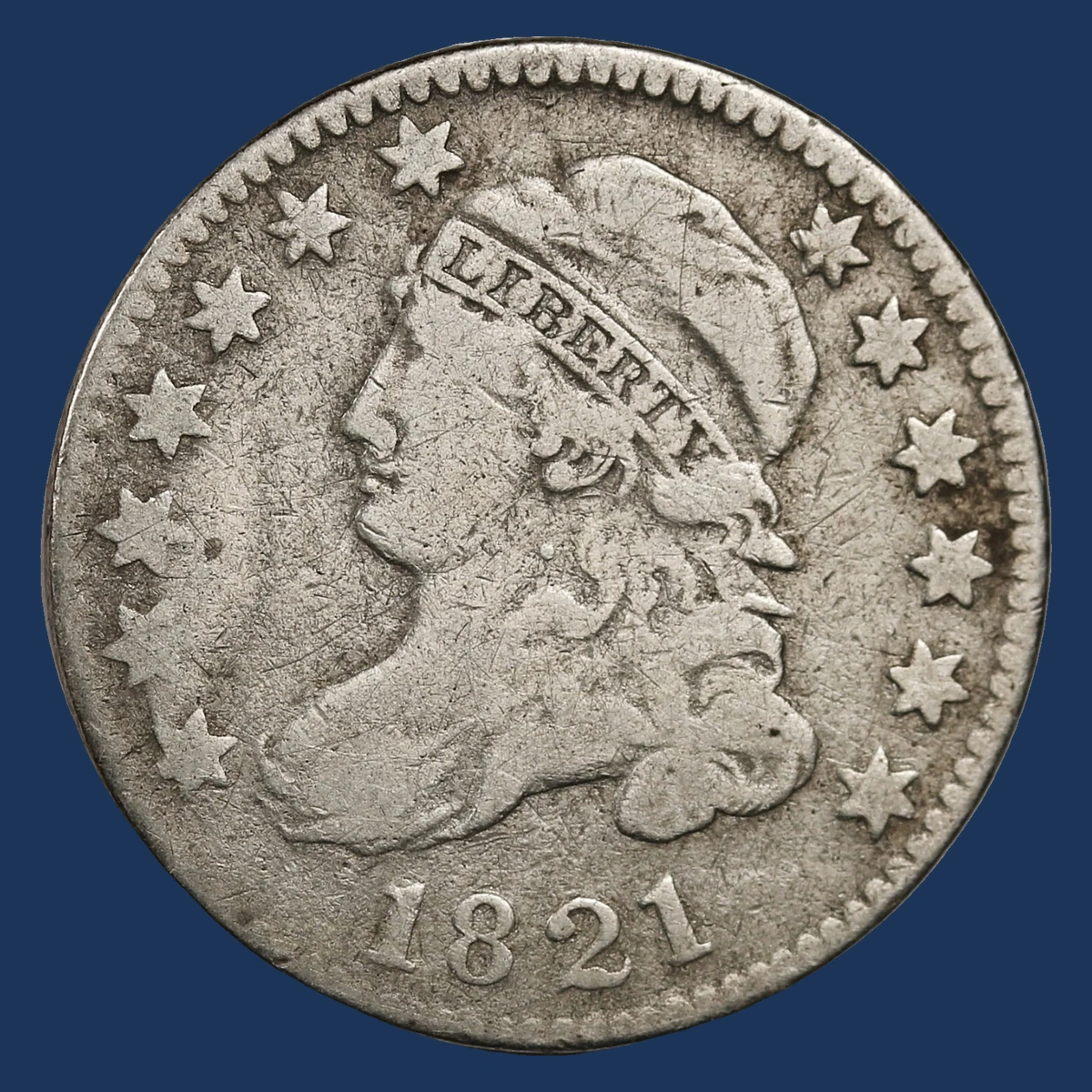
A thin raised line crosses the lower-left stars on a reported Large Date dime. It is different from a missing piece at the rim or a hollow scratch.
The line comes from a crack in the die, the steel tool that stamps the coin. Silver enters the opening during striking and leaves a ridge.
The tool can keep working while its pieces remain in place. Several coins can therefore share the line.
A Large Date alone does not establish the crack; the raised feature must also be visible.
Estimated Value
Estimate $80–$1,200 for a worn Large Date dime with a small genuine crack. That is a whole-coin range, not a large separate premium for the thin line.
A Small Date graded AU55 brought $1,080 in April 2025. AU55 means slight wear, and it is a different date variety.
For the Large Date coin, judge the surviving detail, original surfaces, and crack’s visibility. Cleaning or distracting scratches can reduce its appeal.
How to Identify
Check the basic coin with a scale and calipers: about 2.70 grams and 19 mm is normal before wear. Inspect the grooves around the edge for alterations.
Then use a magnifier on the lower-left stars. Move the lamp to see whether the line rises above the surface or cuts down into it.
Dirt can create a dark line without a raised ridge. A scratch may have pushed-up metal beside its cut, so examine both sides of the line.
Compare the Large Date style as well as the affected star area with a clear example. Begin the error check by finding a raised line through the lower-left stars, rather than relying on a shadow.
2. 1821 Capped Bust Dime Rim and Edge Flaw (Estimated Up to $1,500)
An irregular area crosses the front rim and edge, with a related mark near ST on the back. A collector shared this 1821 dime in an online discussion.
The cause remains open. One suggestion is lamination, where imperfect metal separates in thin layers; another is material caught between the coin and stamping tool.
Those events leave different surfaces, so the edge needs a close look. The discussion does not establish a grading-service identification.
This is one reported flaw with possible explanations, rather than two proven errors on the same dime.
Estimated Value
A genuine Mint-made edge or metal flaw on a worn 1821 dime has an estimated whole-coin range of $100–$1,500. A later cut or repaired edge does not qualify for that estimate.
The Small Date AU55 comparison near $1,080 gives a guide to the underlying coin. It is not a sale of the collector’s piece.
Clear original detail and a convincing cause help support the value. Several suggested explanations do not create several separate premiums.
How to Identify
Rotate the coin under a magnifier and follow the flaw from the front rim across the edge to the back-side ST. Look for a lifted layer or a smooth impression made during striking.
Check the surrounding edge grooves for filing, added metal, or sharp impact damage. These can reveal a change made after the coin left the Mint.
Use a scale and calipers against the normal 2.70 grams and 19 mm. A small surface loss may barely change the weight.
Leave any loose layer attached. To narrow the cause quickly, trace the edge-to-face boundary and check whether it peels in a thin layer or shows a pressed-in impression.
3. 1821 Capped Bust Dime Struck-Through Line (Estimated Up to $2,500)
A curved hollow line sits directly in front of Liberty’s eye. The 2024 Houston auction catalog described it as a strike-through on an NGC AU55 Small Date JR-8 dime.
That means something came between the coin and its stamping tool during the strike. It blocked or pressed into the design, leaving a mark.
The catalog also noted two later fine scratches. They should not be treated as part of the same Mint error.
The object that made the curved impression is not identified, so its shape alone should not be called a wire.
Estimated Value
Estimate $150–$2,500 for worn through lightly worn dimes with a small confirmed strike-through. A clear feature can add interest, but cleaning or unrelated scratches can reduce the price.
An NGC AU55 Small Date JR-8 appeared in sale records at $1,080 in April 2025. It gives a same-year, same-variety condition comparison.
That coin is not identified here as the Houston example. The whole price should not be treated as a premium for the curved line alone.
How to Identify
Look immediately in front of Liberty’s eye, using a magnifier and the 2024 Houston catalog photograph. Follow the curved mark rather than grouping every fine facial line together.
A later scratch can show sharp, disturbed edges. A strike-through should look like an impression made as the picture was struck, while a die crack usually leaves a raised ridge.
Check the Small Date style separately. Weigh the dime against 2.70 grams and use calipers against 19 mm, allowing for wear.
Inspect the edge grooves for unrelated damage. For the quickest comparison, match the curved depression just before the eye to the catalog image, leaving the two later scratches out.
4. 1821 Capped Bust Dime Off-Center Strike (Estimated Up to $6,000)
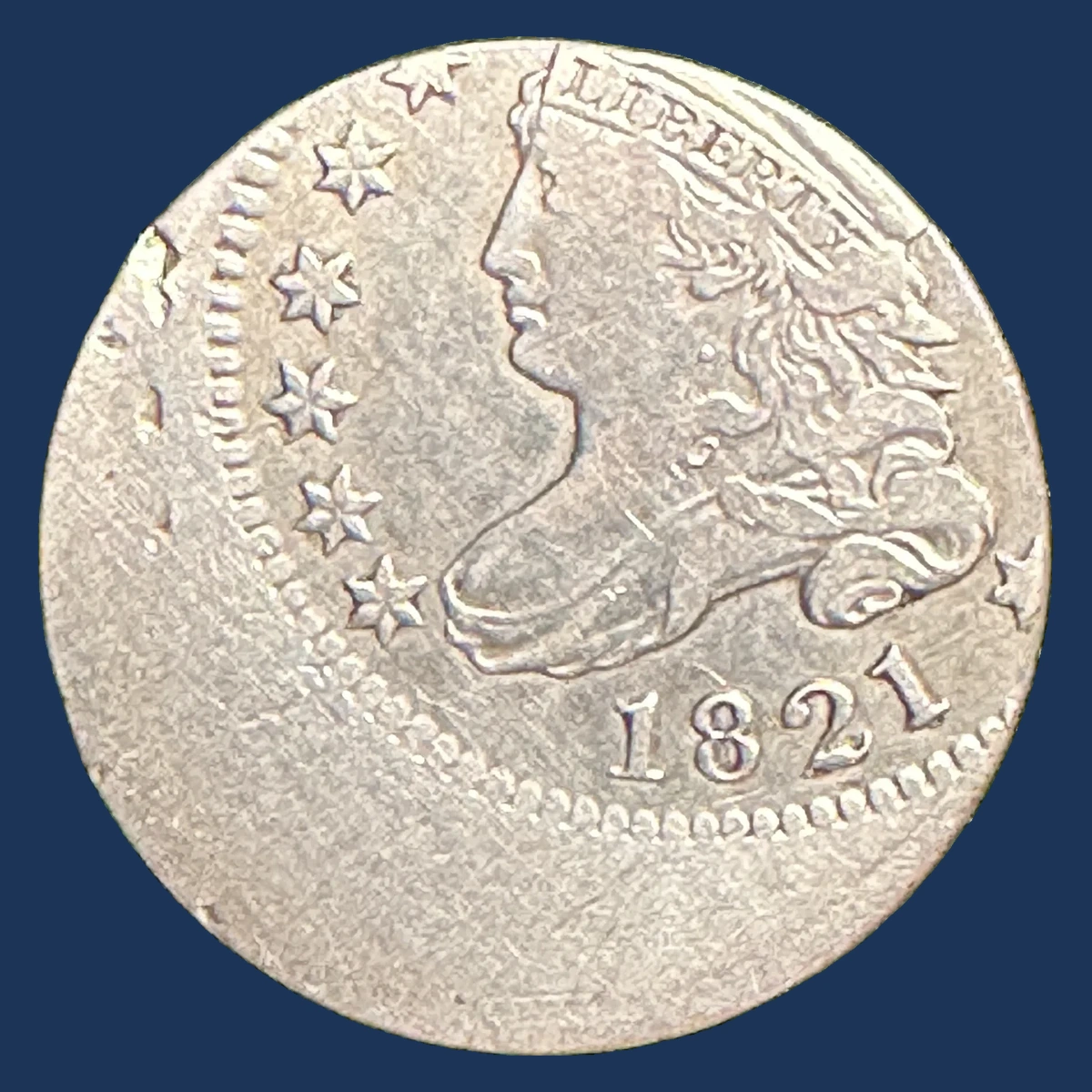
A plain crescent sits beside a picture that runs off the edge. The metal disc was not centered between the stamping tools, so only part of it received the design.
One collector reported an 1821 example without an exact percentage or direction of shift. A separate Large Date JR-4 auction coin was described as 30% off-center.
The 30% figure belongs to that second coin. It should not be applied to every 1821 dime with a similar plain area.
The missing design and remaining unstruck metal need to be considered together.
Estimated Value
An identifiable 1821 off-center dime has an estimated whole-coin range of $1,000–$6,000. The visible shift, readable date, and remaining detail affect the price.
The December 2022 Heritage record shows $2,640 for the 30% off-center Large Date JR-4. It was graded NGC XF Details, cleaned.
That is a same-year error sale, with its cleaning problem included. A minor centering difference deserves a lower comparison than a coin with a substantial unstruck crescent.
How to Identify
Compare both faces first. An off-center strike should displace both pictures; an uneven border on only one side may come from a single tool being out of position.
Check that enough of the date survives to read 1821. With a magnifier, inspect the boundary beside the plain crescent for natural striking detail rather than filing or hammer marks.
Use a scale against the normal 2.70 grams and calipers against the usual 19 mm size. An unusual strike can change the outline without removing metal.
Examine the remaining edge grooves. To recognize the likely error quickly, match the shifted pictures on both faces with the same intact, unstruck part of the disc.
5. 1821 Capped Bust Dime Reverse Die Clash (Estimated Up to $8,000)
Faint extra shapes can appear around the eagle’s head on a Small Date JR-9 dime. An NGC MS64 example was described with these back-side clash marks.
They began when the two steel stamping tools hit each other without a coin between them. The damaged tools then passed traces of the opposite picture onto later coins.
The marks can resemble an echo of the front design. They are different from intended eagle feathers or random scratches.
This example is a circulation coin of the Small Date variety, rather than a Large Date or special collector Proof.
Estimated Value
Estimate $100–$8,000 for whole Small Date dimes with clear back-side clash marks, from worn through well-preserved unworn examples. Much of the upper value comes from condition.
A JR-9 graded PCGS MS64+ CAC appeared at $7,200 in an August 2025 Stack’s Bowers sale. It offers a comparison for the same variety at a high grade.
It is not identified as the earlier NGC MS64 clash coin. The full price does not measure the extra marks alone.
How to Identify
Find the eagle’s head and compare the nearby flat background with the front-side portrait. Use a magnifier and changing light to look for parts of that opposite picture.
Normal feathers belong to the eagle’s design. A random crack forms a line, while a clash mark should match a shape transferred from the other stamping tool.
Check the Small Date circulation type, then use a scale and calipers against about 2.70 grams and 19 mm. Inspect the grooves around the edge for damage.
Later scratches can cross the area without belonging to the clash. Begin by matching an extra shape around the eagle’s head to the opposing front design.
Conclusion
Estimated whole-coin values for these 1821 dimes run from $80 to $8,000. Each feature needs its own check, from a raised star-area line to the blank crescent of an off-center strike.
Keep Small Date and Large Date examples separate, and do not turn an owner’s suggested explanation into a confirmed cause. Clear photographs, original surfaces, and similar condition make the price comparisons more useful.