1814 Dime Error List with Pictures

An 1814 dime with the words crowded into STATESOFAMERICA sold for $1,573 in June 2025. Its unusual lettering is only one of three features worth checking.
These 1814 Capped Bust dime errors have estimated whole-coin values from $200 to $5,000. Others involve a raised rim break or a picture struck off-center.
Read on to learn where to look, and why soft stars or one damaged letter do not establish an error.
1. 1814 Capped Bust Dime Reverse Rim Cud (Estimated Up to $2,000)
A raised patch above the final CA in AMERICA joins the back-side rim. It appears on later examples of the Small Date JR-1 variety.
This patch is called a cud. It forms when part of a die, the steel stamping tool, breaks away at its edge and coin metal fills the opening.
The Small Date issue often has weak stars and soft border details even without this break. Those features alone do not prove a cud.
The raised patch above CA is the feature to find after matching the date style.
Estimated Value
Estimate $200–$2,000 for worn Small Date JR-1 examples with a clear rim break. The price includes the whole dime, so condition and the visible break matter together.
A CAC-approved NGC VF35 Small Date coin sold for $840 in February 2022. VF35 describes a worn coin with much of its design still clear.
That sale was not identified as a matching cud example. It gives a same-variety starting comparison, rather than a price for the break itself.
How to Identify
Compare the 8 with the two 1s in the date. On a Small Date coin, the 8 does not rise far above them.
Turn to AMERICA on the back and use a magnifier above CA. Follow the raised patch into the rim, comparing it with the illustrated JR-1 variety.
Use a scale and calipers against about 2.70 grams and 19 mm, allowing for wear. This type contains about 89.2% silver; inspect its edge grooves for dents or filing.
Weak stars and soft border beads are common on this issue. For the quickest check, look directly above CA for a raised patch connected to the rim, not merely worn lettering.
2. 1814 Capped Bust Dime Bunched Reverse Lettering (Estimated Up to $3,000)
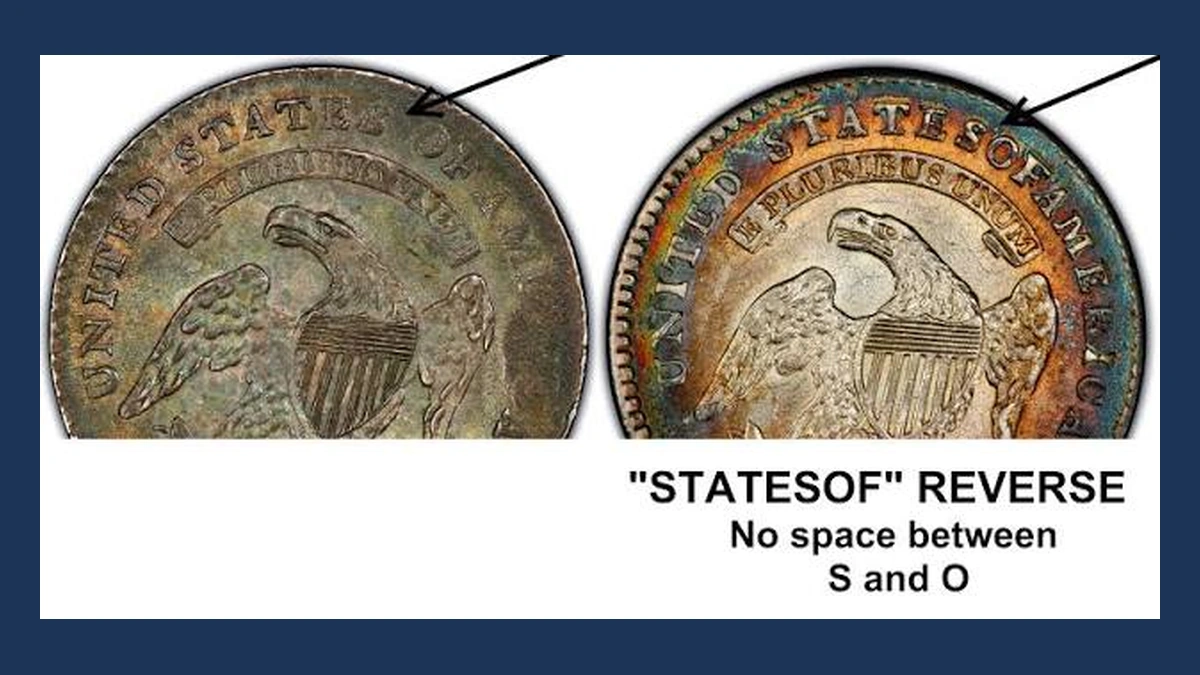
The words on the back nearly run together as STATESOFAMERICA. Their letters were placed too close together on the stamping tool, leaving unusually small spaces between the words.
The same arrangement repeats on coins made with that tool. It does not mean the coin moved sideways during the strike.
The problem is spacing, rather than missing letters or a second outline beside each stroke. Collectors recognize the complete arrangement as a distinct variety.
Wear can blur two nearby letters together, so one crowded-looking gap is not enough to identify this version.
Estimated Value
Worn examples have an estimated whole-coin range of $500–$3,000. CAC’s published comparisons include a VG08 at $744.70 in July 2023.
Two separate VF25 coins each brought $1,380 in April 2025. A VF30 sold for $1,573 in June 2025.
These grades describe circulated coins, with VF pieces retaining more detail than VG. Clear word spacing and original surfaces help the price; cleaning or damage can lower it even at a higher grade.
How to Identify
Read the entire back inscription before looking at single letters. Compare the gaps after STATES and OF with a normal example and a confirmed crowded-letter variety.
A 10× magnifier can show whether the letters occupy the same positions as the reference coin. Do not use worn letters that have blurred together as a substitute for matching the spacing.
Weigh the coin and measure its width with calipers. The normal figures are about 2.70 grams and 19 mm, with some weight loss possible from wear.
Check the grooves around the edge for damage. To recognize the variety quickly, compare both word gaps together rather than judging one narrow space.
3. 1814 Capped Bust Dime Off-Center Strike (Estimated Up to $5,000)
The picture runs beyond the coin’s edge, while part of the metal remains unstruck. A disc sitting off-center between the stamping tools can receive this incomplete design.
An 1814 JR-1 example was shown by a collector in 2007, including photographs of both faces and the edge. Its exact amount of shift is not established here.
Early dimes had their edge grooves prepared separately from the main strike. Grooves can therefore survive beside an unstruck area.
Their presence alone does not rule out an off-center strike on this early type.
Estimated Value
A genuine 1814 off-center dime has an estimated range of $800–$5,000. A clear date, visible shift, and good surfaces help support a higher price.
This is an estimate, not a recorded sale of the collector’s coin. No exact grade or realized price is assigned to that example.
The ordinary Small Date VF35 sale at $840 provides only a starting comparison for the underlying coin. A genuine off-center strike may add a substantial premium.
How to Identify
Study both faces before deciding which part of the picture missed the metal. A magnifier should show a natural boundary beside the plain area, without fresh cutting or hammer marks.
Check the edge all the way around. Its grooves were made separately on this early type, so they can remain beside a part that missed the stamping tools.
Use a scale against 2.70 grams and calipers against the normal 19 mm diameter. Then match the Small Date JR-1 features independently.
A rim dent can remove detail without leaving an original unstruck area. Start by finding cropped design and plain metal together on both faces, then compare their positions to confirm the shift.
Conclusion
The estimated $200–$5,000 range covers three different kinds of 1814 dime features. Check above CA for the rim break, compare both word gaps for STATESOFAMERICA, and examine both faces for an off-center strike.
The whole coin still matters. A readable date, undamaged surfaces, and clear details make useful price comparisons easier, while ordinary weak stars or one worn letter should not be mistaken for a separate error.