1936 Half Dollar Error List with Pictures

Wear did not stop one 1936 half dollar from selling for $15,000 at Stack’s Bowers in November 2019. The coin has a rare doubled design.
A doubled die is a coin-making tool that carries a repeated design. It can leave extra outlines on the coins it strikes.
The 1936 half dollar errors below have an estimated overall range of $85–$15,000. Read on to learn why the exact doubling pattern matters more than a coin’s shine.
1936 Walking Liberty Half Dollar Doubled Die Obverse Error (Up to $15,000)
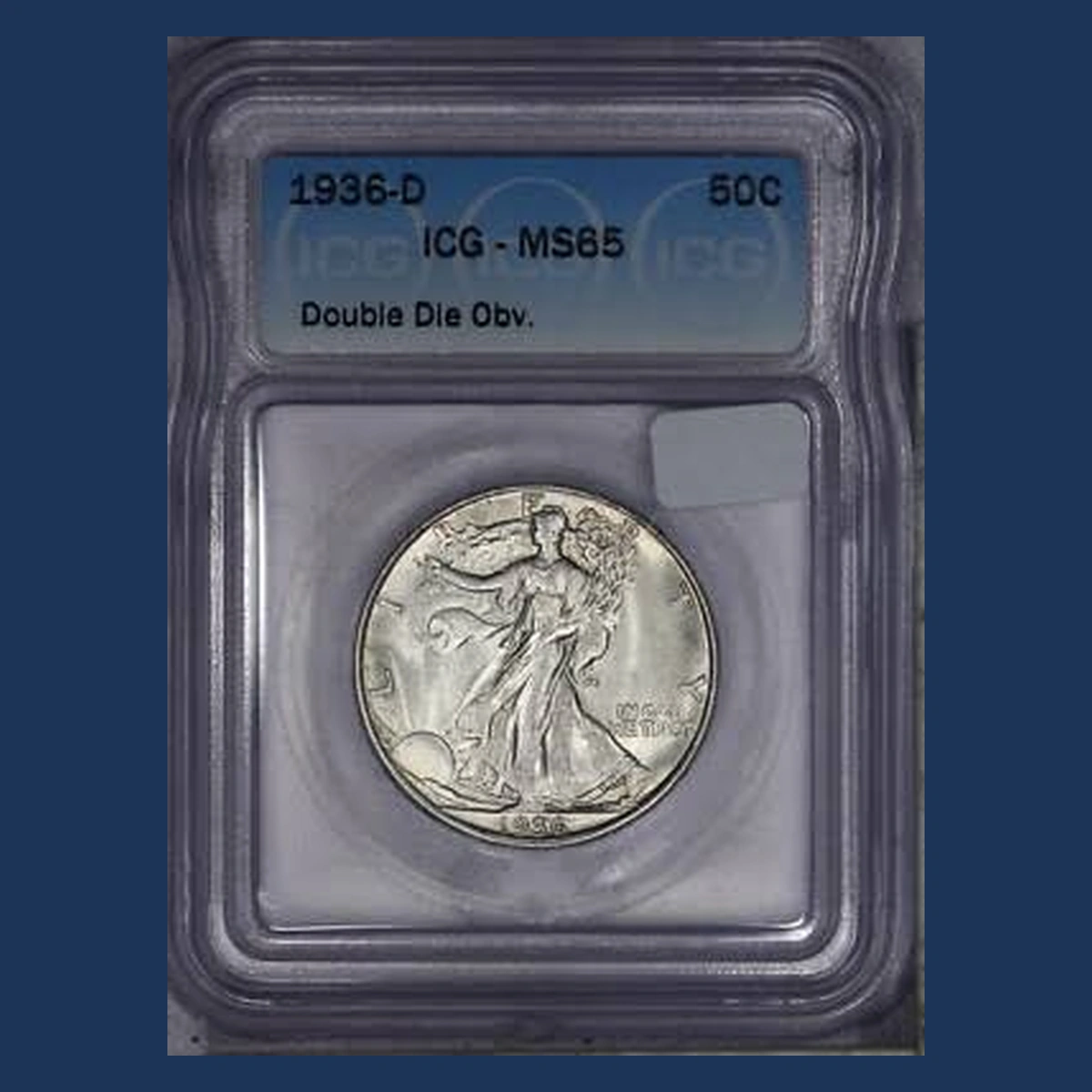
A second outline on the date or motto can be your first clue. Some 1936 halves also show doubling near Liberty’s lower skirt, shoes, or the ground.
The pattern depends on the variety. Philadelphia and Denver examples do not all show the same extra lines.
The doubling began while the die received its design, before it struck any coins. Coins made with that tool then picked up the repeated details.
It takes no second strike. A single thick-looking letter, however, is not enough to match a coin to one of the valuable varieties.
Estimated Value
The rarer FS-101 variety reached $15,000 in a November 2019 sale, despite its worn VG10 grade. FS-101 is the catalog label for that particular doubling pattern.
Philadelphia FS-102 examples have an estimated $85–$4,000 range. A much better-preserved PCGS MS67+ CAC example sold for $3,862.12 in April 2024.
Together, these different varieties span $85–$15,000. A higher grade does not automatically mean a higher price when the doubling patterns differ.
How to Identify
Find the mint first. Philadelphia coins have no mintmark, while Denver coins have a D on the back.
Choose a matching reference photo and examine the date and IN GOD WE TRUST with a 10× magnifier. Check the lower skirt, shoes, and ground wherever that reference shows doubling.
The extra lines should agree with one variety. Combining features from different reference coins will not identify your example.
A flat, shelf-like edge may come from movement during striking instead. Change the light to separate raised lines from scratches or reflections.
When safely accessible, check the coin with a digital scale and calipers against 12.50 grams and 30.6 millimeters. Its edge should have grooves; the clearest confirmation is a matching pattern on a coin from the correct mint.
Conclusion
For 1936 halves, the right pattern can outweigh condition: the worn FS-101 brought $15,000, while a much finer FS-102 sold for $3,862.12. Those are different varieties, not competing grades of one error.
The overall estimated range is $85–$15,000. Start with the mintmark, then compare the doubled details with a clear reference before using either sale to price your coin.