1953 Half Dollar Error List with Pictures

A dime-sized piece of silver received a half-dollar design—and still kept its 1953 date and D mint letter. That unusual coin brought approximately $6,612 in an August 2011 auction.
Other 1953 half dollar errors are less dramatic: peeling metal, a second mint letter, or small ‘teeth’ at Franklin’s lip. Estimated ranges across the examples below run from $40 to $8,000.
Read on to compare seven types and see why the mint letter and collector finish matter alongside the visible feature.
1. 1953 Franklin Half Dollar Lamination (Estimated Up to $175)
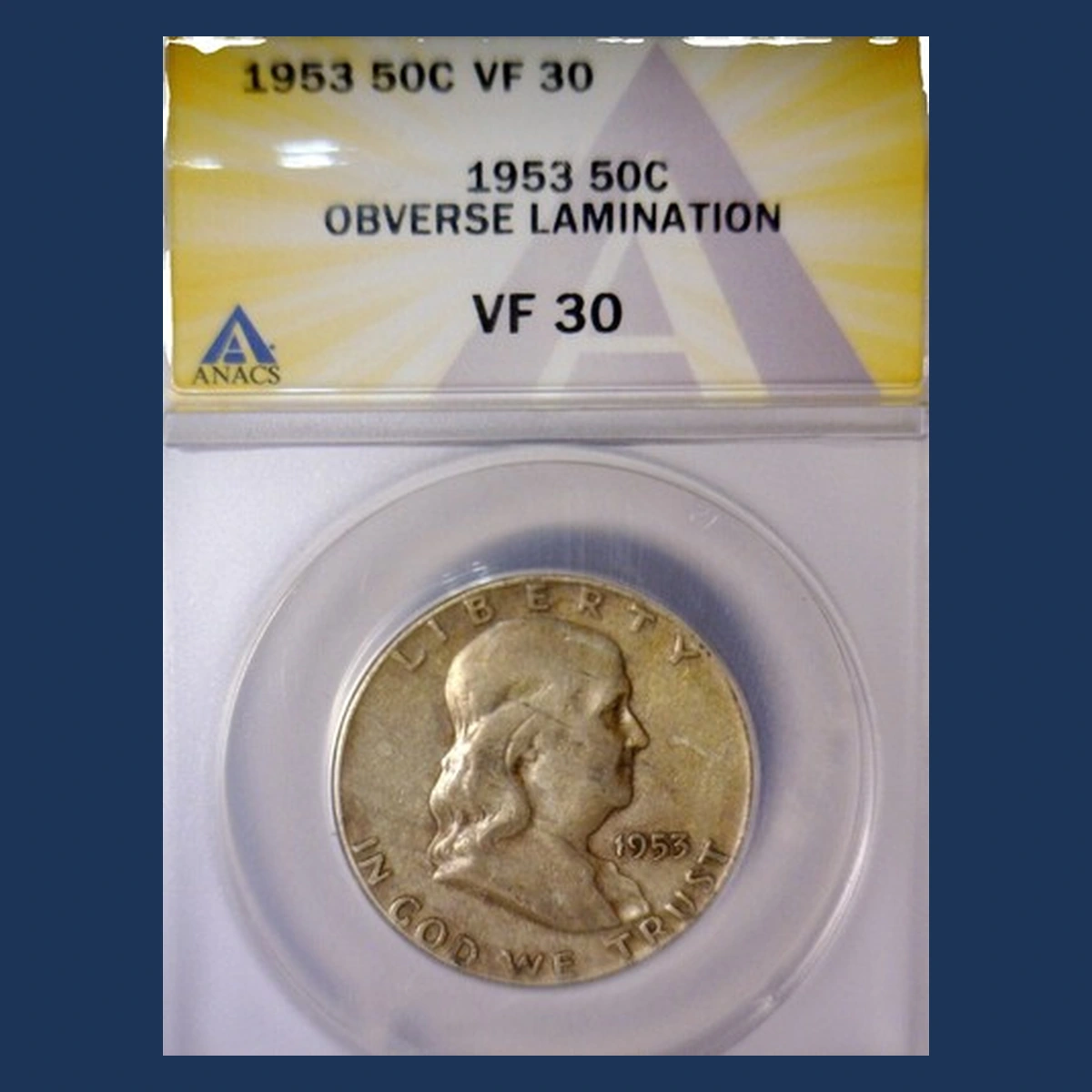
A thin sheet of metal may peel away from a 1953-S half dollar. This local separation is called lamination; it does not mean the entire coin has split into two discs.
A weak bond within the silver mixture allows a layer to lift or fall off. An attached flake and the shallow hollow it leaves behind are two stages of the same problem.
The year reports do not locate the flaw at a particular clock position. Its position should not be assumed.
The physical layer is the clue. Dark color or roughness alone can have many other causes.
Estimated Value
An estimated $50–$175 covers small laminations on worn through ordinary unworn 1953-S coins. The year guide reports minor graded examples around $52–$55, but those figures do not establish a sale of the specific San Francisco report.
A larger attached layer with attractive surrounding detail can support more interest. Missing metal caused by scraping or corrosion is different and does not earn the same added value simply because the surface looks rough.
How to Identify
Find S above the bell and inspect the grooves around the edge. When safely accessible, compare a digital scale and calipers with the normal 12.50 grams and approximately 30.6 millimeters.
A lost flake can reduce weight. Keep any loose metal untouched so its original shape remains available for examination.
With a 10× magnifier and low light, trace the boundary of the affected area. Look for a lifted margin, thin sheet, or shallow separation following the metal’s layers.
Deep pits suggest corrosion, while straight cutting tracks may show scraping. A visible peeling layer or its distinct boundary supports lamination more directly than a brown patch or a gouge through solid silver.
2. 1953-D Franklin Half Dollar Clipped Planchet (Estimated Up to $250)
A substantial section is missing from the reported 1953-D. Collector Sean Reynolds estimated that it lost about 15–20% of its blank, the metal disc before stamping.
The missing part was already absent when the design was applied. This is called a clipped planchet; planchet is another name for the blank.
Its incomplete outline can affect how the nearby rim and design form. The report does not give a specific direction or a definite outline for the gap.
A 1951-S shown in the same discussion has a larger straight clip. That separate coin should not determine how this 1953-D is described.
Estimated Value
For a substantial original clip with a readable date, estimate $75–$250 across worn and ordinary unworn conditions. A year guide reports $66 for a different unusual Denver clip without stating its percentage.
That comparison is not the owner’s 15–20% example. The larger gap may have stronger visual appeal, but the exact shape, readable mint letter, and surrounding surfaces matter more than assigning a fixed price to each percent of missing metal.
How to Identify
Examine both ends of the gap with a 10× magnifier. The stamped design should fit an incomplete blank, rather than stop at a freshly sawn or filed wall.
Check the opposite rim for weakness that may support the clip explanation. That clue is useful but cannot establish authenticity by itself.
Record the full 1953 date and D above the bell. A digital scale should show a clear loss from 12.50 grams for a gap of the reported size, when safely accessible.
Calipers may still read about 30.6 millimeters across an intact part. Original-looking gap surfaces, naturally interrupted edge grooves, and a compatible weight loss together support a clip made before stamping.
3. 1953 Franklin Half Dollar Strike-Through (Estimated Up to $350)
A groove with tiny fiber marks may record something caught during stamping. A collector reports that appearance on a 1953-D, while a listed NGC MS65 1953-S has a front-side strike-through without a named object.
A strike-through occurs when material blocks the die, the steel tool that stamps coins. It can leave an impression in the forming surface.
A separate seller lists a 1953 thread example graded ANACS PR66. This is a Proof, specially made for collectors, and belongs to Philadelphia.
Do not assume all three involved string. Their mint, finish, and reported details remain separate.
Estimated Value
Estimated ranges are $50–$250 for distinct everyday-issue examples and $175–$350 for a comparable collector Proof with a thread impression. The year guide gives about $215 for a prominent MS65 and reports a $225 PR66 comparison.
Those figures do not establish sales of the Denver or San Francisco coins described here. Clear texture, the size of the interruption, and surrounding surface quality affect value.
Reflective Proof surfaces can make a small mark more noticeable.
How to Identify
Decide whether the coin is a regular issue or a collector Proof before comparing its mark. Both normally contain 90% silver, weigh 12.50 grams, and measure about 30.6 millimeters across.
Use a digital scale and calipers when safely accessible, and inspect the edge grooves. Then examine the affected area with a 10× magnifier.
For Denver, look for the reported fiber texture without assuming every line came from string. For San Francisco, compare the front-side mark with that particular coin’s photographs.
A later scratch cuts completed detail and may leave sharp raised lips. A recess shaped by an object while the design was forming is the useful distinction for a strike-through.
4. 1953 Franklin Half Dollar Bugs Bunny and Other Die Clashes (Estimated Up to $400)
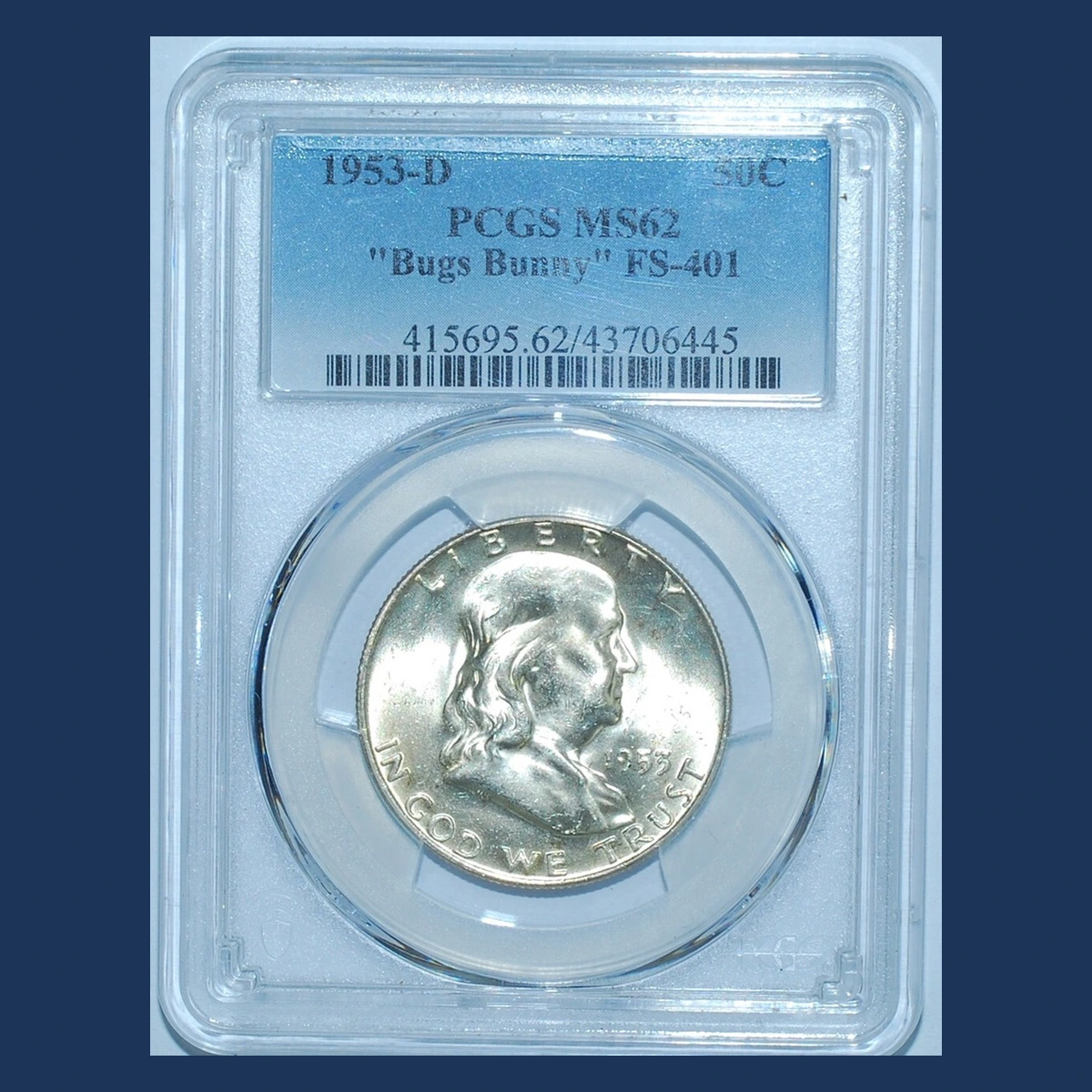
Franklin seems to have extra teeth on some examples. The Bugs Bunny nickname refers to small raised projections at his upper lip.
They can form after the two dies hit each other with no blank between them. Part of the back design marks the front die, and later coins pick up that extra shape.
This is a die clash. Other faint front-side traces may come from the same process without producing obvious teeth.
Reports include Philadelphia, Denver, and San Francisco. Each needs its own photo comparison; every mark near Franklin’s mouth is not automatically the same recognized pattern.
Estimated Value
Allow an estimated $40–$400 for a recognizable clash on worn or ordinary unworn coins. A 1953-D described as SEGS MS65+ recorded $325 at a Key Date Coins auction in August 2025.
Keep that grading service with the comparison rather than treating it as a different company’s grade. Sharp bell lines and overall preservation can affect demand, while a bright spot on the lip or a nickname alone establishes neither the variety nor its value.
How to Identify
Look at the whole mouth before enlarging the upper lip. Raised toothlike detail should fit a known example from the same mint, rather than a scratch, dent, or attached speck.
Check above the bell for the mint letter; Philadelphia regular issues have none. Inspect the edge grooves and measure accessible coins with a digital scale and calipers against 12.50 grams and about 30.6 millimeters.
Now compare the mouth through a 10× magnifier with the appropriate photographs and opposite design. Other related marks may help, but unrelated lines should not be joined into an invented pattern.
The original raised tooth shape matching that mint’s documented clash is the focused check for Bugs Bunny. Overall mouth thickness is less useful.
5. 1953 Franklin Half Dollar Repunched Mintmark (Estimated Up to $500)
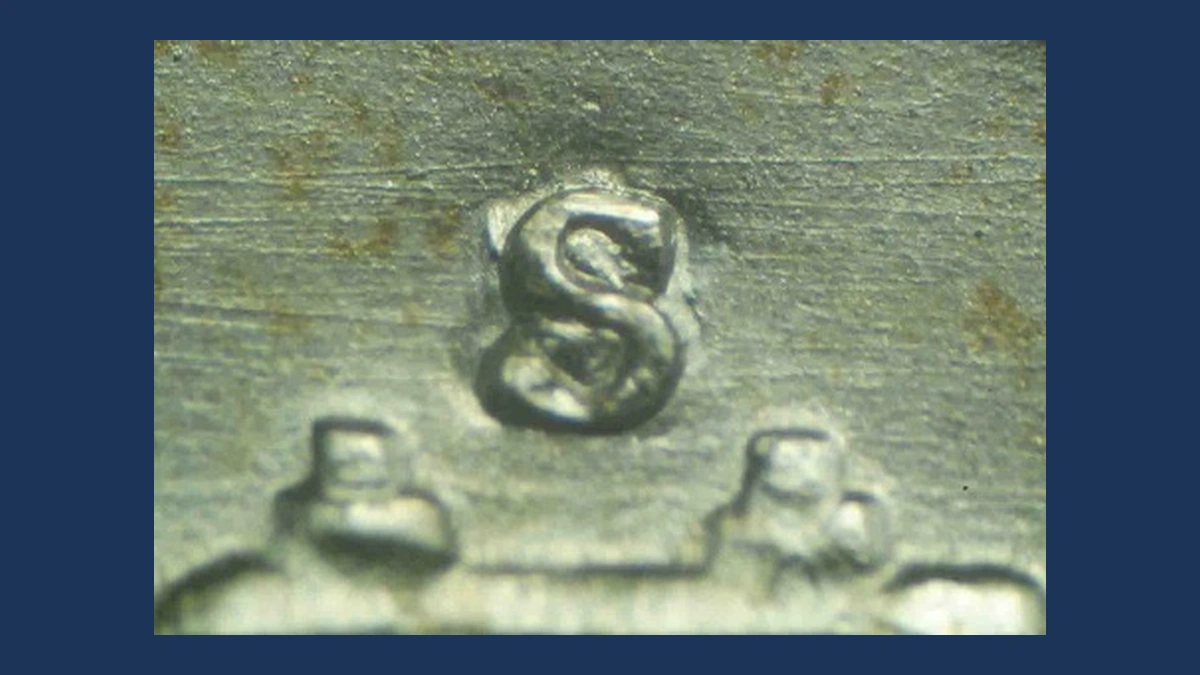
A small second letter can sit beside the mintmark above the bell. Mint workers punched that letter into the die separately, and an earlier position could remain visible after another blow.
Collectors call this a repunched mintmark. The extra shape should preserve part of the same letter, rather than look like a random bump.
Wexler’s reference identifies a 1953-S with an extra S above and to the left. A year guide separately reports a 1953-D with extra D detail below.
Those directions belong to different mint letters. One should not be used to identify the other.
Estimated Value
An estimated $75–$500 covers clearly identified unworn examples below exceptional condition levels. A 1953-S graded PCGS MS65 was offered at $154.99 in the year guide; that is an asking price, not an auction result.
No separate Denver sale is used here, so its bracket is based on comparison. Clear extra letter shapes and original surfaces matter.
Simply finding an S or D above the bell does not make the coin an error.
How to Identify
Inspect the whole mint letter above the bell’s wooden support through a 10× magnifier. For San Francisco, compare the extra curve above and left of the main S with the specialist reference.
The Denver report instead calls for an extra part of D below the final letter. A flat ledge or scratch touching the mintmark does not reproduce an earlier letter’s outline.
Include the date with the back photograph. Check the edge grooves and use a digital scale and calipers on accessible coins against 12.50 grams and approximately 30.6 millimeters.
A recognizable second letter in the correct relative position gives the useful match: upper-left for the referenced S, or below for the reported D.
6. 1953 Franklin Half Dollar Proof Re-Engraved Wing (Estimated Up to $600)
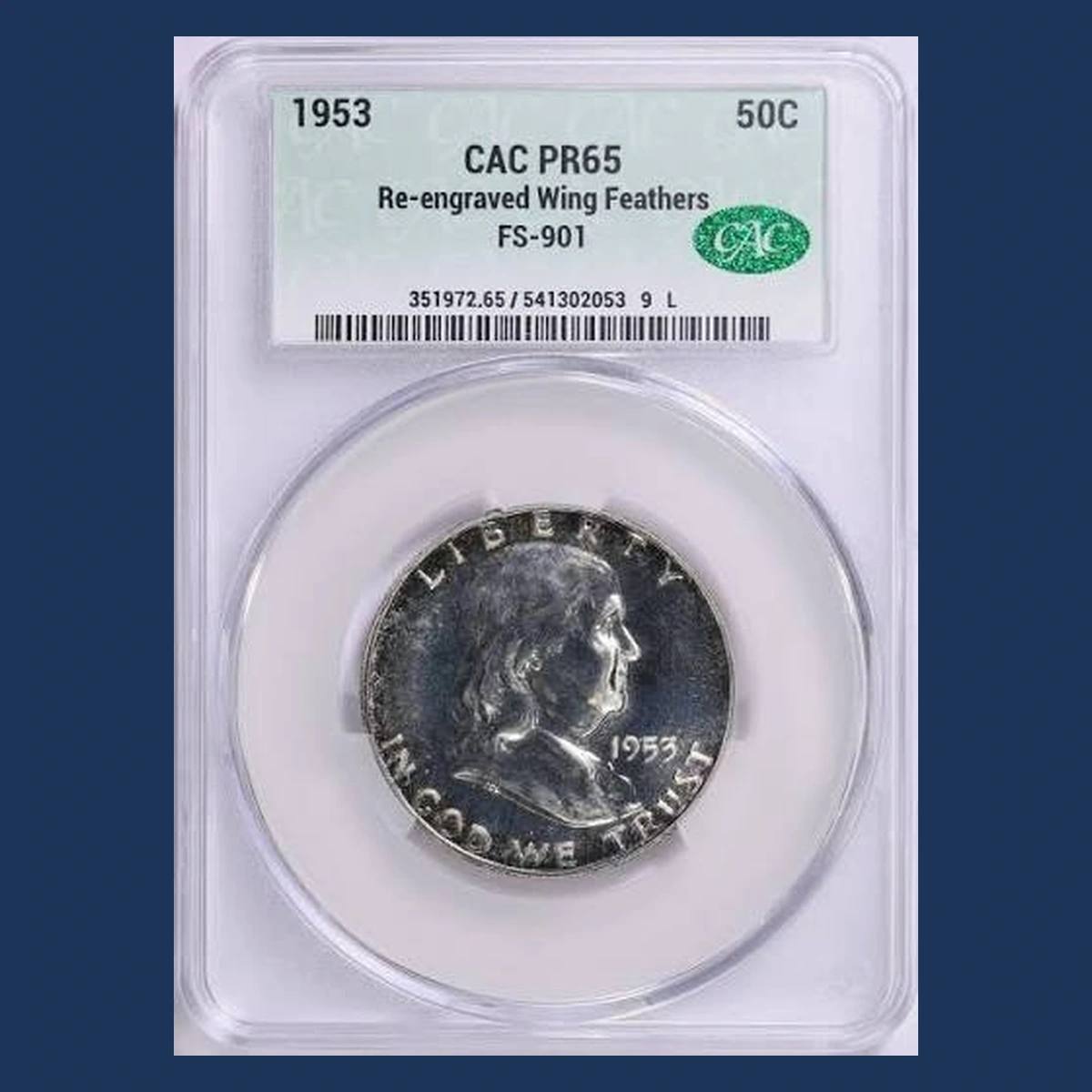
The small eagle’s feathers look unusually coarse on this collector Proof. Polishing had weakened detail in the die, and hand work restored lines on the eagle’s left wing, seen on the viewer’s right.
The new strokes look straighter than the normal flowing feathers. Coins stamped from that repaired die carry them as raised parts of the original design.
PCGS recognizes the Re-Engraved Wing variety. That name describes work on the tool, not someone scratching lines into a finished coin.
It concerns the Franklin half dollar’s small eagle. Similar-sounding feather varieties on Washington quarters are different.
Estimated Value
For confirmed Proofs around PR65–PR66, estimate $250–$600. The year guide reports dealer offers of $330–$425 for PR66 examples, while the PCGS variety page gives no auction record.
These are asking-price comparisons. Clear repaired feathers, mirrored surface quality, and fine scratches affect appeal.
Strong contrast between frosted designs and reflective backgrounds needs its own comparison. The variety’s name does not guarantee that special appearance.
How to Identify
Set the bell upright and find the small eagle to its right. Within that eagle, examine the wing on the viewer’s right with a 10× magnifier.
Confirm a Philadelphia collector Proof with no mint letter. Accessible examples can be checked with a digital scale and calipers against 12.50 grams and about 30.6 millimeters, with grooves around the edge.
Compare the feathers with a normal 1953 Proof under several light angles. Original restored lines rise with the design, while later engraving cuts down into the coin and may push up sharp edges.
The coarse, straighter restored feather pattern on the correct wing identifies the variety. General roughness elsewhere on the eagle does not.
7. 1953-D Franklin Half Dollar on a Dime Planchet (Estimated Up to $8,000)
The metal was meant for a dime, but the press stamped it with Franklin and the Liberty Bell. Stack’s Bowers cataloged this 1953-D error in August 2011, weighing 2.5 grams and graded NGC MS63.
The date and D remained readable. Much of the outer half-dollar design could not fit on the smaller blank.
This differs from cutting down a finished half dollar. The original silver disc was already the wrong size when it entered the press.
The catalog describes a dime blank, not a finished dime. There is no claim that an earlier dime design remains underneath.
Estimated Value
An authenticated example comparable to the cataloged MS63 has an estimated $5,000–$8,000 range. Greysheet records approximately $6,612 for the August 2011 Stack’s Bowers coin.
That is a historical whole-coin result, not a current fixed price. Its readable date, D mint letter, and confirmed dime blank make the comparison useful.
A trimmed half dollar does not qualify just because it is small. Different condition or missing date detail also affects value.
How to Identify
Begin with a digital scale when the coin is safely accessible. The documented piece weighs 2.5 grams, matching a silver dime instead of the half dollar’s 12.50 grams.
Both normal coins contain 90% silver, so color is no help here. Use calipers to compare with a 17.9-millimeter dime and a roughly 30.6-millimeter half dollar, allowing for expansion during stamping.
With a 10× magnifier, inspect the edge for cutting or machining. A genuine wrong blank may not have normal half-dollar edge grooves.
Record the readable 1953 and D. A 2.5-gram weight, naturally formed edge, and half-dollar design running beyond the available metal together support the dime-blank identification.
Conclusion
A peeling layer, a clipped edge, and a dime blank all involve metal, but they leave very different clues. The mouth projections and repaired feathers instead reflect changes to the stamping tools.
Estimated values range from $40 to $8,000. Keep the mint and finish attached to each comparison, especially the separate Denver, San Francisco, and Philadelphia strike-through reports; sharing an error type does not make them the same coin.