1954 Half Dollar Error List with Pictures

A superb 1954 Bugs Bunny half dollar sold for $9,600 in 2020. Its nickname comes from a small toothlike mark at Franklin’s mouth.
Other 1954 half dollar errors are much more dramatic, including coins with a sunken, backward portrait on the back. Estimated values below stretch from $50 to $12,000.
Read on to compare the visible marks, learn how they formed, and see why condition can matter as much as the error.
1. 1954-D Half Dollar Reverse Lamination (Estimated Up to $300)
A thin layer of silver has separated on the back of a known 1954-D half dollar. Harbor Coin offered the example graded PCGS AU58, meaning nearly unworn.
This peeling is called a lamination. A weak bond within the silver-and-copper mixture lets a layer lift or break away.
The damage may interrupt the bell or the flat area around it, depending on its position. The dealer’s description does not give an exact spot.
A small peeling area does not mean the whole coin split in two. That would be a much larger separation through the metal.
Estimated Value
Estimate $50–$300 for a modest original lamination on a nearly unworn or ordinary unworn Franklin half. Harbor Coin’s listing identifies the 1954-D AU58, but no sale amount is used here.
A different 1957 coin brought $74.49 including the buyer’s fee in January 2021. NGC graded it MS63, with peeling on the front.
That sale helps compare a small error. A clear layer and attractive overall surfaces can add appeal.
How to Identify
Leave any loose silver in place. Do not probe beneath it or try to show how far it lifts.
Through a 10× magnifier, move light across the peeling area on the back. Look for depth at its boundary, rather than the smooth surface of a scrape.
Check the D above the bell and the 1954 date on the front. Inspect the edge grooves for a related split.
A safely accessible coin should measure near 30.6 millimeters with calipers and weigh near the original 12.50 grams on a scale. A tiny lost layer may barely change either reading; look for an uneven layer lifting from within the silver.
2. 1954 Half Dollar Curved Clip (Estimated Up to $400)
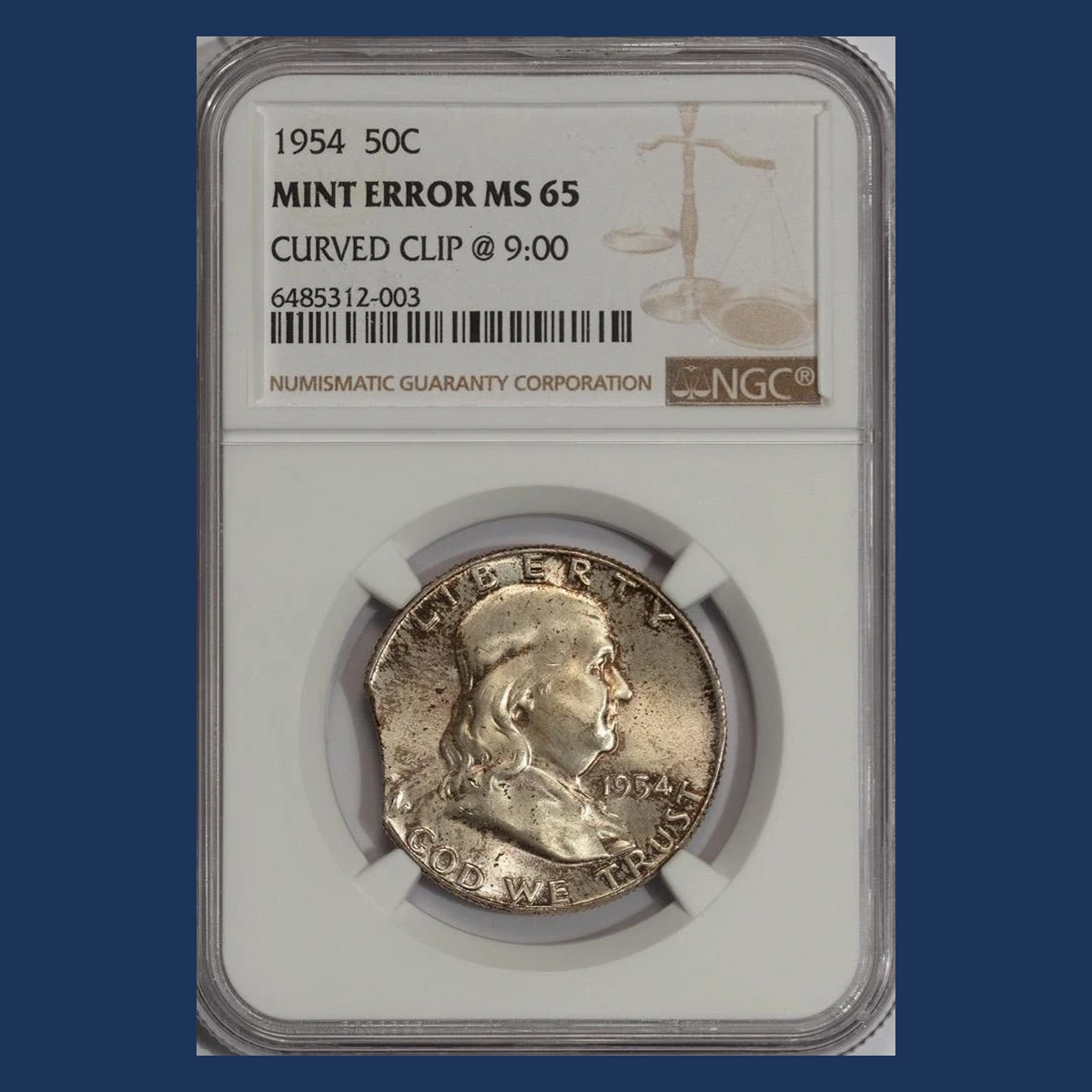
A curved piece can be missing before a coin is stamped. This happens when the punch cutting metal discs overlaps a hole already left in the strip.
The incomplete disc then receives the coin’s design. Its edge keeps the curved gap.
A 1954 year guide reports this error without naming a mint, finish, or exact position on a certified example. It does not establish straight clips or several gaps on one coin.
The shape alone is not proof. Someone can cut a similar notch into a finished coin, so the nearby rim and the gap’s surface both matter.
Estimated Value
Estimate $75–$400 for a genuine modest clip on a worn to ordinary unworn half dollar. A different-year 1962-D graded PCGS MS61 brought $84 in March 2011.
That coin had a four-percent clip. It offers a Franklin comparison near the lower end of the range.
A larger visible gap and better condition may bring more. The estimate does not turn that 1962 sale into a recorded price for a 1954 coin.
How to Identify
Check the two places where the curved gap meets the normal rim. Under a 10× magnifier, look for details that formed around an existing space.
A cut made later can leave sharp tool marks or slice abruptly through the finished design. Weakness on the opposite rim can support a genuine clip, but it need not appear on every coin.
Use a scale to compare weight with the original 12.50 grams. Calipers across intact sections should be near the normal 30.6 millimeters.
Photograph the mintmark area and the interrupted edge grooves. Follow the silver into the curved boundary, checking for smooth spreading during stamping rather than a freshly cut surface.
3. 1954 Half Dollar Reverse Struck Through (Estimated Up to $500)
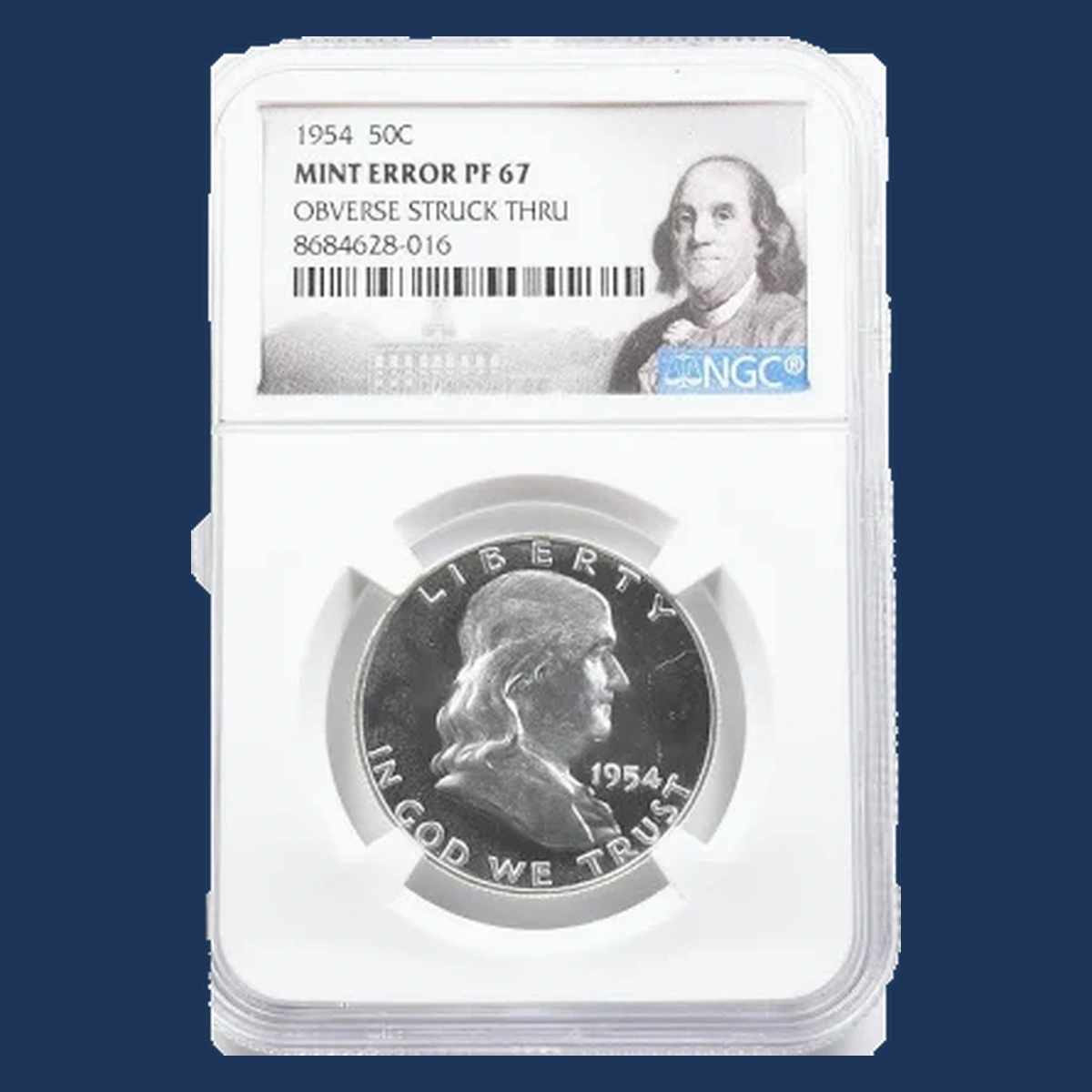
An unwanted object can leave a hollow where part of the bell’s design should appear. Collectors call this a strike-through.
The object sat between the blank and a die, the steel tool that stamps the design. It blocked some detail or pressed its own shape into the silver.
The 1954 report names the back of the coin but gives no exact location or material. It does not establish wire, cloth, or grease as the cause.
Also check the normal picture. The crack drawn in the Liberty Bell belongs to the design and is not an error.
Estimated Value
Allow an estimated $75–$500 for a genuine, visible strike-through on an ordinary collectible 1954 half. Greysheet reports a 1951-S NGC MS64 with a front-side strike-through at $134 in April 2026.
That comparison changes both the year and the affected face. It is not a 1954 sale.
A recognizable object shape may appeal more than a small vague hollow. An object still attached to the coin would need its own closer price comparison.
How to Identify
A small strike-through usually leaves the coin’s size and weight unchanged. When safely accessible, check with calipers and a scale against about 30.6 millimeters and 12.50 grams.
Inspect the edge grooves and identify the mintmark and finish. Then photograph the affected area on the back under several lighting angles.
Look through a 10× magnifier where the hollow meets the normal design. A later impact can push silver into a raised lip around the damage.
A generally weak strike can also soften the bell without leaving an object’s outline. Look for missing detail inside a distinct depressed area, without tool cuts or metal pushed up around it.
4. 1954-S Half Dollar Reported Repunched Mintmark (Estimated Up to $750)
A second piece of an S can appear beside the mintmark above the bell. Workers entered the mintmark into the stamping tool with a hand punch.
If they struck the punch again in a slightly different place, part of the earlier letter could remain. Coins would then show the extra raised curve.
A collector describes a PCGS MS65 1954-S as having this feature. MS65 is an unworn grade; it does not itself confirm the extra mintmark.
The report gives no direction for the earlier S. The coin’s actual letter shape needs comparison before calling the mintmark repunched.
Estimated Value
Estimate $75–$750 for a confirmed 1954-S repunched mintmark on a worn to ordinary unworn coin. No sale of the owner’s MS65 is used here.
PCGS records a recognized 1952-S FS-501 variety graded MS65 at $590 in May 2021. That is a different-year sale with a clear extra S.
The 1954 estimate depends on its own visible extra letter and condition. The older variety’s price does not confirm the owner’s identification.
How to Identify
Find the S above the bell’s wooden support. Under a 10× magnifier, follow any extra curve and ask whether it forms part of another S.
A shapeless bump or flat shelf beside the letter is not enough. Compare a normal 1954-S with clear photographs of the proposed repunched variety.
Do not borrow the extra letter’s direction from a 1952 example. If the coin is graded, photograph the holder wording rather than assuming the grade confirms the error.
Check the edge grooves, and use a scale and calipers when safely accessible against 12.50 grams and about 30.6 millimeters. Look for a separate rounded stroke that fits an earlier S impression.
5. 1954 Half Dollar Reported Planchet Crack with Brockage (Estimated Up to $1,500)
An opening through the silver is different from a raised line on its surface. A planchet crack means the metal blank itself was split.
A 1954 year list describes an “extreme brockage crack.” Brockage means a struck coin pressed a sunken, backward picture into another coin during minting.
The wording suggests both features, but it does not identify a specific example or show the crack’s route. Each feature needs its own visible evidence.
The cent-sized and dime-sized brockages discussed below are separate examples. Their backward pictures do not establish that either coin also has a split through its metal.
Estimated Value
A genuine mint-made opening in a normal silver Franklin half is estimated at $100–$600. With a genuine partial brockage, the combined estimate is $500–$1,500.
A related 1952-D AU53 clamshell error had a $599 asking price. A clamshell is a hinged separation inside the metal, not the same as a through-crack.
That offer was not a completed sale. The combined range applies to the actual opening and backward image together, not the name alone.
How to Identify
Examine the alleged backward picture separately from the crack. Through a 10× magnifier, it should be sunken into the surface and recognizable as a mirrored design.
Pressing coins together after minting can imitate this effect. Check for flattened surfaces and damaged rims.
Now inspect the opening from both faces and the edge. A raised ridge or shallow scratch is not a split through the coin.
For a normal silver-half blank, compare scale and caliper readings with 12.50 grams and 30.6 millimeters, allowing for missing metal. Follow the edge grooves into the split; look for a natural opening without saw cuts, alongside a separate sunken, backward picture.
6. 1954 Half Dollar Proof Doubled Die Obverse (Up to $7,950 Reported)
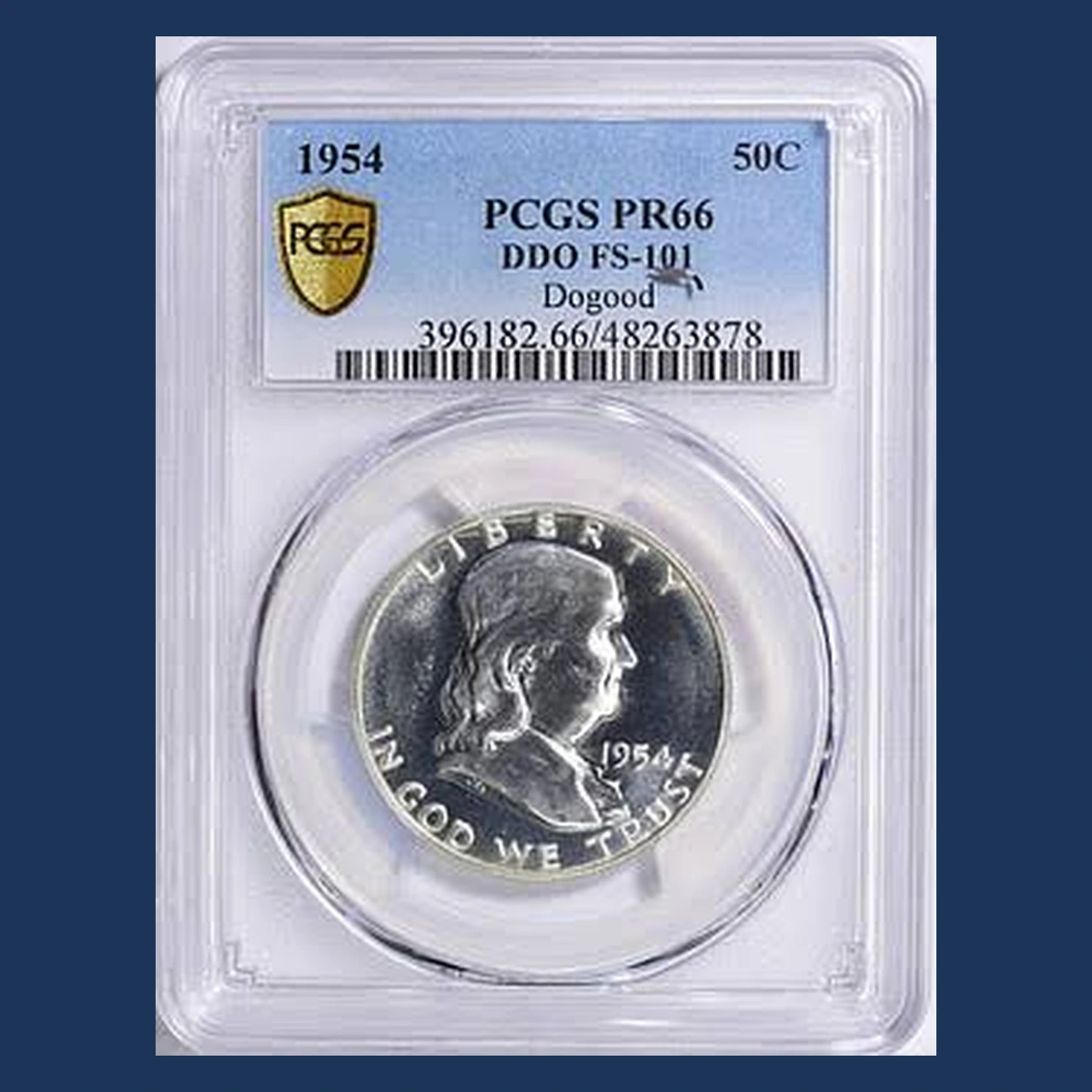
Extra outlines in the front lettering can appear on the recognized 1954 FS-101 variety. It is a Proof, a coin specially made for collectors.
The doubling began in the steel stamping tool before it touched the coin. It is not just a bright reflection from the smooth surface.
PCGS lists this half-dollar variety, and GreatCollections offered an example graded Proof 64. Examine LIBERTY and IN GOD WE TRUST against clear photographs of the variety.
Use photographs of the 1954 Franklin Proof variety. Similar labels on other coins do not show where its outlines should appear or establish the same pattern.
Estimated Value
Greysheet lists $400–$960 across its quoted grades for this Proof variety. PCGS also records $7,950 in April 2022 for an NGC PF67 eBay Best Offer entry.
That is a reported marketplace figure, not a verified major-auction result. It does not promise the same price for every high-grade coin.
The GreatCollections Proof 64 listing has no public sale amount used here. Visible doubling, surface marks, and overall appearance affect the comparison.
How to Identify
Leave a graded Proof in its sealed holder. Use a 10× magnifier across LIBERTY and IN GOD WE TRUST while moving the lamp.
A reflection moves with the light. A raised extra outline stays in the same place on the letter.
Compare photographs of the recognized 1954 Proof variety, checking the full date and finish. Flat shelves beside letters can come from movement during stamping rather than a doubled tool.
When safely accessible, check the edge grooves and compare scale and caliper readings with 12.50 grams and about 30.6 millimeters. Find extra raised outlines that remain under changing light and match the same letters in the variety photographs.
7. 1954 Half Dollar Bugs Bunny and Other Die Clashes (Up to $9,600)
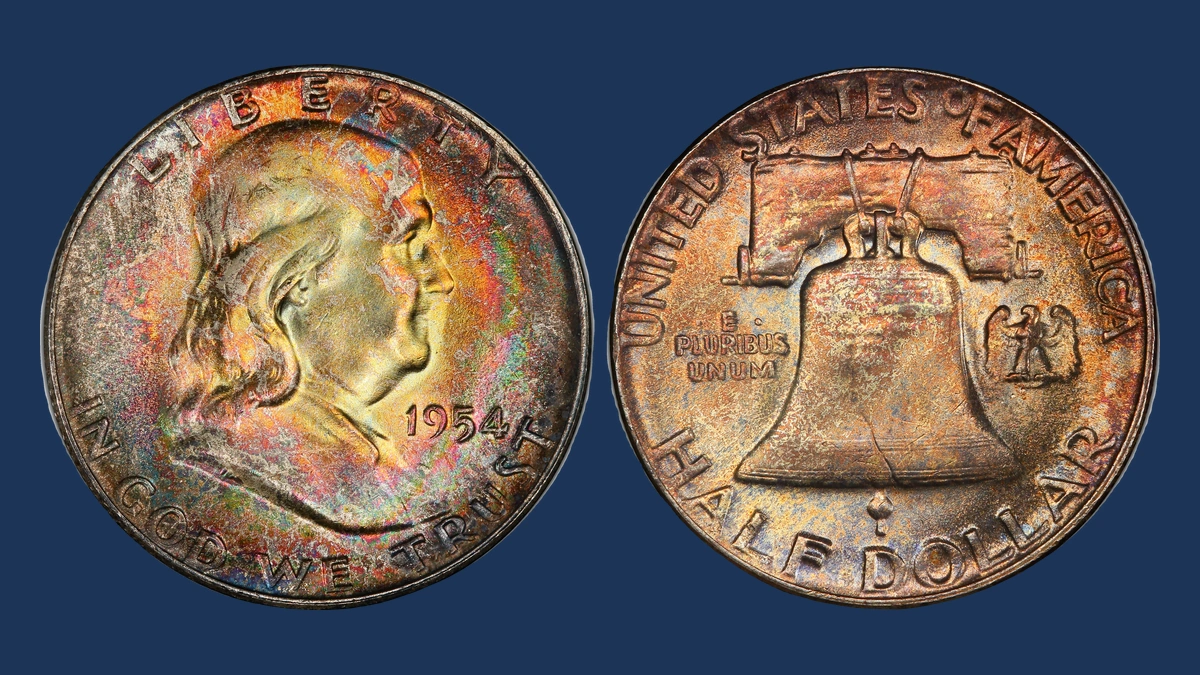
Franklin can seem to have a small tooth sticking out at his lips. Collectors call this the Bugs Bunny variety.
The mark began when the two steel stamping tools hit without a blank between them. Part of the eagle’s wing left an impression on the tool showing Franklin.
Later coins received that extra shape near his mouth. Examples are known from both Philadelphia and Denver.
Another Philadelphia variety has different extra outlines on the front. Full Bell Lines, or FBL, means sharp, complete lines at the bell’s base; it describes strike quality, not another error.
Estimated Value
An exceptional Philadelphia MS67 FBL Bugs Bunny brought $9,600 at Heritage in October 2020. A separate MS67 without FBL sold for $3,600 in August 2021.
Estimate $50–$750 for ordinary collectible examples. Superior graded coins may reach $750–$9,600.
The highest auction record belongs to a superb whole coin. Its price reflects outstanding condition and sharp bell lines, rather than a fixed amount paid for the tiny mouth projection.
How to Identify
Identify the mint before comparing close-ups. Philadelphia has no mintmark, while Denver has a D above the bell on the back.
The normal coin contains 90% silver and has grooves around its edge. When safely accessible, a scale and calipers should show about 12.50 grams before wear and 30.6 millimeters across.
Use a 10× magnifier at Franklin’s mouth and compare a recognized example from the same mint. Check nearby surfaces and the rim for damage that might have pushed silver toward his lips.
Other clash varieties need their own photographs. For Bugs Bunny, look for the same small raised toothlike shape extending from the mouth, rather than an arbitrary lump.
8. 1954 Half Dollar Wrong Planchet Errors (Estimated Up to $12,000)
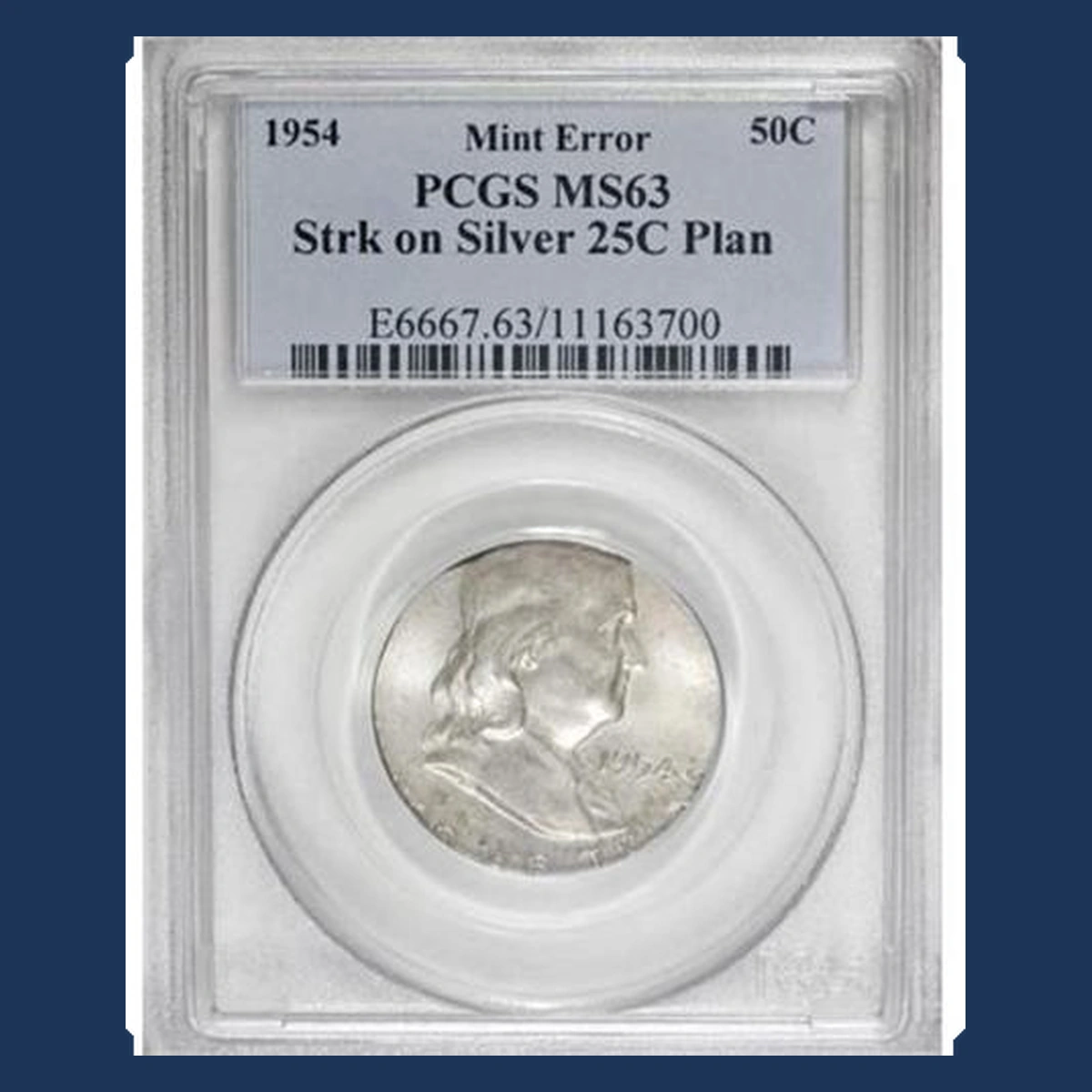
A half-dollar picture can be too large for the metal beneath it. A wrong planchet is a blank intended for another coin size.
Three 1954 examples show this mistake. A silver-quarter blank graded PCGS MS63 keeps the full date and most of Franklin and the bell.
A bronze-cent blank graded MS65 Brown and a silver-dime blank graded MS62 also have brockage on the back. Both carry a sunken, backward picture left by another coin.
These were smaller blanks, not finished cents or dimes stamped over again. Their limited surface area could hold only part of the half-dollar design.
Estimated Value
The silver-quarter MS63 sold for $1,610 in July 2009. Estimate $1,500–$5,000 for comparable quarter-blank examples.
The cent- and dime-blank coins with brockage have a broader estimated range of $3,000–$12,000. No 2014 sale price for either example is used here.
That larger range values both mistakes on one coin. Do not add a separate brockage price to it; condition and the visibility of both pictures affect the total.
How to Identify
Weight helps separate the three smaller blanks. Their original standards were 6.25 grams for a silver quarter, 2.50 grams for a silver dime, and 3.11 grams for a bronze cent.
These are standard weights, not recorded measurements of the pictured coins. Use a scale when safely accessible.
With calipers, compare starting widths of about 24.3, 17.9, and 19.05 millimeters respectively. Stamping can spread the metal; a normal half is 30.6 millimeters and 12.50 grams.
Inspect the edge for grinding and photograph any surviving mintmark. Under a magnifier, look for the large half-dollar design ending naturally at the smaller blank’s edge; check the backward back image separately on the cent and dime examples.
9. 1954 Half Dollar Reverse Brockage (Estimated Up to $12,000 for Compound Examples)
Franklin appears on both faces, but one picture is backward and sunken into the metal. That second picture is a brockage.
A previously struck coin stayed in the way during stamping. Its raised portrait pressed into the new blank instead of the intended back design.
Stack’s Bowers described this on a 1954 cent-blank error and cataloged a dime-blank example beside it. Their fronts received the normal half-dollar picture.
These are the same two small-blank coins described above. One mistake concerns the wrong piece of metal; the other concerns the coin that pressed the backward picture into it.
Estimated Value
Estimate $3,000–$12,000 for genuine Franklin brockages on these smaller blanks as complete coins. This repeats the combined estimate above; it is not an extra charge.
A dealer catalog from 1982 offered a 1954 cent-blank full back brockage for $1,000. That was an asking price, not a completed sale.
It is also not a result from the 2014 auction. Today’s comparison depends on condition and how clearly the backward picture can be seen.
How to Identify
Under a 10× magnifier, check whether the back portrait sinks into the metal. A brockage should be backward, so compare it with a mirrored photograph of Franklin’s normal portrait.
The 2014 cataloged pair provides examples on two smaller blanks. Pressing finished coins together can imitate the image, so examine the rims and surfaces for later damage.
Use a scale and calipers when safely accessible. Before stamping, the bronze cent standard was 3.11 grams and 19.05 millimeters; the silver dime was 2.50 grams and about 17.9 millimeters.
The edges need not have full half-dollar grooves. Turn to the back and look for recognizable Franklin features that are both sunken and reversed.
Conclusion
A peeling patch and a backward portrait tell very different stories on a 1954 half dollar. Check the metal, the picture, and the edge before choosing a price comparison.
Estimated values run from $50 to $12,000, with condition making a large difference. The small-blank brockages combine two mistakes on the same coins, so use one total price rather than adding the two sections together.