1988 Half Dollar Error List with Pictures

Extra outlines on a few letters helped one 1988-S half dollar bring $902 at auction in September 2014. It is a Proof, a coin specially made for collectors.
This 1988 Kennedy half dollar error list also covers missing metal, shifted designs, and a back that faces the wrong way. Estimated values range from $5 to $1,500.
Read on for the marks and simple checks that separate these errors.
1. 1988 Kennedy Half Dollar Die Crack and Die Chip Errors (Estimated Up to $150)
A small raised lump may fill part of an 8 in the date. Reports of 1988 chips and cracks also point to the eagle’s feathers, without naming a specific mint or graded example.
These marks can begin when a die, the steel tool that stamps the design, breaks. Coin metal fills the small break and becomes a raised lump or line.
Nothing extra was glued onto the coin. The raised mark is part of the struck metal.
Dirt, corrosion, or later damage can resemble these features. A dark spot inside an 8 is not enough by itself.
Estimated Value
Small, clearly visible cracks and chips have an estimated value of $5–$150. Ordinary tiny lumps usually sit closer to the lower end.
A much larger back die break on a 1976-D half dollar graded NGC MS65 sold for $256 in June 2026. That is a different year and a stronger defect.
The comparison helps explain why a dramatic break can attract more interest than the modest 1988 marks described here.
How to Identify
Aim a lamp across the date and inspect both 8s with a 10× magnifier. Move the light until you can see whether the dark-looking spot is actually raised.
A chip should rise from the coin’s surface. Glue, dirt, or corrosion may show a different color or a clear boundary around the deposit.
A normal half weighs 11.34 grams and measures 30.61 mm across. A scale and calipers can check these figures while you inspect the edge for later damage.
Do not scrape a suspicious lump. Look first for original raised metal continuing smoothly from the surrounding surface into the filled part of the numeral.
2. 1988 Kennedy Half Dollar Clashed Dies Error (Estimated Up to $200)
A faint part of the eagle may seem to appear where it does not belong. A clash can leave marks from one side’s design on the other side.
It happens when the two stamping tools meet with no blank between them. Their damaged surfaces can then leave faint extra shapes on later coins.
A general 1988 report describes clashes, but it does not identify a specific mint, finish, or exact set of marks. Suggested portrait and eagle areas still need a real design match.
Random lines are not enough. Scratches can look surprisingly suggestive under strong light.
Estimated Value
For a clear, genuine clash, the estimated range is $20–$200. A faint line usually has less appeal than a recognizable piece of the opposite design.
A strong clash on a 1973-S Proof sold for $720 in October 2022. It was graded PCGS PR68 Deep Cameo, meaning it had strong contrast between frosted designs and a mirrorlike background.
That older collector coin belongs to a higher price level than the general 1988 report.
How to Identify
Before deciding that a line is an eagle feather, compare it with the actual eagle design. The shape and position must fit where the two tools could have touched.
Use a magnifier and move the light across the smooth background. Parallel polishing lines or random scratches will not follow a recognizable part of the opposite design.
Check the edge for seams or crushing that might come from joining two coin halves. Both regular 1988 halves and the San Francisco Proofs use layered metal, normally weighing 11.34 grams and measuring 30.61 mm.
After checking with a scale and calipers, return to the faint outline: it should match a specific part of the opposite design.
3. 1988 Kennedy Half Dollar Rotated Dies Error (Estimated Up to $300)
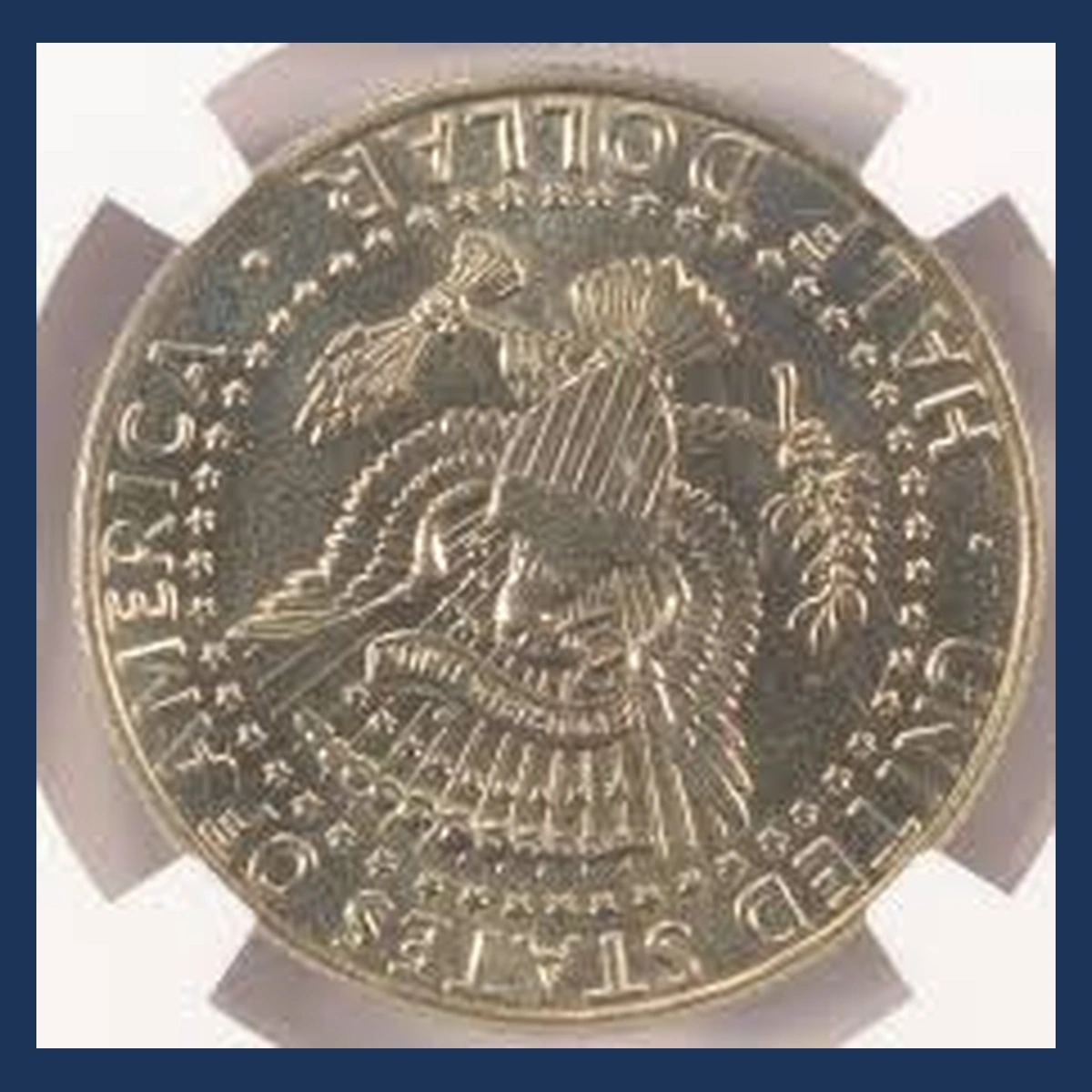
The back of a half dollar can face upside down even though both designs look complete. You notice it only when you turn the coin over without letting it spin.
Two 1988-P examples graded NGC MS65 have this 180-degree error. Collectors call their face arrangement medallic alignment.
Normally, flipping Kennedy top to bottom leaves the eagle upright. These coins instead leave the eagle upside down because one stamping tool was turned halfway around.
Separate upright photos hide the problem. The coin must stay in a fixed position while both sides are checked.
Estimated Value
Two NGC MS65 examples sold together for $288 in July 2021. That was the price of the pair, not $288 for each coin.
Use an estimated $60–$300 per coin for smaller rotations through attractive 180-degree examples. MS65 describes a coin without circulation wear, though small marks can remain.
A different-year 2000-P half with a 75-degree rotation brought $79 in March 2025. Both the angle and surface condition affect demand.
How to Identify
Hold Kennedy upright, then flip the coin top to bottom. Keep the top and bottom points on the same vertical line as you turn it.
A normal eagle will now stand upright. For the recorded 180-degree error, it will be upside down.
Repeat the movement slowly. Letting the coin spin between your fingers can create a false result.
Then inspect the edge with a magnifier for a seam from two joined pieces. A digital scale and calipers should show about 11.34 grams and 30.61 mm, although correct measurements alone cannot rule out alteration.
The simple first test is a repeatable upside-down eagle after that controlled top-to-bottom flip.
4. 1988 Kennedy Half Dollar Doubled Die Reverse Variety (Estimated Up to $350)
Letters in UNITED STATES OF AMERICA may show extra raised edges on a reported 1988 back variety. These are different from the front lettering on the known San Francisco FS-101 Proof.
For a true doubled die, the extra shapes are already in the stamping tool. Coins made by that tool repeat the same shapes in the same places.
The back report does not name a specific mint or clearly matched die. A thick-looking letter needs closer inspection before it receives a variety name.
The familiar FS-101 name cannot be transferred from the front to this back report.
Estimated Value
An older 1965 special mint-set coin with doubled back details brought $408 in March 2024. That ANACS MS66 example contains 40% silver and has a different finish from a regular 1988 half.
For a genuine, clearly matched 1988 back variety, estimate $25–$350. Small extra edges belong toward the lower end.
Flat doubling caused by movement during striking does not receive this variety premium. The older sale is only a comparison.
How to Identify
Inspect the ends of several letters in UNITED STATES OF AMERICA with a 10× magnifier. Look for split tips or rounded extra outlines, rather than a vague thick appearance.
A normal 1988 half weighs 11.34 grams and is 30.61 mm wide. Use a scale and calipers if the coin is loose, then check for scratches around the letters.
A flat shelf beside a thinner main letter often comes from movement during striking. It differs from a second rounded design edge already present in the die.
Compare several letters with a clear known example and move the lamp. The useful starting clue is a repeated raised split that remains visible under different lighting.
5. 1988 Kennedy Half Dollar Missing FG Initials Error (Estimated Up to $400)
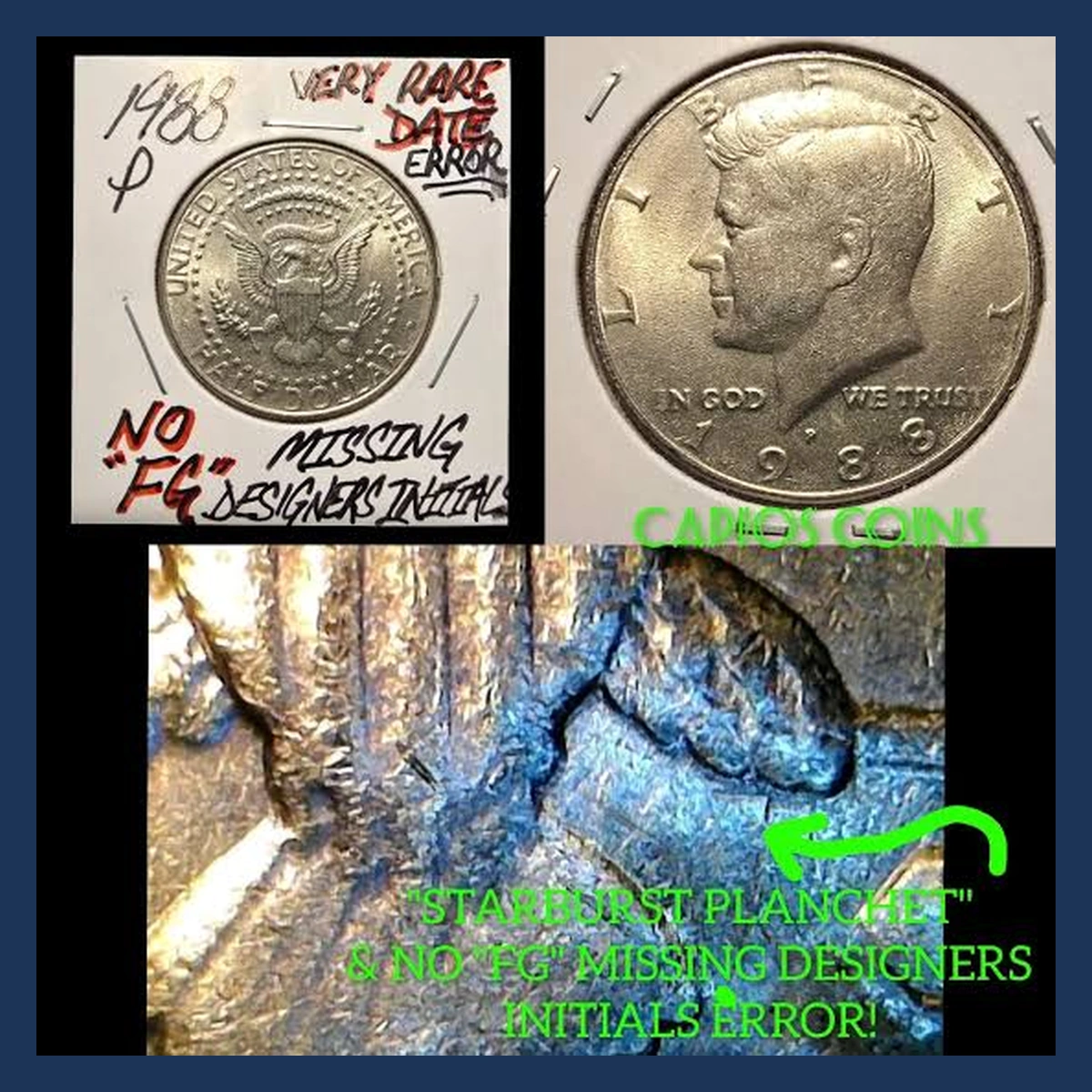
The small FG initials can be difficult to see beside the eagle’s tail. They are the designer’s initials, and a 1988-P report describes coins where they are missing.
That report points to polishing of the die. Polishing can remove the shallow grooves that would normally make the letters.
However, no clearly matched graded example is established by the report. A blank-looking spot does not reveal the cause on its own.
Wear can weaken the letters, debris can block them during striking, and later smoothing can erase them. These possibilities should not all be called the same error.
Estimated Value
A recognized 1982-P No FG variety graded PCGS MS66+ sold for $384 in May 2024. That different year offers a comparison, not a confirmed price for the reported 1988-P omission.
Estimate $30–$400 for a convincing, correctly identified 1988 example. Sharp feathers and clean surrounding surfaces make the missing letters easier to judge.
Weak or partly visible initials do not earn the full premium for completely missing FG letters.
How to Identify
Use a normal half dollar to locate FG between the eagle’s leg and tail area. Check that same spot with a magnifier and light from the side.
Tiny surviving strokes can disappear in a bright frontal photo. Turn the light slowly before calling the initials absent.
Compare the nearby feathers. If everything is worn flat, the missing letters tell you much less than an empty spot surrounded by sharp details.
Scratches or a smoothed patch may show later removal. A scale and calipers should still read near 11.34 grams and 30.61 mm, but normal size cannot prove the cause.
The first useful view shows sharp neighboring feathers with no trace of either F or G.
6. 1988 Kennedy Half Dollar Obverse Struck Through Error (Estimated Up to $450)
Part of the front design is interrupted on a 1988-D half graded NGC MS67. That high grade describes strong preservation, so the missing detail is not simply circulation wear.
An object or substance came between the blank and the stamping tool. The design could not reach the metal normally in that area.
This is called a strikethrough. The obstruction may have fallen away after striking.
The listing identifies the front as the affected side but does not name the material or give its size. It should not be called a cloth, grease, or retained-object error without further visible evidence.
Estimated Value
The NGC MS67 front strikethrough sold for $59 on July 15, 2021. Its high grade did not make it an expensive error.
Estimate $25–$450 across small interruptions through larger, clear impressions. Size and appearance often matter more than a grade alone.
A different-year 1976-D clad half with strikethroughs on both sides brought $114 in March 2025. Neither result identifies the unknown substance involved in the 1988 example.
How to Identify
Study the border where the normal design meets the affected patch. Under a magnifier, look for lettering or portrait details that stop because something blocked the strike.
A later hit may slice into an already complete design and push metal up around its edges. Check for those rough borders before treating a depression as a Mint error.
Weigh an accessible coin against 11.34 grams and check its 30.61 mm width with calipers. Include the edge in your inspection, since pressure damage can affect both the face and rim.
A full-front photograph keeps the patch in context. Focus first on interrupted struck details without fresh cuts or piles of displaced metal around them.
7. 1988 Kennedy Half Dollar Clipped Planchet Error (Estimated Up to $600)
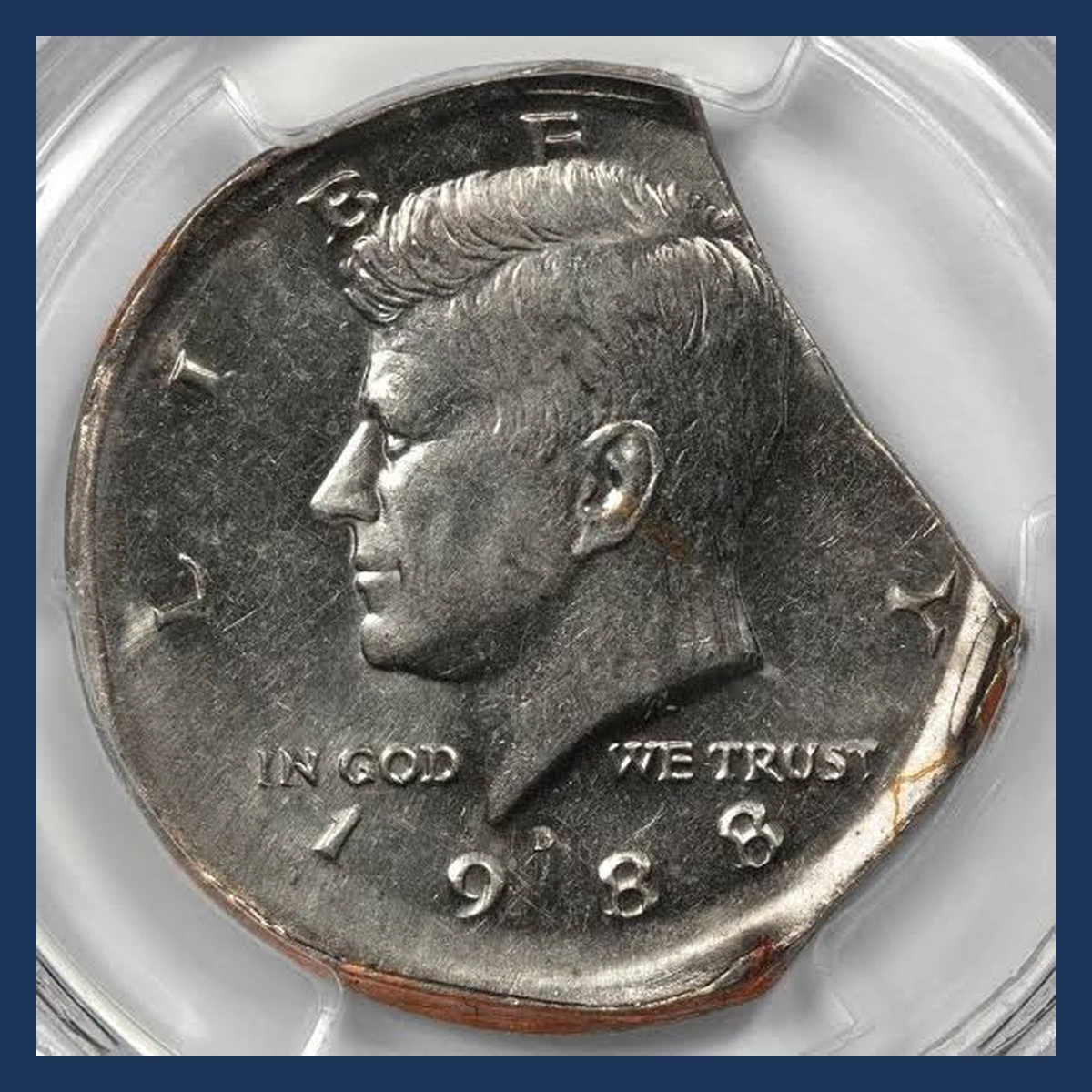
Four curved bites give one 1988-D half dollar an unusually uneven outline. Heritage sold the NGC MS65 coin as a quadruple curved clip.
The missing areas began when the Mint cut the blank from a metal strip. All four gaps were already present when the remaining blank received its design.
This is one coin with four clips, not four separate errors for pricing. Each missing section can affect how its nearby rim formed.
Later cutting can also create notches around a coin. Count the curves, but inspect their edges before accepting them as original Mint-made shortages.
Estimated Value
The 1988-D quadruple clip sold for $234 in July 2021. Its four-gap arrangement offers more visual interest than many small single clips.
An estimated $35–$600 covers ordinary clips through attractive multiple-clip examples. Surface marks and remaining design also affect the price.
For a lower comparison, a 1993-D single curved clip graded ANACS MS64 sold for $34.74 including the auction fee in August 2025. That is a different-year, simpler error.
How to Identify
Photograph the whole coin so all four gaps remain visible. Then use a magnifier to inspect the two ends of each curve.
Look for rims that weaken or bend toward the missing metal. Some clips also cause a weak area on the opposite rim, but the four gaps need not all look identical.
A normal blank starts at 11.34 grams. A scale should show less weight when metal is missing, though later cutting can also make a coin lighter.
Measure surviving widths against 30.61 mm with calipers and inspect the edge for file or saw marks. Begin with the curved boundaries: original rim changes around each gap matter more than the number of notches.
8. 1988 Kennedy Half Dollar Uncentered Broadstrike Error (Estimated Up to $750)
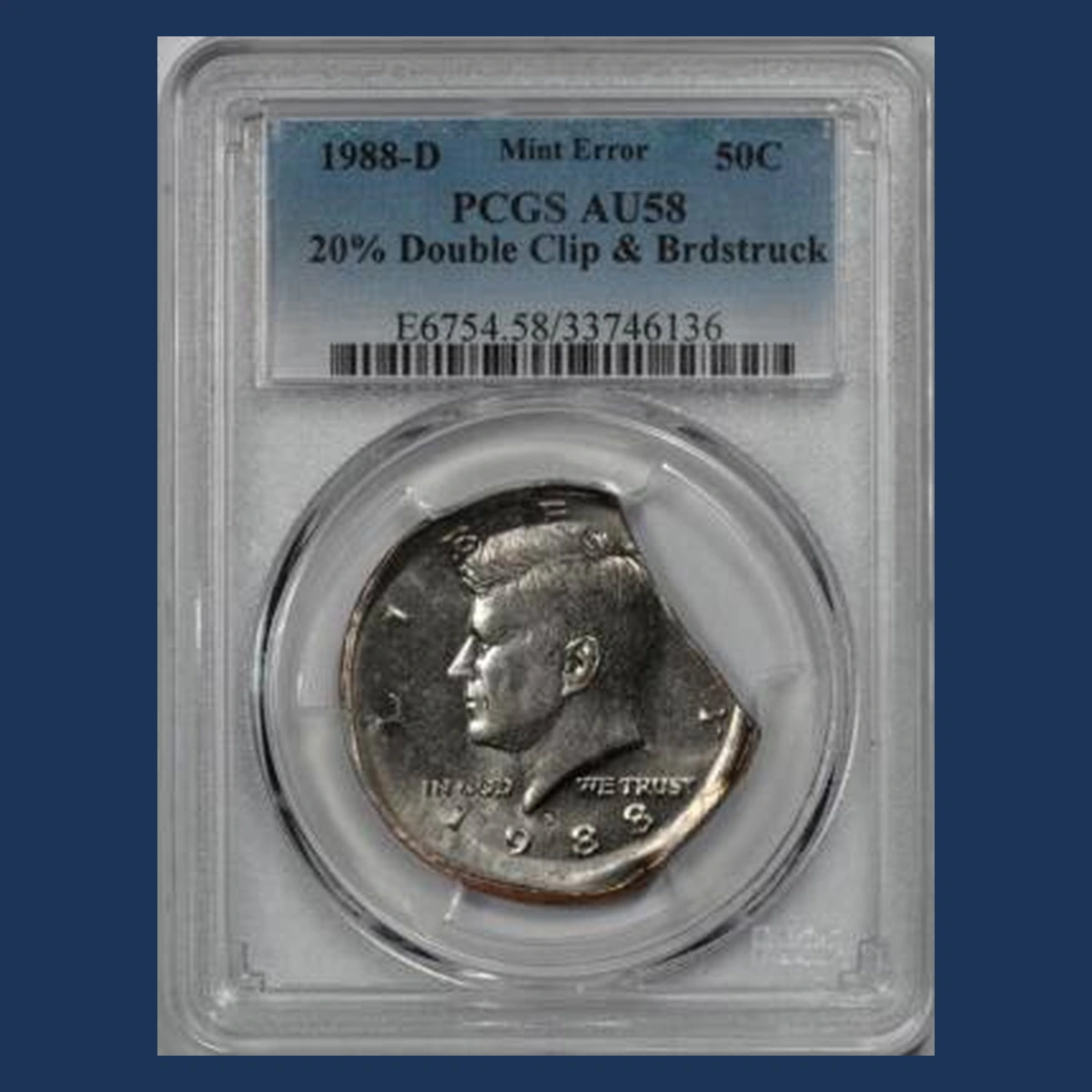
One 1988-P half spread so widely that a specialist compared its size with a silver dollar. It is still a clad half dollar, made from bonded metal layers rather than silver.
The NGC MS63 coin is an uncentered broadstrike. Its blank expanded unevenly because the ring normally controlling its width did not hold it in place.
The design remains complete. That is the key difference from an off-center strike, which misses part of the design.
The silver-dollar comparison describes its appearance. It is not an exact measurement or a claim about the coin’s metal.
Estimated Value
A 1990-P broadstrike graded ANACS MS61 sold for $192 in March 2025. A dealer offered a 1983-P NGC MS65 example for $175; that second figure is an asking price.
Using those different-year comparisons, estimate $125–$750 for the 1988 type. Very broad spreading and attractive surfaces can support a higher price.
An enlarged coin made by later flattening does not qualify. Its width must come from the original strike.
How to Identify
Trace the outer lettering all the way around both faces. On a broadstrike, the designs should stay complete even though the border is wider on one side.
The coin’s width may vary by direction, so take several gentle caliper measurements. Compare them with a normal 30.61 mm half, then weigh it against 11.34 grams.
The extra width does not mean extra metal. Inspect the edge with a magnifier for spreading and missing or incomplete grooves.
Later pressure can also flatten a coin, but it usually crushes designs or changes the surface. Complete, uncrushed lettering inside a naturally expanded outline is the simplest first check for this broadstrike.
9. 1988 Kennedy Half Dollar Proof Doubled Die Obverse FS-101 (Estimated Up to $1,100)
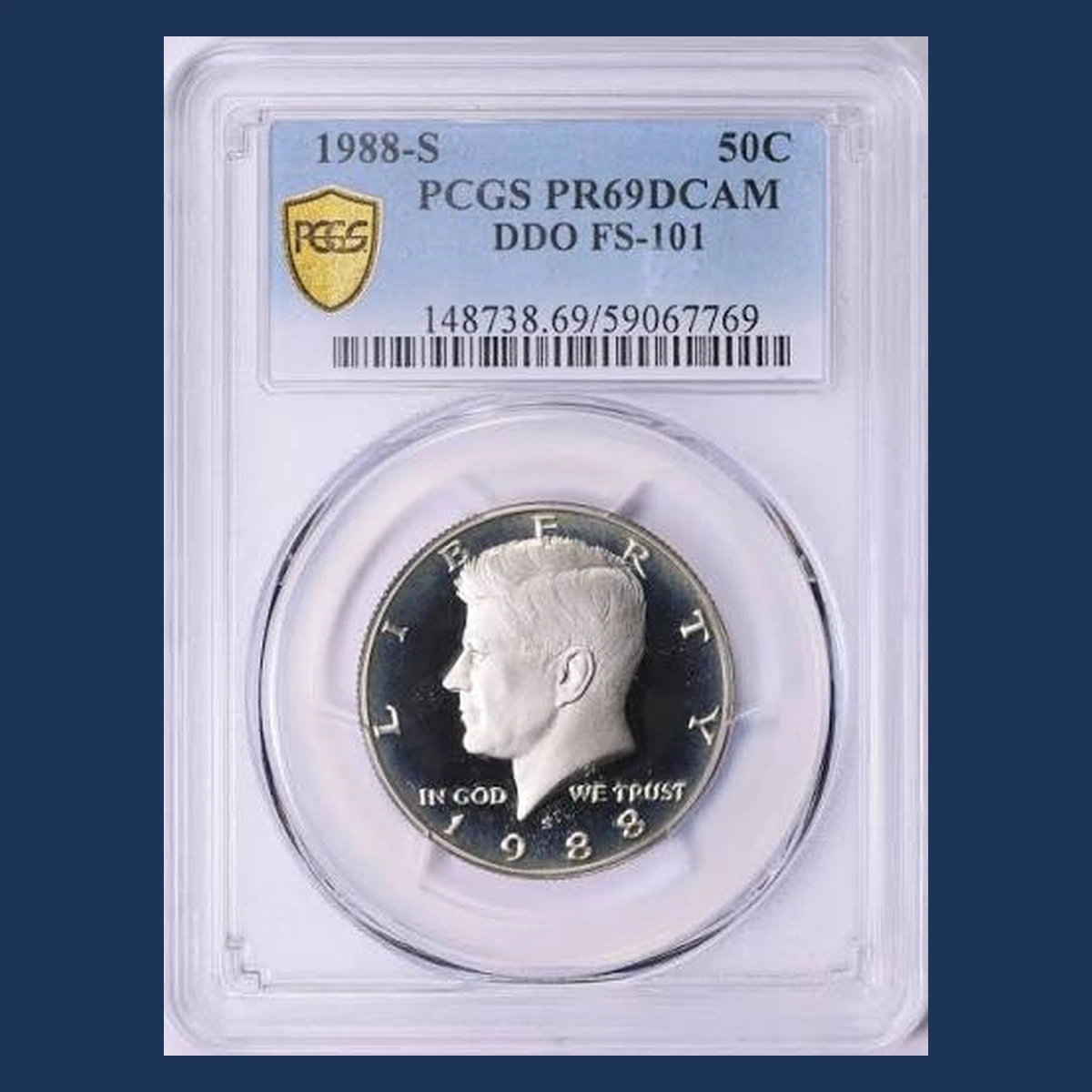
Several front letters split into extra outlines on the 1988-S Proof FS-101. Look at IBER in LIBERTY and the word IN, then the upper corners of R and U in TRUST.
The doubled shapes were part of the die that stamped these coins. This makes the pattern repeat in the same places on other examples.
Proofs normally receive repeated blows, but those blows should line up. A shiny second-looking edge alone does not establish this variety.
PCGS recognizes FS-101. Different grades and levels of frosted contrast describe its appearance, rather than creating separate kinds of doubling.
Estimated Value
A PR68 example sold for $902 at GreatCollections on September 14, 2014, according to PCGS. The estimated range is $100–$1,100 for correctly matched coins.
Clear surfaces and strong contrast between frosted designs and shiny backgrounds improve appeal. Fine scratches, haze, or dull patches can lower demand.
The old auction result is a useful comparison, not a guaranteed price. Check the actual letters and condition before expecting a similar amount.
How to Identify
Check for the S mintmark and collector finish first. Despite its bright appearance, a normal 1988-S Proof contains no silver and has the same 11.34-gram weight and 30.61 mm diameter.
Use a scale and calipers only if the coin is already loose. Leave a graded coin in its holder.
Under a magnifier, inspect IBER in LIBERTY, then IN. Continue to the upper corners of R and U in TRUST and compare with clear FS-101 photographs.
Soft lighting reduces bright reflections that can resemble extra edges. The fastest useful comparison is the combined split lettering in IBER and IN, supported by the matching TRUST corners.
10. 1988 Kennedy Half Dollar Off-Center Strike Error (Estimated Up to $1,500)
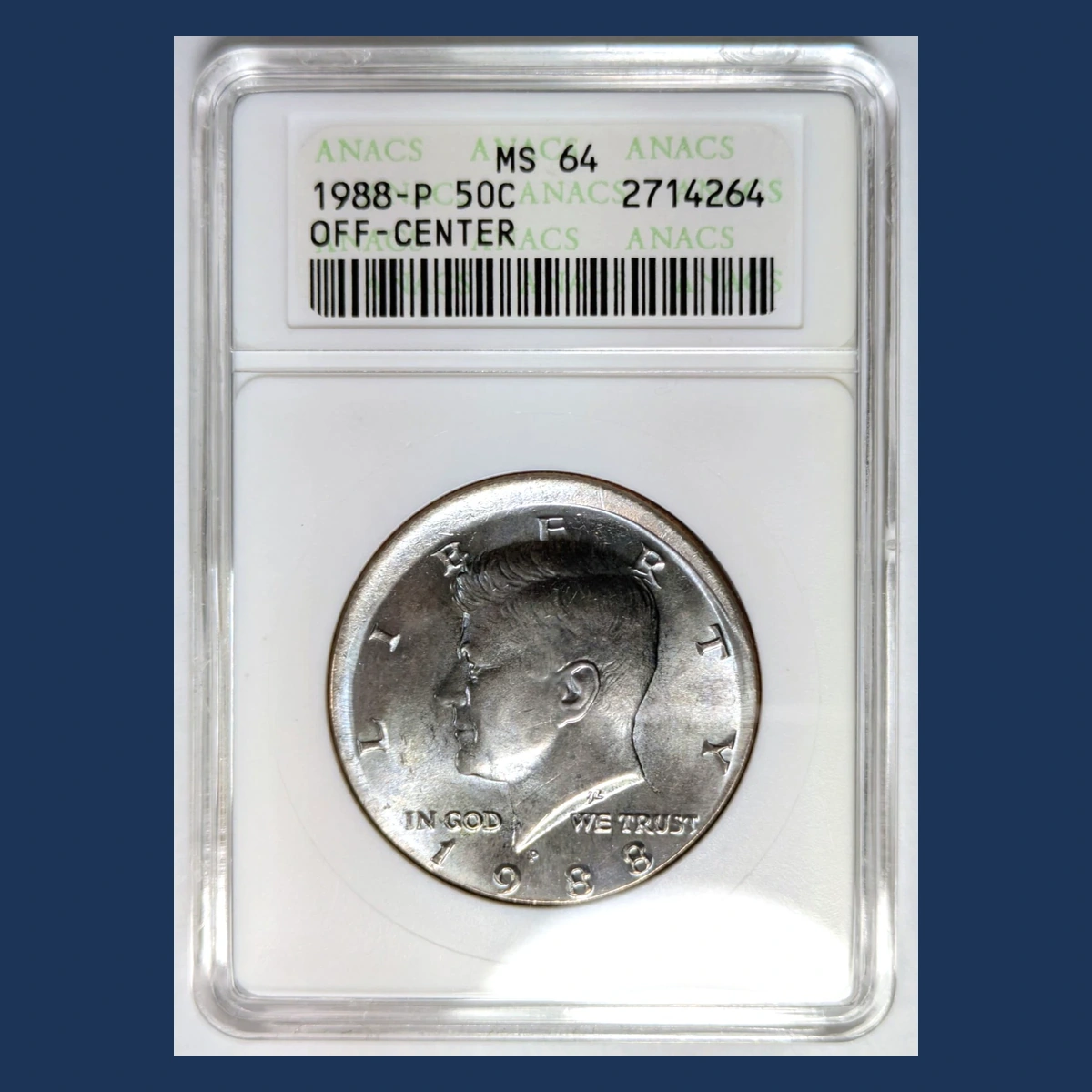
Most of the surface is blank on a dramatic 1988-D half illustrated by NGC. Only a small part passed between the stamping tools, leaving the design about 80% off center.
NGC identifies the coin as MS66. The visible date is cut short, so its identification does not mean all four digits can be read on the coin.
Other reports mention Philadelphia examples as well. The Denver coin’s grade and 80% shift belong to that particular piece.
An off-center strike leaves original blank metal beside the design. It does not remove the design from a previously complete coin.
Estimated Value
For genuine 1988 off-center halves, estimate $100–$1,500. Clear identity, original surfaces, and an interesting balance of design and blank area all affect the price.
A 1990-P example struck 10% off center sold for $198 in September 2025. It was graded NGC MS66 and provides a different-year comparison for a smaller shift.
The much larger 1988-D example may attract stronger interest. NGC’s illustration does not provide an auction result for that coin.
How to Identify
The large blank area should appear on both faces beside the same shifted strike. Compare that arrangement with NGC’s 1988-D example, keeping its partly missing date in mind.
A magnifier can reveal original blank texture. Grinding away a finished design instead leaves scratches and changes the metal’s surface.
An intact blank starts near 11.34 grams, so use a scale to check for unexpected metal loss. Calipers can document the changed outline against the normal 30.61 mm width.
Inspect the edge too; grooves may be incomplete where the blank missed the surrounding ring. Matching shifted designs on both faces beside untouched blank metal are the clearest first signs.
Conclusion
Estimated 1988 half-dollar error values range from $5 to $1,500. A raised chip, four curved gaps, or split Proof lettering each calls for a different check.
Try the simplest one first: flip the coin carefully for rotation, inspect the whole edge for clips, or enlarge the named letters for FS-101. Match the actual feature and condition before comparing prices, and remember that the $288 rotation sale included two coins.