1999 Half Dollar Error List with Pictures

An 8.5-gram copper 1999-P half dollar sold for $5,280 in May 2022. Both outer metal layers were absent before striking, leaving much less metal than an ordinary coin.
These 1999 half dollar errors range from tiny transferred marks to major missing-layer pieces, with estimated values of $15–$6,500. Some listed varieties remain candidates rather than confirmed examples.
Use the eight sections below to compare the actual surface, shape, and weight of your coin.
1. 1999-P Kennedy Half Dollar Reported Die Clash (Estimated Up to $150)
Normally, a blank separates the portrait and eagle tools. If the press closes without one, the tools can hit each other.
These dies are steel tools that stamp coins. Their contact can leave parts of one picture on the opposing tool, which later passes the unwanted traces to coins.
A 1999-P value article reports a small number of clashed examples without a specific certification or location map.
An extra mark must fit the opposite picture’s shape and position. An isolated scratch or polishing streak does not become a clash simply because it looks unusual.
Estimated Value
For a clearly recognizable 1999-P clash, estimate $15–$150. Faint but genuine traces fit the lower end, while easily seen transferred shapes can attract more interest.
This is an estimate for the reported type, not a documented clash sale. The dramatic 1999-D off-center coin later in this guide sold for $552.
That result gives a sense of scale rather than a direct price match. A subtle tool trace and a large shifted strike appeal for different reasons.
How to Identify
Compare enlarged photographs of both faces, keeping their normal relationship. Look for an outline on one face that could come from the opposite picture.
Use a 10× magnifier and angled light to separate shallow design from a scrape. The shape must fit where the two tools could meet.
A coin pressed against another finished coin can also receive sunken reversed marks. That later damage needs to be distinguished from the original clash.
Check P, the date, and the edge grooves. Use a scale and calipers when safely accessible against 11.34 grams and about 30.6 mm.
A recognizable part of the opposite design in the correct relative position is the useful match, rather than one unexplained line.
2. 1999-P Kennedy Half Dollar Clipped Planchet (Estimated Up to $300)
A substantial curved segment is missing from the cataloged 1999-P example. Heritage identifies it as a twenty-five-percent clip, graded MS63 for unworn condition with visible marks.
A genuine clip begins before striking. An overlapping punch can leave part of a blank missing, and the later strike shapes the remaining metal around that gap.
That sequence differs from sawing a notch into a finished half dollar. The edge and nearby design should help tell them apart.
Other clips can be straight or irregular. Those possible forms do not change the documented curved outline of this particular Philadelphia coin.
Estimated Value
Estimated values of $50–$300 cover genuine collectible 1999 clips. The documented Philadelphia example identifies a real coin, but no sale amount is assigned to it here.
A nearby-year 1998-D with a ten-percent triple clip sold for $99 in March 2025. It was also graded MS63, though it has a different clip arrangement.
That transaction gives a practical comparison. Remaining design, clear boundaries, and surface quality matter alongside the percentage of missing metal.
How to Identify
Inspect the two points where the curved gap joins the intact rim. Under a 10× magnifier, look for natural strike flow rather than fresh cuts, saw marks, or burrs.
Follow the surviving edge grooves toward the missing section. The nearby design should agree that the gap existed before the picture was struck.
Use a scale when safely accessible against the intact 11.34-gram standard. Calipers across an undamaged span should relate to the normal 30.6 mm diameter.
The opposite rim may be weak, but that clue is not mandatory on every genuine clip. Keep the date and P visible.
Compare the complete curved outline and its rim transitions; a stated percentage alone cannot authenticate another similarly shaped coin.
3. 1999 Kennedy Half Dollar Doubled-Die Candidates (Estimated Up to $350)
A doubled die carries repeated design before it strikes the coin. On the front, letters and date digits can reveal it; on the back, inspect lettering and eagle details.
The 1999 guide discusses doubling broadly and uses the familiar 1974-D TRUST example. It does not establish that same feature on a 1999 coin.
Neither face receives a definite 1999 variety identification from that discussion. Front and back candidates therefore need their own evidence.
An extra edge should repeat a real design shape. It should not inherit another year’s location, catalog number, or reputation.
Estimated Value
A clearly identifiable doubled die on an unworn 1999 half is conditionally estimated at $60–$350. Small repeated detail fits the lower end, while a bold pattern can draw stronger interest.
The estimate uses a roughly $60 starting point in a modern Kennedy guide for 2007. That is another year’s guidance, not a 1999 sale.
A high grade does not prove the mechanism. Flat doubling caused during striking does not automatically receive the same variety value.
How to Identify
Choose one well-preserved letter or digit and inspect its whole outline with a 10× magnifier. A flat shelf that narrows the main stroke suggests movement during striking instead.
Place a normal coin photograph beside it at the same size. For a back candidate, retain enough eagle and lettering to show exactly where the feature sits.
The front need not also be doubled. Treat each proposed feature according to what is visible.
Use a scale and calipers when safely accessible: layered-metal coins weigh 11.34 grams, while silver Proofs weigh 12.50 grams. Proofs are specially made collector coins; both versions measure about 30.6 mm and have edge grooves.
The same extra shape on another coin made with that tool gives the strongest practical match.
4. 1999 Kennedy Half Dollar No-FG Candidate (Estimated Up to $400)
The tiny initials FG can be difficult to see. One surviving stroke changes the description from missing initials to weak initials.
The 1999 guide presents complete absence as a possibility, rather than identifying an established specimen. On recognized varieties of other years, heavy polishing of the stamping tool can erase these shallow letters.
That explanation should not be assumed for every smooth-looking 1999 example. Wear, an obstructed strike, or later smoothing may also hide detail.
Examine the surrounding feathers as well as the letters. Their surfaces can help explain why the initials are hard to read.
Estimated Value
A recognized 1972-D No FG variety sold for $900 in December 2022. Its MS64 grade means unworn with some marks.
That older variety shows why genuinely absent initials can interest collectors. It does not establish a 1999 example or its price.
For a 1999 candidate with proven mint-made absence and collectible surfaces, estimate $75–$400. This conditional value does not apply simply because a photograph is too dark or soft to show the initials.
How to Identify
Search beside the eagle’s tail and the leg on the viewer’s right with a 5×–10× magnifier. Rotate the light to find strokes hidden by glare or color.
Compare a normal coin of the same finish, keeping adjacent feathers in view. Wear and later smoothing may affect those feathers differently from a polished stamping tool.
Do not clean the area to make letters appear. Preserve the surface for comparison.
A scale and calipers help identify safely accessible coins: layered metal weighs 11.34 grams and silver Proofs 12.50 grams. Both measure about 30.6 mm with edge grooves.
Look for any surviving part of F or G; one clear stroke means weak initials rather than complete absence.
5. 1999-P Kennedy Half Dollar Reported Strike-Through (Estimated Up to $450)
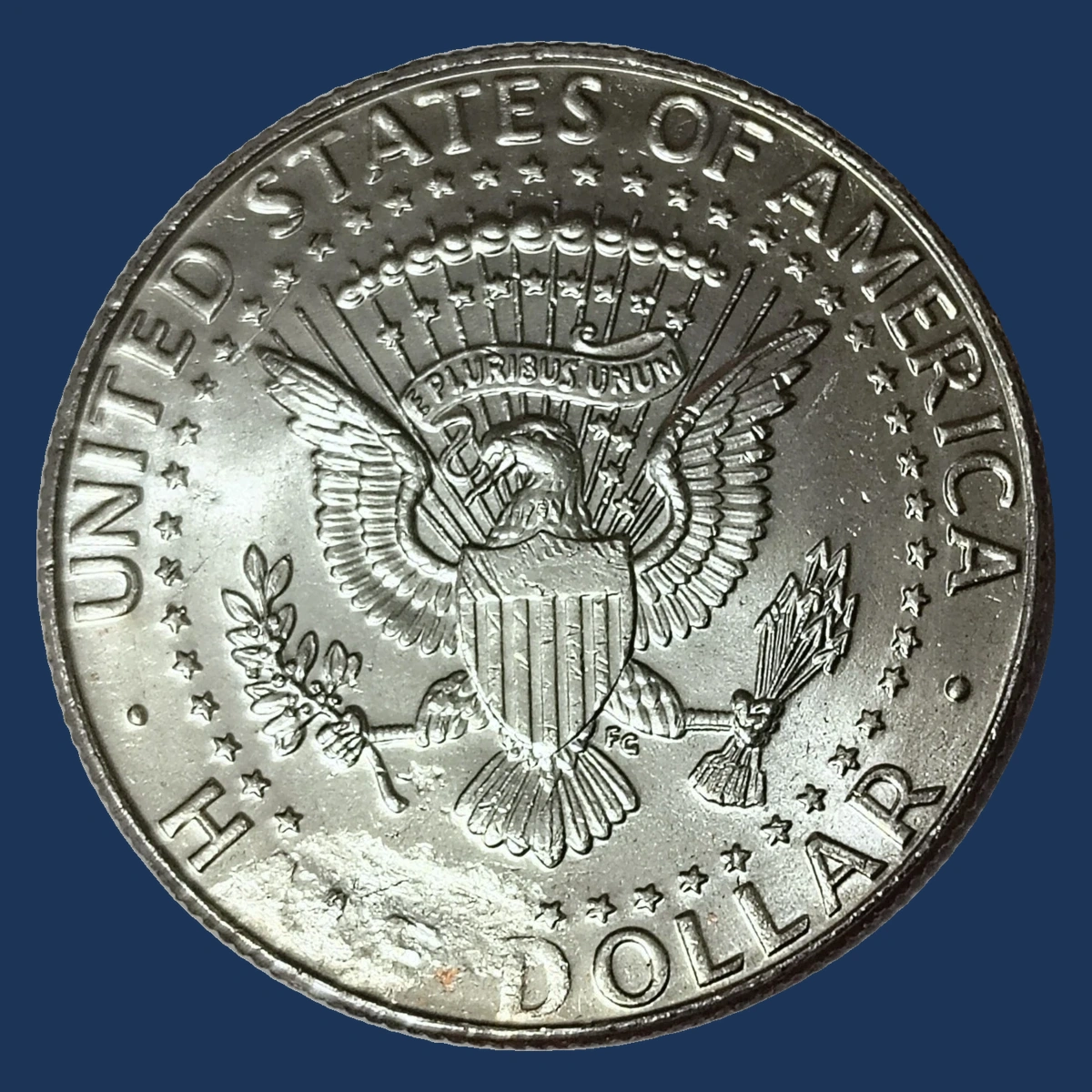
Something between the stamping tool and blank can interrupt the picture. It may leave a hollow, a texture, or a patch where normal detail never formed.
A seller’s listing identifies a 1999-P as struck through. It gives no certification or specific trapped material.
The report therefore does not establish cloth, wire, grease, or another named object. Each would leave different clues.
Begin with the actual surface and the surrounding design. Guessing a familiar object from an unclear mark can turn a later dent or scrape into a misleading mint-error story.
Estimated Value
Estimated values of $25–$450 cover a small interruption through a distinct object impression on an attractive unworn coin. The upper end needs a clear genuine feature.
A 1992-D with an identifiable edge-groove fragment impressed into its front sold for $336 in July 2021. It was graded MS64.
That older coin provides a comparison for the same broad mechanism. The seller-reported 1999-P has no assigned grade or recorded sale amount in this estimate.
How to Identify
Inspect the feature without removing anything from it. Low light and a 10× magnifier can show whether detail fades into a compressed patch or metal was torn away later.
Look for any impressed texture, but do not name an object unless the shape supports it. Compare the surrounding shine and design with undamaged areas.
Check the opposite face too. Pressure damage may disturb both sides, while corrosion can leave irregular pits.
For a safely accessible 1999-P, use a scale and calipers against 11.34 grams and about 30.6 mm. Inspect the edge grooves; normal measurements alone cannot prove a surface error.
The useful clue is an interruption formed during the strike without the displaced metal of a later gouge.
6. 1999-P Kennedy Half Dollar Reported Tilted Broadstrike (Estimated Up to $500)
A tilted broadstrike combines outward spreading with an uneven position during striking. The blank was not held normally by the retaining ring and sat at an angle.
Its widened border and thickness can therefore vary around the edge. Both pictures and the complete edge need examination.
A dealer lists a 1999-P as NGC MS63 tilted broadstruck. That grade means unworn with visible marks, but the report gives no tilt direction here.
A partly restrained strike may have a different stepped edge. Later flattening can also make a coin broad, so width alone does not settle the cause.
Estimated Value
The seller displayed £242.22 as an asking price. That is neither a completed sale nor a US-dollar result.
An estimated $150–$500 suits an identifiable unworn 1999-P with visible tilt and original surfaces. A different-year 1998-P broadstrike on a Type 1 blank sold for $106 in January 2010.
A Type 1 blank had not yet received its raised rim. That additional feature and the older sale date make it a limited comparison, not a direct price match.
How to Identify
Look edge-on from several directions before focusing on the portrait. Compare thickness around the coin and use calipers gently when safely accessible to record its uneven outline.
An ordinary layered-metal half measures about 30.6 mm and weighs 11.34 grams. A scale helps check whether the coin retained its normal metal.
Use a 10× magnifier where regular edge grooves meet the unusual perimeter. The pictures should remain consistent with natural broadstriking rather than later crushing.
A step deserves its own examination and does not automatically prove the seller’s tilt description. Check for filing or repeated compression marks.
Uneven thickness should agree with original metal spreading around the edge, giving one coherent explanation for the tilted strike.
7. 1999-D Kennedy Half Dollar Off-Center Strike (Estimated Up to $750)
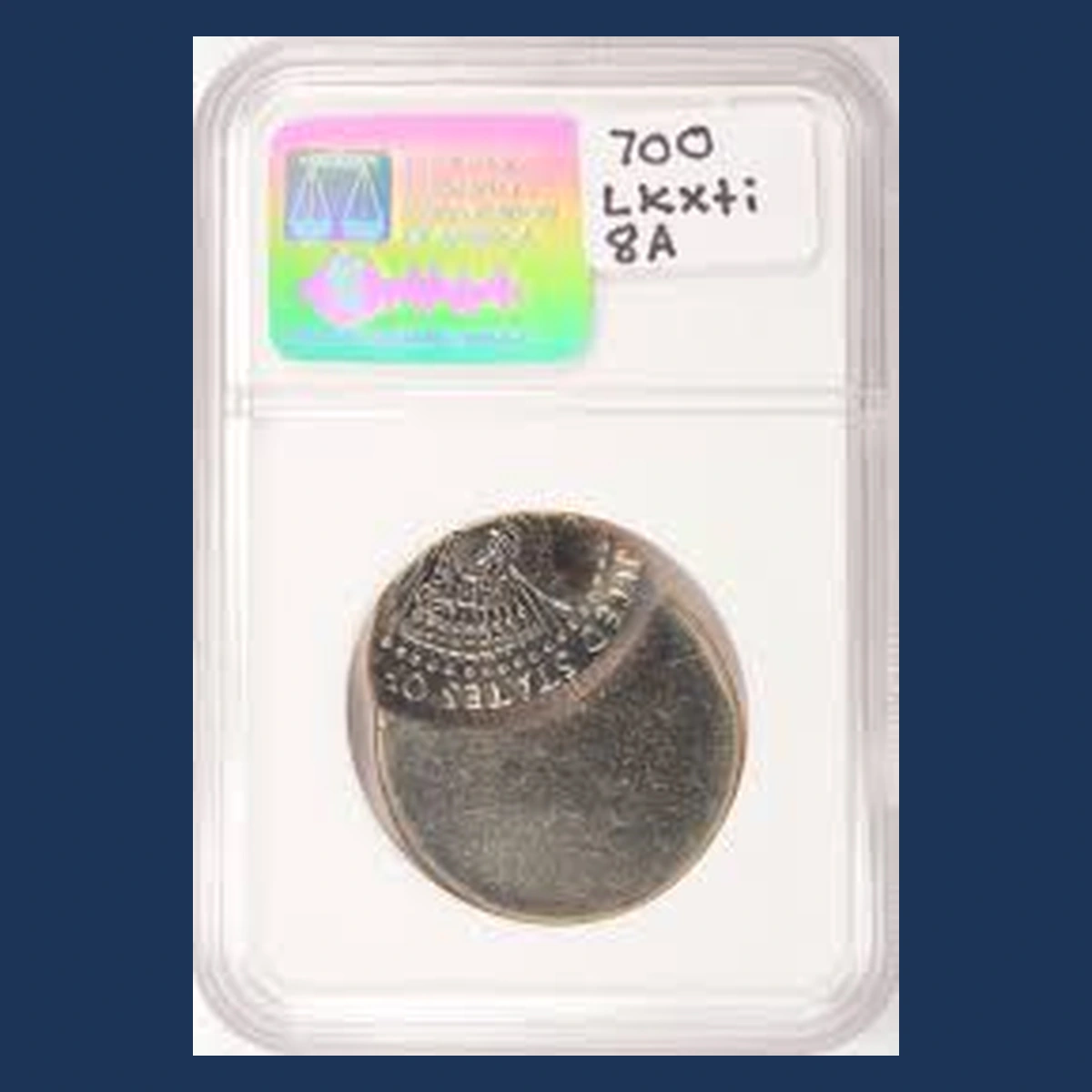
The Denver example has a documented sixty-five-percent off-center strike. It was graded MS66, meaning exceptionally well-preserved and unworn.
The blank sat partly beyond the stamping tools. Only the area they reached received the picture, leaving a large area of untouched metal.
That contrast makes the error easier to understand than an uneven rim alone. The shift should affect both faces in a matching way.
The percentage belongs to this cataloged coin. A single misaligned tool can shift one picture without producing the same whole-blank displacement, so it is not automatically the same kind of error.
Estimated Value
The MS66 example sold for $552 on March 20, 2023. It provides a same-year result within an estimated $100–$750 range for collectible off-center 1999 halves.
Smaller shifts generally fit lower values. A dramatic readable-date coin with attractive surfaces can bring more, but price does not rise by a fixed amount per percentage point.
The surviving picture and condition matter together. A larger shift that removes the date may be a less useful comparison.
How to Identify
Read 1999 and check the mint letter before judging the percentage. Without the date, a Kennedy portrait alone cannot identify this year.
Photograph both faces in matching orientation. Use a 10× magnifier to inspect the boundary between design and untouched metal for grinding or erased detail.
The ordinary starting weight is 11.34 grams. A scale can help distinguish missing picture from missing metal; use it only when the coin is safely accessible.
Calipers record the outline against the normal 30.6 mm diameter. Inspect surviving edge grooves alongside areas that escaped the retaining ring.
A matching shift on both faces beside original bare metal is the essential check, rather than unequal borders in one cropped view.
8. 1999-P Kennedy Half Dollar Struck on a Bare Copper Core (Estimated Up to $6,500)
This 1999-P was struck without either silver-colored outer layer. The blank was an 8.5-gram copper core instead of a normal layered-metal half-dollar blank.
Its AU58 grade indicates slight wear. The thinner body left less metal available to fill the design, helping explain the softly struck outer details.
An irregular metal strip can leave copper extending beyond its outer layers before blanks are punched. That provides a way for a bare-core blank to reach the press.
Both copper faces, reduced weight, and compatible strike matter together. A brown surface alone does not establish this unusual missing-layer error.
Estimated Value
The AU58 copper-core half sold for $5,280 on May 6, 2022. Estimate $3,500–$6,500 for a comparably identified 1999-P with sound surfaces.
That value belongs to a coin struck without both outer layers. A partly missing layer is a different comparison.
The amount should not be transferred to a stained ordinary half or a copper-plated coin. The same structural evidence must support the claimed error, not just a similar color.
How to Identify
Compare the substantial weight difference first: 8.5 grams for the auction coin against the normal 11.34 grams. A precise scale helps, but destructive alteration can also make a coin lighter.
Use a 10× magnifier on both faces and the edge. Look for absence of both normal outer layers, while checking for etching, filing, plating, or peeling after striking.
Calipers record the outline against roughly 30.6 mm. Inspect the edge grooves and thinner body when safely accessible.
The weak outer design should fit the reduced metal available during the strike. Consider copper color only alongside these physical observations.
Reduced weight, two bare faces, and a compatible original picture together provide the strongest copper-core match.
Conclusion
Estimated values span $15–$6,500, with the bare copper-core strike at the expensive end. Its low weight, missing outer layers, and weak outer picture explain the error together.
Use the same care with smaller features. A doubled-looking edge or faint FG needs a close comparison, while the documented off-center coin offers a clear example of shifted pictures beside metal that never received a design.