1824 Quarter Error List with Pictures

Every known 1824 Capped Bust quarter carries an earlier 2 beneath its final 4. The tiny remnant can be surprisingly difficult to see, even on a well-preserved coin.
An exceptional MS64 example sold for $141,000 in May 2015. That price reflects a scarce whole coin, not an extra premium added for discovering the overdate.
This 1824 Capped Bust Quarter error guide explains the 1824/2 feature and an estimated $1,500–$150,000 range. Read on to locate the earlier digit without mistaking damage for its faint outline.
1824 Capped Bust Quarter 4 Punched over an Earlier 2
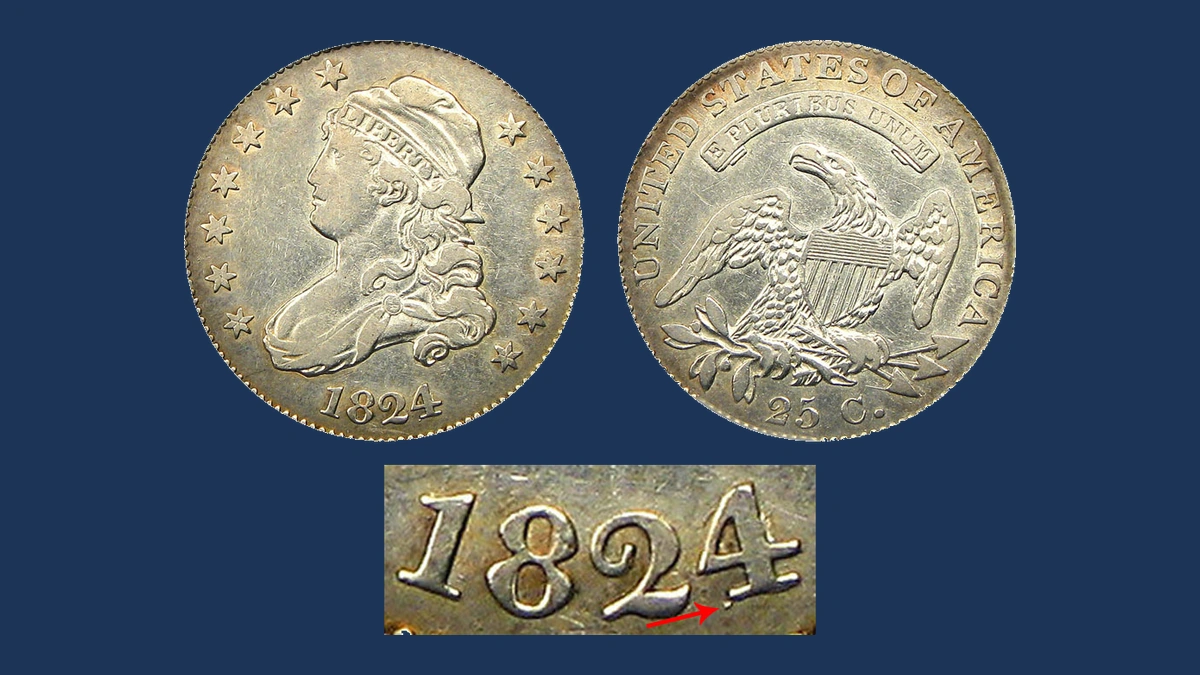
The final 4 partly covers a faint earlier 2. This is an overdate, created by changing the date on a steel stamping tool rather than altering each finished coin.
An unused tool bearing 1822 was changed to 1824 and paired with the back tool used for the previous year’s quarters. Every known 1824 quarter came from that pair.
The earlier 2 can remain weak even when the coin has little wear. It is not supposed to look like a complete second numeral.
The recognized date is written 1824/2 to describe the overlapping digits.
Estimated Value
Estimate $1,500–$150,000 across heavily worn through exceptional unworn examples. The scarce date, remaining detail, and original surfaces explain much of that wide spread.
PCGS records $141,000 on May 19, 2015 for an MS64 sold by Stack’s Bowers. MS64 means an attractive unworn coin with some marks.
Because the overdate belongs to every known 1824 quarter, it is already included in the date’s normal collector value. Do not add a second error price.
How to Identify
Begin with a clear photograph of an identified 1824/2, keeping the entire date visible on both coins. The comparison should show where the faint earlier strokes lie below and toward the lower left of 4.
Use a magnifier and move the lamp slowly across that area. A remnant may appear under one lighting angle and disappear under another, so avoid judging it from a single bright photograph.
Look for the same small contours as the reference, not a whole readable 2. Scratches, dents, and corrosion can create unrelated shapes in the same space.
Wear can hide the underdigit, and even unworn examples may show it weakly. Match the surviving lower strokes to the known overdate before interpreting an isolated mark.
Conclusion
The 1824/2 is the normal date variety for every known 1824 quarter, and its earlier digit is often faint. A matched close-up is more helpful than expecting a bold second 2.
Estimated whole-coin values run from $1,500–$150,000. The $141,000 MS64 sale shows the importance of exceptional preservation; it does not mean that finding a weak remnant makes a worn coin equally valuable.