1852 Quarter Error List with Pictures

The 1852 quarter’s repeated date links ordinary pocket-change coins with an exceptionally rare Proof. Proofs are collector coins made with special preparation.
One such Proof sold for $176,000 in May 1998, a price for the rare whole coin rather than its date alone. Ordinary examples are a different market.
This guide to 1852 quarter errors covers the repeated date, turned back designs, and a slightly shifted Proof back. Estimated whole-coin values span $150 to $200,000; follow the checks to separate these appearances before comparing prices.
1. 1852 Liberty Seated Quarter Rotated Back on the Repunched-Date Variety
The eagle can appear tilted after you turn an 1852 quarter over in the usual way. Two circulation examples of the repeated-date variety were reported with substantial rotation.
One back was turned 90 degrees and the other about 45 degrees. They are separate coins, not two positions of a moving part on one coin.
This happens when a die, the steel tool that stamps a design, turns out of normal orientation. The picture can remain centered even though it faces the wrong direction.
The reported rotations concern Philadelphia circulation coins. They do not establish rotated Proof or New Orleans examples.
Estimated Value
For genuine circulation examples with these substantial rotations, estimate $300 to $6,000. The amount of wear and the clarity of the repeated date help narrow that range.
A large, easily demonstrated turn is more attractive than a slight variation visible only after careful measurement. Original surfaces also matter on this scarce early issue.
This is an estimated whole-coin range for the combined appearance. The repeated date and rotation are not separate prices to add together.
How to Identify
Hold Liberty upright, then flip the coin top to bottom without twisting it sideways. The eagle should normally finish upright too.
Repeat the movement while keeping your fingers at the same points. Turning left to right instead can make normal American coin alignment look wrong.
If the back remains tilted, photograph both positions with the turning direction recorded. About 90 degrees puts the eagle sideways; about 45 degrees leaves it diagonally tilted.
Next examine the date for the 1852/52 pattern described below, because that is the variety connected with the reported examples. Independently rotated listing photos cannot establish the coin’s alignment.
A sealed holder should remain closed; a specialist can check the relationship through the holder.
2. 1852 Liberty Seated Quarter Repunched Date on Circulation Coins and Proofs
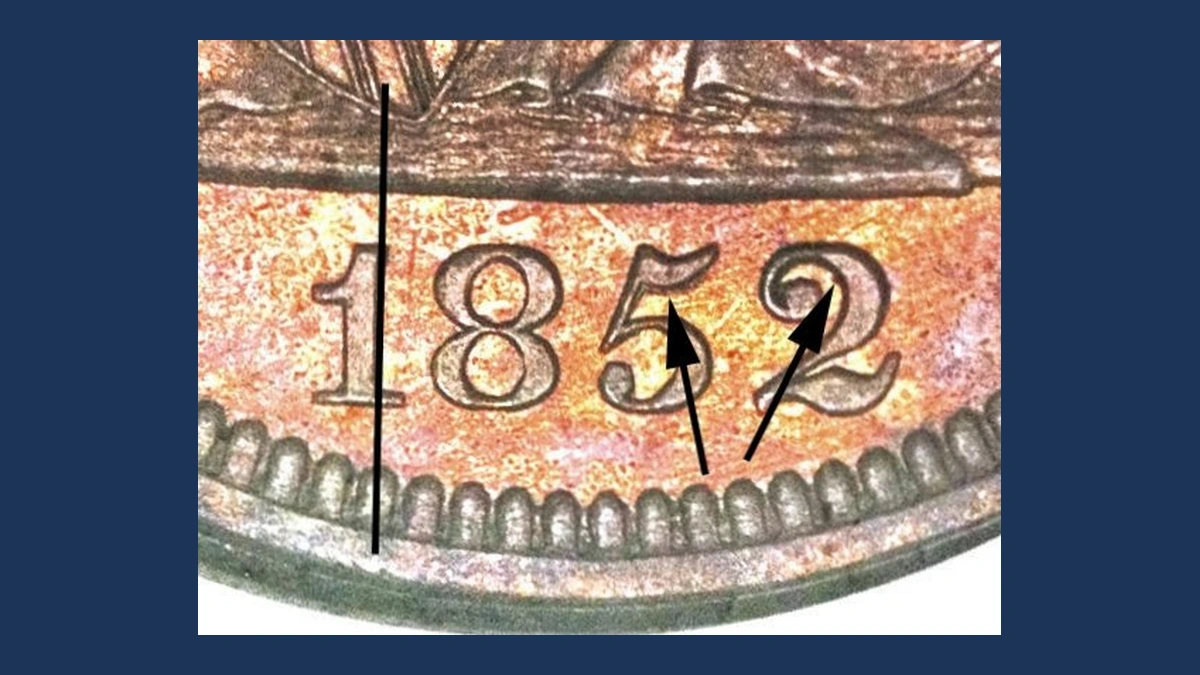
The final digits can show an earlier impression beneath the finished date. Called 1852/52, this Philadelphia variety appears on both ordinary circulation coins and rare Proofs.
The date was entered more than once while the tool was prepared. That does not mean the date on each coin was stamped separately.
Besides the extra strokes at 52, the position of the complete date helps identify the tool. The right edge of 1 sits near shield lines six and seven.
The photographed Proof was described with repunching at 852. Its unusual finish requires separate confirmation from the date pattern.
Estimated Value
For circulation examples, estimate $150 to $8,000 across worn through better-preserved coins. For the exceptionally rare Proof, an estimated $100,000 to $200,000 reflects a very different market.
The Proof brought $176,000 in May 1998; Greg Johnson’s variety study also records $138,000 in August 2008. These are successive whole-coin results, not prices paid solely for repeated numerals.
A circulation strike cannot use those Proof prices just because its date matches. Preservation and confirmed method of manufacture remain essential.
How to Identify
Use the complete date and shield together, rather than cropping the image tightly to 52. The position of 1 helps when wear has softened the extra strokes.
Compare the right edge of 1 with vertical shield lines six and seven in a photograph of the identified variety. The other ordinary front tool places the date farther left, near line five.
Now enlarge 5 and 2 under angled light to compare the earlier outlines. On the described Proof, inspect 8 as well; do not assume a scratched digit is an extra punch impression.
The date identifies the tool, not the finish. A polished circulation coin can look shiny, so an apparent Proof needs examination of its complete surfaces and strike by an early-Proof specialist.
3. 1852 Liberty Seated Quarter Slightly Shifted Back on the Rare Proof
On the cataloged 1852 Proof, the back design sits slightly toward the top of the coin. That produces unequal spacing between the picture and the rim.
The auction description of the NGC PR65 coin places the shift toward 12 o’clock. PR65 is a Proof grade indicating strong preservation.
This describes movement across the face, not a back design turned at an angle. It also does not establish that both faces were struck off center.
The same Proof has the repeated date discussed above. Its small back shift belongs to that complete rare coin.
Estimated Value
Use an estimated $100,000 to $200,000 for this rare Proof as a whole. That range reflects the coin’s rarity, quality, and documented history, not a separate reward for slight misalignment.
The small shift does not justify adding another error price to the repeated-date estimate. They describe one object.
A similar-looking border on an ordinary circulation coin would need its own assessment. It would not gain the rare Proof’s value merely because the back also sits slightly high.
How to Identify
Compare the space above the eagle with the space below the denomination in a straight-on photograph. The described back is shifted upward toward 12 o’clock.
Keep the whole rim visible when making this comparison. A cropped top edge or a tilted camera can create a similar impression without any tool displacement.
Check the front separately to establish whether its centering differs from the back. The catalog’s back-only observation must not be expanded into an off-center strike affecting both faces.
Before applying this coin’s history or value, match the Proof itself through a recognized grading record and full photographs. The repeated date, surface finish, and complete design should agree with that identification, rather than only an uneven border.
Conclusion
The date position, the direction of the eagle after a flip, and the width of the back border answer different questions. Check each feature on the actual coin.
Estimated values span $150 to $200,000, with rare Proofs accounting for the highest figures. A worn circulation piece with the same date pattern belongs in a much lower range.
When two features occur together, value the coin once rather than adding two estimates.