1860 Quarter Error List with Pictures

A nearly invisible O can change how you identify an 1860 quarter. New Orleans pieces sometimes have such faint mint letters that they can be mistaken for Philadelphia coins.
The distinction matters: an exceptional 1860-O brought $28,200 in October 2021. That was a condition record, not a price established for a weak O.
Among 1860 quarter errors, this guide examines the reported weak mintmark, with estimated whole-coin values of $100 to $6,000 for worn through lower-grade unworn examples. Learn where to look before deciding that a faint circle is a genuine O.
1860 Liberty Seated Quarter Weak O Mintmark
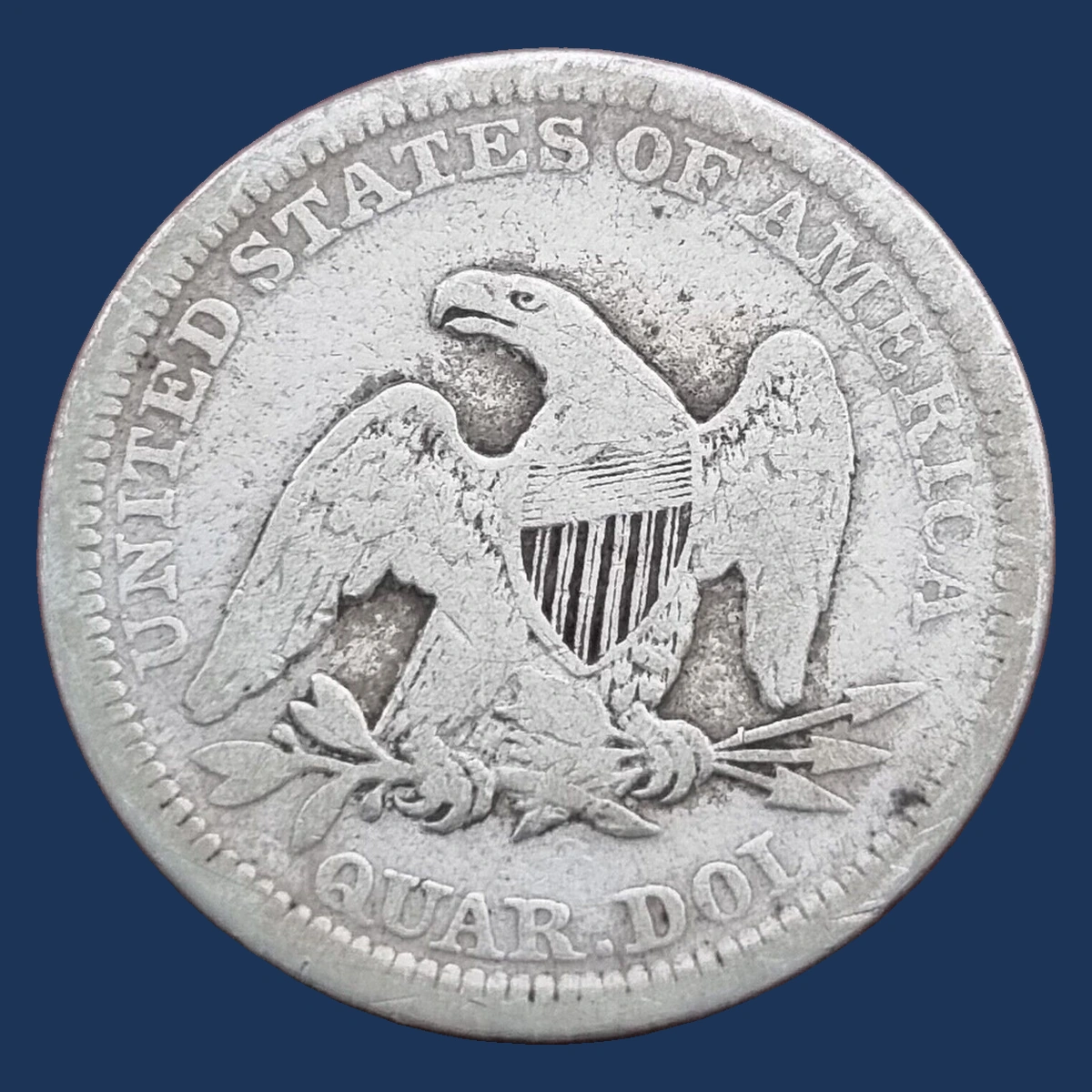
The small O beneath the eagle identifies a quarter made in New Orleans. On some 1860-O quarters, it is unusually faint even though other details remain readable.
An LSCC study of weak mintmarks discusses this problem and warns about misleading shadows. A dark ring alone is not a mint letter.
The weak appearance occurs with particular dies, the steel tools that stamp coins, and stages of their use. Its exact cause should not automatically be called grease filling the tool.
Wear or later cleaning can make an already faint O harder to recognize.
Estimated Value
The main value lies in correctly identifying the New Orleans issue. Estimate $100 to $6,000 for worn through lower-grade unworn pieces, with damage and surface quality affecting the result.
As a whole-coin comparison, PCGS lists an MS64 sale at $3,055 in July 2015. MS64 describes an unworn coin with some visible marks.
A weak letter does not automatically raise the price above a bold one. Attractive surfaces and a secure mint identification matter more than how faint the O looks.
How to Identify
Use two photographs under different light directions to test the apparent O below the eagle. A toning ring changes in contrast, while a surviving letter should have a raised outline.
Check the nearby surface for scraping or smoothing that could have removed part of a letter. Do not rub the area to clear it.
If the letter remains hard to read, compare the complete front and back with identified 1860-O examples. Matching features from the same stamping tools can help when a single close-up cannot.
The grooved side of the coin provides another check for a specialist using published edge studies. These grooves are different from the tiny teeth around the faces; do not count those teeth instead.
Keep a sealed coin in its holder for that review.
Conclusion
A weak O makes the mint harder to read, but it does not turn every unmarked 1860 quarter into a rarity. Compare the faint letter, nearby surface, and both complete faces.
The estimated $100 to $6,000 range covers worn through lower-grade unworn New Orleans pieces. Stronger preservation can bring much more.
When shadows remain misleading, a specialist’s matching of the stamping tools is more useful than a brighter photograph alone.