1873 Quarter Error List with Pictures

A worn 1873-CC quarter with arrows sold for $6,600 in December 2019, without an advertised mint error. That comparison matters when judging a similar worn Carson City coin with peeling metal.
This 1873 quarter error list explains that documented flaw and three reported error types. Estimates for the examples and conditions discussed span $50–$18,000.
First notice the mintmark and arrows beside the date, then use the checks below to examine the unusual feature.
1. 1873 Liberty Seated Quarter Repunched Mintmark
The CC or S below the eagle identifies Carson City or San Francisco. An extra part of the same letter can indicate that the mintmark was entered more than once.
This happened in the die, the stamping tool, before coins were made. A second punch placed slightly differently could leave part of the first impression behind.
The 1873 year guide reports repunched mintmarks without identifying a particular coin or direction. A wide S or two closely spaced C letters alone do not establish this error.
Normal mintmark shapes also vary.
Estimated Value
For a confirmed repunched mintmark on a worn to lightly worn 1873-S quarter, estimate $75–$2,500. Clear extra letter shapes and attractive original surfaces would support the stronger end.
That estimate does not cover rare Carson City quarters or exceptionally preserved coins. Their underlying issue and condition need separate valuation.
A mintmark must show an actual repeated impression to earn a variety premium. Normal differences in letter size, spacing, or style do not justify this estimate.
How to Identify
Find the mintmark below the eagle and identify the letters before examining their edges. A Philadelphia quarter normally has no mintmark, so an isolated lump there is not automatically a repeated letter.
Use a magnifier to compare the S or CC with a normal coin of the same issue. Note whether the apparent extra metal follows a recognizable section of a letter.
A rounded bump can be a small tool break, while corrosion can make the edge rough and irregular.
Take one photograph with the whole mintmark and another showing the raised extra outline. A specialist needs that complete shape to distinguish a repeated letter from an unrelated bump.
2. 1873 Liberty Seated Quarter Doubled Design
A letter or star may carry two closely spaced raised outlines instead of one. When those outlines were already present in the stamping tool, collectors call the result a doubled die.
The tool repeats its doubled detail as it makes more coins. This differs from a coin moving during the strike and developing a flat shelf beside part of the picture.
The 1873 quarter guide lists this type, but does not identify a confirmed front or back pattern. Neither the mint nor the presence of date arrows is specified.
Estimated Value
A confirmed doubled design on a worn or moderately preserved Philadelphia quarter has an estimated range of $50–$2,500. Strong separation across recognizable details would be more desirable than faint thickening.
This is a conditional estimate for a genuine variety, not a price assigned to every thick-looking 1873 letter. Rare Carson City issues and specially made collector Proofs require separate comparisons.
Wear, harsh cleaning, and flat movement doubling can greatly reduce the relevance of that range.
How to Identify
Photograph the suspected doubled feature under two lighting directions, then compare the pictures with a normal quarter of the same issue. Reflections can imitate a second edge, especially on a Proof, a coin specially made for collectors.
Use a 10× magnifier to trace raised separation through neighboring parts of a letter, star, or other design. Normal arrows beside the date and the different shapes of the 3 are not themselves evidence of doubling.
The 1873 report supplies no single confirmed pattern, so keep the exact positions visible in photographs for a specialist. Look for the same arrangement on another coin from that stamping tool, rather than relying on general thickening.
3. 1873 Liberty Seated Quarter Off-Center Strike
A smooth crescent beside a displaced design can show that the blank sat partly outside the stamping tools. The strike then misses part of the blank and pushes some of the design beyond its edge.
The year guide reports off-center 1873 quarters, but gives no exact mint, percentage, or photographed example. The arrowed and non-arrowed designs therefore remain separate possibilities.
An uneven border alone is insufficient. One misplaced stamping tool may shift only one face, while a coin struck without its surrounding collar can spread with its design complete.
Estimated Value
For an authenticated off-center Philadelphia or San Francisco quarter in worn through lightly marked unworn condition, estimate $500–$10,000. A readable date and a clear displacement help support collector interest.
The range is an estimate from comparable early silver striking errors, not an 1873 auction result. A slight shift should not be priced like a dramatic missing portion.
Carson City pieces need their own valuation because the rare date-and-mint combination can outweigh the striking error.
How to Identify
Place images of the front and back side by side. Identify the unstruck crescent and locate where the design runs off the opposite edge on each face.
The two faces should support the same displacement. If the unusual border appears on only one face, compare a misaligned stamping tool instead.
Next check the date and any surviving arrows without filling in missing details by guesswork. Arrows normally accompany the 6.25-gram version; the no-arrows standard is about 6.22 grams.
A scale and calipers can check a loose coin against its issue’s normal weight and 24.3-millimeter diameter. Inspect the edge for cuts or flattening, then return to whether the original strike genuinely leaves design missing.
4. 1873 Liberty Seated Quarter Front Lamination
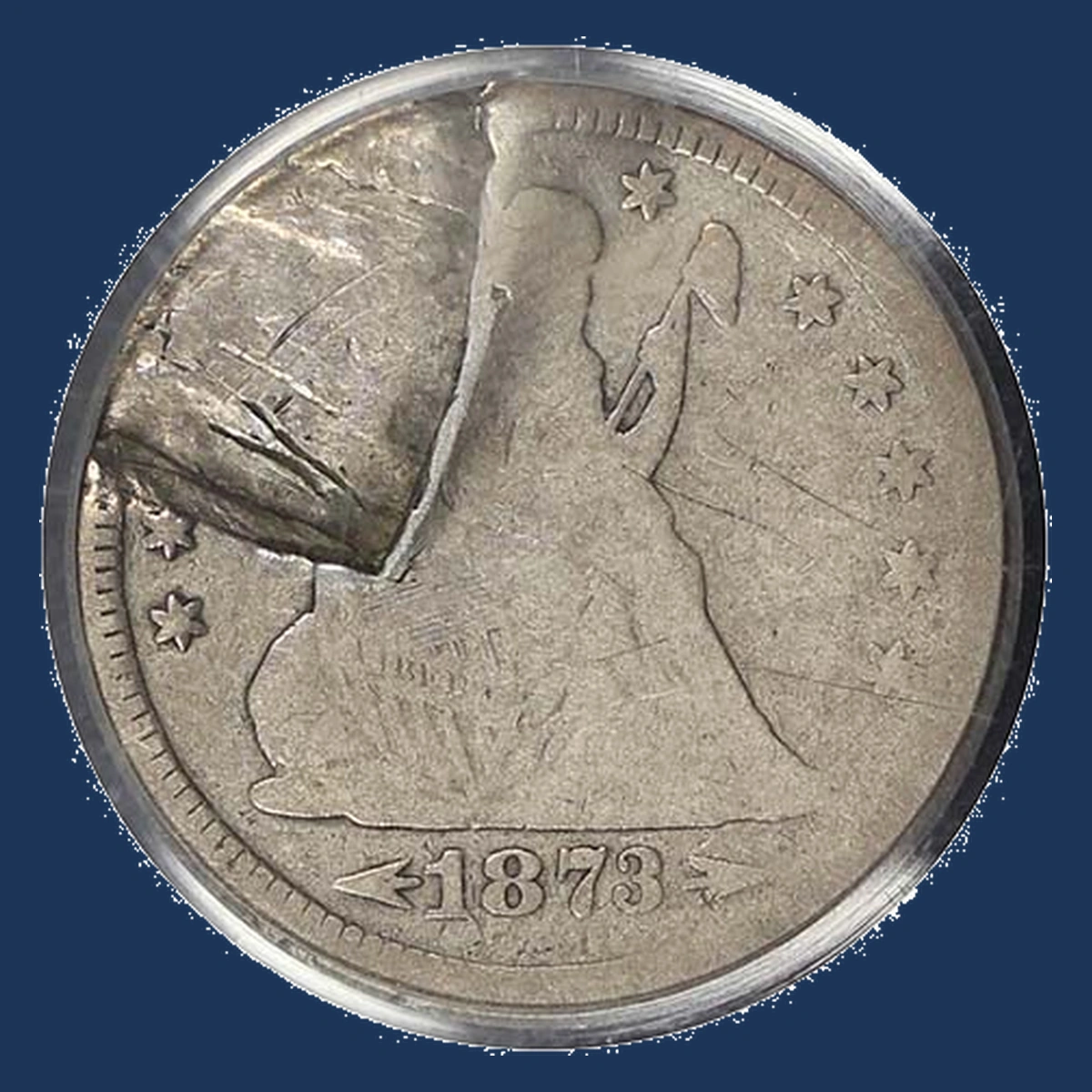
A documented 1873-CC quarter has metal separating on the front. The PCGS label identifies a lamination, a split within the metal from which the blank was made.
This coin belongs to the version with arrows beside the date. It was graded G6, meaning heavy wear with major outlines still recognizable.
A lamination can leave a thin flap, a rough shallow opening, or both. Its cause lies within the silver alloy rather than a deliberately bonded outer layer.
That distinction matters: these quarters are not built like modern copper-centered clad quarters.
Estimated Value
Allow an estimated $5,000–$18,000 for a genuine, heavily worn 1873-CC Arrows quarter with a comparable lamination. Much of that value comes from the scarce coin itself.
For context, Heritage sold a different PCGS G6 Arrows quarter for $6,600 on December 6, 2019. That auction did not advertise a lamination, so it is a normal-coin comparison.
How much original surface survives, the severity of the split, and any later damage will affect the total price.
How to Identify
The CC mintmark and arrows beside the date establish which issue you are examining. The certified coin illustrated in Mint Error News belongs to that combination.
Keep it sealed if it is in a grading holder. A magnifier and low light can reveal a flap or shallow separation through the clear plastic.
Follow the boundary of the affected area and compare it with the published front. Look for a layered opening without probing beneath it or attempting to lift loose metal.
A tool-crack line adds raised metal to the picture, while a lamination separates part of the blank. Scraping may leave cutting marks or displaced metal instead.
The split’s boundary and surviving original surface provide a stronger check than a dark patch in a photograph.
Conclusion
The estimated $50–$18,000 span covers different coins, from commoner issues with confirmed varieties to a worn Carson City quarter with peeling metal. It is not a single price scale for every 1873 quarter.
Keep the arrows, mintmark, and actual surface feature together when making comparisons. Normal differences in the date or mintmark size should not be mistaken for extra impressions or missing metal.