1903 Quarter Error List with Pictures

Do not stop at the four date digits when examining a 1903 quarter. Extra numeral traces may lie beside the normal date or down among the tiny border teeth.
Other 1903 quarter errors change the whole outline, including a broadstruck example graded NGC AU58. Comparable broadstrikes have an estimated $300–$3,000 value.
The full estimated range below is $50–$5,000. Follow the date and edge checks to distinguish these different minting problems.
1. 1903 Barber Quarter Repeated and Misplaced Date Impressions
An extra curve beside a date digit may survive from an earlier position of the date punch. This is called a repunched date, because another impression partly overlapped the first on the stamping tool.
A more widely displaced impression can leave numeral traces down near the small border teeth. That appearance is called a misplaced date.
The lower-border report for 1903 concerns a New Orleans quarter, identified by O on the back. The separate repeated-date report does not establish one particular mint or digit pattern, so the two appearances need their own comparisons.
Estimated Value
Confirmed 1903 date-punch varieties have an estimated whole-coin range of $50–$1,000. Strong recognizable parts of an earlier digit are more appealing than vague thickness or a heavily worn border.
The estimate includes differences in mint and preservation. It assumes the extra shapes belong to an original punch impression rather than scratches or normal border teeth.
A low-looking normal date does not qualify by itself. The additional numeral trace is the feature that needs to be established.
How to Identify
Use the normal date as your starting point, then follow each digit’s edges under a 10× magnifier. A possible repeated impression should form part of a recognizable numeral rather than an isolated bright line.
For the New Orleans misplaced-date report, move down toward the toothlike inner border. Look for extra digit-shaped detail among those teeth, and confirm the O below the eagle on the back.
Compare with an ordinary 1903-O before deciding that an unusual tooth is a numeral. Wear can join neighboring shapes and make a normal border confusing.
Take a photograph that includes both the regular date and the lower area. Their spacing is essential to distinguishing overlapping date impressions from a more widely misplaced punch.
2. 1903 Barber Quarter Broadstrike on a Blank
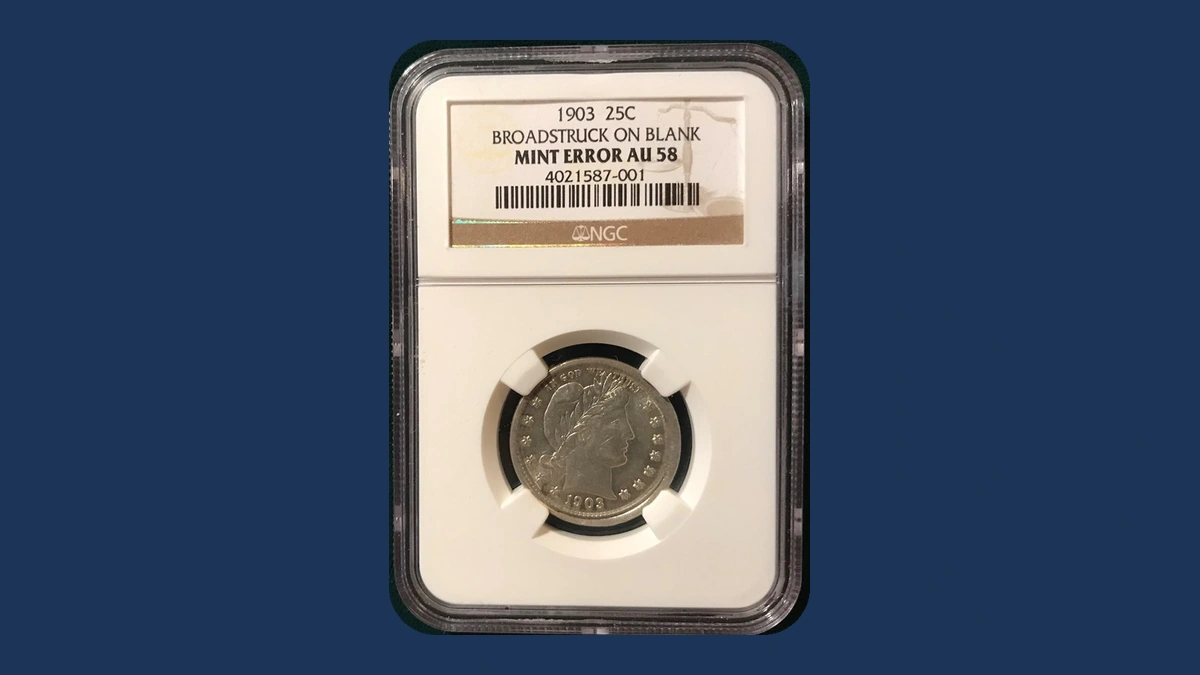
A wide outline can form when the blank, the metal disk used to make a coin, spreads without full restraint from the edge ring. The design remains on the enlarged piece instead of being contained within the usual border.
The VSI collector display includes a 1903 quarter labeled broadstruck on a blank and graded NGC AU58. That grade indicates only slight wear.
The label should be read together with the actual edge and design. It does not provide a measured diameter or establish every detail of how the blank was prepared.
Estimated Value
Estimate $300–$3,000 for a comparable genuine 1903 broadstrike, depending on preservation and the amount of visible spread. The illustrated lightly worn coin shows why clear design can help an expanded outline stand out.
For a later-date comparison, a 1965 Type 1 broadstrike in PCGS MS61 sold for $192 in June 2024. That sale does not establish a price or a blank-preparation subtype for the 1903 coin.
Original surfaces remain important when comparing examples.
How to Identify
Follow the outer letters and stars before focusing on the extra border. They should fit on the expanded metal rather than disappear beyond it as part of an off-center strike.
Look at the edge from the side to see where the normal grooves are absent or altered. A holder photograph may hide that edge, so avoid guessing from the front alone.
For a loose coin, compare the widest and narrowest diameters with the normal 24.3 millimeters. Extra width supports expansion but can also result from hammering after minting.
Inspect the portrait and eagle for crushed detail or impact marks.
Keep the complete outline, surface, and edge together in the comparison; a broad border by itself cannot explain how the coin was made.
3. 1903 Barber Quarter Design Missing the Edge of the Blank
When the blank is not centered between the stamping tools, part of the design can miss the metal. A bare crescent remains opposite the side where the image runs beyond the edge.
An older dealer catalog reproduced in Mint Error News lists a 1903 Barber quarter with this error. The report identifies a Philadelphia example but does not establish its percentage or direction of displacement.
The unstruck area is still part of the coin. That distinguishes the outline from a clipped blank, where some metal was missing before the design was applied.
Estimated Value
Genuine 1903 off-center quarters can be estimated at $500–$5,000. The size of the shift, readability of the date, and preservation of the unstruck metal all affect value.
A different Barber quarter, a 1907-S graded PCGS AU53 with a three-percent shift, is offered at $2,250. That is a current dealer asking price, not a completed sale or a 1903 transaction.
Compare each coin’s mint and condition as well as the visible displacement.
How to Identify
Check both faces to see whether the incomplete designs and plain areas line up. A centered back behind an uneven front may instead indicate a misplaced stamping tool.
Now identify the plain crescent and inspect its surface under low light. An original unstruck area should not contain flattened remains of finished lettering or fresh grinding marks from later alteration.
Carefully read the entire date and keep it connected to the complete outline in photographs. A percentage from another example does not measure this coin’s shift; judge its surviving design, and do not assign a mint from a missing section alone.
Conclusion
Estimated values for the 1903 quarter errors discussed here range from $50–$5,000. Small extra date traces require a different inspection from a coin whose metal spread beyond its normal outline.
Compare raised digit shapes, preserve the complete border in photographs, and check both faces before naming a shifted strike. Each estimate concerns the whole coin, including its mint, wear, and any later surface damage.