1925 Quarter Error List with Pictures

An undated Standing Liberty quarter struck far off center sold for $33,600 in July 2022. Its missing date prevents calling it a 1925 coin, but the sale shows what an exceptional striking mistake can attract.
The 1925 quarter errors discussed here have estimated values of $40–$8,000. Every regular 1925 quarter came from Philadelphia without a mintmark.
Below, compare the reported extra outlines, missing edges, and shifted designs with the checks each one needs.
1. 1925 Standing Liberty Quarter Possible Lamination and Peeling Metal
A thin piece of metal can separate from a coin’s surface like a peeling skin. This is called lamination, and it begins with a weakness within the metal blank.
The flaw may open before or after the design is struck. Its boundary can look ragged rather than neatly cut.
A clearly identified 1925 example has not been established by the available source. This remains a possible error to examine, not a reason to rename every scratch.
The coin is solid silver alloy, containing ninety percent silver. It does not have the separate outer layers found on modern clad quarters.
Estimated Value
For an authenticated 1925 lamination, use an estimated $40–$400. Small surface flakes on worn coins fit nearer the bottom, while a clear, larger separation can draw more interest.
The estimate includes the whole silver quarter. A rough surface caused by corrosion or scraping does not qualify for the same error range.
Preserved design around a peeling area makes the feature easier to understand. An attached flap can be useful evidence and should remain untouched.
How to Identify
Leave any loose flap alone. Lifting it can remove the very edge that helps explain how the surface separated.
Under a magnifier, follow the boundary between intact design and the rough area. A thin layered break differs from a smooth gouge made by a tool.
Tilt the coin to look beneath a raised edge without touching it. Design crossing a weakness can help show how the flaw relates to the original strike.
Check other surfaces for scattered corrosion pits or parallel scrape lines. Those patterns can explain missing metal without a defect in the original blank.
Finish at the flap’s base: look for a continuing thin separation rather than metal piled up by a cut.
2. 1925 Standing Liberty Quarter Reported Doubled Front Design
Extra outlines have been reported around the date, Liberty’s head, and the shield. These areas all lie on the coin’s front.
A doubled die is a stamping tool that already carries a repeated design. The coin can receive those extra outlines in a single normal strike.
The 1925 report does not establish one precise doubling direction or a named, illustrated variety. An apparent second line therefore needs a careful comparison.
The new recessed date design is normal for this year. Neither its lower position nor ordinary weakness on Liberty’s head should be mistaken for doubling.
Estimated Value
Allow an estimated $40–$600 for a correctly identified doubled-front example. Small, lightly separated outlines would usually fit below a clear pattern on a well-preserved coin.
The extra shape should be visible in good close-ups rather than appearing only under one harsh reflection. A thick letter by itself gives little reason for a large premium.
This is an estimated whole-coin range. Strong overall detail, natural surfaces, and confirmation of a doubled tool are the important value factors.
How to Identify
Place the date, head, and shield under magnification one at a time. Check whether an extra raised shape follows an actual digit or design edge.
Then change the light angle and compare a normal 1925 coin. The surrounding date recess belongs on both coins; it is not another outline of the digits.
Look for a flat shelf beside a reduced main shape, which often points to mechanical doubling during the strike. True tool doubling should match a repeated pattern, not just a bright line in one photograph.
Photograph more than one affected detail for an error specialist. A consistent second shape at several related points is more useful than one blurry edge.
3. 1925 Standing Liberty Quarter Clipped Blank
A blank with part of its edge missing can still pass through the press. The resulting quarter has a gap in its outline beside normal design.
For a curved clip, the punch that cuts blanks may overlap an earlier hole in the metal strip. The missing section was therefore absent before the quarter received its picture.
Clipped 1925 quarters are reported, though the exact size and position of a specific gap are not established. The year alone cannot tell you where to look.
Cutting or filing a finished quarter can make a similar outline, so the edge needs close inspection.
Estimated Value
An authenticated clipped 1925 quarter can fit an estimated $50–$700. Larger gaps are often more noticeable, but clear original edge detail is just as important.
A readable date keeps the coin tied to this issue. Heavy damage, cleaning, or a gap that removes most identifying detail can make it less desirable.
Treat this as an estimated range rather than a reported auction sale. A weak rim opposite the gap supports identification but does not create an additional separately priced error.
How to Identify
First establish that the remaining date actually reads 1925. A clipped Standing Liberty quarter without a readable year cannot be assigned here from its general design alone.
For a loose candidate, check the weight on a digital scale against the normal 6.25 grams. Missing metal should reduce it, although wear and later cutting also reduce weight.
Now examine the gap’s surface and endpoints with a magnifier. Saw marks, sharp burrs, and letters sliced through after striking favor later damage.
Look across to the opposite rim for possible weakness from metal flow. Its absence alone does not rule out a clip; inspect how the original design meets both ends of the gap.
4. 1925 Standing Liberty Quarter Clashed E Near Liberty’s Robe
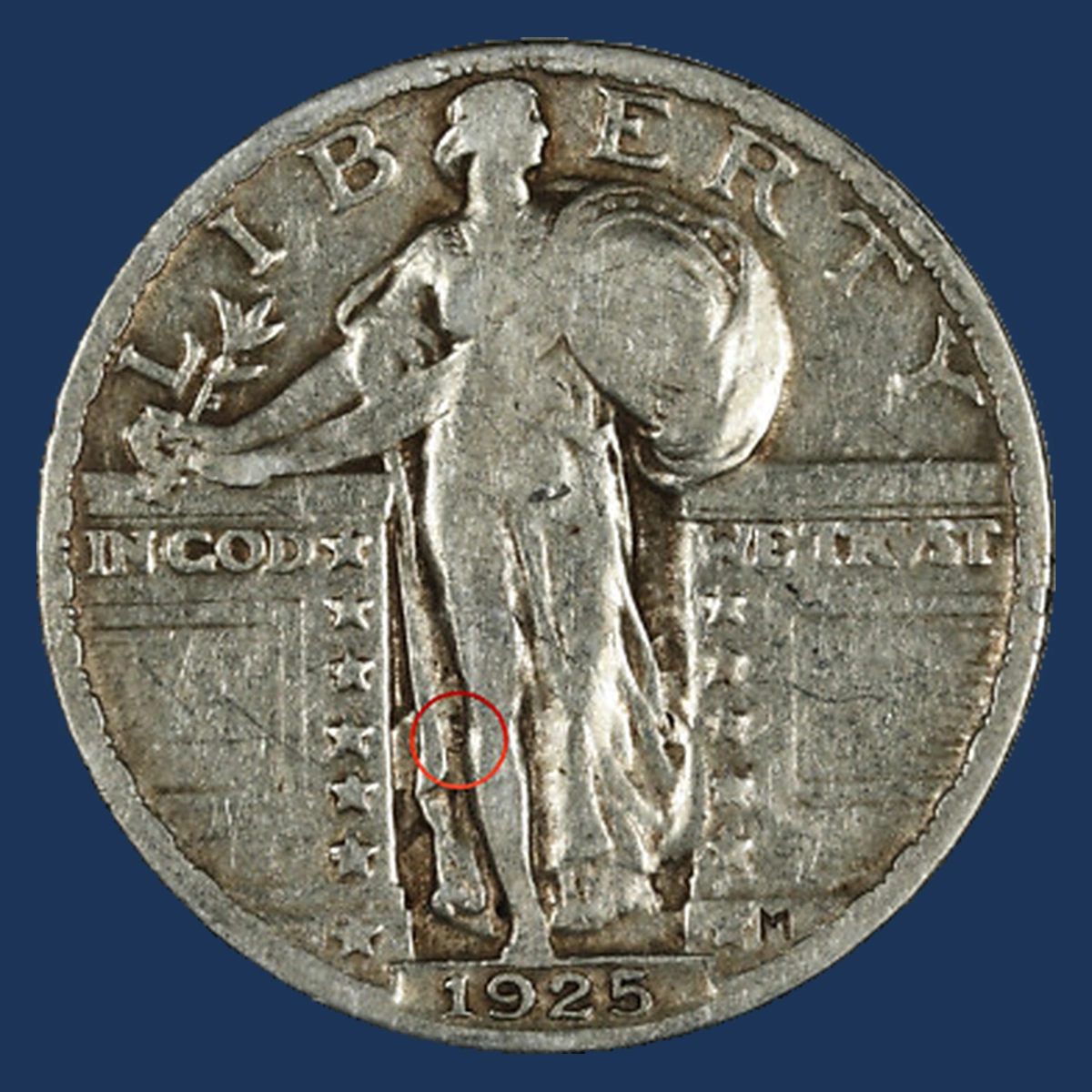
An E-shaped trace near Liberty’s lower robe can belong to the design from the other side of the coin. It is reported near the knee or lower skirt area on 1925 examples.
The tools that stamped the two faces may have struck each other without a blank between them. That collision could transfer part of one design to the opposing tool.
Later coins then received the stray letter shape along with their normal pictures. This is called a die clash.
A seller has listed a worn 1925 example as a clashed E. Its listing is a report, not independent authentication.
Estimated Value
Estimate $40–$1,200 for a genuine 1925 clashed-E quarter, depending on visibility and overall condition. Clear traces on an attractive coin can appeal to collectors of this series.
For a separate-year comparison, a 1929-S clash variety graded PCGS MS66+ brought $2,520 in January 2022. That unusually well-preserved, unworn coin is not the worn 1925 seller example.
The comparison illustrates how strongly grade can affect a whole-coin price. A faint clash does not make every coin worth the same amount.
How to Identify
Locate the knee and lower robe before interpreting any isolated E-like scratch. The reported feature needs to sit within that part of the design, rather than anywhere on the coin.
Compare the shape with the reverse lettering that could have transferred when the tools met. A few random lines do not establish a clash merely because they resemble part of a letter.
Use low side lighting and a magnifier to inspect the trace without rubbing the surface. Follow its outline through the fabric area.
Compare a clearly identified 1925 example and keep ordinary robe folds separate from the stray letter. A matching E outline is more useful than an unexplained scratch nearby.
5. 1925 Standing Liberty Quarter Off-Center Strike
The entire picture shifts when the blank is not properly placed between the stamping tools. Some of the design misses the metal, leaving a blank crescent on the opposite side.
The year’s source reports off-center strikes but does not establish a specific direction or percentage for a dated example. Each candidate must show its own displacement.
An uneven rim alone is not enough. A shifted tool can affect one face while the other remains centered.
A broadstrike can also look uneven while retaining the whole picture. A true off-center strike loses part of the intended design beyond the edge.
Estimated Value
For an authenticated, readable 1925 off-center quarter, estimate $300–$8,000. A modest shift on a worn coin differs greatly from an exceptional, dramatically displaced example.
A Standing Liberty quarter struck thirty-five percent off center sold for $33,600 in July 2022. Its date was missing, and NGC graded it MS65 Full Head, with sharp head detail.
That exceptional undated coin is a series comparison, not a confirmed 1925 sale or a routine price target.
How to Identify
The blank crescent and the lost design should explain each other. Follow the picture to the opposite edge and see which parts ran beyond the metal.
Turn the coin over next. Both faces should fit the misplaced blank, rather than only one tool’s picture shifting within an otherwise normal coin.
Inspect the empty surface under a magnifier. Flattened lettering, grinding scratches, or a polished patch can reveal a finished design that somebody removed.
If the coin is loose, calipers can record its outline against a normal quarter of about 24.3 millimeters. That measurement describes its shape; the visible loss of design establishes the off-center feature.
Read all four date digits before calling it a 1925 example.
Conclusion
These estimates span $40–$8,000, from small confirmed surface or die features to a substantial dated off-center strike. Remember that 1925 quarters normally lack a mintmark and have a recessed date.
Match the suspected error to its cause: repeated tool outlines, transferred reverse lettering, a missing piece of blank, peeling metal, or misplaced striking. Clear photographs of the date and affected area make each comparison more useful.