1967 Quarter Error List with Pictures

Copper color helped set apart a 1967 quarter that sold for $2,115 in September 2013. Its Washington-and-eagle design had been struck on a blank intended for a penny.
1967 quarter errors range from small doubled details to unusual metal and paired pieces. Estimated values below run from $20–$15,000, with the highest range reserved for authenticated silver-blank coins.
No mintmark is normal this year. Read on to separate real striking faults from ordinary features and later damage.
1. 1967 Washington Quarter Clashed Designs and a Coin-Edge Impression
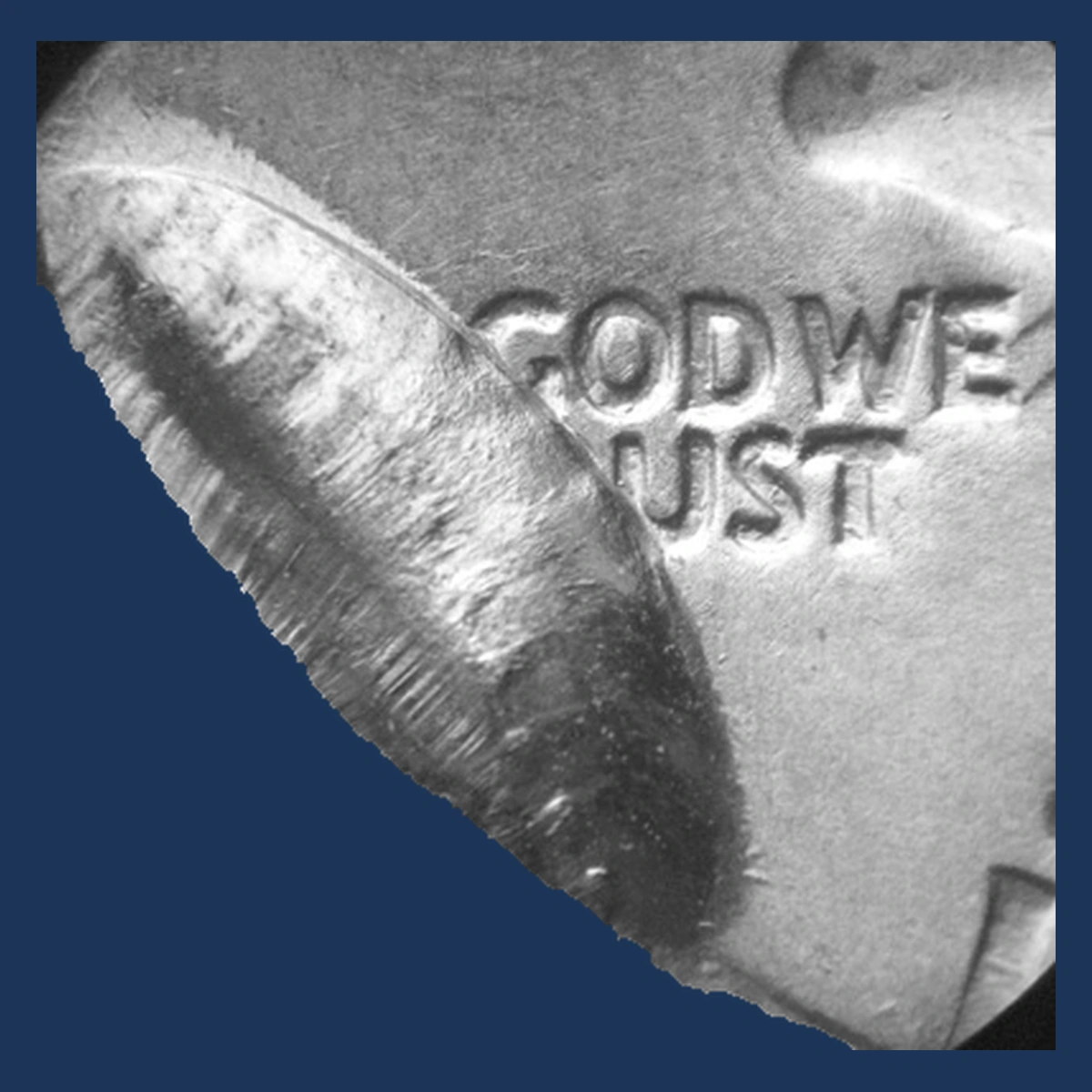
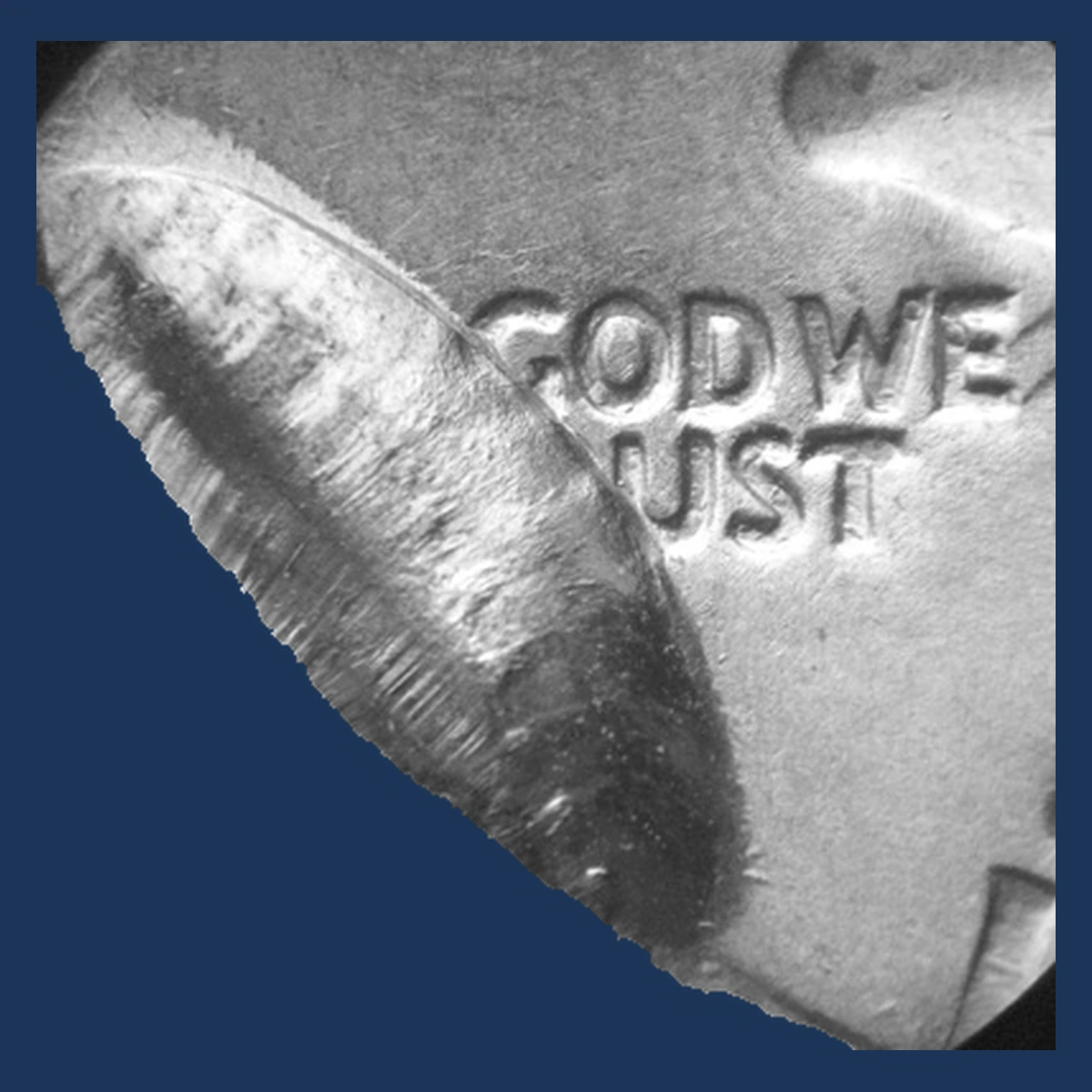
Wing shapes beside WE belong to the eagle, not to Washington’s normal portrait. They can appear after the two dies, or stamping tools, collide without a blank between them.
The ADC-25c-1967-01 example shows two misplaced clashes and a shifted front tool. Other traces include feathers behind the hair ribbon and parts of Washington’s face near the eagle.
A toothed impression beside IN GOD WE TRUST records contact with another struck coin’s edge. That mark differs from the transferred design lines, so a plain dent or random scratch cannot explain the whole combination.
Estimated Value
For a clearly matched example, estimate $20–$300. Strong, recognizable transferred features are easier to collect than a few faint lines that require a long explanation.
The toothed impression can add interest when its original surface remains clear. This range applies to the combined features on the coin, rather than assigning a separate price to each clash, shifted design, and edge impression and adding them together.
How to Identify
Find WE under a 10× magnifier and compare the unusual outlines with the tops of the eagle’s wings. Then inspect the area behind Washington’s hair ribbon for feather-like traces.
On the reverse, look below and left of the beak for Washington’s neck and chin outline. A nose-shaped trace lies above and left of the arrow tips.
The impression beside the front motto needs a separate check: look for repeated edge teeth within it. A smooth depression does not show that contact.
Photograph both faces under angled light. The named combination requires these related shapes in their matching positions, including the toothed mark beside the motto.
2. 1967 Washington Quarter Off-Center Strike
A bare area beside a partly missing picture points to a blank that sat away from the center of the press. Washington and the eagle are then struck partly beyond the available metal.
The 1967 off-center type appears in year listings, without one established direction or percentage for every example. A candidate therefore needs its own clear photographs of both faces.
Do not confuse it with a shifted front tool. That can make Washington look off center while the eagle remains centered, whereas a misplaced blank affects the position of both designs.
Estimated Value
A working estimate is $25–$400 for an identifiable 1967 off-center quarter. A clear date and an attractive unstruck crescent can matter more than a very large displacement that loses the year.
A later comparison is a 1988-P quarter struck 30% off center, graded ANACS MS63. It sold for $109 in January 2022; that price describes the later coin and gives context for the estimated range here.
How to Identify
A shifted Washington portrait with a centered eagle points toward one misaligned tool. Start by comparing the two faces, keeping photographs upright so a tilted camera does not exaggerate the shift.
For an off-center strike, find where both designs miss the metal and where the blank remains untouched. Under a magnifier, that bare area should lack sanding grooves or flattened traces of letters that were once there.
Measuring the remaining design is useful only after these surfaces make sense. Read the date within the struck area, then photograph the border where clear design meets the original blank crescent on each face.
3. 1967 Washington Quarter Missing Front Clad Layer
The Washington side of this quarter exposes copper where a pale outer layer should be. A normal clad quarter has copper-nickel sheets bonded to a copper center.
The documented NGC MS63 example weighs 4.7 g, below the normal 5.67 g quarter standard. Its missing front sheet accounts for a physical loss of metal, not just a change in surface color.
Brown staining can look similar in a photograph. A convincing example must show that a layer is absent, with the remaining metal and edge supporting the explanation rather than chemical damage or copper plating.
Estimated Value
The NGC MS63 example sold for $139 in December 2022. MS63 means the coin has no circulation wear, although noticeable marks may remain.
Estimate $50–$500 for a comparable 1967 missing-layer quarter. The extent of the loss, surviving detail, and freedom from corrosion influence where a coin fits.
An attractive exposed copper face can be desirable, but brown color without actual layer loss does not qualify for this range.
How to Identify
A digital scale gives an immediate useful comparison for a loose candidate: normal quarters weigh about 5.67 g, while the illustrated example weighs 4.7 g. Keep a sealed certified coin in its holder and use its recorded weight.
Weight alone does not identify the missing material. Inspect the edge under a magnifier and follow the remaining pale outer layer around the copper center.
Now compare that structure with the exposed front face. Look for scraping through completed letters, heavy corrosion, or an added surface coating that could explain the appearance differently.
The copper-colored Washington face must agree with a genuinely absent sheet and the lower weight.
4. 1967 Washington Quarter Struck Through Thread or Other Material
A thread caught between a blank and the tool can leave a narrow sunken path through the design. An ANACS MS65 example comes from a Special Mint Set, or SMS, made for collectors.
Another ordinary 1967 quarter has a much larger blocked area on its eagle side. That NGC MS64 piece has a different shape of obstruction, and the material responsible is not identified.
These are two coins. Neither a thread-shaped groove nor a broad weak area automatically proves grease was involved, and the SMS finish should not be called a regular Proof finish.
Estimated Value
Estimate $30–$600 across genuine 1967 thread and broader struck-through examples. Fine thread impressions generally fit lower portions than a large, unmistakable obstruction with sharp surrounding detail.
For context, a 1976 quarter struck through cloth, graded NGC MS66, sold for $881.25 in January 2017. Its visible fabric pattern and different grade make it a stronger comparison than a shallow unidentified mark, rather than a direct price for the 1967 SMS coin.
How to Identify
Follow the narrow mark from end to end under a magnifier. A thread impression should lie below the surface and interrupt the design, rather than sit above it like a tool crack.
A scratch can also be sunken, so inspect its sides for fresh displaced metal or sharply sliced letters. Do not drag a pin through the mark.
For the separate eagle-side example, study how the larger blocked patch meets clear surrounding feathers and lettering. Its shape can establish an obstruction without revealing exactly what material caused it.
Check the collector-set identity before using an SMS price comparison. In the thread example, the key visible clue remains a thin recessed path crossing otherwise normally struck detail.
5. 1967 Washington Quarter Raised Front Die Break
An extra lump on the front can form when part of the stamping tool breaks away. Metal flows into the newly opened space, producing a raised area where the normal design should have been.
A certified NGC MS65 example carries the identification WQC-67-1A. Its exact outline must be matched to that variety’s photograph, rather than treating every 1967 lump as the same break.
This happens during manufacture. Metal pushed inward by a later rim blow, a spot of solder, or dirt stuck to the surface can create bumps with a different cause and value.
Estimated Value
The WQC-67-1A example graded NGC MS65 brought $372 in December 2022. That grade describes an unworn coin with relatively few marks.
Estimate $50–$750 for clearly identified 1967 front die breaks, allowing for size, shape, and condition. An obvious raised area interrupting the design can attract more interest than a tiny bump.
The auction price belongs to the named example; a different outline should receive its own assessment.
How to Identify
Compare a clear WQC-67-1A photograph with the complete raised outline on your coin. Use the nearby portrait details and letters as fixed points, so a similar-looking lump elsewhere does not mislead you.
With a magnifier and angled light, inspect the boundary for a seam, different texture, or loose material attached to the surface. A broken stamping tool leaves solid coin metal filling its missing area, rather than a substance added on top.
An impact can push metal inward from a flattened rim and disturb nearby letters. Keep the surface untouched, and match the break’s boundary and neighboring design to the named photograph before using its auction price.
6. 1967 Washington Quarter Clipped or Elliptical Blank and Collar Combinations
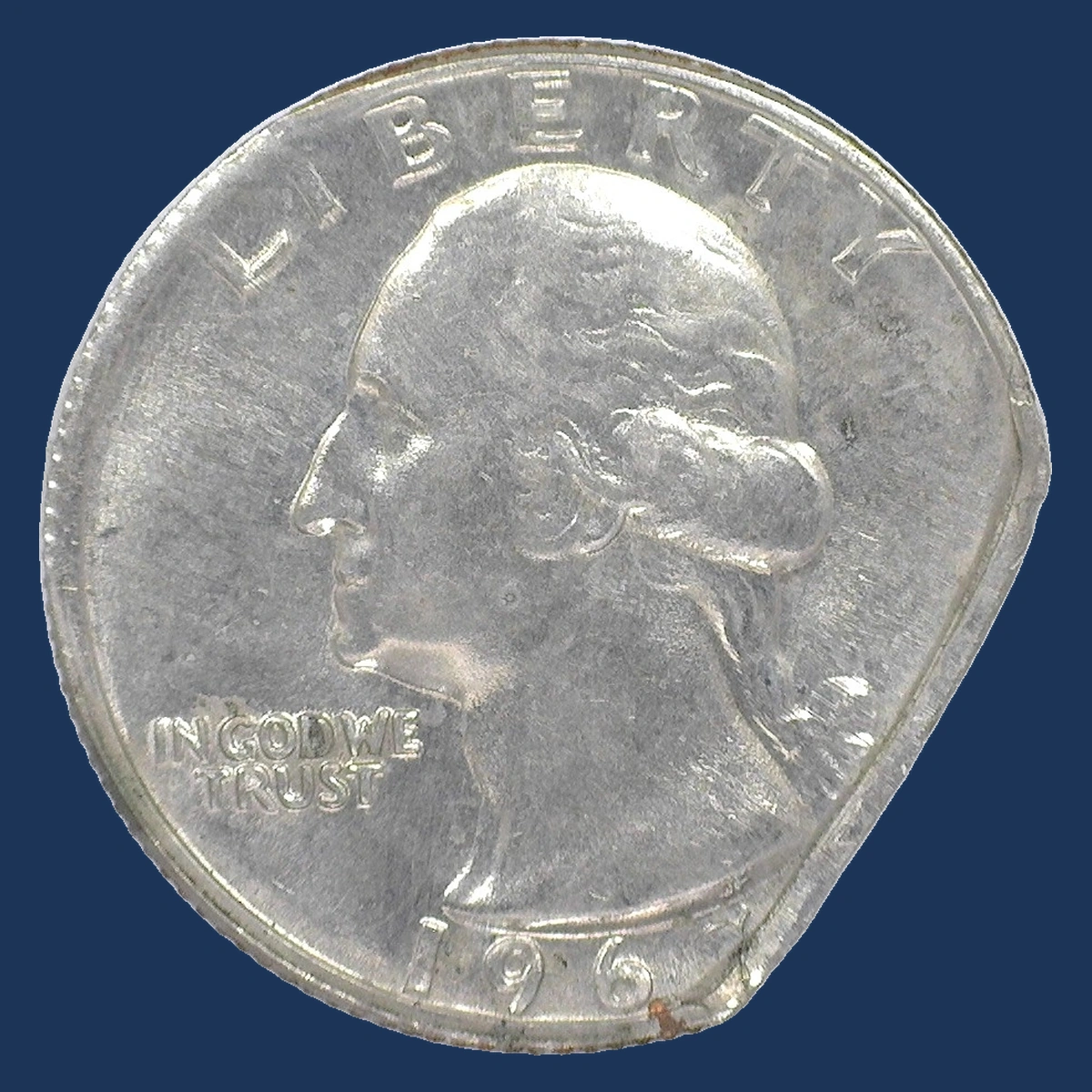
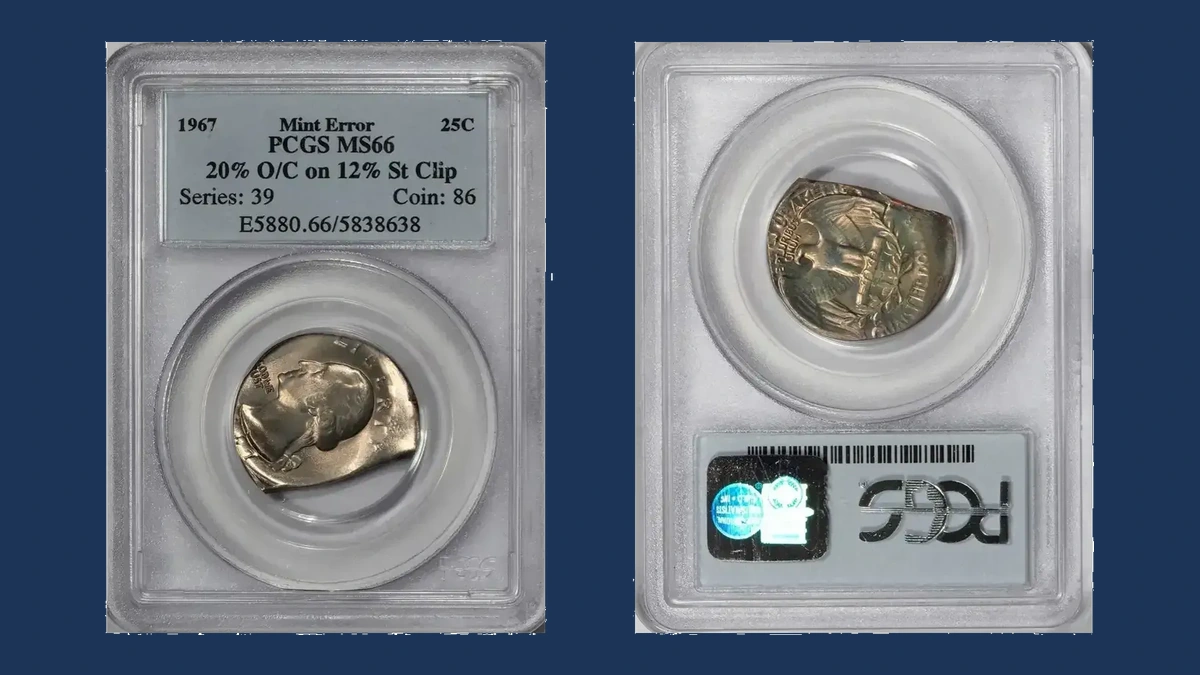
Several 1967 quarters show incomplete blanks, ranging from straight gaps to two or three curved clips. Another has an elliptical outline, meaning it is oval rather than normally round.
Some also spread beyond the collar, the ring that limits a quarter’s edge during striking. Others show a stepped edge because only part of the blank entered that ring.
A 21% straight-end clip was struck on a Type One blank, which had not received its raised rim before striking. The term describes blank preparation, not a separate 1967 design or a dated unstruck disc.
Estimated Value
July 2021 sales included a straight clip at $79, double curved clips at $144, and a triple-clip partial-collar coin at $84. These were separate NGC-graded coins.
The PCGS MS64 elliptical example brought $74, while a PCGS MS65 45% clip with broadstriking brought $94 in that sale.
Estimate $20–$800 across the group, depending on original surfaces, shape, and condition. Multiple visible faults do not require adding separate prices together.
How to Identify
Trace the entire edge before counting gaps. Straight missing sections and curved clips can have different outlines, but each needs original struck metal around its ends.
Use a magnifier to look for fresh file marks or letters cut after striking. Weigh loose examples: two different documented coins, the straight clip and the ellipse, each weigh 4.4 g.
That shared weight does not make them the same shape. The separate straight-clip partial-collar coin weighs 3.2 g.
View stepped edges from the side to separate a partial collar from simple flattening. On expanded examples, check how the complete surviving design meets the widened border.
The oval example needs its original edge preserved; its outline alone does not prove that the metal gradually becomes thinner.
7. 1967 Washington Quarter Doubled Front and Reverse Varieties
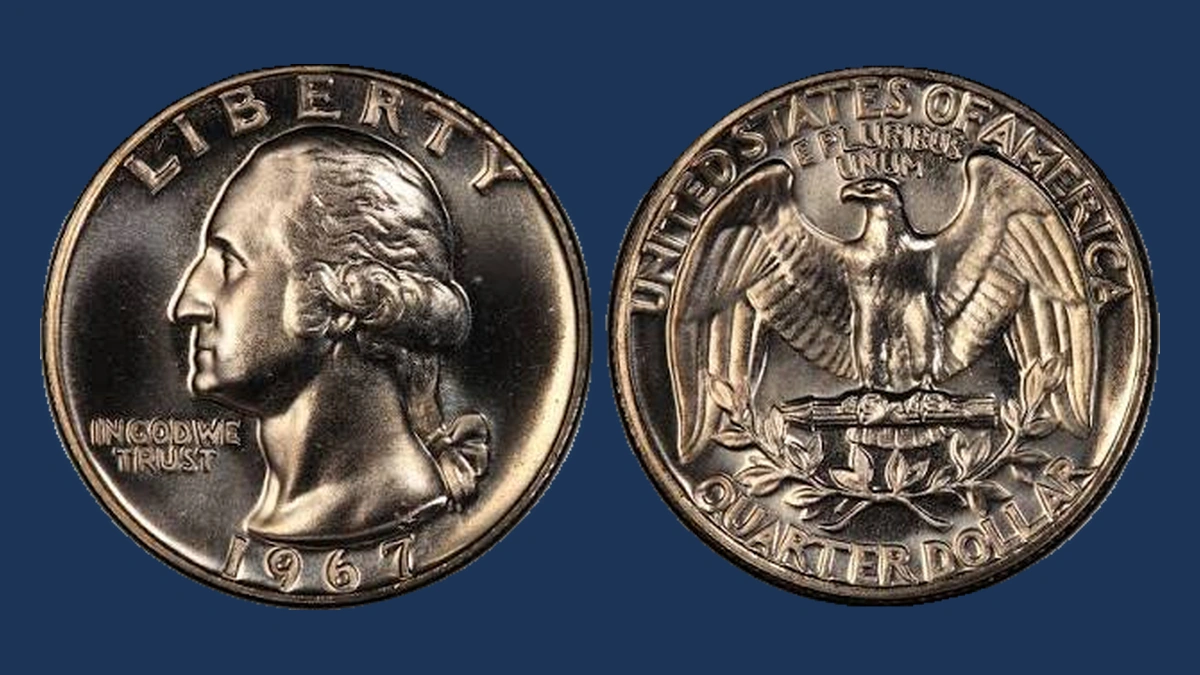
Extra outlines in LIBERTY, the date, or the eagle-side words can be built into the stamping tool itself. Each coin struck by that doubled die can repeat the same affected details.
The named 1967 varieties include five front patterns and five reverse patterns. Some can occur together, while others belong to separate tool pairs.
The SMS FS-101 variety doubles front lettering and other portrait details. SMS FS-801 affects the denomination and branches on the back, while other listed patterns differ in position and direction rather than representing additional blows to the coin.
Estimated Value
PCGS records an SMS FS-101 graded SP68 at $431 in September 2016. Its listing for SMS FS-801 records an SP67 example at $224 in June 2019; both are reported eBay results.
Estimate $20–$1,000 across identified varieties and grades. Strong separation, correct identification, and attractive surfaces matter more than a general doubled-letter label.
Collector-set finish and condition remain part of the whole coin’s value.
How to Identify
For a possible FS-101, examine LIBERTY, IN GOD WE TRUST, the date, and the eyelid with a 10× magnifier. Compare the repeated outlines with the SMS variety photographs.
FS-801 calls for a different route: start with QUARTER DOLLAR and the branches below the eagle. Its supporting marks include a large raised mark beneath LIBERTY’s L, near brow height.
The illustrated variety listings also separate smaller patterns. Front WDDO-003 and WDDO-004 both affect LIBERTY but have different nearby tool marks.
Do not label every example SMS when its finish is not established. Match several doubled details to one complete pattern, rather than combining convenient features from different photographs.
8. 1967 Washington Quarter Struck Through a Capped Die
A very soft, distorted design can develop when an earlier coin sticks to a stamping tool. That trapped coin forms a cap between the tool and later blanks, blocking or weakening the normal image.
The capped-die type is reported for 1967, but the year report does not establish a particular certified example. Its appearance needs more than a general resemblance to a weakly struck quarter.
Wood-like streaks or uneven color are not enough. A cap affects how the design reaches the metal, while staining changes color and circulation wear gradually removes already raised details.
Estimated Value
For an authenticated 1967 capped-die strike, use an estimated $150–$1,200. The range favors clear distortion that can be explained by a trapped coin over the tool.
A shallow, weak-looking image belongs near the lower end only after its cause is established. A dramatic affected face with original surfaces may draw more interest.
This estimate is conditional on identifying the mechanism; an ordinary worn quarter with streaky color does not receive the same value.
How to Identify
Compare the affected face with the other side before looking at color. A covered tool can weaken one design while the opposite tool still produces a much clearer impression.
Examine the portrait and outer words with a magnifier. Look for smoothly weakened or stretched design, rather than scratches that simply remove raised areas.
Worn coins usually lose their highest points first. A capped-tool effect follows how the covering metal blocks the strike, so the distribution of weakness matters.
Check both surfaces for signs of deliberate flattening or chemical attack.
Have a specialist assess a convincing candidate against confirmed capped-die examples. The deciding feature must be a blocked and distorted struck image, not a wood-like color pattern.
9. 1967 Washington Quarter Broadstruck Coin and Matching Clad-Layer Brockage
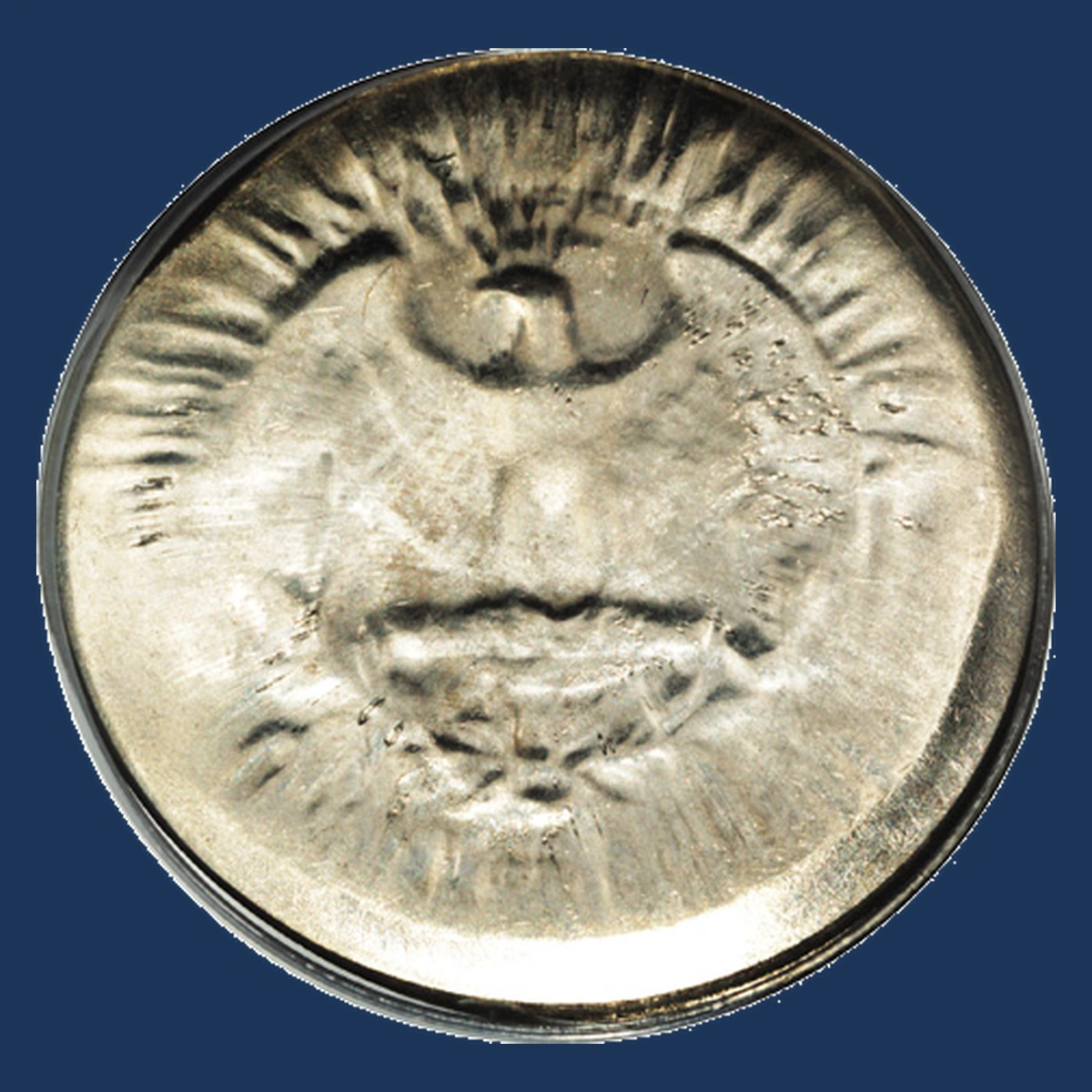
These two pieces explain each other. The main quarter has an expanded outline and a weak eagle side, while the thin companion carries a sunken mirror image of that reverse.
The mirror image is called a brockage. It formed when the quarter’s struck design pressed into the separate outer-layer sheet rather than another blank receiving only the normal tool design.
The pair apparently entered the press together and prevented the collar from containing the metal properly. The companion has no date of its own; its relationship with the dated quarter connects it with 1967.
Estimated Value
The PCGS-graded pair sold together for $1,638.75 in April 2008. The quarter was MS64, and the separate clad sheet was MS62.
For an intact, convincingly matched pair of this kind, estimate $1,000–$3,000. The amount concerns both pieces together, not the value of either one alone.
Keeping the matching sheet matters because it helps explain the quarter’s weak reverse and preserves the physical evidence of their shared strike.
How to Identify
The separate sheet should carry a sunken mirror image of the eagle side. Angle the light while using a magnifier to check that its lines are recessed rather than raised.
Compare that reversed image with the dated quarter’s weak reverse. Their corresponding details should explain why the quarter failed to receive a normal sharp impression.
Now look at the expanded outer lettering and the outlines of both pieces.
A matching pair requires more than two unusually wide coins. Photographs at the same scale help compare the parts without handling their surfaces.
Leave certified pieces in their holders instead of trying to fit them together. Match the sheet’s mirror-image features directly to the quarter’s weak eagle-side design.
10. 1967 Washington Quarter Wrong Penny, Nickel, Dime, or Silver Blank
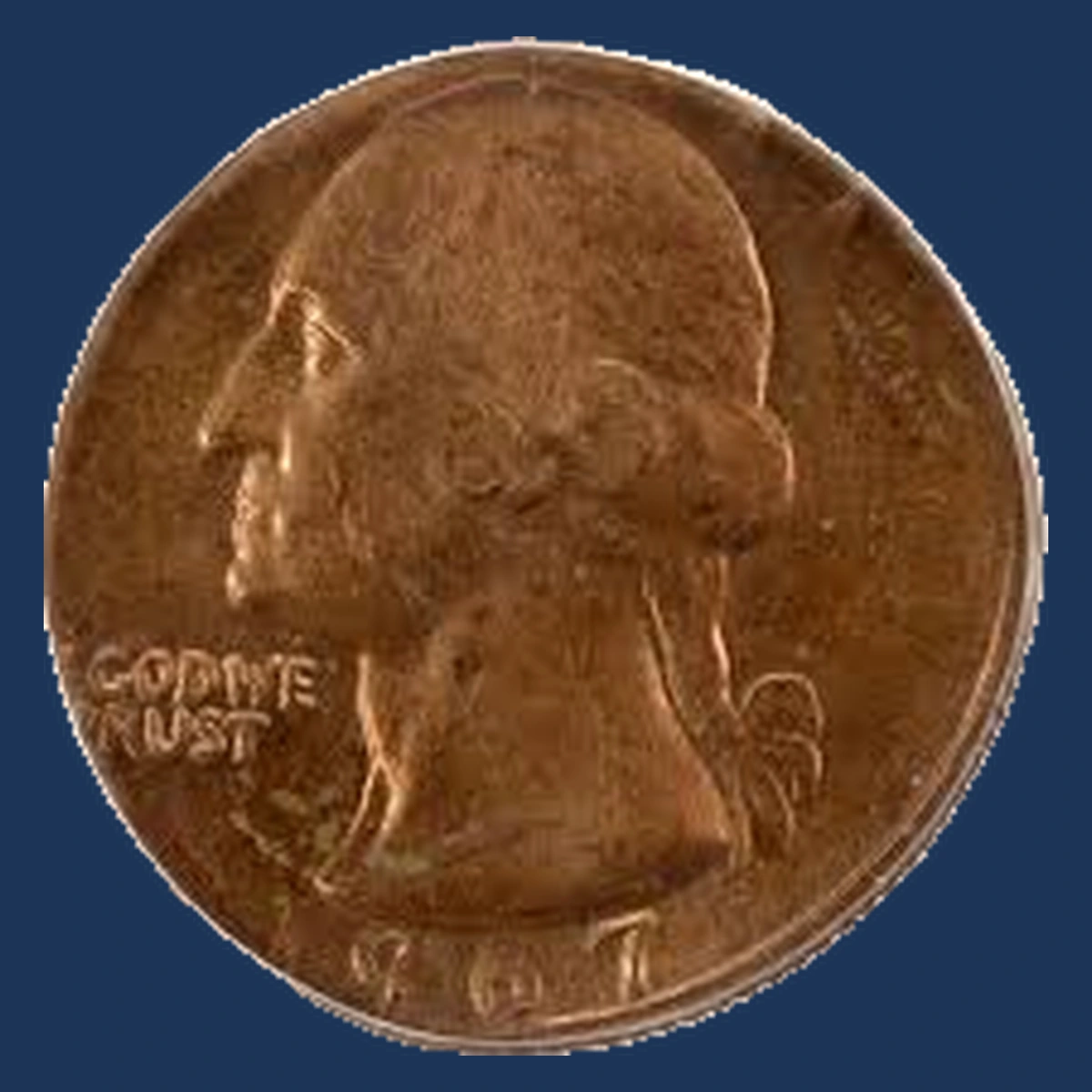
A quarter’s design can land on metal intended for another coin. Documented 1967 examples use penny, nickel, and clad dime blanks, producing different colors, widths, and missing outer letters.
One penny-blank example also received two strikes. Its actual weight is 3.1 g, separate from another penny-blank coin recorded at 3.2 g.
A different error used an older ninety-percent-silver quarter blank. An ANACS AU58 Details example had been cleaned.
Ordinary 1967 quarters and SMS coins use copper-nickel outer layers over copper. Silver is not a normal version of this issue.
Estimated Value
The PCGS MS65 penny-blank coin brought $2,115 in September 2013. A separate twice-struck penny-blank example sold for $1,560 in December 2022.
Estimate $150–$3,000 for identified penny, nickel, and dime blanks, and $5,000–$15,000 for authenticated silver-blank quarters. The combined range is $150–$15,000.
The cleaned silver example needs its own condition allowance; its catalog appearance does not supply a disclosed sale price for that coin.
How to Identify
A penny-blank example can show Washington and the eagle while stretching the partial date toward the edge. On the nickel-blank AU50 example, look instead for displaced design and distorted RTY in LIBERTY.
For loose coins, use a scale and calipers: penny blanks normally start near 3.11 g and 19.05 mm, nickels near 5 g and 21.21 mm. Clad dime blanks start near 2.268 g and 17.91 mm.
Striking can change width. The actual 3.1 g twice-struck penny example needs two overlapping impressions as well as the correct metal.
Silver candidates need a nondestructive alloy test, not a scratch test. The older quarter standard is 6.25 g and ninety-percent silver; color or sound alone cannot establish that identity.
Conclusion
A missing mintmark is expected on a 1967 quarter, but missing metal or a repeated design deserves a closer look. Estimated values across these groups range from $20–$15,000.
Keep ordinary coins, Special Mint Set coins, and wrong-metal examples separate when comparing prices. Start with the specific visible feature, then use matching photographs or a measured metal check to decide whether the comparison fits.