1985 Quarter Error List with Pictures

Two 1985 quarters can explain one minting accident. A matching Philadelphia pair sold together for $1,725 in April 2008, preserving the places where the coins contacted each other.
This 1985 quarter error list also covers missing metal, repeated strikes, and coins made on the wrong blank. Estimated ranges extend from $5–$15,000, with rare wrong-metal claims requiring authentication.
Follow the visible features below to distinguish a small surface mark from an error affecting the entire coin.
1. 1985 Washington Quarter Reported Doubled Design Details
Small repeated outlines may appear beside the motto, LIBERTY, or Washington’s hairline. Back-design reports point to the eagle’s neck and wing tips, the country name, and E PLURIBUS UNUM.
A doubled die is a steel stamping tool carrying extra design detail before the coin is struck. The same pattern can therefore appear on several coins.
The front reports mainly concern Philadelphia, with Denver also mentioned. The back report does not establish a specific mint.
No fixed catalog pattern is established for these examples. A thick-looking letter needs more evidence than a bright close-up photograph.
Estimated Value
For a confirmed 1985 doubled-tool variety, estimate $5–$300. Strong separation at recognizable details would support more interest than a barely visible thick edge.
The range is conditional on identifying a genuine repeated pattern. It does not give an error premium to every coin showing a flat shelf beside a letter.
Wear and scratches can hide the tiny shapes needed for comparison. A clear, original surface lets another collector follow the same features and understand the identification.
How to Identify
Photograph the whole affected face first, including the date and any readable mint letter. Keep a suspected Denver pattern separate from a Philadelphia example.
Choose two nearby letters in LIBERTY or the front motto and examine them with a 10× magnifier. Look for rounded extra contours or split corners rather than one broad shiny edge.
Turn the light while holding the coin still. A reflection changes with the light, while a real extra stroke remains in the metal.
For the back, compare the eagle’s neck and wing tips with a normal quarter. Feathers already contain lines, so follow their actual shapes before calling any line an extra image.
A variety specialist can then compare the repeated details with documented examples.
2. 1985 Washington Quarter Half-Turn Design Alignment
The eagle can remain upside down after Washington is flipped from top to bottom. A half-turn difference between the stamping tools produces that unusual relationship.
A collector reported a 1985-P example, and error specialist Mike Diamond stated that he owned another with the same 180-degree alignment. The accounts concern the same kind of rotation.
They do not prove which tool moved or exactly when it did so. The physical relationship between the two designs is what can be checked.
Two separately straightened photographs hide this feature. The turning motion must preserve the coin’s original orientation.
Estimated Value
A genuine 180-degree rotation has an estimated range of $20–$300. Its appeal comes from an obvious, repeatable difference between the two faces.
The collector reports do not supply a completed sale price. An unworn surface and a clearly demonstrated half-turn make a coin easier to compare with other rotated-design errors.
A coin moving inside its holder or two photographs taken in different positions can create a false appearance of rotation. The estimate requires the actual alignment to be confirmed.
How to Identify
Hold Washington upright against a fixed background, then turn the coin from top to bottom around a horizontal axis. Do not twist it sideways during the motion.
A normal quarter should show its eagle upright after that flip. Compare another quarter if you need to check the motion.
If the eagle remains upside down, repeat the test and photograph both positions without separately rotating the images. Include the P and readable year.
Inspect the edge for an added seam or evidence of a novelty coin assembled from two pieces. A specialist can judge the continuous coin and its face alignment together before confirming a mint-made half-turn.
3. 1985 Washington Quarter Local Peeling or Split Metal
A small flap can lift from the surface while the rest of the quarter looks normal. The metal may have separated along a weak area during blank preparation or striking.
The 1985 report calls this lamination, a term used for peeling or splitting metal. It does not establish the exact mint, face, or shape.
Clad quarters also have bonded outer layers, so a local peel needs its own explanation. It should not automatically be treated as the same coin as a whole missing-face layer.
An attached flap, shallow opening, and nearby design can help show how the separation developed.
Estimated Value
Estimate $10–$350 for an authenticated local peel or lamination. A small shallow opening usually offers less visual interest than a larger attached flap with clear original design.
This estimate concerns the local defect described here. A complete missing outer layer belongs to its own comparison later in the guide.
The original boundary matters more than the size of a brown patch. Scrapes, corrosion, and attempts to lift the metal can reduce both the evidence and the coin’s appeal.
How to Identify
Do not lift the loose metal. Move the light instead, using a low angle to reveal where the flap remains attached.
Follow any letter or portrait detail across the loose piece and onto the surrounding surface. A continuous part of the original design can help explain the relationship between them.
Take a second photograph from the opposite lighting direction, then include the complete back. A local peel on one face does not establish that an entire outer layer has separated.
Look around the opening for scrape marks, dents, or a sharp fold from later interference. Leave loose fragments with the coin so a specialist can examine the separation without losing its original context.
4. 1985 Washington Quarter Grease-Blocked Design
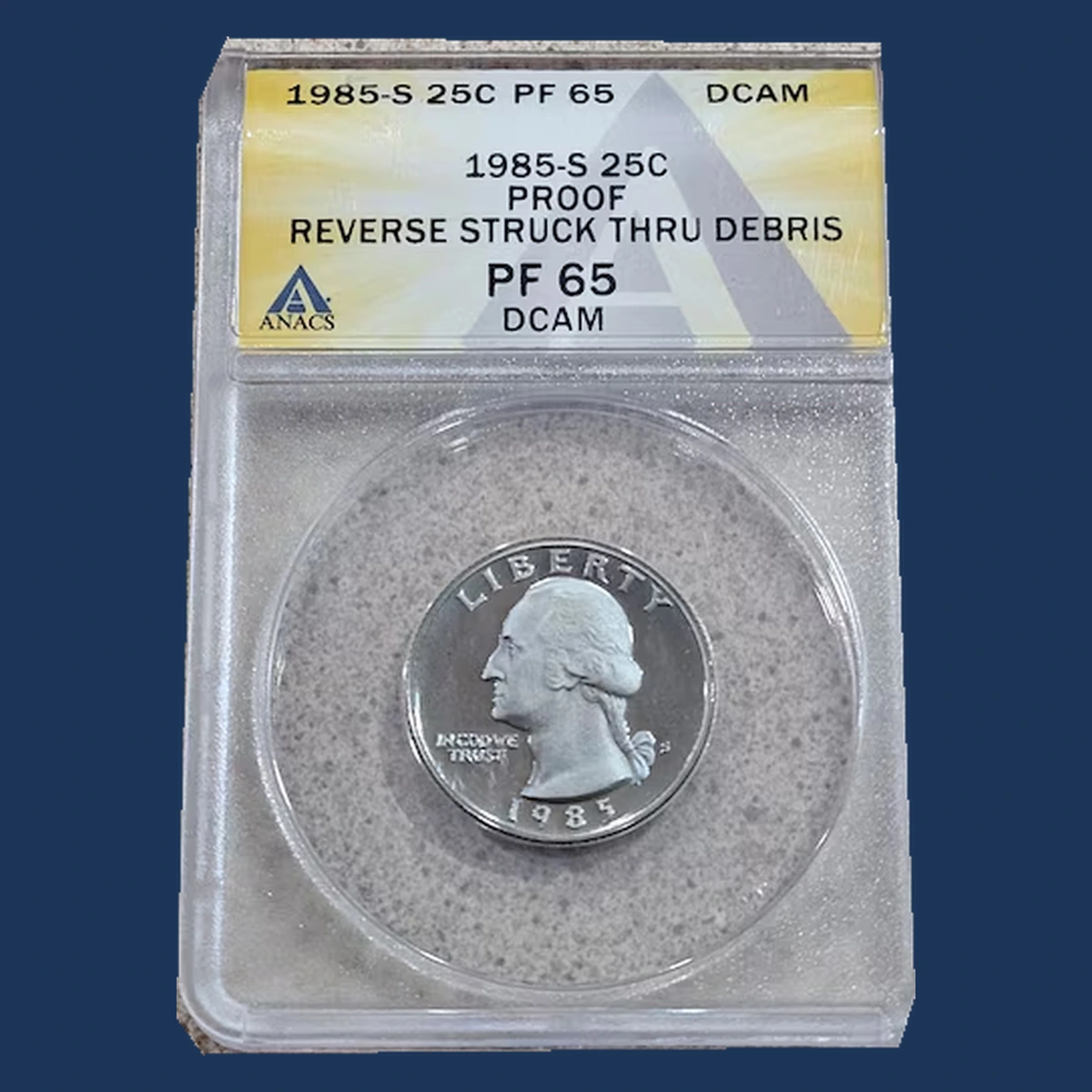
Weak letters or softly formed feathers can appear beside sharper parts of the design. Material in the stamping tool’s recesses can prevent those details from forming fully.
The 1985 reports describe grease-related weakness at the front motto and hair, as well as the eagle’s breast. Philadelphia and Denver ordinary strikes are mentioned.
The shape alone cannot identify grease with certainty. Wear, low striking pressure, and tool polishing can also soften parts of a quarter.
A letter that resembles a different letter is not automatically a new variety. First explain why the expected strokes are missing.
Estimated Value
For genuine blocked-design errors, use an estimated $5–$500 range. A small weak letter belongs near the lower end, while a large clear interruption can attract more interest.
Sharp detail beside a blocked patch shows the interruption clearly. That contrast is more useful than an extreme enlargement of one weak letter.
A weakly photographed feather or heavily worn motto is a poor comparison. Preserved surrounding details and an original surface make the identification more convincing to another buyer.
How to Identify
Compare the highest parts of Washington’s portrait with the weak area before deciding that something blocked the design. General wear can flatten the hair and lettering together.
Now find a sharp detail immediately beside the patch. Photograph the transition into the weak area without changing the light or camera position.
On the back, distinguish a locally soft eagle breast from widespread wear across the wings and surrounding letters. A similarly worn normal quarter is useful for comparison.
Examine the background for fine parallel scratches or a polished patch where someone may have removed finished details.
Do not clean the area to make it clearer. The untouched surface helps a specialist distinguish blocked detail from low striking pressure, polishing, and later damage.
5. 1985 Washington Quarter Raised Tool Breaks and Rim Cuds
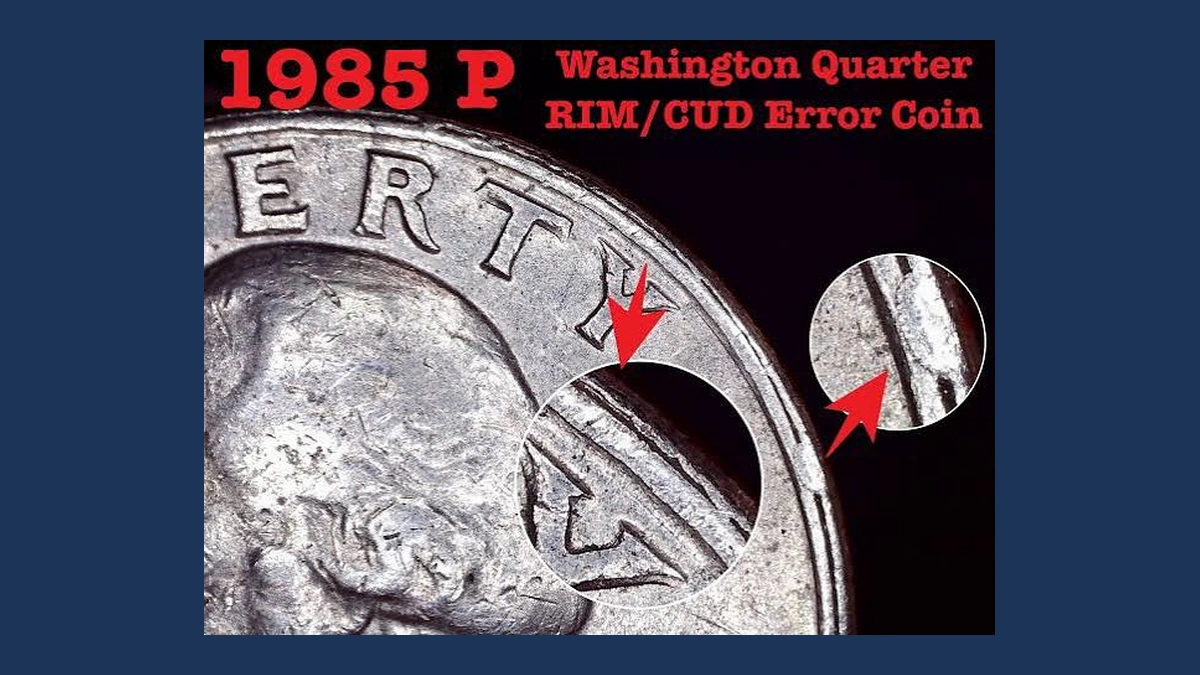
A piece missing from a stamping tool allows extra metal to rise into that space. The coin can show a raised patch where part of the normal design should be.
A 1985-P example was cataloged as an obverse die break, meaning a break affecting the front. NGC graded it MS64, an unworn grade with some marks.
A separate Philadelphia rim-cud example is also reported. A cud connects to the rim, but the front-break description does not establish that connection.
The two reports therefore need their own shapes compared. An interior bump should not automatically be renamed a rim cud.
Estimated Value
An estimated $5–$500 covers minor through substantial genuine tool-break features. A larger patch replacing readable design generally provides a stronger display than a tiny rim bump.
The MS64 grade describes condition. Compare the raised area separately: a small interior patch and a large rim-connected break can attract very different bids.
Check the original metal before choosing a comparison. An edge impact can push ordinary rim metal inward and resemble a raised patch without recording a broken stamping tool.
How to Identify
Begin at the outside edge if a raised patch is being sold as a cud. Follow its connection to the rim and check where normal design gives way to the extra metal.
An isolated raised area farther inward may be a different kind of tool break. The Philadelphia front-break example needs comparison with its own photographs, since its description does not give a clock position.
Light the patch from two directions to separate a solid raised shape from the lips of a dent. Inspect the edge for an impact that pushed rim metal inward.
Turn the quarter over and look for a matching pressure mark. Photograph both faces so the raised feature can be judged together with any later damage.
6. 1985 Washington Quarter Curved and Straight Clips
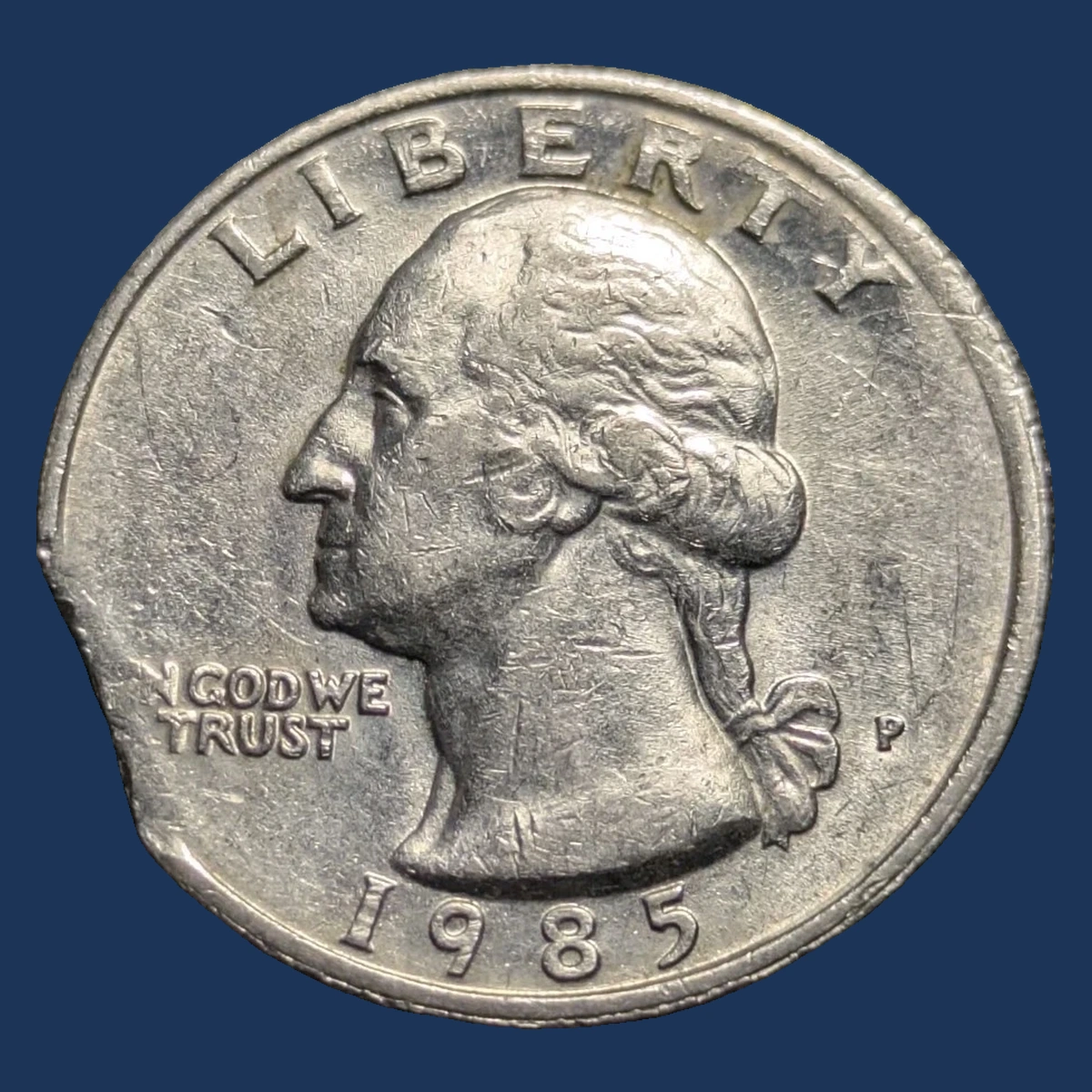
A curved gap can come from cutting a new blank across an earlier hole in the metal strip. A straight missing section can result from the strip’s boundary.
The incomplete blank then receives the quarter design. Its rim and nearby lettering may form differently beside the shortage of metal.
A Philadelphia example has a ten-percent curved clip and an NGC MS63 grade. A separate AU58 coin has a twenty-three-percent clip whose precise shape needs its own photograph.
Straight clips are also reported for 1985 without a fixed mint for a particular example. Not every genuine missing section must be curved.
Estimated Value
Allow an estimated $10–$600 for authenticated curved or straight clips. Larger clear gaps and an intact date can create a more attractive display.
The ten-percent and twenty-three-percent examples have different grades and should not be treated as one coin with changing measurements. AU58 means slight wear, while MS63 indicates an unworn surface with marks.
Clipping a finished quarter later also removes metal. A naturally formed rim beside the opening is more important than simply matching a percentage from a listing.
How to Identify
At the gap, inspect both places where the missing section meets the normal rim. Those junctions show how the original strike formed beside the incomplete blank.
Compare a curved opening with a curved reference and a straight opening with a straight one. The twenty-three-percent example must not inherit the ten-percent coin’s shape.
Look across the coin for a weak opposite rim, but use it only as supporting evidence. Genuine clips do not all show that clue equally strongly.
A magnifier can reveal cutting lines, burrs, and filed metal inside a later notch. Photograph the gap and surrounding design together before selecting the closest original-blank comparison.
7. 1985 Washington Quarter Broadstrike
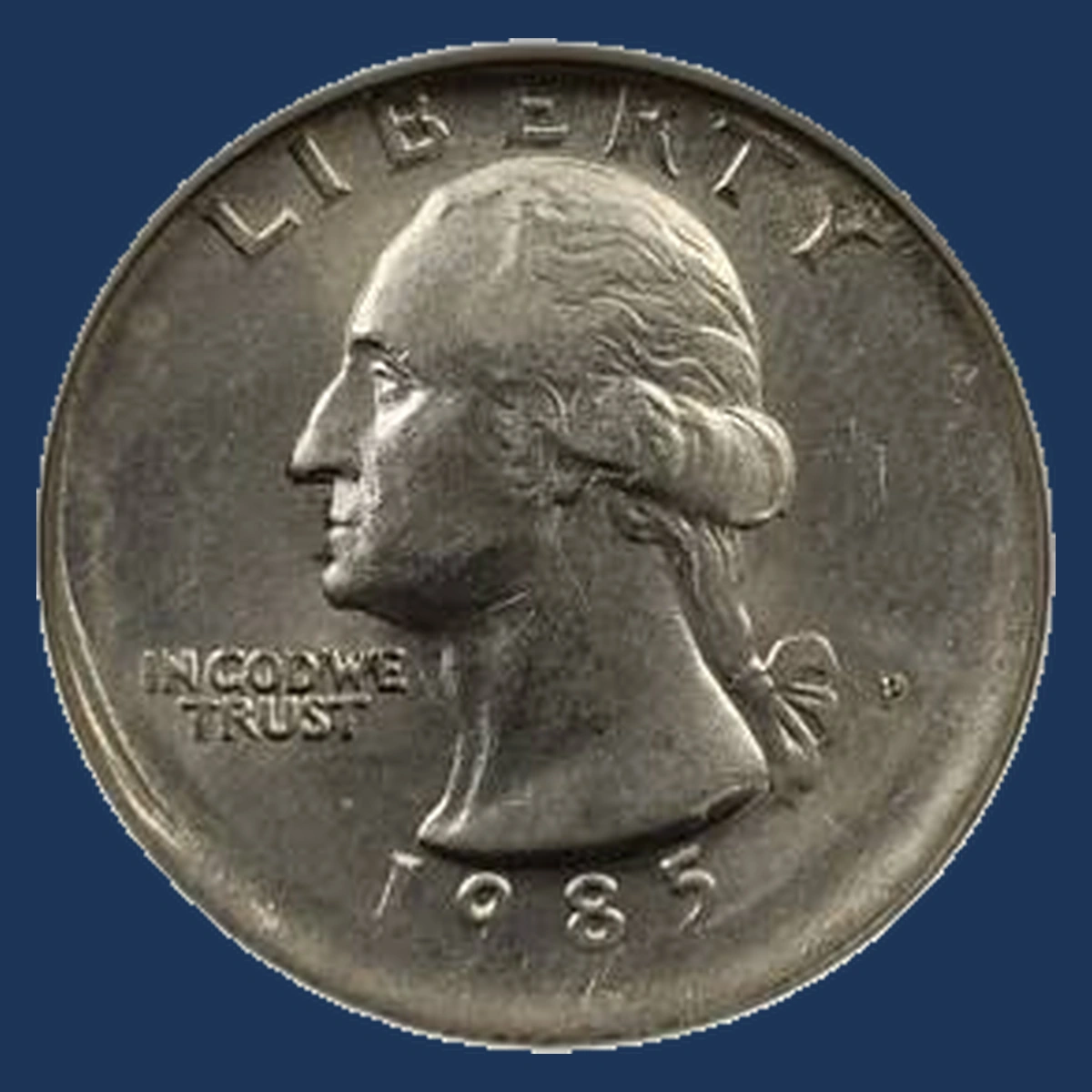
A broadstrike has more metal outside the normal design because the blank was not properly held by its surrounding ring. That ring, called the collar, normally limits width and forms edge grooves.
The quarter can spread beyond its normal outline while keeping its whole picture. Its design need not sit perfectly in the middle of the expanded metal.
Year-specific reports mention Philadelphia and Denver examples without one fixed diameter. Each candidate needs its own measurements and edge examination.
A wider outline alone is not enough. Hammering a finished quarter can enlarge it while crushing already formed letters.
Estimated Value
For a genuine ordinary 1985 broadstrike, estimate $25–$800. Strong, natural expansion and a well-preserved complete design would support the higher portion.
A slightly wider border offers less impact than clearly expanded metal around the complete design. Sharp outer words help show what happened during the strike.
Look at the whole coin when comparing prices. Missing edge grooves without convincing expansion can have a later cause, and heavy damage reduces the usefulness of an otherwise similar shape.
How to Identify
Trace the outer lettering around Washington and the eagle to determine whether the intended design remains on the metal. Missing outer artwork points toward an off-center strike instead.
For a loose coin, compare several widths with the normal 24.3 millimeters. Uneven spreading may make the outline wider in one direction than another.
Inspect the edge for natural metal flow rather than grinding or deliberate smoothing. Check the raised letters for crushing from later pressure.
The absence of normal grooves needs support from the expanded original strike. A specialist should be able to explain the complete picture and wider border together before confirming this reported type.
8. 1985 Washington Quarter Missing Outer Layer
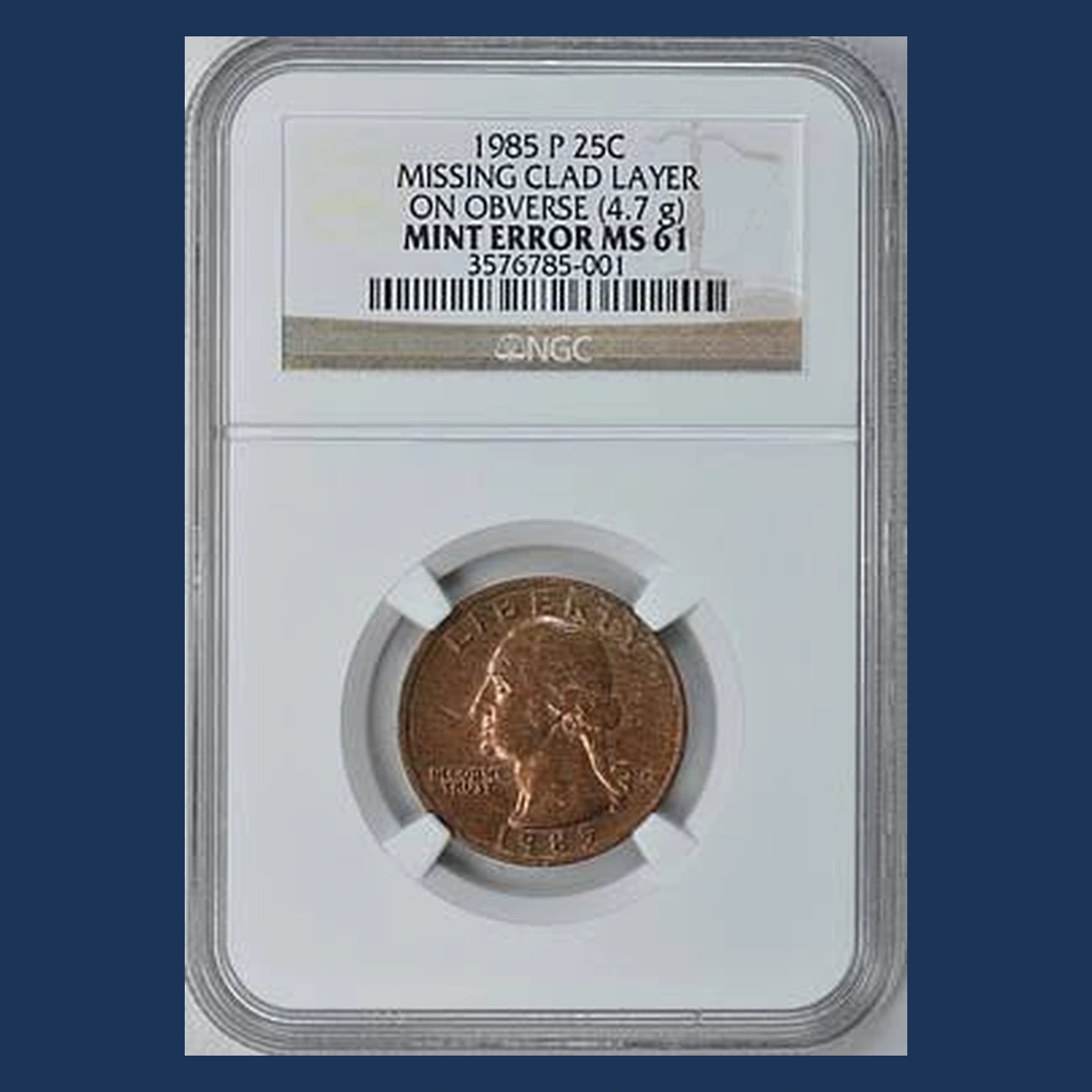
The front of one Philadelphia quarter shows the copper core instead of its usual pale outer layer. The back still provides a comparison with the normal clad surface.
A clad quarter is made from bonded layers of metal. If an outer layer separates, the remaining coin weighs less and can show a different color on one face.
The documented example weighs 4.68 grams and carries an ANACS MS63 Red-Brown grade. Those measurements belong to this specimen.
Brown toning alone does not establish missing metal. The exposed surface, edge, and reduced weight need to agree.
Estimated Value
Estimate $50–$1,000 for a genuine missing-layer 1985 quarter. A nearly complete exposed face with clear original details usually offers a stronger display than a small missing patch.
The 4.68-gram coin has loss on the front. Compare that exposed face with another example before using its appearance to judge a smaller surface peel.
A normal quarter weighs about 5.67 grams. Being light supports an examination, but it does not explain whether metal separated before striking or was removed afterward.
How to Identify
For a loose coin, start with the scale reading and a clear edge photograph. A normal quarter weighs about 5.67 grams, while the documented front-loss example weighs 4.68 grams.
Keep a certified coin in its holder. Its recorded weight can be checked without removing it.
Compare the copper-colored front with the normal pale back under neutral light. Follow the boundary of the missing metal into the edge rather than judging the brown color alone.
Look for surviving struck detail on the exposed surface and for scraping or rough chemical damage. A stain can alter color without removing an outer layer.
The exact timing of separation requires specialist examination. The individual coin’s weight and surface must support that conclusion together.
9. 1985 Washington Quarter Indent with a Partial Collar
A shallow blank-shaped depression and an uneven edge can record two parts of one accident. Another object covered some of the blank while the surrounding ring held only part of its edge.
The depression is called an indent. A partial collar can leave an edge step where the ring stopped controlling the expanding metal.
A Philadelphia example was described in a 2014 Stack’s Bowers lot and graded PCGS AU58. That grade indicates slight wear.
The lot also contained another coin with an incomplete date. Its features should not be assigned to the fully dated 1985 example.
Estimated Value
An estimated $50–$1,000 applies to a genuine indent combined with a partial-collar strike. The clearest examples show how both features formed during the same event.
Both features belong to one coin, so their values should not be added. A sale including other coins gives a lot total, not this quarter’s individual price.
A small edge step and faint depression generally offer less visual impact than an obvious overlap. Original surfaces help distinguish the feature from later pressure damage.
How to Identify
The edge and the depression provide two separate checks. Turn the quarter slowly to see whether the edge changes from normally grooved metal to a step or differently formed section.
Photograph that change in profile and then locate the shallow depression on the face. Its curved boundary should show where the normal design was interrupted by the overlap.
A plain indent does not need backward letters, so do not mistake the absence of transferred words for a problem. Check the opposite face for marks from later squeezing.
Keep the whole readable date in another photograph. When comparing a multiple-coin auction lot, use the image of the fully dated 1985-P coin rather than its companion with an incomplete date.
10. 1985 Washington Quarter Partial Brockage with a Partial Collar
Backward, sunken design detail is the main clue to a brockage. It forms when an already struck coin impresses its design into another blank.
One 1985-P quarter combines this transferred front-side impression with a partial-collar strike. The edge was not fully contained while the extra design was being pressed into the coin.
NGC graded the example MS63, meaning unworn with noticeable marks. Its catalog description does not establish a precise percentage for the transferred design.
The matching coin that made the impression was not included. A second object should not be invented simply to complete the story.
Estimated Value
The documented combination sold for $71 on January 2, 2023. That result concerns the NGC MS63 specimen, not a complete face-covering brockage.
For the broader type, estimate $50–$1,500. Larger readable transfers and stronger overall condition can change the comparison considerably.
A buyer needs to see the actual backward detail rather than rely on the word brockage in a title. A plain depression, even with a partial-collar edge, is not the same identifying feature.
How to Identify
Use side lighting to determine whether the extra detail sinks into the surface. Try reading any transferred letter shapes backward.
Compare those shapes with the design of a normal quarter. A recognizable transferred feature is more useful than a random rough patch.
Follow the boundary between the transferred impression and the normal strike, then examine the edge step separately. Together they should support the two features stated in the catalog.
Two finished coins pressed together later can also leave copied marks. A specialist must assess the metal flow and surviving original design before confirming that the impression formed during minting rather than through later damage.
11. 1985 Washington Quarter Off-Center Strike
A blank sitting partly outside the stamping tools receives only part of the design. The remaining crescent stays blank, producing an off-center strike.
The examples range from a Philadelphia ten-percent error to a Denver coin struck eighty percent off center toward eleven o’clock. Their separate grades and positions belong to separate coins.
Clips can accompany the misplaced strike. One Philadelphia coin is fifteen percent off center with a two-percent clip, while another curved-clip example weighs 5.2 grams.
The 5.2-gram coin has no established off-center percentage here. It should not inherit the other specimen’s fifteen-percent description.
Estimated Value
Use an estimated $50–$2,000 range for genuine 1985 off-center quarters, depending on the shift, readable date, and condition. An additional clip can make a particular combination more distinctive.
The ten-percent Philadelphia example appeared in a two-coin lot with a 1972 dime. That dime’s fifteen-percent description and any shared lot total do not become this quarter’s details.
Large shifts need careful attribution when little design survives. An impressive blank crescent does not by itself establish the year or mint.
How to Identify
Find the boundary where the struck design ends and untouched metal begins. At least some intended artwork should be missing from the blank.
For the Denver eighty-percent example, check the direction against an upright front. Its eleven-o’clock position belongs to that coin, not to all 1985 off-center strikes.
Inspect any clipped area independently of the blank crescent. A clip removes part of the original blank, whereas an off-center strike leaves unstruck metal present.
Keep the fifteen-percent off-center specimen with a two-percent clip and the 5.2-gram curved-clip specimen in separate photographs. If the date is incomplete, retain the grading service’s attribution rather than describing hidden digits as clearly visible.
12. 1985 Washington Quarter Double and Multiple Strikes
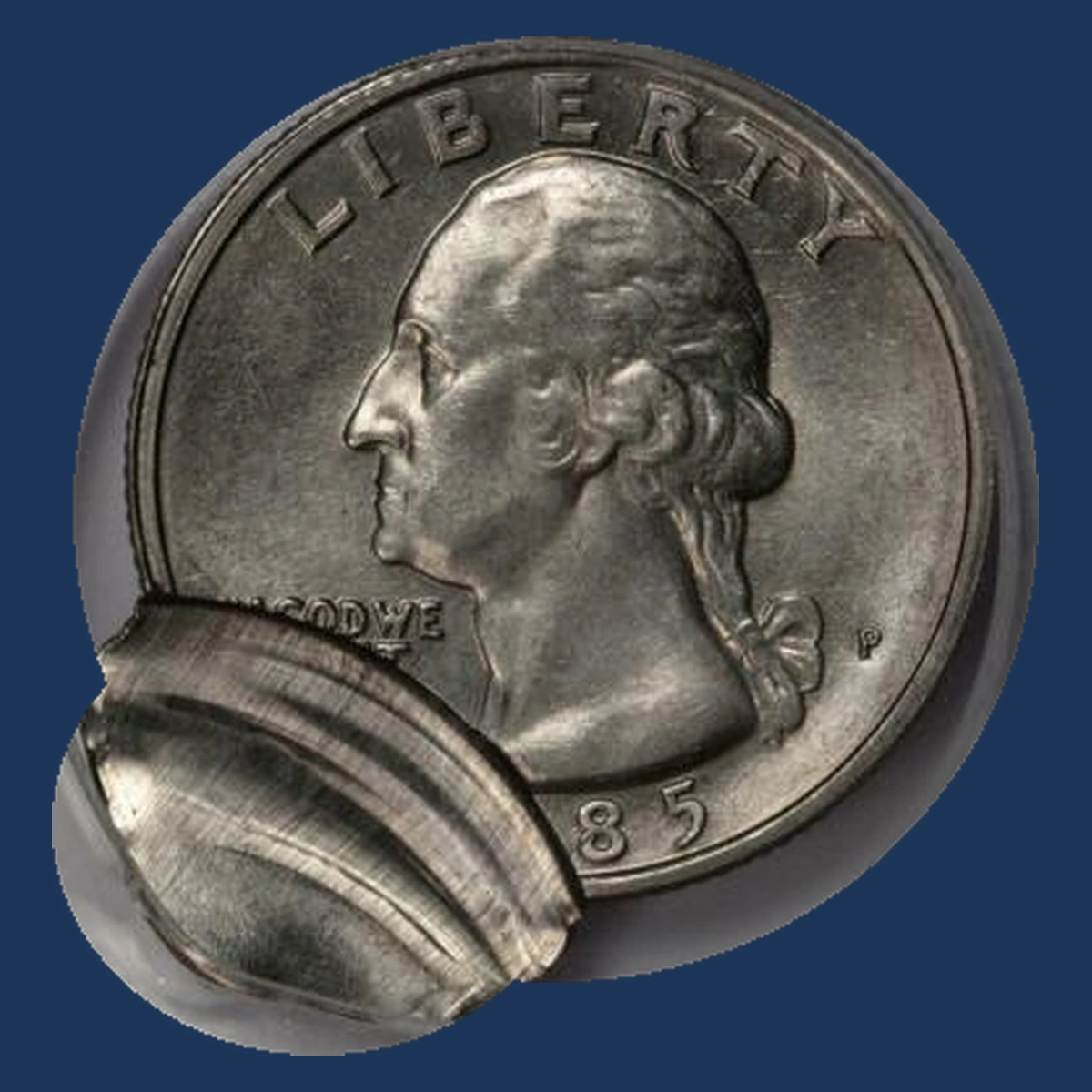
A coin that remains in the striking area can receive another blow in a new position. Overlapping portraits, dates, or borders may survive from the separate strikes.
The 1985 examples include double, triple, and other multiple strikes. The amount of displacement differs from coin to coin and sometimes from one blow to another.
One triple-struck Philadelphia coin has its third strike seventy-five percent off center. Another triple-struck example has all three impressions off center.
An attributed “(1985)” double strike has both impressions off center. The parentheses mean the year is assigned, rather than fully readable on that specimen.
Estimated Value
Estimate $100–$2,500 across these repeated-strike examples. Preservation and how clearly the impressions can be followed matter alongside the number of blows.
A Philadelphia double strike with its second impression seventy percent off center sold for $480 in January 2023. The triple strike with its third impression seventy-five percent off center brought $264 in September 2024.
The attributed “(1985)” double strike sold for $1,080 that September. These are separate sales and separate arrangements of the design.
How to Identify
Start with a wide photograph of both faces and choose one portrait or border to follow. Mark that impression before tracing another, so fragments of one strike are not counted twice.
For the triple strike with a third blow seventy-five percent off center, locate that final displaced image separately. That percentage does not describe all three blows.
Check where a later strike flattened earlier lettering and compare the corresponding face. Small repeated details from a doubled tool do not produce these widely shifted complete impressions.
Keep later damage distinct from the mint error. The AU Details–Damaged triple strike has both.
If only parts of the year survive, retain the assigned “(1985)” description. Count no more blows than the surviving impressions or reliable catalog description support.
13. 1985 Washington Quarter Matching Two-Coin Error Pair
Two coins can preserve opposite sides of the same collision. In this Philadelphia pair, a newly arriving blank slid partly underneath a coin that had already been struck.
The retained coin pressed part of its back into the upper area of the incoming piece. The resulting surfaces explain why the two quarters belong together.
One coin shows an off-center strike and an upper indent. The other carries a second design on its left side, turned about ninety degrees.
PCGS graded the pieces MS65 and MS64. Those are two individual grades for one matching pair, not two separate types of error.
Estimated Value
The matching pair sold together for $1,725 on April 19, 2008. That amount covered both coins.
For a comparable authenticated pair, estimate $800–$4,000. A clear physical match and preserved original surfaces can add interest beyond the appearance of either piece alone.
Do not divide the sale mechanically to price an unrelated single quarter. The ability to reconstruct one minting accident is part of what the buyer receives, and separating the pieces can remove that evidence from the set.
How to Identify
Photograph each quarter on both faces before arranging the pair for comparison. Keep the two certification labels with their respective coins.
Locate the upper contact area on the incoming piece and compare it with the design that could have produced the transfer. Check scale and curvature, not merely whether both coins show errors.
Then trace the displaced left-side design on the retained coin. Its roughly ninety-degree turn describes the second impression on that coin.
Never force the pieces against each other to prove a fit. A specialist can compare enlarged photographs and the physical boundaries while keeping their surfaces intact and the two-coin history together.
14. 1985 Washington Quarter Front Die Cap
A coin stuck to a stamping tool can receive further blows. Its metal spreads and rises around the tool, forming a cup-like die cap.
The documented Philadelphia example has a high lip on the right. Its front remained against the tool during repeated contacts.
The back carries an expanded transferred design described as a counterbrockage. This reflects additional contact with other struck surfaces rather than a simple normal back.
At least four strikes were reported for this NGC MS68 coin. Shiny surfaces do not make it a Proof, a collector coin made with specially prepared tools.
Estimated Value
This dramatic die cap sold for $1,495 on January 15, 2005. The NGC MS68 grade records very high preservation for the documented piece.
A broader estimated range is $800–$6,000. The height of the wall, recognizable design, and condition help explain differences between individual caps.
The old sale provides a dated example, not a promise about a future auction. A shallow bent quarter needs a different assessment from a naturally expanded cap that preserves repeated striking evidence.
How to Identify
Begin with a side view so the raised wall and overall depth can be seen. A front-facing photograph alone can hide the most important shape.
Compare the right-hand lip with the lower parts of the perimeter. Look for stretched metal and design that developed with the expanding shape.
Examine the transferred back details without assuming that every counterbrockage must look like a simple sunken mirror image. Repeated contacts can change the transferred design.
Look for sharp bend lines or crushed surfaces suggesting that an ordinary coin was shaped afterward. Keep the cap in a holder suited to its depth, and let an error specialist assess the strike sequence without flattening it.
15. 1985 Washington Quarter Wrong Blank
A quarter design can be struck on a blank intended for another denomination. A smaller blank may leave outer letters missing even though the remaining picture is well formed.
Confirmed Philadelphia examples were struck on nickel blanks. One NGC MS66 specimen weighs 5.0 grams, while another PCGS AU58 coin has part of QUARTER DOLLAR outside the metal.
A separate Denver silver-dime-blank claim appears in year guides. The cited reports do not establish an auction lot or authenticated specimen.
That claim needs to remain a separate identification question. It should not inherit the measurements or sales of the confirmed nickel-blank coins.
Estimated Value
Confirmed nickel-blank quarters have an estimated $200–$1,500 range. The 5.0-gram NGC MS66 example sold for $288 in January 2023, and a separate MS67 coin brought $305.50 in October 2012.
For a Denver silver-dime-blank example, the conditional estimate is $1,000–$15,000 after authentication. Repeated six-figure claims without a matching original auction record are not completed-sale evidence.
The blank’s actual metal and size determine which comparison applies. A light quarter is not automatically a silver-dime error.
How to Identify
A missing copper-colored stripe at the edge is worth investigating, but color alone cannot identify a wrong blank. Record the width and weight of a loose coin before choosing a comparison.
The confirmed nickel-blank quarter weighs 5.0 grams. Examine the smaller outline and the outer words cut off by the edge, rather than expecting a normal quarter’s complete lettering.
A silver dime blank would be a different object, normally about 2.5 grams. The 2.27-gram standard applies to clad dime blanks instead.
Have a specialist test the metal without damaging it. A grading label must match the pictured coin and identify the actual blank; the separate Denver silver claim needs that evidence before a buyer treats it as confirmed.
Conclusion
A 1985 quarter can carry more than one feature, such as a clip beside an off-center strike. Identify the complete object before comparing prices or counting its impressions.
The estimated ranges discussed here span $5–$15,000. Keep matching pairs together and leave lifted metal untouched.
For a small or light coin, confirm the actual blank. A large asking price cannot replace the evidence in its size, metal, and surviving design.